


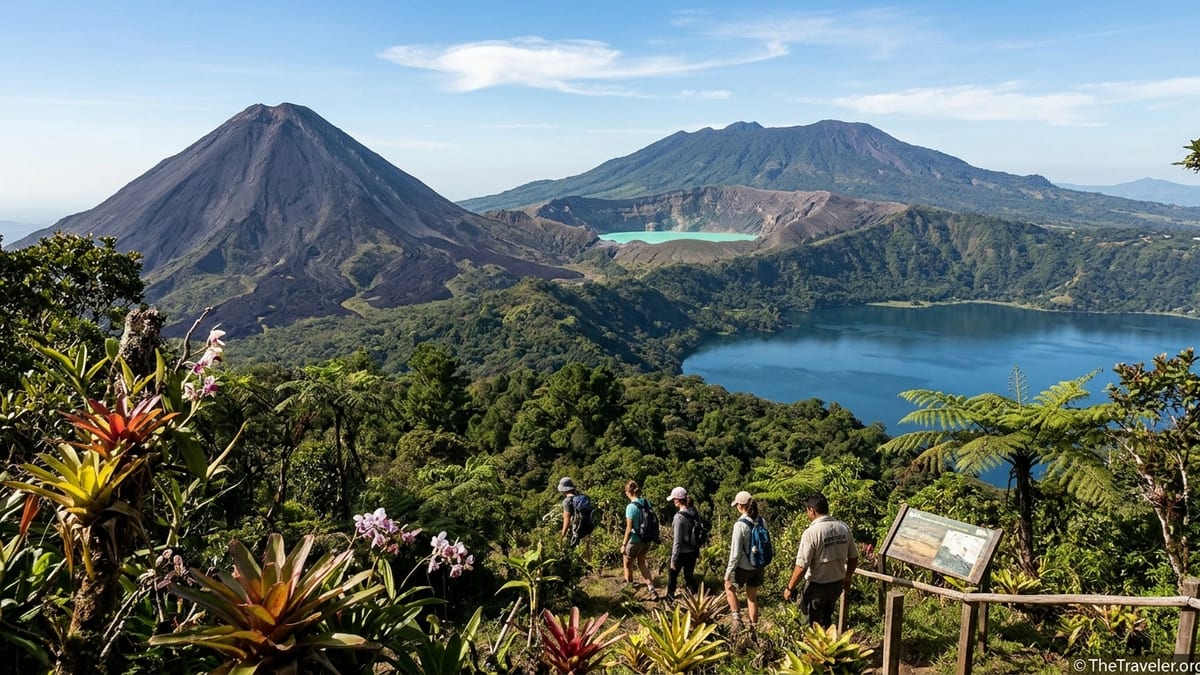
Straddling the departments of Santa Ana and Sonsonate in western El Salvador, Los Volcanes National Park protects a dramatic cluster of three peaks: the active Santa Ana Volcano (Ilamatepec), the iconic cone of Izalco and the forested Cerro Verde. Often labeled Cerro Verde National Park in tourism materials, this protected area offers crater hikes, cloud forest trails and sweeping viewpoints toward Lake Coatepeque, all within a few hours of San Salvador and the Pacific surf coast.
Get the latest updates straight to your inbox!
Understanding Los Volcanes National Park
Los Volcanes National Park forms part of the Apaneca–Ilamatepec volcanic range and officially includes the Santa Ana, Izalco and Cerro Verde volcanoes, spread across the departments of Santa Ana and Sonsonate. Visitors commonly encounter the name Cerro Verde National Park or Cerro Verde Recreational Park, which refers to the main access area and viewpoints on the flanks of the dormant Cerro Verde volcano, but administratively it is within the wider Los Volcanes complex. For travel planning, you can treat the terms Los Volcanes, Cerro Verde and Cerro Verde National Park as referring to the same visitor hub and trailhead area.
This compact park suits several types of travelers. Strong hikers are drawn by the guided summit route to Santa Ana and the steeper, more rugged climb of Izalco. Nature enthusiasts and birdwatchers focus on Cerro Verde’s cooler cloud forest, orchids and shaded trails. Landscape photographers come for sunrise or clear dry season days when the emerald crater lake of Santa Ana, Lake Coatepeque and the perfect cone of Izalco line up in a single panorama. Families and casual visitors find that the short walks and viewpoints around Cerro Verde provide impressive scenery without committing to a summit hike.
Most international visitors experience Los Volcanes as a long day trip from San Salvador, Santa Ana city or the coastal surf towns, often combined with lunch or a swim stop at Lake Coatepeque. A smaller number stay overnight in Santa Ana, or in simple lodging on or near the Cerro Verde access road, to start hikes earlier and enjoy cooler evenings in the highlands. Choosing between these patterns depends largely on your tolerance for early starts, your hiking ambitions and whether you prefer to travel by public bus, private driver or organized tour.
Main Experiences in the Park
The signature experience at Los Volcanes is the guided hike to the summit of Santa Ana Volcano, known locally as Ilamatepec. This active stratovolcano offers a relatively attainable half-day ascent on a well-established trail, culminating at a wide crater rim with views down to a turquoise acidic lake. Local authorities and tourism bodies treat Santa Ana as an active but closely monitored volcano, and official guidance can temporarily restrict access to the rim or close the route during bad weather or increased activity. Plan your trip on the assumption that a certified local guide will be required and that you will join a group departure from the main trailhead late in the morning.
The hike to Izalco Volcano is shorter in horizontal distance but significantly steeper and more rugged underfoot, with long stretches of loose volcanic rock and exposed slopes. Departures are usually less frequent than Santa Ana hikes and may not operate daily, reflecting both demand and safety policies. Travelers often describe Izalco as more physically demanding, suited to those with good knees, balance and heat tolerance. Check in advance, through recent local reports or tour operators, whether Izalco hikes are currently running and if additional guide or police tourism accompaniment is required.
Cerro Verde itself provides a different kind of experience. The top of this long-dormant volcano is covered in cool, humid forest threaded with short trails, viewpoints and an orchid area or garden that highlights the diversity of epiphytes in the region. From the miradores near the old hotel complex you look directly across to Santa Ana’s broad summit and the perfect cone of Izalco, while another viewpoint opens toward Lake Coatepeque. For many visitors who are not keen hikers, spending a few hours walking these easier loops and vantage points is enough to appreciate the park’s landscapes.
Beyond hiking, Los Volcanes is known among birders for highland and forest species, especially in quieter sectors away from the main recreational area. Serious birdwatching usually benefits from arranging a specialized guide in advance. Many general visitors combine the park with a visit to Lake Coatepeque on the same day, either to admire the lake from elevated viewpoints along the access road or to descend to lakeside restaurants and swimming spots after a morning on the trails.
Choosing Your Base: San Salvador, Santa Ana or Near the Park
The first major planning decision for Los Volcanes is where to base yourself. Santa Ana city is the most practical base for independent visitors intent on catching the early public bus toward Cerro Verde and joining the mid-morning guided hike to Santa Ana’s summit. From Santa Ana, it is usually possible to reach the trailhead using a combination of local transport without an excessively early pre-dawn departure, and the city offers a modest but growing range of guesthouses and midrange hotels. Travel writers preparing detailed guides should identify a small set of currently bookable properties in Santa Ana that are within a reasonable taxi ride of the bus departure point, confirming exact travel times under typical morning traffic.
San Salvador, by contrast, is best for visitors prioritizing comfort, dining options and access to a broad range of organized tours. Many tour operators based in the capital offer full-day volcano trips that include round-trip transport, park entrance fees and a certified guide, sometimes adding Lake Coatepeque, coffee farm stops or city walking tours to build a full itinerary. Using San Salvador as a base reduces the need to understand local bus schedules but typically requires an earlier departure and longer day, since driving times to the Cerro Verde access area are greater than from Santa Ana.
Staying near the park itself, on or close to the access road to Cerro Verde, offers the most immersive highland experience and the shortest reach to the trailheads. However, lodging in this immediate area is limited and conditions can change as small properties open, close or shift focus. Writers should research and verify a small selection of currently operating accommodations along the Cerro Verde road or near the main park entrance, checking that they are active, bookable and truly within short driving distance of the ranger station or recreational area. Given cool nighttime temperatures, these stays appeal to travelers who value quiet, forest air and early starts over nightlife or restaurant variety.
Surf towns such as El Tunco or El Zonte on the La Libertad coast can also serve as bases for a volcano day trip, but in practice this works almost entirely through organized tours or private drivers. While the straight-line distance is not great, the need to climb from sea level to highland trailheads on winding roads makes for a long day, and public transport connections from the coast to Cerro Verde are complex for a single-day visit. Travelers based on the coast should consider whether they are comfortable with an early tour pick-up and late return as the price for fitting Los Volcanes into a surf-focused itinerary.
Getting There: Roads, Buses and Tours
Los Volcanes is reached primarily along paved trunk highways followed by the dedicated road that climbs to Cerro Verde. From San Salvador, current guidance from local conservation and tourism organizations notes two main routes: one option follows the highway toward Sonsonate, where travelers connect with route 209, a bus that climbs directly to the park entrance. Another option follows route 20 in the direction of Santa Ana, exiting at the El Congo junction before joining the same climbing road toward Cerro Verde. Drivers will find the ascent winding but generally in good condition, with signposted turn-offs toward the recreational area; conditions can vary after heavy rains, so updated local information is prudent.
Public transport options are centered on the Santa Ana and El Congo area. A widely used service is bus route 248, reported in recent local transport guides as running between El Congo and Cerro Verde with an approximate travel time of about an hour for the climb. Fares are relatively low by international standards, but schedules, operating days and even the exact boarding point can change with little notice. Any current guide should instruct readers to confirm departure times and boarding locations on the ground in Santa Ana or El Congo shortly before travel, and not to rely solely on older blog posts or third-party schedules when timing a volcano summit attempt.
From Sonsonate and other western towns, travelers typically connect via the CA-8 highway toward San Salvador before branching toward the Cerro Verde access road. Driving from the international airport usually involves skirting around or passing through San Salvador, then following the same trunk routes used by capital-based visitors. In all cases, journey times can lengthen significantly at peak commuter hours or in heavy rain, so planning extra margin time to reach the trailhead before the daily guided departure is wise.
Many visitors find it simpler to arrange a full volcano day tour, either from San Salvador, Santa Ana or the main surf towns. These packages usually include round-trip transport, park entrance fees and a local guide for the Santa Ana hike, and sometimes add lunch and a Lake Coatepeque stop. As of mid to late 2026, published examples suggest that tour prices for foreign visitors can vary widely depending on group size, inclusions and starting point. Any up-to-date guide should compare at least two real-world tour offerings and one or two do-it-yourself cost breakdowns, clearly marked with verification dates, to help readers judge the trade-off between convenience and cost.
Park Access, Fees and Regulations
Entry to Los Volcanes National Park is controlled through ranger stations and a formal access point, where visitors are subject to registration and internal regulations. The Ministry of Environment and related agencies publish a standardized entry form and internal rules for the park, covering both day visitors and those accessing specific sectors. Policies outline the need to submit to mandatory registration on arrival, provide basic personal and group information, and in some sectors give details about vehicles and planned activities.
Internal regulations emphasize environmental protection, visitor safety and a quiet atmosphere. Official documents specify that bringing alcoholic beverages into the park is prohibited, as is smoking within park boundaries. Visitors are required to collect and remove their trash to designated containers, avoid using loudspeakers or vehicle sound systems, and comply with restrictions on weapons and potentially dangerous tools at the entrance. Domestic pets are generally not permitted, with narrow exceptions noted by the tourism authorities for certified assistance animals in specific parks.
Entrance fees are structured by visitor category and can change over time through official tariff schedules. Examples from recent practice indicate that foreign visitors pay separate charges for access to the recreational area and, in some cases, for the Santa Ana volcano trail itself, along with a modest per-person fee for a local guide. However, amounts have been adjusted more than once in recent years and may differ between national and foreign visitors and among age groups. To avoid inaccuracies, writers should consult the latest official tariff documents or on-site signage and include only verified, dated examples rather than fixed universal amounts.
Regulations also cover the use of drones, camping, commercial photography and organized events. These activities may require special authorization, and rules can be updated in response to environmental or safety concerns. A responsible guide should advise readers to check the latest official documents or inquire directly with park authorities or certified guides before planning drone flights, overnight stays in lesser-known sectors or large group excursions.
Guides, Safety and Volcano Conditions
Los Volcanes is not only a scenic landscape but an active volcanic area, and safety policies reflect that reality. Santa Ana Volcano experienced its last significant eruption in the mid-2000s and remains under close monitoring by Salvadoran authorities. Access to the crater rim and surrounding slopes can be modified or temporarily closed if seismic or gas measurements change, if heavy rain raises landslide risk, or if authorities deem conditions unsuitable for visitors. Travelers should approach summit plans flexibly and be prepared for last-minute route changes or cancellations, especially during the rainy season.
Current guidance from official documents, tourism authorities and recent on-the-ground reports converge on the point that a certified local guide is mandatory for the standard Santa Ana summit trail. Visitors joining from the main Cerro Verde area typically gather for a group departure late in the morning, accompanied by guides and often by members of the tourism police. Independent hikers are not generally allowed to walk unaccompanied on the official summit route. Policies for Izalco are similar or even more restrictive, with departures only at set times and under guided supervision, reflecting the trail’s difficulty and exposure.
Beyond volcanic activity, security conditions on access roads and trails have improved in recent years, and as of 2026 national-level travel advisories for El Salvador generally classify the country as a destination where standard precautions are adequate. Nonetheless, visitors should stay attentive to any updated advisories concerning western El Salvador’s highland routes. Checking recent traveler reports and official security statements in the weeks before a visit can help identify any unusual closures, construction projects or temporary security operations that might affect road access or visiting hours.
On the trails themselves, the main risks are environmental and physical. Strong sun at higher elevations, sudden rain, loose rock on Izalco and sections of uneven terrain on Santa Ana all require suitable footwear and a realistic assessment of personal fitness. Guides typically set a moderate pace but must keep groups moving within the day’s time window, so anyone with mobility limitations or heart or respiratory conditions should consult a doctor before attempting a summit hike and consider focusing on Cerro Verde’s shorter, gentler paths instead.
Seasons, Weather and When to Visit
Los Volcanes lies in a tropical region with a distinct dry and rainy season that shapes the visitor experience. In general terms, the dry season runs from roughly November to April, bringing sunnier skies, firmer trail conditions and a higher likelihood of clear crater and lake views. This is the most popular time for summit hikes and photography, especially between December and February when daytime temperatures at elevation are warm but not excessively hot.
The rainy season, roughly May through October, typically features afternoon downpours, mist and occasional thunderstorms, with the heaviest rains in the middle months. Morning hikes can still be feasible and sometimes offer atmospheric clouds swirling around crater rims, but trails may become muddy and slippery, and cloud cover can obscure views for hours at a time. Landslide risk and storm-related park closures are more likely during this period, especially after several days of continuous rain.
Because climate patterns in Central America have shown increasing variability, a current guide should not rely solely on historical averages. Writers are encouraged to consult the latest available regional climate data and recent visitor or ranger reports when advising on month-by-month conditions for Los Volcanes. Highlighting typical temperature ranges at the Cerro Verde recreational area versus the warmer basins around Lake Coatepeque can also help visitors plan appropriate clothing.
Whatever the season, cooler air and frequent breezes at altitude make layers essential. Even on dry season afternoons, a passing cloud bank or brief shower can drop temperatures quickly on exposed slopes, while forested sections on Cerro Verde retain moisture and can feel markedly cooler than lowland cities or beaches on the same day.
Budgeting Your Visit
Planning a visit to Los Volcanes involves accounting for several cost components rather than a single bundled fee. At a minimum, visitors should expect to pay for transport from their base to the park, park entrance charges and any additional volcano trail fees, guide services where required, and food and water for the day. Many travelers also add a detour to Lake Coatepeque, which may involve extra transport and meal expenses at lakeside establishments.
Do-it-yourself visitors using public buses from Santa Ana or Sonsonate typically face lower transport costs but must plan around early departures and infrequent services. Guides and park fees are generally collected in cash at the trailhead or ranger station, often with different pricing tiers for Salvadoran citizens, residents and foreign tourists. Organized tours, especially those including hotel pick-up in San Salvador or coastal towns, bundle these elements into a single per-person price that reflects hotel distance, group size and added stops such as Lake Coatepeque or coffee farm visits.
For an up-to-date budget section, travel writers should gather at least two concrete real-world examples for both approaches, each with a clearly stated verification date. One example might detail a recent public-transport-based day trip from Santa Ana, itemizing bus fares, entrance charges and guide contributions reported by travelers in 2025 or 2026. Another might present a current 2026 group tour rate from a reputable operator in San Salvador or El Tunco, explaining which costs are included and which, such as meals or optional lake activities, remain extra.
Because fees and tour prices are subject to periodic adjustment for inflation, park management needs and operator costs, it is safer to present them as indicative rather than guaranteed. Readers should be encouraged to treat any quoted amounts as ballpark figures and to reconfirm both park fees and tour rates shortly before travel.
Practical Tips, Accessibility and Final Decisions
Timing is central to a successful visit to Los Volcanes. Rangers and tourism authorities usually schedule a single main guided departure for the Santa Ana and Izalco hikes late in the morning from the Cerro Verde area, with visitors advised to arrive at the trailhead well before this time to register, pay fees and organize into groups. Recent traveler reports suggest that reaching the park by mid-morning is prudent, which often means leaving Santa Ana or San Salvador in the early morning, especially if relying on public buses. The Santa Ana hike commonly takes between three and five hours round trip, depending on group pace and time spent at the crater, while Izalco’s steeper route can feel similarly long despite being shorter.
Packing appropriately can make the difference between an enjoyable outing and a punishing one. Sturdy closed footwear with good grip is essential for both volcanoes, particularly Izalco’s loose rock. Sun protection in the form of a hat, high-SPF sunscreen and sunglasses is crucial, as sections of both trails are fully exposed. A light rain jacket or poncho, a warm layer for windier sections and a small daypack help manage rapidly changing conditions. Ample water and energy-rich snacks are important, since while small vendors may operate near some access points, you should not rely on finding food once on the trail.
Less-mobile visitors and those traveling with young children or older relatives can still enjoy Los Volcanes by focusing on Cerro Verde’s viewpoints and short forest walks instead of the summit routes. Paths around the recreational area are generally shorter and gentler, though not all are fully accessible, and some viewpoints require navigating steps or uneven ground. For travelers with specific mobility challenges, it is advisable to consult park staff or guides ahead of time about the current condition of particular paths and the feasibility of reaching key viewpoints by vehicle and short walks.
In deciding how to structure a visit, readers should weigh their fitness level, time, budget and appetite for logistical complexity. Those with limited time, who prefer simplicity and a guaranteed guide, may find that a tour from San Salvador, Santa Ana or the coast offers the best balance of effort and reward. Independent travelers who enjoy navigating local transport and want to keep costs down might base themselves in Santa Ana, catch the early bus toward Cerro Verde and focus on the Santa Ana summit, adding Izalco only if conditions and schedules align. Visitors more interested in cool air, photography and gentle nature walks than in strenuous ascents could prioritize Cerro Verde’s trails and Lake Coatepeque views, perhaps with an overnight stay near the park to enjoy the highland atmosphere once the day crowds have gone.
Whichever approach you choose, Los Volcanes rewards flexibility and respect for local guidance. By checking the latest regulations, confirming guide requirements and transport schedules, and selecting a base that matches your style of travel, you can experience one of El Salvador’s most striking volcanic landscapes in a way that is safe, memorable and aligned with your own priorities.