


Ordinary US, British and many European passport holders can currently visit Morocco visa free for up to 90 days for tourism, subject to standard admission checks at the border. Other nationalities either need a visa obtained from a Moroccan consulate or can use Morocco’s official Accès Maroc eVisa system. This guide breaks down the practical rules for major nationalities, how the eVisa works, and what border officers actually look for when you arrive.
Get the latest updates straight to your inbox!
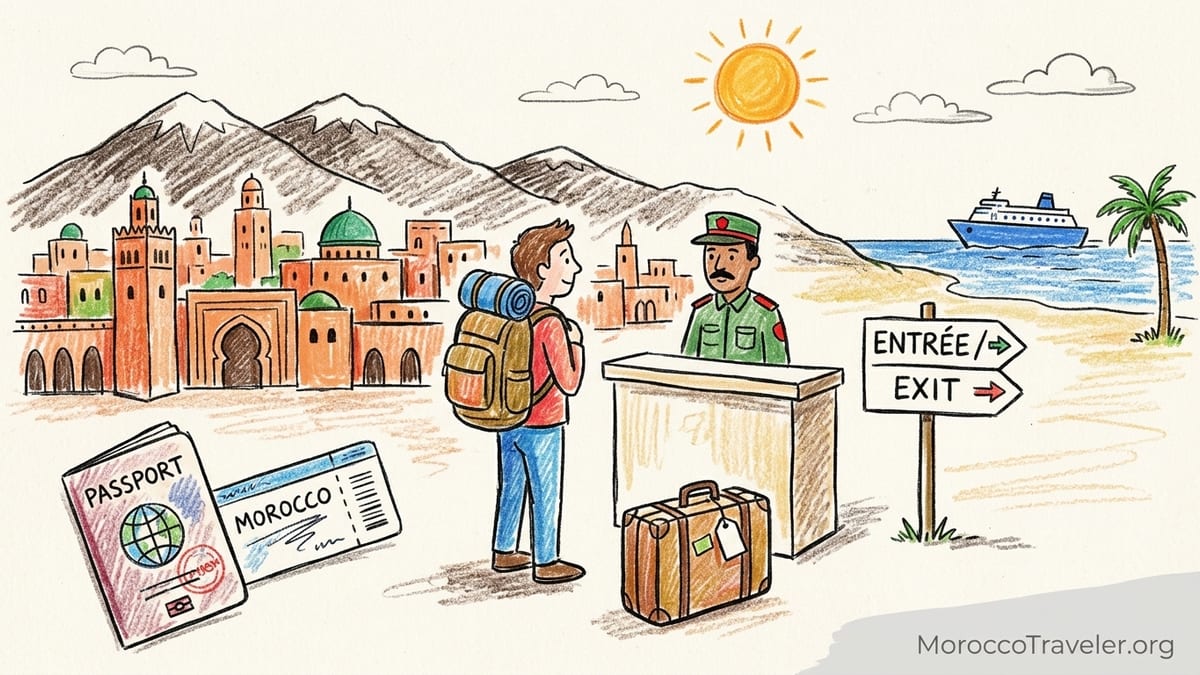
Last checked date and core visa free rules
This guide was last checked on 13 November 2026 against Moroccan government, consular and recent airline guidance. Rules can change quickly, so treat this as a planning tool and always recheck official sources shortly before you travel.
US citizens traveling on an ordinary passport can visit Morocco without a visa for tourism or short business visits of up to 90 days. This position is confirmed by recent US government travel advisories, which state that no tourist visa is required for stays of 90 days or less. Airlines flying from New York or Miami to Casablanca routinely board US tourists without prior visas when they hold confirmed return tickets within that 90 day window.
British citizens traveling on a full British citizen passport are likewise visa exempt for stays up to 90 days. The UK government’s Morocco entry guidance, updated in August 2026, explicitly confirms this 90 day visa free stay for tourism. British travelers on London to Marrakech routes with carriers such as British Airways and easyJet rely on this exemption and do not usually obtain any visa before travel for holidays of one to three weeks.
Most European Union and Schengen area nationals, including citizens of France, Spain, Germany, Italy, the Netherlands, Sweden and others, are also visa exempt for visits up to 90 days. This is reflected in recent European consular information and in the visa free country lists used by ferry operators between Spain and Morocco. A French or Spanish tourist boarding a ferry from Algeciras or Tarifa to Tangier for a two week holiday will not normally need a visa if traveling on a standard national passport.
Passport validity, stamps and basic border checks
Morocco’s published rules and foreign government advisories do not fully agree on passport validity, which creates confusion. UK guidance for Morocco states that your passport should be valid for at least three months beyond the date you arrive. US and Canadian government pages, however, currently advise that travelers hold at least six months of remaining validity when entering Morocco, reflecting a cautious standard some airlines follow. In practice, Moroccan law requires that your passport be valid at the time of entry, but many carriers will apply the stricter three or six month rules at check in, because they are responsible for returning passengers who are refused entry.
To reduce risk, travelers from all countries are strongly advised to travel with at least six months’ validity remaining on the date of entry and at least one or two completely blank pages. This goes beyond the bare legal minimum in Morocco but aligns with the more conservative rules used by many airlines and travel insurance providers. Several recent cases reported by travelers involved airline staff in Europe refusing boarding to passengers bound for Casablanca when their passports had less than three months remaining, even though Moroccan officers might have admitted them.
On arrival in Morocco, immigration officers may ask for proof of accommodation, such as a paid hotel reservation in Marrakech medina, a riad booking in Fes or an apartment rental confirmation in Casablanca. They may also ask to see a return or onward ticket within 90 days, and evidence of sufficient funds to cover your stay. In practice, this might mean showing a printed or digital flight confirmation back to Paris or New York and a recent bank statement or a credit card. Many travelers are simply stamped in after a few routine questions, but officers have full discretion to ask for supporting evidence and can refuse entry if they are not satisfied.
It is also important that your passport is stamped on entry. Both British and Canadian travel advisories note recent cases where visitors struggled to leave Morocco because their passport did not show an entry stamp. Always check the page before leaving the counter at Casablanca Mohammed V Airport or Marrakech Menara Airport. If there is no stamp, politely ask the officer to correct the omission so your legal stay is clearly documented.
What visa free 90 days actually means
The 90 day visa exemption is a permission to stay as a visitor, not a right to work or live in Morocco. It begins on the calendar day you enter, as shown by your passport stamp. For example, a US tourist flying from Chicago to Marrakech and arriving on 1 March would normally be allowed to remain until around 29 or 30 May, depending on how Moroccan authorities count the period in practice. At airports, officers commonly treat the arrival day as day one and allow stays up to and including the day before the corresponding date three months later.
Visa free entry does not convert into a residence permit. If you intend to live, study or work in Morocco, you must obtain the appropriate authorization through Moroccan authorities, typically after arrival. For instance, someone moving to Casablanca for a long term job at a multinational firm would enter, then work with their employer to secure a residence card through the local police and immigration administration. Simply exiting and reentering every 90 days as a “tourist” to live continuously in Morocco can cause problems at the border and may lead to questioning or refusal of entry.
Tourism extensions are sometimes possible but are not automatic and are handled within Morocco, usually by local police or immigration departments in major cities. Travelers report that extensions require a formal application, supporting evidence such as proof of funds and accommodation, and sometimes payment of a fee. Approval is never guaranteed, and officers may insist that the visitor instead leave and reenter at a later date. For that reason, if you genuinely need more than 90 days, you should plan in advance and consult a Moroccan consulate or your employer or school in Morocco rather than relying on an extension request at the last minute.
Leaving and reentering Morocco does not reset your status in a guaranteed way. An American who spends 80 days in Morocco, takes a ferry to Spain for two days, then returns may receive a fresh 90 day stamp, but immigration officers can and do look at recent entry and exit patterns. If they suspect that someone is trying to use repeated short stays to live in the country, they can limit the stay on the new stamp or deny entry. For long term stays, travelers should seek proper residence authorization rather than testing the limits of tourist rules.
Accès Maroc eVisa system and who can use it
Morocco’s official eVisa platform, known as Accès Maroc, allows certain foreign nationals who would otherwise need a visa to apply online instead of visiting a consulate. The system was launched in July 2022 to streamline visits for tourism and business, and it has continued to operate through 2026, although there have been periods of technical disruption when payment or file upload functions were temporarily unavailable.
The eVisa is designed for three main categories. Category A covers citizens of a specific group of visa required countries, which currently includes India, Thailand, Vietnam, Jordan, Israel, Azerbaijan, Benin, Brunei, Cambodia, Guatemala and Laos, traveling on ordinary passports with at least 90 days of validity from the application date. Category B is for visa required nationals who hold valid residence permits for certain countries, including European Union member states, the United States, Canada, Australia, the United Kingdom, Norway, New Zealand, Switzerland, Japan and the United Arab Emirates, and whose residence permit is valid for at least 180 days on the date of application. Category C covers visa required nationals who hold valid, non electronic visas for certain countries such as Schengen states, the United States, the United Kingdom, Canada, Australia, Ireland, Japan, Norway and New Zealand.
For example, an Indian citizen living and working in Milan on a valid Italian residence card can usually apply online through Accès Maroc under Category B. A citizen of a country like Pakistan who holds a valid multiple entry Schengen visa issued by Spain may fall under Category C, even if they live outside Europe. In all these scenarios, the applicant must still be from a nationality that normally needs a Moroccan visa and must not already be on Morocco’s visa exempt list.
The eVisa is an authorization for a single uninterrupted stay in Morocco. Official guidance states that it allows a stay of up to 30 days from entry for tourism or business. It is typically valid for entry within a limited period from the date of issue, often around 180 days, though travelers should always check the exact validity dates printed on their individual approval PDF. Once issued, the eVisa is linked to the passport details provided at application; if your passport changes, you will usually need to apply again.
Applications require an online form, a scanned copy of the passport, a recent digital photo and supporting documents such as flight bookings, hotel reservations and, for Category B and C applicants, scans of residence permits or visas. Official announcements about the launch of the system stated that standard applications are processed within about 72 hours and express options in around 24 hours, though in practice some travelers report longer waits when additional checks are needed or when the portal is experiencing heavy demand.
Citizenship, residence permits and common misunderstandings
A key distinction in Moroccan visa rules is between citizenship and residence in another country. Holding a US or EU residence permit is not the same as holding US or EU citizenship. Visa exemption for Morocco is based on the nationality in your passport, not on where you live. An Indian citizen with permanent residence in Canada still counts as Indian for Moroccan visa purposes, but their Canadian residence card can make them eligible for the Moroccan eVisa under Category B. They are not treated the same as a Canadian citizen, who is fully visa exempt for short visits.
This distinction often causes confusion at airline check in. For example, an Indian national who lives in Italy and has a valid Italian residence permit may be allowed to apply for the eVisa. If they forget to obtain it and arrive at the airport with only their Indian passport and Italian residence card, the airline system may still show “visa required” for Morocco because the nationality is Indian. Without an approved eVisa or consular visa, check in staff are likely to deny boarding to avoid an airline fine, even though the passenger has secure residence in the European Union.
By contrast, a dual national US French citizen who holds both passports can choose to enter Morocco using either one, because both nationalities are on the visa exempt list. In this case, the person should decide which passport to present consistently for the entire journey, from airline check in to Moroccan immigration, to avoid complications. If they book their ticket as a US citizen and add their US passport details, then arrive at Marrakech immigration with a French passport, the differing numbers can lead to questioning or delays at the border.
Emergency or temporary passports are another gray area. Some foreign ministries, including Canada’s, warn that Morocco may apply different rules to holders of emergency passports or travel documents. An American issued an emergency limited validity passport after losing their main document in Europe could, in theory, be admitted visa free to Morocco, but the airline and Moroccan border officers might apply stricter scrutiny or even refuse entry. In such situations, travelers should obtain written confirmation from a Moroccan consulate and from the airline before travel.
Nationality comparison matrix and stay calculations
For quick planning, it is useful to compare how major nationalities are treated under Morocco’s current policy. US, UK and most EU citizens are visa exempt for tourism and short business stays up to 90 days. Canadian and Australian citizens also appear on Morocco’s visa exempt lists and enjoy similar 90 day permissions. Indian nationals remain visa required but can often use the eVisa system when they meet the residence or existing visa conditions described earlier. Other travelers, such as many African and Asian nationals, may still need to visit a Moroccan consulate to obtain a traditional visa.
Consider some concrete stay calculations. A US tourist arriving in Marrakech on 10 January and leaving on 5 February will be well within the 90 day allowance. A British couple arriving in Casablanca on 1 June and planning a long summer in Essaouira until 28 August still fit within roughly 90 days and should not need any extension. A German citizen taking a ferry from Algeciras to Tangier Med on 15 April and returning to Spain on 10 May is clearly under one month and is treated the same as air arrivals.
For an Indian citizen living in Italy, the situation is different. Suppose they plan a ten day holiday in Marrakech in October and hold a valid Italian residence permit and an Indian passport with more than six months of validity. They must check their eligibility on the Accès Maroc portal and, if eligible, apply online for an eVisa before travel. Once the eVisa is approved and downloaded, they can show it at airline check in in Milan and on arrival in Marrakech, where officers can still ask the usual questions about accommodation and funds.
Travelers who combine multiple short trips in one season should pay attention to cumulative time in Morocco. A Canadian digital nomad who spends 60 days in Agadir from January to March, leaves to work remotely in Lisbon for two months, then returns for another 70 day stay in June and July may not face any issues because each individual stay is under 90 days and separated by time abroad. However, patterns of back to back long stays that approach a full year in Morocco on repeated tourist entries can draw scrutiny at the border.
Arrival scenarios: airport, ferry and family travel
Arrival experiences vary depending on your route. A US tourist flying directly from New York to Marrakech Menara will usually complete a brief paper entry form distributed on the plane or available in the arrivals hall, then queue for passport control. The officer will scan the passport, ask brief questions such as “How long are you staying?” and “Where will you stay?” and may request to see hotel confirmations in the city, for example at a riad near Jemaa el Fna square. If satisfied, the officer stamps the passport with a dated entry stamp and allows the traveler to proceed to baggage claim and customs.
A British couple arriving at Casablanca Mohammed V Airport from London Gatwick with return tickets in two weeks and a prepaid hotel in central Casablanca would have a similar process. Since their passports are visa exempt, airline staff at departure mainly check the six month validity rule recommended by UK and airline systems, the return ticket, and sometimes evidence of accommodation. At Moroccan passport control, the officer may ask only basic questions and stamp them in for up to 90 days, even though they plan to leave much sooner.
An EU visitor, such as a Spanish citizen, entering Morocco by ferry from Algeciras to Tangier Med will usually complete passport checks onboard or upon disembarkation. Spanish and other EU passport holders are again treated as visa free visitors for up to 90 days. Ferry companies in southern Spain familiar with Moroccan travel patterns are accustomed to checking only that passports are valid and that any minors have consent documentation if traveling without both parents.
For an Indian passport holder living in Italy, the arrival sequence begins earlier. Before buying flights, they would visit the Accès Maroc portal to verify eligibility. If eligible under Category B due to their Italian residence, they would submit the eVisa application, upload scans of their passport and residence card, and pay the applicable fee by card. After receiving the approval PDF, they would print it and keep a digital copy. At Milan or Rome airport, airline staff would inspect both the eVisa and the underlying passport and residence card before issuing a boarding pass. On arrival in Casablanca or Marrakech, Moroccan officers would scan the passport and eVisa, pose regular questions and, if all is in order, grant a 30 day stay.
Children, families, dual nationals and repeat entries
When traveling with children, Morocco applies the same basic visa rules as for adults, but documentation can be more complex. Children who are citizens of visa exempt countries such as the US, UK, France or Germany generally do not need a visa for short visits. However, families should carry birth certificates or custody documents if the family name on the child’s passport differs from the accompanying adult or if only one parent is traveling. Some airlines flying to Morocco from Europe have asked single parents for written consent from the non traveling parent as an extra safeguard against international abduction.
Dual nationals should take particular care to use one passport consistently. A British Moroccan dual national might have both a British passport and a Moroccan passport. They can enter Morocco as Moroccan citizens using the Moroccan passport, which may give them more rights once inside the country, or as British visitors with a 90 day limit. Whichever path they choose, they should use the same document for airline check in and border control to avoid confusion. If they enter as Moroccan, they may not receive a clear tourist entry stamp, which can be relevant for foreign tax residence or insurance claims.
Repeat entries during the same trip are common for travelers combining Spain and Morocco. For instance, a British backpacker may fly to Marrakech, spend a week, then take a budget flight to Madrid, then later a ferry from Algeciras back to Tangier and fly home to London. Each crossing normally generates a fresh entry stamp in Morocco, and as long as no single stay exceeds 90 days, immigration officers rarely raise concerns. Problems are more likely when an officer sees back to back stamps showing almost continuous presence in Morocco across several 90 day periods.
Families should also be aware of the difference between border rules and airline policies. A Canadian family with passports expiring in four and a half months might technically meet Moroccan entry law but still be refused boarding by a cautious airline that insists on six months’ validity for all international flights. Travel insurers sometimes side with airlines in disputes of this kind, so renewing passports before booking long haul trips to Morocco is generally the safer choice.
Border checks versus airline document control
Morocco’s border police and airline check in staff perform similar but distinct roles. Airlines verify documents before boarding because they face fines and the cost of removing passengers if someone is refused entry on arrival. They rely heavily on automated systems that summarize visa rules, often in conservative terms. That is why a boarding agent at Toronto or Manchester Airport may insist on six months’ passport validity, an onward ticket and proof of accommodation, even if Moroccan rules technically ask for a shorter validity period.
Border officers in Morocco make the final decision on entry. They are bound by Moroccan law and internal guidance, and they can exercise discretion when a traveler’s situation is unusual. For example, an American arriving in Casablanca with four and a half months of validity left might be admitted after questioning, especially if they show that their stay will be only two weeks. The same traveler might never reach that point if the airline in New York refuses to carry them based on its own policies.
This split leads to a practical rule of thumb: when in doubt, prepare to meet the stricter of the two sets of requirements. If your airline demands six months of passport validity and printed proof of your Casablanca hotel and return flight to Boston, provide those even if Moroccan authorities do not always ask. If your nationality is visa required but eligible for the Accès Maroc eVisa, apply early so you have time to resolve any payment or technical issues or to switch to a consular application if necessary.
Because official Moroccan sites and foreign government advisories are updated periodically, travelers should treat this guide as a snapshot. Before finalizing any trip, recheck entry rules using the official Accès Maroc portal to test whether you need a visa or eVisa, and consult your own foreign ministry’s travel advice for Morocco, paying close attention to passport validity recommendations and any recent reports of travelers being turned away at the border or by airlines.
Conclusion: plan conservatively and check again before you go
Morocco’s entry rules are relatively friendly for US, UK, EU, Canadian and Australian visitors, who can normally enjoy up to 90 days visa free for tourism as long as they meet standard admission conditions. The country has added flexibility through the Accès Maroc eVisa for selected visa required nationalities, including Indian citizens and other travelers with qualifying residence permits or visas from Europe, North America and a handful of other states.
Yet the details matter. Differences between citizenship and residence permits, varying passport validity recommendations, and the separate powers of airlines and border officers can all derail an otherwise simple trip. Concrete examples from recent seasons show that travelers who ignore airline rules or leave eVisa applications too late are the ones most likely to miss flights or be refused boarding.
For a smooth experience, start by checking whether your nationality is visa exempt or eligible for the eVisa through official Moroccan channels. Then confirm your own government’s passport validity advice and align your documents with the strictest rule you find. Book refundable accommodation when possible, keep printed and digital copies of your bookings and eVisa, and leave extra time at the airport for check in when flying to Morocco.
Handled with a bit of advance preparation, Morocco’s entry rules are manageable and predictable, allowing you to focus on the country itself: wandering the alleys of Fes, watching the Atlantic surf at Essaouira, or riding the overnight train between Tangier and Marrakech, confident that your paperwork will not distract from the journey.