


Planning a Red Sea holiday in Egypt often starts with one confusing question: should you apply for an eVisa before you fly or simply buy a visa on arrival at the airport? For visitors heading to Hurghada, Marsa Alam, Sharm el-Sheikh and other Red Sea resorts, the answer depends on your nationality, your itinerary and whether you expect to leave South Sinai for Cairo, Luxor or the Nile Valley. As of November 13, 2026, Egypt still operates parallel systems: a national eVisa portal, paid visas on arrival at key airports and a separate free "Sinai-only" entry stamp for certain Sharm arrivals. Understanding how these pieces fit together can save you time, money and stress at the border.
Get the latest updates straight to your inbox!
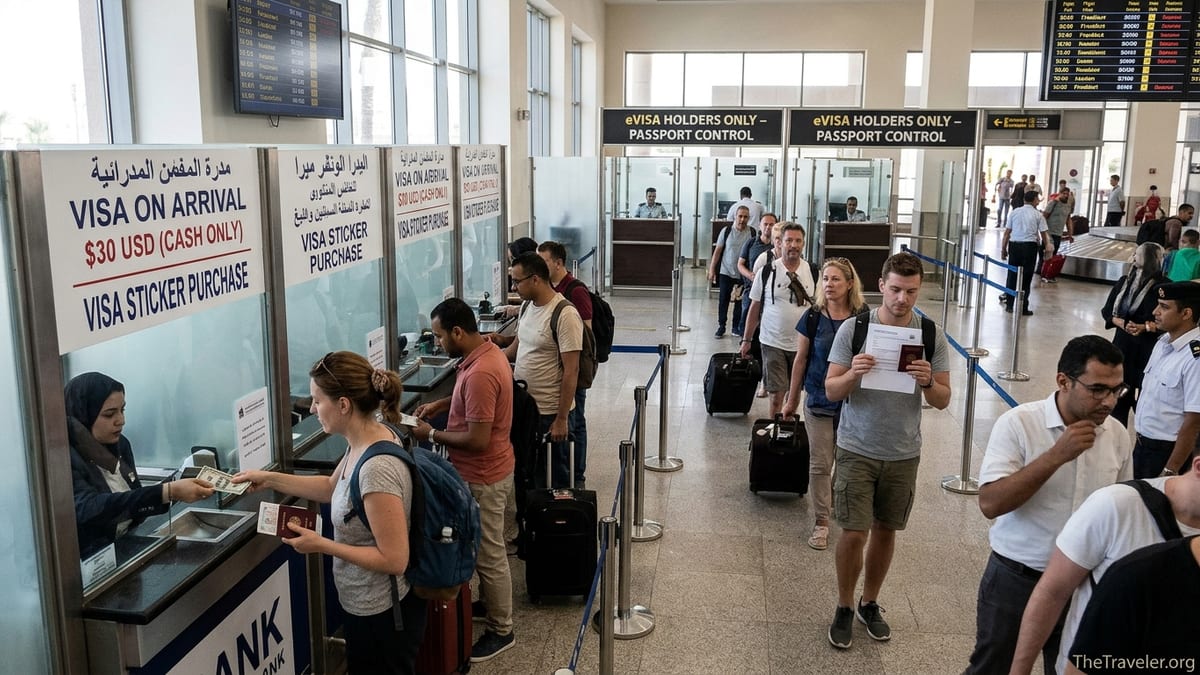
Who can use the Egypt eVisa, who gets visas on arrival and who needs advance approval
Egypt’s official eVisa portal serves as the starting point for most international tourists whose nationality is not visa exempt. The site confirms that standard tourist eVisas are issued as either single entry or multiple entry documents, obtained entirely online, and that travelers must print the approved eVisa and present it at passport control on arrival. The portal lists eligible nationalities, which at the time of writing include many European Union states, the United Kingdom, the United States, Canada, Australia, New Zealand and several Asian countries. Travelers whose passports are on this list can choose between an online eVisa before departure or a traditional visa on arrival at major airports.
According to information available on the portal and corroborated by several national foreign ministry advisories, the standard tourist eVisa fee is 25 US dollars for a single entry and 60 US dollars for a multiple entry visa. These prices match what many Red Sea liveaboard and resort operators quote to their guests when directing them to the official eVisa system. Processing time is typically described as a few working days, and many recent travelers report approvals within about 24 to 72 hours, although the authorities advise applying at least one week in advance in case of delays or additional checks.
Nationals of countries that are not eligible for an eVisa must normally obtain a visa in advance at an Egyptian consulate or embassy or, in some cases, travel agencies must seek prior security approval. This group often includes several African, Asian and Middle Eastern nationalities, where security screening is stricter and where last minute airport visas are not an option. In these cases, travelers cannot rely on a spontaneous Red Sea getaway and should confirm their status with the nearest Egyptian consulate well before booking flights.
Alongside the eVisa, Egypt continues to issue classic visas on arrival for eligible nationalities at major airports such as Cairo, Hurghada, Marsa Alam and Sharm el-Sheikh. Government tourism information and multiple embassy advisories state that these are 30 day tourist visas, sold at dedicated counters or bank kiosks immediately before passport control. Recent sources describe the current standard fee as 30 US dollars in cash for a single entry sticker, which is then affixed to your passport and stamped by the immigration officer. Multiple entry versions are not normally sold on arrival and instead require the online portal or consular processing.
How the eVisa works in practice compared with visas on arrival
On paper, Egypt’s eVisa is designed to avoid queuing at airport bank counters and to give travelers peace of mind before they board their flight. Applicants create an account on the official portal, enter their passport details, upload any requested documents, pay online by card and then receive an email decision. The portal expressly instructs travelers to print the eVisa and present the hard copy to the immigration officer alongside their passport upon arrival. In practice, this means you still join the same immigration hall queues as everyone else, but you skip the earlier step of buying a visa sticker.
Travel reports from Red Sea airports suggest that the time savings can vary widely. At quieter times, such as midweek midday arrivals into Hurghada outside peak European school holidays, visa on arrival counters may be lightly used, and purchasing the 30 US dollar sticker in cash at the bank window adds only a few minutes. Arrive on a Saturday afternoon charter wave from multiple European cities, and long lines can form at those same counters, with some travelers reporting 30 minutes or more simply to buy the sticker before then joining the passport queue. In those busy windows, holding an approved eVisa can shorten the overall arrival process because you walk straight from the aircraft into the passport line.
The main advantages of the eVisa are predictability and cashless payment. You know in advance that your passport and basic travel plan have been cleared and you do not need to carry exact US dollar notes or euros to exchange at the airport bank. On the other hand, some travelers prefer the flexibility of buying a visa on arrival, especially if their plans are not yet fixed or if they are unsure they will actually travel. If a trip is cancelled, an unused eVisa fee is not routinely refunded, whereas no visa on arrival means no cost.
It is also important to understand that holding an eVisa does not guarantee entry. As with visas on arrival, Egyptian border officials retain discretion to question travelers and to refuse entry in rare cases if documentation, security or purpose of travel appears problematic. Both systems usually expect your passport to be valid for at least six months beyond the date of arrival and to contain at least one blank page for stamps and stickers. Airlines may deny boarding if your documents do not appear to meet these requirements, regardless of the type of visa.
The Sinai-only stamp versus an ordinary Egyptian tourist visa
Sharm el-Sheikh and the wider South Sinai coast operate under a distinct scheme that often confuses first time visitors. In addition to standard Egyptian tourist visas, certain tourists arriving directly into Sharm el-Sheikh, Nuweiba or Taba, by air or through the Taba land border, can receive a free “Sinai-only” entry permission. Official Egyptian tourism information describes this as an entry permit stamp issued on arrival, valid for up to 14 or 15 days, that covers stays limited to the resorts of Sharm el-Sheikh, Dahab, Nuweiba, Taba and nearby attractions such as St Catherine’s Monastery and Ras Mohammed National Park.
This Sinai-only stamp is not an Egyptian visa in the regular sense. It does not permit travel to Cairo, Luxor, Hurghada, Marsa Alam or any other destination outside the South Sinai region. Sources ranging from embassy travel advisories to detailed visa guides stress that anyone wishing to visit mainland Egypt must instead hold a full tourist visa, obtained as an eVisa before travel or purchased on arrival where eligible. Travelers relying on the free Sinai-only stamp who later decide to book a domestic flight to Cairo or an overland journey to the Nile Valley routinely find that they cannot pass road checkpoints or board flights without upgrading to a full visa first.
Converting a Sinai-only stamp into a full visa inside Egypt is possible in theory but inconsistent in practice. There is an immigration office in Sharm el-Sheikh, and some visitors report being able to pay for a regular tourist visa there. Others describe being sent back to the airport or told to leave the country and reenter with the correct documentation. Because of this uncertainty, tour operators that run day trips from Sharm to Cairo or Luxor usually instruct their guests to buy a full tourist visa at the airport on arrival, even if their stay in Sharm is shorter than 15 days.
For most Red Sea itineraries beyond South Sinai, the rule of thumb is straightforward. If your trip includes Cairo, the pyramids, Luxor, Aswan, Hurghada, Marsa Alam, El Gouna or any Nile cruise, you need an ordinary tourist visa, not the Sinai-only stamp. The free stamp is best reserved for travelers whose entire holiday is within Sharm el-Sheikh, Dahab, Nuweiba or Taba and who are certain that they will leave Egypt again within about two weeks.
Airport specific experiences: Hurghada, Marsa Alam, Sharm el-Sheikh and Cairo
At Hurghada International Airport, charter airlines from the United Kingdom, Germany, the Netherlands, Poland and other European countries arrive in concentrated waves. Visa-on-arrival counters, often operated as bank booths, are located before passport control, where eligible tourists line up to pay the 30 US dollar fee and receive the visa sticker. Local dive cruise and resort operators sometimes advertise “visa assistance” or “pre-arranged visas” in Hurghada and Marsa Alam, which usually means a staff member meets you, guides you to the counters and handles the sticker purchase on your behalf. This can be convenient after a long flight, but the underlying visa is still the standard 30 day sticker and you still must pass regular passport control.
Marsa Alam International Airport serves fewer flights but many are full charter services bringing divers and all inclusive guests to the southern Red Sea. Visa procedures are similar to Hurghada, with eligible nationalities offered visas on arrival and others obliged to show an eVisa or consular visa. Because queues can be shorter here, some visitors report little difference in overall arrival time between eVisa holders and those buying stickers, though exact experiences change with seasonal demand and the number of simultaneous arrivals.
Sharm el-Sheikh Airport is where the Sinai-only situation creates the most confusion. On entering the immigration hall, eligible tourists see both visa-on-arrival counters and immigration lanes. Those intending to stay only in South Sinai for up to 15 days can skip the visa counter and proceed directly to passport control, where they request or are routinely granted the free Sinai-only stamp. Those who plan to visit Cairo, Luxor, Hurghada or Marsa Alam, even on a single day excursion, should instead buy the paid visa sticker first or arrive with an eVisa. Some tour operators and hotels remind guests that roadblocks and domestic airport checks around Sharm enforce this distinction, and that leaving the Sinai region without a full visa can result in being turned back or required to pay for an urgent visa.
Cairo International Airport remains Egypt’s busiest international gateway and is often more crowded than Red Sea airports. For visitors whose primary goal is a Red Sea resort, flying directly to Hurghada or Sharm can simplify entry because the airport layout and queues are generally geared toward tourists. At Cairo, eVisa holders may gain more value from having completed their paperwork in advance, as visa-on-arrival lines, currency exchange needs and larger volumes of connecting passengers can extend total arrival time. Regardless of entry point, travelers with nonstandard passports, such as temporary or emergency travel documents, should check with their airline and the nearest Egyptian consulate, as some carriers refuse to transport passengers whose documents do not clearly meet Egypt’s published entry rules.
Documents, families, extensions and the risk of overstaying
Whichever route you choose, certain baseline entry requirements apply to almost all tourists. Egyptian and foreign government advisories commonly state that passports should be valid for at least six months beyond the date of arrival and should be machine readable. Travelers are often asked by airlines or at the border to show proof of onward or return travel, such as a round trip ticket, and confirmation of accommodation through a hotel booking or cruise voucher. While budget travelers sometimes enter with only a first-night booking and a rough plan, tour operators bringing groups to Hurghada, Marsa Alam or Sharm generally bundle hotel vouchers and flight details in a single itinerary that border officials can review quickly.
Families should ensure that every child has their own passport where required by their home country and that the chosen visa route applies equally to them. Recent accounts from Sinai emphasize that overstaying a Sinai-only stamp, even by a day, can lead to fines calculated in Egyptian pounds per person, including for children. In Egypt more broadly, overstaying a standard 30 day tourist visa can result in fines to be paid at a bank desk in the airport before check in, and in more serious or prolonged cases, immigration authorities can initiate formal overstay procedures that include higher penalties or deportation. Travelers sometimes report that minor overstays are handled with a fine and no long term ban, but this is not guaranteed and policies can tighten without notice.
Tourists who wish to extend their stay beyond the initial 30 days usually need to visit a regional passport and immigration office, such as the main office in Cairo’s Abbasiya district or local branches in some resort areas. Experiences here vary, with some visitors obtaining one or more month-long extensions after providing photos, application forms and fees, and others being refused or told to leave and reenter instead. There is no automatic right to an extension, and readers should not assume that because a friend obtained three extra months in previous years they will receive the same treatment in 2026.
Travelers using emergency passports or temporary documents issued after loss or theft face an additional complication. While some have reported being admitted on emergency passports plus an eVisa or consular note, others have been denied boarding by airlines or asked to secure fresh permission from Egyptian authorities. In such edge cases, direct contact with both the airline and an Egyptian consulate is the safest course rather than relying on general guidance aimed at standard biometric passports.
Worked fee examples for common Red Sea itineraries
Consider a British couple flying from London to Hurghada for a 10 night all inclusive stay. Under current rules, United Kingdom passport holders are eligible for both the eVisa and the visa on arrival. If they choose the eVisa route and each requests a single entry online, they pay 25 US dollars per person via the official portal, for a total of 50 US dollars. They print their approvals and on arrival walk directly to passport control with the eVisas and passports. If the same couple decides to purchase visas on arrival instead, they head to the bank counter at Hurghada Airport, pay 30 US dollars per person in cash for the visa stickers, totalling 60 US dollars, and then proceed to immigration. In this scenario the eVisa saves them 10 US dollars compared with buying on arrival, but only if they are confident they will travel and apply early enough for processing.
Now imagine an American family of four flying to Sharm el-Sheikh for a 12 day resort holiday, with no plans to visit Cairo, Luxor or Hurghada. United States citizens currently qualify for the Sinai-only arrangement when arriving directly into South Sinai and not leaving the region for up to 15 days. The parents could simply walk from the plane to passport control, receive the free Sinai-only stamp for each family member and enjoy their stay without any visa fee at all. If they later decide to book a last minute day trip to the pyramids, they would discover that their entry permission does not allow travel to Cairo and would need to arrange a full tourist visa, usually by purchasing one at Sharm airport before departure. Travelers with even a small chance of leaving Sinai often choose to pay for the full visa on arrival at the start to avoid this complication.
A third example involves a traveler combining a Red Sea holiday with classic Nile sites. Suppose a German diver plans a week in Marsa Alam followed by three days in Luxor before flying home from Hurghada. Germany is on the list of countries eligible for both eVisa and visa on arrival. This traveler must secure a regular Egyptian tourist visa that covers the whole country because their itinerary leaves the Red Sea coast for Upper Egypt. They can either apply online in advance, paying 25 US dollars for a single entry eVisa, or buy the visa sticker for 30 US dollars at Marsa Alam Airport on arrival. Choosing the eVisa might make sense if their arrival hour coincides with a heavy charter schedule, while a calm late evening flight might make the visa on arrival perfectly efficient.
These examples illustrate that the best choice is highly personal. A cautious planner with fixed flights and hotels may prefer the certainty and potential savings of an eVisa. A last minute beachgoer booking a package to Hurghada a few days before departure may have no realistic option except a visa on arrival. A short Sharm-only visitor on a tight budget can legitimately use the free Sinai-only stamp, while anyone with a hint of a plan to visit Cairo or Luxor should invest in the full visa from the outset.
Avoiding scams: unofficial websites and paid “assistance” services
Because Egypt’s eVisa is an online product, a cottage industry of unofficial visa websites has emerged. Many of these sites use language and design that resemble official government pages and appear prominently in search results. They typically offer to “process” an Egypt visa application for an extra service fee on top of the official 25 or 60 US dollar charges. Some are genuine intermediaries that submit your details to the real portal, while others are poorly regulated or even fraudulent, charging high fees without adding real value. The official digital gateway emphasizes that it is the sole legitimate government portal for Egypt eVisas, and travelers should take care to navigate directly to it rather than following sponsored search results.
At the airports, another grey area involves visa-on-arrival assistance desks and unsolicited helpers in the arrival halls. In Hurghada and Sharm el-Sheikh, for example, visitors sometimes report being approached immediately after disembarking by individuals in uniforms or branded shirts offering to “handle your visa” or “fast track” you for an extra fee. In many cases, these people simply walk you to the same bank counter that everyone else uses, apply the same 30 day visa sticker and then escort you, while retaining a commission for themselves. This is not an official fast track service and does not change the visa you receive.
Some legitimate tour operators and high-end resorts do sell structured arrival assistance packages that include escorting guests through visa purchase and passport control. These can be worthwhile for nervous travelers, older guests or those arriving very late at night, but they are optional conveniences, not a different class of immigration clearance. For most independent travelers, knowing where the official bank counters are located and having exact cash in US dollars or equivalent foreign currency is enough to navigate the process without paying third parties.
To protect yourself, treat any request for payment that is not clearly at a government bank window or official counter with caution. Decline unsolicited offers politely, follow airport signage to the visa desks and immigration lanes, and keep control of your passport at all times. If you choose to use a meet and assist service arranged by your hotel or dive operator, confirm in writing what services are included and whether the cost covers only guidance or also the underlying visa fee.
How to decide: an at-a-glance guide and final checklist
A simple way to choose between Egypt’s entry options is to ask yourself three questions. First, is my nationality listed as eligible for an eVisa or visa on arrival, or do I clearly fall into a category requiring consular or pre-approval processing? Second, am I visiting only Sharm el-Sheikh, Dahab, Nuweiba or Taba for less than 15 days, with no realistic chance of adding Cairo, Luxor, Hurghada or Marsa Alam? Third, do I prefer to pay online in advance, even if my trip might later change, or would I rather retain flexibility and pay a little more in person at the airport?
If you are from a country such as the United Kingdom, Germany, France, Italy, the United States, Canada or Australia, heading to Hurghada or Marsa Alam and planning to tour beyond Sinai, your basic choice is between an eVisa at 25 US dollars for single entry or a 30 US dollar visa on arrival. If you are flying directly into Sharm el-Sheikh, staying two weeks or less and have no plans to leave South Sinai, the free Sinai-only stamp remains a valid budget friendly choice. If your passport is from a state not listed as eVisa or visa-on-arrival eligible, your first stop should be the nearest Egyptian consulate to confirm what type of visa, security clearance or group tour arrangement you need.
Before traveling, verify that your passport has at least six months of remaining validity, that you have printed copies of any eVisa approval, and that you carry details of your return or onward travel and your hotel or cruise bookings. Keep some spare passport photos and a pen handy in case you are asked to fill out arrival forms or apply for an in-country extension. Build extra time into your arrival plans if you expect peak charter traffic or if you are connecting to a domestic flight the same day.
Finally, remember that visa and entry rules can and do change with little warning. The information in this guide reflects regulations and typical experiences reported up to November 13, 2026, but readers should double check key points, such as eligible nationalities, exact fees and document requirements, shortly before departure. For most travelers to Hurghada, Marsa Alam and Sharm el-Sheikh, the process is straightforward once understood: choose the right visa type for your itinerary, avoid shortcuts that sound too good to be true and arrive prepared with the documents and patience to enjoy Egypt’s Red Sea coast.