


Croatia is now part of the Schengen Area, and since 2026 it has used the EU Entry/Exit System at its external borders, including the crossings with Bosnia and Herzegovina. For non-EU visitors, every crossing from Croatia into Bosnia and back means your entry and exit from Schengen are logged digitally. On your first Schengen crossing you can be asked for fingerprints and a photo, which adds a little time at the booth. This changes how long it takes to clear border control, but it does not change Bosnia and Herzegovina’s own entry rules, which are completely separate and still depend on your nationality and visa status.
Get the latest updates straight to your inbox!
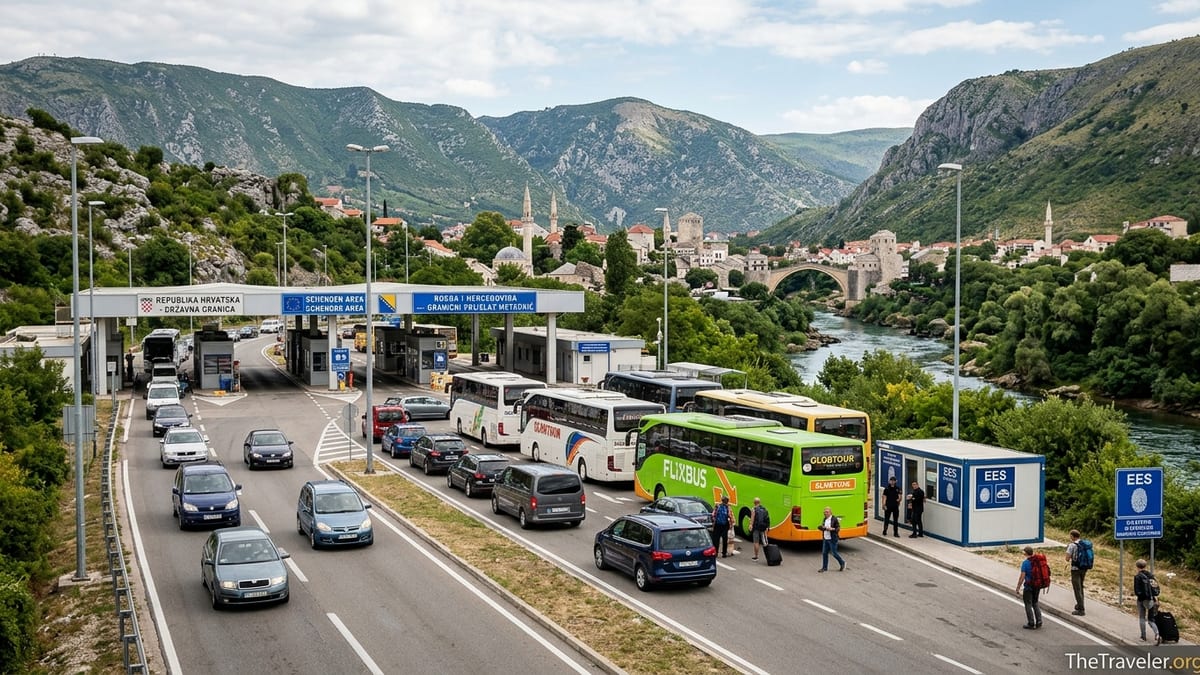
Understanding Croatia, Schengen and the EES at the Bosnia Border
Croatia joined the Schengen Area in January 2023, turning its borders with Bosnia and Herzegovina into external Schengen frontiers. Since April 2026 the EU Entry/Exit System has been fully rolled out, and Croatian police now use it at the Bosnia crossings for most non-EU and non-Schengen nationals on short stays. The first time you cross into or out of Schengen after this rollout, you can expect your passport to be scanned, your entry or exit recorded, and usually a face photo and sometimes fingerprints taken.
On later crossings the process is usually quicker, but the system still checks that you respect Schengen stay limits and that your previous crossings match your stated itinerary. Queues build because every non-EU traveler in front of you also has to pass the same checks, and cars or buses move forward one by one. At busy periods, reports from summer 2026 show waits of an hour or more at some Croatian land borders when many travelers reached the booths at once, especially on weekends and around holidays.
It is important to separate two sets of rules. Croatia and the rest of Schengen apply common rules on how long you can stay in the area and whether you need a Schengen visa. Bosnia and Herzegovina applies its own rules, with different visa-free lists and different permitted lengths of stay. Crossing for even a short visit to Mostar or Sarajevo does not reset your Schengen clock, and it does not exempt you from Bosnia’s entry rules.
For tourists using Dubrovnik, Split or other Dalmatian bases, this means border time is now a more significant factor in planning day trips into Bosnia. The trips are still entirely feasible, but you need more margin in your schedule and a clear idea of the paperwork required.
Mostar from Dubrovnik: Neum Corridor, Inland Roads and Border Reality
Mostar is the classic cross-border excursion from Dubrovnik. The most direct road route follows the coast north from Dubrovnik toward the Neum corridor, then turns inland through the Neretva valley toward Čapljina and Mostar. Many tour buses and private transfers now combine use of the Pelješac Bridge, which keeps some traffic entirely inside Croatia before cutting inland, with one main border crossing near Metković into Bosnia.
Typical road distances on this route are about 140 to 160 kilometres one way, depending on the exact crossing and whether you detour to places such as Počitelj or Kravica waterfalls. In free-flowing conditions, the driving time between Dubrovnik and Mostar is often quoted at around three hours. However, realistic door-to-door timing is closer to three to four hours each way once you factor in border control, short breaks, and traffic near Dubrovnik and in the Neretva valley.
On the way from Croatia into Bosnia you normally pass two controls in quick succession. First comes Croatian exit control, where EES records that you are leaving the Schengen Area, then Bosnia’s entry control, where your right to enter Bosnia is checked. On the way back to Dubrovnik you again see two booths: Bosnia exit, then Croatia entry with EES. If you are traveling on a tour bus, you can be asked to step off with your passport while officers check documents and, on the Croatian side, sometimes inspect the luggage hold.
Travelers in 2025 and 2026 report that on quiet weekdays it is still possible to cover the Dubrovnik–Mostar route in roughly three hours door to door, but at peak times queues for Croatia entry can add an extra hour or more. Summer Saturdays and long weekends are particularly sensitive, and even a line of a few cars can move slowly because some non-EU passengers need their biometrics enrolled one by one. This is why even well-organised day tours sometimes return to Dubrovnik later in the evening than advertised.
Mostar from Split: Interior Highway, Buses and Day-Trip Viability
From Split, Mostar is still within day-trip range, but it is a longer and more road-heavy excursion. Rather than hugging the coast the entire way, most scheduled buses and private transfers use the interior Croatian highways for part of the journey before turning toward the border, often in the Metković or Imotski area, then continuing across southern Bosnia to Mostar. The distance is roughly 170 to 200 kilometres one way.
Current bus schedules show several daily services from Split’s main bus station to Mostar, typically operated by carriers such as Globtour and FlixBus. Advertised journey times range from about three and a half hours to four and a half hours, with real-world travel often landing toward the upper end of that window once delays and local stops are included. Online booking platforms and recent timetable summaries commonly price one-way tickets from around 20 to 30 euros, depending on the departure time, carrier and how far ahead you book.
As with Dubrovnik routes, every bus from Split to Mostar has to clear Croatian exit and Bosnian entry on the way out, then Bosnian exit and Croatian entry with EES on the way back. Passengers are routinely asked to disembark at least once per direction and present passports individually. Buses cannot bypass queues, so congestion at the checkpoint immediately stretches the timetable.
In practice, a same-day return from Split to Mostar is feasible if you catch the first morning bus and return on an afternoon or evening service, but it can be a long day. It is common for travelers to build in an early start, spend the afternoon and evening in Mostar, and then return the following day, which softens the impact of any border delays and allows time for side trips to nearby highlights along the Neretva valley.
When a Day Trip Works and When to Stay Overnight
Mostar is the only one of the two cities where a same-day return from Croatian coastal bases can realistically feel like a proper visit. From Dubrovnik, a carefully planned tour or private transfer can get you into Mostar by late morning and have you back at your hotel by evening, assuming routine border conditions. From Split, the distances and slower inland roads mean you should expect tighter time on the ground if you attempt a day return, although it can still suit determined visitors on structured coach excursions.
That said, EES-related procedures and general traffic have made the timing less predictable than in the past. It is no longer sensible to count on an exact return time to the minute. If you absolutely must catch an evening flight or ferry from Dubrovnik or Split, planning a Bosnia excursion on the same day is not advisable. Even an unexpected 45-minute queue at the Croatian border can wipe out your contingency and turn a smooth day trip into a race to the airport.
Staying at least one night in Mostar removes much of this pressure. With an overnight, you can travel out from Croatia in the late morning or early afternoon, check in to your accommodation, enjoy the Old Bridge area after the day-tour crowds leave, and return to the coast the next morning when border traffic is usually lighter. This approach is particularly attractive for visitors traveling in July and August, or during busy holiday weekends when more local traffic also clogs the main crossings.
For travelers combining Bosnia stopovers with a longer Croatian itinerary, it can also make sense to route onward through Mostar rather than treat it as a standalone excursion. For example, some bus services link Split or Dubrovnik with Mostar and continue toward Sarajevo or inland Croatia. Using these through-routes may save you one extra border crossing compared with bouncing back and forth on repeated day trips.
Sarajevo from the Croatian Coast: Distances, Buses and Realistic Durations
Sarajevo lies significantly deeper inside Bosnia and Herzegovina than Mostar, and that extra distance changes the type of trip it should be. From Dubrovnik, even the most direct itineraries to Sarajevo are more than 230 kilometres and involve winding mountain roads once you leave the Neretva valley. From Split, the distance is broadly similar, with inland highways followed by slower two-lane roads through the Bosnian interior.
Direct long-distance buses between Sarajevo and Split run at least once daily according to recent Croatian and Bosnian bus station timetables, typically taking around six to seven hours in the timetable. Services between Sarajevo and Dubrovnik are less frequent and often seasonal, and they also tend to occupy a six to seven hour window even without serious congestion. Real journey times vary with weather, roadworks and border queues.
On these longer runs, the cumulative impact of two border formalities in each direction is stronger. Buses may stop once for Croatian exit and Bosnian entry, then several hours later repeat the pattern in reverse if the route clips Croatian territory again. Passengers are expected to leave the bus with their passports at least at the Croatian entry checkpoint, where EES registration and customs checks take place. Operators in the region have begun advising passengers to be prepared for additional time at the frontier compared with the pre-EES period.
As a result, Sarajevo is rarely a wise choice for a simple day trip from Dubrovnik or Split. A same-day return would involve 12 or more hours on the road and leave only a token window to explore the city itself. For most travelers, at least one or two nights in Sarajevo is a more sensible minimum, allowing time for the old town, museums and hillside viewpoints without constantly checking the clock or worrying about the trip back to the coast.
Documents, Visas, Vehicle Rules and Schengen Stay Limits
Any visit from Croatia into Bosnia and Herzegovina requires you to think through three sets of rules. First, you must be allowed to enter and re-enter the Schengen Area, which includes Croatia. Many nationalities, such as citizens of the United States, Canada, the United Kingdom, Australia and others, can visit the Schengen Area visa-free for short stays, but they still face the 90 days in any rolling 180-day limit. Travelers with Schengen visas must make sure their visa is valid for multiple entries and has not expired.
Second, Bosnia and Herzegovina applies its own visa policy. Several nationalities that are visa-free for Schengen, including citizens of most of Europe and North America, are also currently visa-free for Bosnia for short tourist visits. Others, however, do need a Bosnian visa even if they can enter Croatia without one, and some may have different allowed lengths of stay. Because rules are updated periodically, you should always confirm your status through official Bosnian consular information or your foreign ministry’s travel advice before making firm plans.
Third, if you are driving a rental car from Croatia across the Bosnia border, you need to check both permission and insurance. Most Croatian rental companies require you to declare cross-border use at booking and either include or sell a supplementary insurance document, commonly referred to as a Green Card, covering Bosnia and Herzegovina. If cross-border travel is not explicitly authorised in your contract, you can be turned back at the border or find yourself uninsured in the event of an incident. Organized tours and private transfer companies typically handle these requirements on your behalf.
An important misconception is that popping across the border into Bosnia somehow pauses or resets your Schengen 90-day counter. It does not. The EES system accurately logs each entry to and exit from Croatia and other Schengen countries, and border officials can see your running tally. If you spend, for example, 85 days in Schengen, cross to Bosnia for a short visit, then try to return for a further 10 days, you can be refused entry for exceeding the limit. Short side trips should therefore be planned within an overall Schengen schedule that comfortably respects the 90 in 180 day rule.
EES Queues, Timing and How to Build a Safe Buffer
Since EES became fully operational at Croatian external borders, periods of congestion have been reported at several crossings with Bosnia and Herzegovina. Local media and travelers have described kilometre-long queues at major road checkpoints during summer peaks and holiday weekends. The extra time needed to capture biometrics for non-EU travelers, on top of existing passport and customs checks, has contributed to longer waits at times, although staffing levels and procedures continue to be refined.
Conditions are far from uniform. Early mornings on weekdays outside school holidays often see relatively quick processing, while Friday evenings, Sunday afternoons and the start or end of big holiday periods are much more prone to bottlenecks. Some borders that carry large flows of local cross-border traffic are especially sensitive to any technical slowdown in the digital system. On the other hand, smaller crossings used mainly by tourist traffic can feel calmer but may have fewer booths open.
The practical response is to build generous buffers into your travel plans. If you are heading out from Dubrovnik or Split on a day trip to Mostar, an early departure improves your odds of smoother border formalities and leaves more daylight to recover from delays. When returning to Croatia, avoid planning tight onward connections, particularly flights and ferries, on the same evening. For journeys to or from Sarajevo, assume that the scheduled six to seven hours on the bus could occasionally become eight, especially on very busy days.
Real-time border queue information and local traffic reports are useful tools, but they cannot remove all uncertainty. Treat any advertised excursion timetable as approximate and keep the following day relatively light if possible. Flexibility is especially important for independent drivers, who might choose an alternate crossing or a different time of day if they see heavy congestion building at one checkpoint.
Independent Travel or Organised Excursion, and Is Bosnia Worth It?
One of the main decisions for visitors based in Dubrovnik, Split or the Dalmatian coast is whether to handle a Bosnia side trip independently or to book an organised excursion. Independent travel by bus gives you more control over your schedule and budget, and it is perfectly viable for Mostar and Sarajevo as long as you hold the necessary documents and allow for looser timings. Drivers enjoy maximum freedom to stop at viewpoints and villages, but they must take full responsibility for cross-border insurance, car rental conditions and navigation.
Organised day tours and private transfers, in contrast, package the logistics. Reputable operators are accustomed to the border routine, know which crossings are usually faster on particular days, and can advise if new procedures are causing delays. They cannot bypass EES or immigration control, but they can reduce your stress by handling paperwork, explaining what will happen at the border and, in some cases, adjusting departure times in response to current conditions. For many short-stay holidaymakers, this trade-off is worth the premium.
Whether Bosnia is “worth it” depends chiefly on your time budget and your tolerance for uncertainty. If you only have two full days in Dubrovnik and a tight onward flight schedule, it may be better to focus on the Croatian coast and leave Mostar and Sarajevo for a future trip. If you have four or five days along the Dalmatian coast, adding a day trip or, better, an overnight to Mostar is often a highlight, offering a vivid contrast in architecture, culture and recent history. Sarajevo, with its complex past and mountain setting, rewards a minimum of one or two nights for those who can spare them.
The key is to align your ambitions with the new reality at the border. EES has not closed the door on side trips from Croatia into Bosnia and Herzegovina, but it has made timing more sensitive and record-keeping more precise. As long as you stay well within your Schengen stay limits, meet Bosnia’s visa requirements for your nationality, secure the right permissions for vehicles and allow for flexible travel days, a visit to Mostar or Sarajevo remains entirely realistic. Choosing one or more nights in Bosnia, and considering an excursion that handles the formalities for you, can turn what might otherwise be a rushed, stressful box-ticking exercise into a rich and memorable detour.