


Landing in Mumbai for the first time can feel overwhelming. Chhatrapati Shivaji Maharaj International Airport (BOM) is one of India’s busiest hubs, with two main terminals, heavy traffic outside, and a maze of transport options into the city. This guide walks you step by step through Terminals 1 and 2, how to get a taxi or Uber/Ola, using trains, metro and buses, inter-terminal transfers, and what first‑time visitors should know to start their Mumbai trip smoothly.
Get the latest updates straight to your inbox!
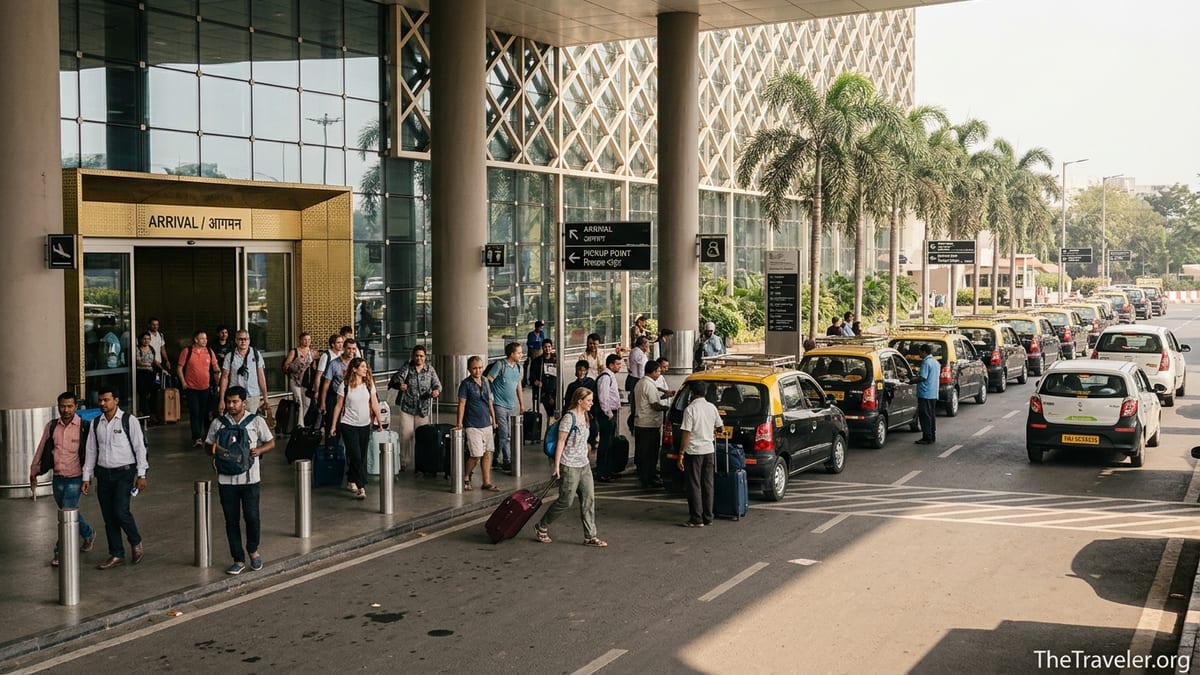
Understanding Mumbai Airport: Terminals, Layout and Airlines
Mumbai’s Chhatrapati Shivaji Maharaj International Airport has two active passenger terminals: Terminal 1 (T1) and Terminal 2 (T2). Terminal 1 is the older Santacruz domestic terminal, used mainly by low cost Indian carriers on domestic routes, while Terminal 2 at Sahar handles all international flights and a large share of full‑service domestic operations. Airlines like IndiGo, Akasa Air and Air India Express typically use T1 for many domestic services, while full‑service brands such as Air India or Vistara usually operate from T2 on both domestic and international routes. Always check your booking or airline app the day before you fly, because some carriers split operations across both terminals.
Physically, the two terminals are a few kilometers apart by road. You cannot walk between them with luggage, and there is no airside connection for transferring passengers. If you are arriving on an international flight at T2 and continuing to a domestic flight from T1 on a separate ticket, you must clear immigration, collect your bags, exit to the landside area and then travel to T1 by road. The reverse is true if you land at T1 and depart internationally from T2.
Terminal 2 is the showpiece: a large, modern building with high ceilings, extensive art installations and a central security area that can feel crowded at peak times. It has multiple levels for departures, arrivals and ground transport, along with lounges, transit hotel rooms and many food outlets. Terminal 1 is more compact and utilitarian, with fewer restaurants and shops but generally shorter walking distances from check in to the gates. First‑time travelers who prefer a quieter feel often find T1 less intimidating, though it is busier in the evening bank of domestic flights.
For orientation, remember this simple rule: most international flights in and out of Mumbai operate exclusively from T2, while T1 is a domestic base for budget airlines. If your itinerary connects internationally and domestically on the same through ticket with the same airline group, your domestic leg will often be scheduled at T2 to make the transfer easier. If your tickets are separate, plan extra time in case you need to cross from one terminal to the other by road.
Arriving at BOM: What to Expect at Immigration, Baggage and Customs
If you are arriving from overseas at Terminal 2, the first stage after deplaning is immigration. Queues can vary widely: a late‑night arrival from Europe might clear in 20 minutes, while a morning bank of flights from the Gulf can easily stretch waits to nearly an hour. Keep your passport, visa or e‑visa printout and accommodation details handy. Lines are clearly marked for Indian nationals, e‑visa holders and other foreign passports, but staff will redirect you if you join the wrong one.
After immigration you reach the baggage claim hall. Large display screens show belt numbers, but flights can share carousels, so double‑check the flight listed. Baggage delivery times also vary; at quieter times bags may appear within 15 minutes, while at peak hours or on heavily loaded long‑haul flights you might wait 30 minutes or more. Trolleys are free and plentiful near the carousels. If your bag is missing, look for the baggage services desk near the exit of the hall before customs.
Customs screening in Mumbai is usually straightforward. You select the green channel if you have nothing to declare, or red if you carry restricted items or high‑value electronics beyond allowance. Officers may scan random bags, but many passengers simply pass through without questions. Once you exit customs at Terminal 2, you enter the arrivals hall with money changers, ATMs, SIM card counters, and official airport taxi desks. For domestic arrivals at Terminal 1, baggage and customs are simpler and you exit directly into a smaller arrival area with prepaid taxi counters and signs to the pickup points.
Many first‑time visitors are tempted to stop at the first currency exchange counter they see airside. Rates there can be less favorable than in town or at some landside counters. A practical approach is to change only a small amount, enough for your first taxi ride and snacks, and then use ATMs or city money changers later. International cards are widely accepted by most larger hotels and restaurants in Mumbai, but having some cash on arrival is useful for smaller taxis, street food or tips.
Getting into the City: Taxis, Uber, Ola and Private Transfers
The most common way to leave Mumbai Airport is by car: either a prepaid taxi, an app‑based ride through Uber or Ola, or a prearranged hotel or private transfer. Inside both T1 and T2 arrivals halls you will see official prepaid taxi counters run under the airport’s authority. Here you give your destination, pay in advance with cash or card, receive a printed slip and then proceed to the taxi queue outside. This system avoids haggling and is usually the simplest option for first‑time visitors, especially late at night or after a long flight.
App‑based cabs like Uber and Ola operate legally from the airport, but their pickup points are not right outside the terminal doors. At Terminal 2 you typically book your ride once you reach the arrivals level, then follow signs or ask staff for the rideshare pickup levels in the multi‑level car park, such as P4 or P6 depending on where your car is assigned. Fares from T2 to South Mumbai areas like Colaba or Fort often fall in a broad range that can start around the equivalent of 8 to 10 US dollars in light traffic and rise with peak‑hour congestion or surge pricing. At Terminal 1, riders sometimes choose to walk a short distance towards the main road and select that as the pickup point on the app to avoid additional airport access fees included when the airport is set as the pickup.
Real‑world experience shows that confusion often arises at the cab bays. Tired passengers exit T1 or T2 and are approached by touts offering “Uber” or “Ola” but then attempting to negotiate an off‑meter cash fare or redirect you to an unmetered vehicle. To avoid this, always book through the official app, check the driver’s name and number plate in the app and verify them before getting in. If anyone tries to steer you away from the signed pickup area, decline politely and continue to the marked zone or prepaid desk. Many locals recommend that first‑timers, especially those arriving alone at night, use the airport’s prepaid AC taxis or a hotel‑arranged transfer for the least hassle.
If you are staying at a midrange or upscale hotel in neighborhoods such as Bandra Kurla Complex, Lower Parel or Nariman Point, it is worth asking if they offer airport transfers. Some properties send private cars that wait at the arrivals gate with your name on a placard. These services cost more than an UberX ride but are still reasonable by international standards and save you from navigating the rideshare bays on your first visit. Sharing your flight number ensures the driver can track delays and adjust pickup time.
Metro, Local Trains and Buses: Cheaper Ways to Reach Mumbai
Mumbai’s rail and metro system can be useful if you are traveling light and comfortable with crowds. The airport itself is not yet fully integrated with a dedicated metro line directly into the terminals, but several existing metro corridors run fairly close, and future expansions are planned to connect new city districts and even the wider region. For now, most passengers still rely on a short taxi or auto‑rickshaw ride from the terminal to the nearest suburban rail or metro station.
The closest suburban railway stations are Vile Parle (East) for Terminal 1 and Andheri (East) for Terminal 2. In practice, this means you would exit the terminal, take a metered auto‑rickshaw or cab for a short hop to the station, then board a local train towards Churchgate or CSMT if you are heading into South Mumbai. Fares on these trains are extremely low compared with taxis. For example, a one‑way second‑class ticket from Andheri to Churchgate costs only a fraction of a typical airport taxi fare. However, trains become very crowded during morning and evening rush hours, and handling large suitcases on packed platforms and coaches is challenging for newcomers.
Metro lines are expanding across Mumbai and Thane, making some suburbs more accessible. Sections of newer lines now link areas like Andheri, Dahisar, Thane and parts of Navi Mumbai with air‑conditioned trains and clearly marked stations. To use them from the airport, most travelers currently take a short auto or taxi ride to the nearest operational metro station, then continue by metro to their destination corridor and transfer to a rickshaw or cab at the other end. For instance, a traveler staying in a northern suburb might ride a cab from T2 to the nearest metro stop, then continue by metro to avoid road traffic.
Public and private airport buses also serve the terminals. Air‑conditioned buses link the airport with business districts such as Bandra Kurla Complex, Andheri, Thane, Navi Mumbai and South Mumbai. These services are cheaper than taxis and more comfortable than crowded suburban trains, though they are slower than private cars in heavy traffic. If you are alone with one backpack and heading somewhere along a main corridor, the bus can be an economical choice. Check the current routes and timings at the transport information counters in the arrivals hall or on city transport apps once connected to local data.
Inter‑Terminal Transfers: Moving Between T1 and T2
Because Terminal 1 and Terminal 2 are on separate sites, changing terminals is essentially a short city journey. There is no internal people mover and no walkway between them. Depending on traffic, the drive can take from 10 minutes in light conditions to 25 minutes or more at peak times, even though the actual distance is only a few kilometers. Always allow generous connection time if you are on separate tickets, particularly during evening rush hours or the late‑night international rush.
Most passengers transfer between T1 and T2 using regular city taxis, airport prepaid cabs or app‑based rides. On arrival at one terminal, you exit with your luggage, locate the prepaid taxi counters or rideshare pickup zones and then give the other terminal as your destination. When using Uber or Ola, choosing “CSMIA Terminal 1” or “CSMIA Terminal 2” precisely as the drop off ensures the driver follows airport signage to the correct departures level. Fares for this short sector are modest compared with city journeys, but because airport access and parking fees are built into app fares, the per‑kilometer rate can look disproportionate to the distance.
Some full‑service airlines operating through tickets provide inter‑terminal transfer buses for passengers connecting between domestic and international flights, particularly when both legs are on the same carrier group. In these cases, you may be instructed to follow airline staff after baggage claim or remain in a dedicated transfer holding area. The arrangements vary by airline and schedule, and not every ticket includes this option, so you should confirm at the time of booking or with airline support before relying on it.
To avoid stress, treat transfers between T1 and T2 as if you were changing airports. If your first flight is domestic into Terminal 1 and you have a long‑haul international departure from Terminal 2 booked separately, allow at least three to four hours between scheduled arrival and departure. This buffer must cover potential domestic delays, baggage delivery, the taxi ride between terminals, security queues and immigration at T2. Travelers with checked baggage, family members or mobility needs should be even more conservative.
Navigating Arrivals: SIM Cards, ATMs, Food and Short Sleeps
Once you exit customs at Terminal 2, you step into a busy arrivals hall filled with drivers holding placards, families waiting for relatives and a mix of service counters. Telecom providers often maintain booths that sell local SIM cards or eSIM activation packages, which can be convenient for travelers whose home roaming plans are expensive. Bring a passport photo and be prepared to show your passport for registration. Activation can range from near‑instant to a few hours, so do not rely on a new SIM the second you buy it. Many visitors instead use airport Wi‑Fi to book their ride, then sort out mobile data later in the city.
ATMs from major Indian banks are usually available in landside areas of both terminals. Using an ATM linked to a large national bank can help minimize withdrawal problems, although your home bank may still charge an international fee. Withdraw a sensible first amount rather than very small sums, as each withdrawal may incur a flat overseas charge. For example, taking out the equivalent of 100 US dollars once on arrival can be more cost‑effective than drawing 20 dollars five separate times.
Food and coffee options are more numerous in Terminal 2 than in Terminal 1. At T2, you can find recognizable chains serving coffee, sandwiches, Indian snacks and international fast food, as well as local brands offering dosas, biryanis and sweets. If your onward journey into the city will be long due to traffic, it can be wise to eat a quick meal or at least grab bottled water here before heading outside. Terminal 1 has fewer choices but still covers basics like tea, coffee, simple Indian meals and snacks near arrivals and departures.
For travelers in transit or with overnight layovers, Mumbai Airport hosts an airside transit hotel inside T2 and landside hotels within a short drive, especially around the Sahar Road and Marol areas. The airport transit hotel offers rooms that can be booked for short blocks, providing a bed, shower and Wi‑Fi without needing to clear immigration, if your itinerary qualifies. If you have already entered India or are between separate tickets, nearby airport hotels, including international chains and local midrange properties, provide convenient rest stops. Many hotels offer free or paid shuttle transfers to both terminals, which can be particularly valuable for families or elderly travelers.
First‑Time Mumbai Survival Tips from the Airport Onward
The transition from the controlled environment of the terminal to the organized chaos of Mumbai’s streets can be intense. Heat and humidity may hit you the moment the sliding doors open, even late at night in the warmer months. Keep a small bottle of water accessible and dress in light, breathable fabrics. If you are landing from a cooler climate, consider removing extra layers before you exit to avoid discomfort while waiting for transport in open air or semi‑covered taxi bays.
Traffic is part of the city’s character. A ride from Terminal 2 to South Mumbai can take anywhere from 60 to 90 minutes or more, depending on the time of day, roadworks and monsoon conditions. It is common for locals to plan airport rides with large buffers; for example, leaving Colaba three hours before an evening international departure. As a first‑time visitor, avoid booking tight dinner reservations or meetings soon after landing. If your flight lands at 9 p.m., assume you may not reach a hotel in Fort or Colaba before 11 p.m., especially in the rainy season.
Safety around the airport and in taxis is generally good, but situational awareness is important. Choose official taxis or rides booked through recognized apps, keep your valuables out of sight and avoid sharing personal information such as your full itinerary or where you are staying in detail with casual strangers. Many visitors prefer to send live location updates to a friend or family member via messaging apps while in the taxi, especially on night arrivals. Drivers are used to this and usually do not object.
Finally, embrace the city’s noise and energy as part of the experience. On your first drive from the airport, you may pass clusters of roadside food stalls, billboards advertising Bollywood films and glimpses of the local suburban trains. Use the ride to adjust your expectations and observe how the city moves. Knowing in advance that the airport arrival process may take time, that cabs may involve short waits and that traffic will be heavy can help you stay calm and begin your Mumbai journey on the right note.
FAQ
Q1. Which terminal will my flight use at Mumbai Airport?
Most international flights use Terminal 2, while many low cost domestic flights use Terminal 1. Full‑service domestic flights from airlines like Air India or Vistara often depart from Terminal 2, but you should always confirm on your ticket or airline app before travel.
Q2. How long does it take to get from Mumbai Airport to South Mumbai?
Travel time from either terminal to areas like Colaba or Fort is typically 60 to 90 minutes by taxi in normal traffic. During peak hours or heavy rain it can take longer, so it is wise not to schedule tight plans within an hour of your expected arrival downtown.
Q3. Is Uber or Ola cheaper than a prepaid taxi at Mumbai Airport?
App‑based rides can sometimes be cheaper, especially in off‑peak times, but they include airport access fees and may surge during busy periods. For first‑time visitors who value simplicity, an official prepaid AC taxi booked at the airport counter is often the most straightforward option, even if the fare is slightly higher.
Q4. Can I walk between Terminal 1 and Terminal 2?
No, the two terminals are on separate sites a few kilometers apart and are not connected by a pedestrian walkway. You must take a taxi, app‑based cab or airline‑provided transfer bus where available, and allow at least 30 minutes door to door including waiting time.
Q5. Are local trains a good option from the airport for first‑time visitors?
Local trains from nearby stations like Andheri or Vile Parle are very cheap and fast but can be crowded and overwhelming, especially with large luggage. Experienced budget travelers with light bags may use them, but most first‑time visitors find taxis, app‑based cabs or buses more comfortable after a long flight.
Q6. Where can I buy a SIM card at Mumbai Airport?
At Terminal 2 arrivals you will usually find counters from major telecom providers offering tourist SIMs or eSIM activation. You need your passport and may need a small photo. Activation can take from a few minutes to a few hours, so it is sensible to rely on airport Wi‑Fi initially.
Q7. Is it safe to arrive at Mumbai Airport late at night?
The airport operates 24 hours and remains busy through the night, with staff, police and many passengers around. Official prepaid taxis, hotel cars and app‑based cabs continue to run overnight. Use only recognized services, avoid unmarked private cars and share your ride details or location with someone you trust.
Q8. How early should I reach the airport for departure?
For domestic flights, arriving around two hours before departure usually works, though many locals allow a bit extra during holiday periods. For international flights, arriving three to four hours in advance is recommended to cover check in, immigration and security queues, especially at peak late‑night departure banks.
Q9. Can I find vegetarian or vegan food at the airport?
Yes, both terminals offer plenty of vegetarian options, including Indian dishes like dosas, thalis and snacks. Vegan choices may be more limited but you can often find simple items like idlis, rice dishes, salads and certain breads that fit plant‑based diets. Ask staff about ingredients if you have strict requirements.
Q10. Are there luggage storage facilities at Mumbai Airport?
Facilities such as left luggage or cloak rooms have operated at various times at or near Terminal 2, but availability and rules can change. If you plan to store bags, check the latest information with the airport or your airline before you travel, and consider booking a nearby hotel day room as an alternative for secure storage and rest.