


Nepal remains one of the world’s great trekking destinations, but its entry rules have become more structured in recent years. A tourist visa, including the popular Visa on Arrival at Kathmandu Tribhuvan International Airport, allows you to enter the country but does not by itself authorize travel into every Himalayan trekking region. Separate trekking permits, guide rules and regional restrictions apply, and travelers who rely on outdated online advice risk being turned back at checkpoints or fined. This guide brings together the latest official information as of November 13, 2026, to help you plan legally compliant treks across Nepal.
Get the latest updates straight to your inbox!
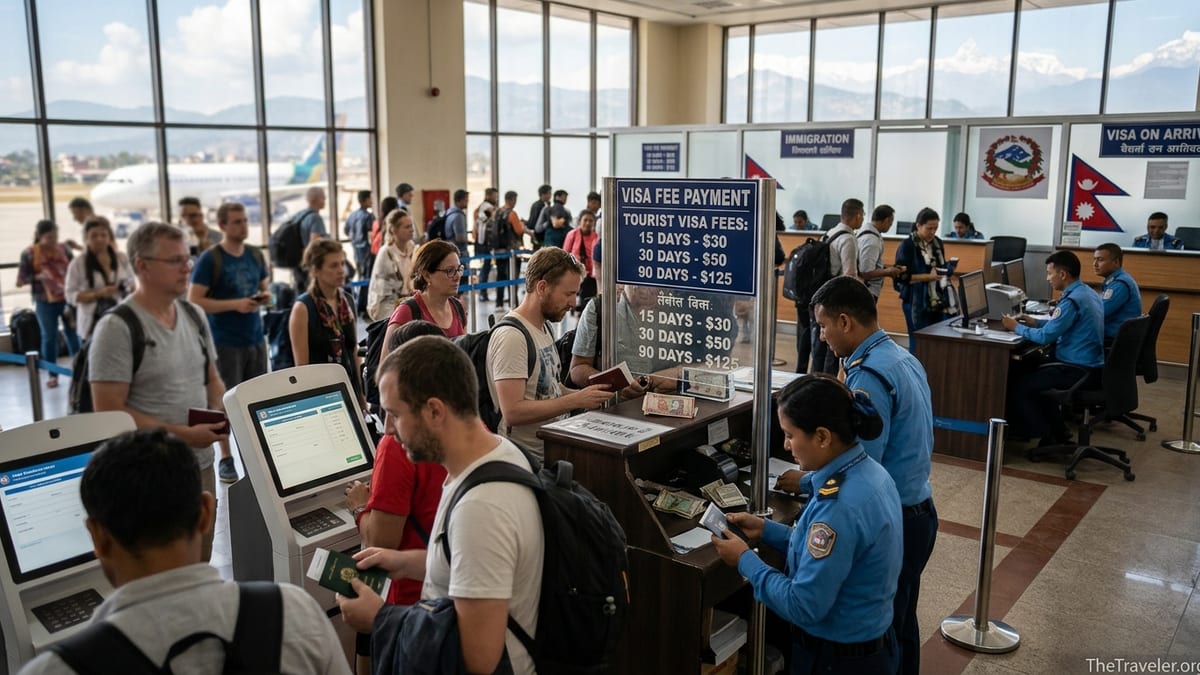
Current Tourist Visa on Arrival Options and Eligibility
For most nationalities, Nepal continues to offer a Tourist Visa on Arrival at international airports and designated land borders. As of mid 2026, the Department of Immigration confirms three main entry options for tourist visas: 15 days for 30 US dollars, 30 days for 50 US dollars and 90 days for 125 US dollars, all issued as multiple-entry visas for the chosen period. These fees are set in the immigration regulations and are consistent across airports and authorized land crossings, though they remain subject to change by the Nepali government without prior notice.
Not every passport holder is eligible for Visa on Arrival. The Department of Immigration publishes a short list of nationalities that must obtain a visa in advance from a Nepali embassy or consulate and cannot rely on on-the-spot issue at Kathmandu or border posts. Travelers from those countries can still usually visit as tourists, but only with pre-arranged authorization. Before flying, it is important to check the current list on official channels and not assume that all foreign nationals are treated the same at the border.
Indian citizens occupy a unique category. Under long-standing bilateral arrangements, Indians do not require a tourist visa to enter Nepal for most purposes and can typically travel using a passport or certain government-issued photo IDs such as an election card. This does not exempt them from trekking permits or internal regulations in restricted areas, but it does mean that the standard Visa on Arrival queues and fees described above generally do not apply to Indian nationals.
Citizens of SAARC countries, which include nations such as Bangladesh, Bhutan, Pakistan and Sri Lanka, may benefit from preferential treatment in some areas of Nepal’s entry and trekking system. While they normally obtain tourist visas on arrival at the same headline prices as other non-Indian visitors, several trekking permits and national park fees are discounted for SAARC passport holders. Travelers should carry their physical passport to prove eligibility for these reduced rates, since border guards and permit officers do not accept photographs or photocopies as proof of nationality.
Arriving at Tribhuvan International Airport: Step by Step
Kathmandu’s Tribhuvan International Airport remains the primary entry point for trekkers. After disembarking, passengers who need a visa follow signs to the immigration hall where they will first encounter electronic kiosks and paper forms for the Tourist Visa on Arrival application. Travelers can either complete the online visa form in advance through the government portal and bring a printed confirmation, or use the airport kiosks to enter personal details, travel plans and local contact information. The system then generates a receipt or confirmation slip that must be presented at the payment counter.
Next, visitors proceed to the bank counter or designated payment desks inside the immigration area. Here they select their required visa duration of 15, 30 or 90 days and pay the corresponding fee. The authorities emphasize that payment should be in convertible foreign currency, typically US dollars, euros or other major currencies, or in some cases by card where card terminals are operational. Recent official warnings highlight fraudulent third-party visa payment websites, so travelers are strongly advised to pay only at the official counter or through the authorized government online platform, not via unverified intermediaries.
With the visa fee receipt in hand, passengers join the appropriate immigration queue. At the counter, they present their passport, which must usually be valid for at least six months from the date of entry, the completed arrival card, and the visa application and payment confirmation. Officers may request a recent passport-size photograph, although the electronic system increasingly captures images on the spot. Families or groups should be prepared for each traveler to be processed individually. Once the officer is satisfied, they will place a visa sticker in the passport indicating the type of visa and the authorized period of stay.
Travelers who already hold a tourist visa issued by a Nepali embassy abroad skip the payment counter and proceed directly to immigration control. However, even with a pre-issued visa, they must still complete an arrival card and may be asked about accommodation, onward travel and financial means. Importantly, receipt of a tourist visa at the airport merely authorizes entry into Nepal as a visitor; it does not replace trekking permits or grant access to restricted Himalayan regions, which are controlled by separate regulations and agencies.
Overland Entry, Extensions and Maximum Length of Stay
Nepal also permits overland entry at a number of official border crossings with India and China, including Kakarbhitta, Birgunj, Belahiya and Gaddachauki on the Indian frontier. At these posts, the process broadly mirrors the Kathmandu airport system: visitors fill out the tourist visa form, pay the same published fees of 30, 50 or 125 US dollars at an immigration or bank counter and receive the visa sticker from border officers. Facilities may be more basic than in Kathmandu, and electronic kiosks or card payment systems are not always available, so carrying printed passport photos and crisp foreign currency notes remains wise.
Once in Nepal, tourists can extend their stay at the Department of Immigration in Kathmandu or the Immigration Office in Pokhara. Official schedules indicate that tourist visa extensions are charged at approximately 3 US dollars per day, payable in Nepali rupees at the prevailing government rate, with a minimum charge equivalent to 15 days even if you extend for a shorter period. Multiple-entry facilities can be added for an additional fee. All extensions are subject to an annual ceiling: tourists may stay in Nepal for a maximum of 150 days in a single visa year, defined by the authorities as January to December.
Extensions are not automatic. Applicants must complete an online extension form, submit their passport with a valid visa, provide passport-sized photographs and in some cases show proof of address in Nepal, such as a hotel booking or trekking agency letter. A late fee applies if a tourist overstays before applying for an extension, and serious overstays can attract fines or other penalties. Trekkers planning long routes, such as a combined Manaslu and Annapurna circuit or extended volunteering followed by trekking, should map their itinerary carefully to avoid bumping up against the 150-day annual limit.
It is crucial to distinguish between the visa period and trekking permits. Extending your tourist visa is a separate process from renewing national park or restricted-area permits. Even if your visa remains valid, you must ensure that any regional permits you hold cover the exact dates and locations of your trek. Immigration officers at border exits may check only visa validity, while local checkpoints inside trekking regions will focus on trekking-specific documentation.
Trekking Permits, TIMS and Regional Authorities
Nepal operates a layered system of trekking regulations that sits on top of the national visa regime. The core elements are the Trekkers’ Information Management System, usually known as TIMS, national park or conservation area entry tickets and, in certain sensitive border regions, special restricted-area permits. These instruments are administered by a combination of the Department of Immigration, the Department of National Parks and Wildlife Conservation, the National Trust for Nature Conservation and the Nepal Tourism Board, often working with licensed trekking agencies.
Since March and April 2023, the rules around TIMS and guides have tightened significantly. Official communications from the Nepal Tourism Board confirm that on most major trekking routes, independent trekkers are no longer permitted to set out alone. Instead, they must travel with a licensed trekking guide registered in Nepal and obtain a TIMS card issued through a recognized trekking agency rather than buying one as an unaccompanied individual. This change was introduced partly for safety and rescue coordination, after a series of accidents and missing-trekker incidents in previous years.
National park and conservation area permits are distinct from TIMS. For example, trekking in Sagarmatha National Park, which covers much of the Everest region, requires a park entry ticket collected at the park gate, typically near Monjo. The Annapurna Conservation Area Project, which encompasses much of the Annapurna Circuit and Base Camp areas, is managed via a conservation permit issued by the National Trust for Nature Conservation in Kathmandu or Pokhara, or via authorized agents. These permits involve fixed fees, with lower rates for SAARC citizens and higher rates for other foreigners, and are checked at multiple points along the trails.
Restricted-area permits, sometimes called special permits, apply to border-sensitive corridors such as Upper Mustang, Upper Dolpo and parts of the Manaslu region. These are issued only through government-registered trekking agencies and require trekkers to be accompanied by a licensed guide. Group size rules also apply, typically requiring at least two foreign trekkers listed on the same permit, even if they are effectively traveling as a private party with one guide and porter team. The costs in these areas are substantially higher than in standard national parks and are charged per person for a defined period, usually by the week.
Everest, Annapurna, Langtang, Manaslu and Upper Mustang Compared
For an Everest Base Camp trek beginning with a flight to Lukla, trekkers currently need at least two main permits on top of their tourist visa. The first is the Sagarmatha National Park entry ticket, purchased at the park gate, and the second is a local entry fee collected by the rural municipality in the Khumbu region, sometimes charged in Lukla or Monjo. Since the 2023 regulatory changes, trekkers on standard Everest routes such as Base Camp, Gokyo Lakes or the Three Passes are also required to hold an agency-issued TIMS card and be accompanied by a licensed guide, although the specific enforcement practices can vary slightly by season.
Annapurna itineraries involve a different combination of authorities. A classic Annapurna Circuit or Annapurna Base Camp trek requires an Annapurna Conservation Area permit, issued by the National Trust for Nature Conservation, and a TIMS card linked to a licensed guide. The conservation permit is checked at several points such as Besisahar, Dharapani or Chhomrong, while TIMS records are used for safety tracking and statistical purposes. Unlike restricted regions, the Annapurna area itself is not classified as a restricted border zone, so no special restricted-area permit is needed, but the guide and TIMS card requirements introduced in 2023 still apply on major routes.
Langtang, close to Kathmandu, usually demands a Langtang National Park entry ticket and a TIMS card, again tied to a registered guide. The region has seen destructive earthquakes and landslides in recent history, and authorities pay particular attention to trail safety and weather-related risks. Manaslu and Upper Mustang work differently. Manaslu, including the popular circuit that often links into the Annapurna trail network, is designated as a restricted area for specific sections. Trekkers there must secure a restricted-area permit at rates that vary by season, with higher weekly fees in autumn and reduced rates in other months, and they must be part of a group registered through a trekking agency with a licensed guide and, typically, at least two foreign clients named on the permit.
Upper Mustang is among the most tightly controlled trekking areas in Nepal. Access north of Kagbeni requires a restricted-area permit at a substantial fixed weekly fee charged per person, in addition to the Annapurna Conservation Area permit. Solo permits are not issued; trekkers must be part of an agency-organized party and travel with a licensed guide. Checkpoints along the Kali Gandaki corridor verify restricted permits, and those without proper authorization are turned back. These rules illustrate vividly why holding a generic tourist visa is not enough to guarantee access: even a perfectly valid 90-day multiple-entry visa does not override the regional restrictions that apply in Upper Mustang or other sensitive border zones.
Why Pre‑2023 Online Advice is Now Misleading
For many years, Nepal was known as a relatively easy destination for independent trekkers, and countless blog posts, guidebooks and forum threads still describe a system where individuals could buy a TIMS card in Kathmandu or Pokhara and head into the mountains without a guide. The revised TIMS provisions that took effect around March and April 2023, along with related policy adjustments documented by the Nepal Tourism Board and Department of Immigration, have effectively ended that era on most mainstream trails. Foreign Individual Trekkers are now expected to book through agencies and trek with licensed guides on designated routes.
This shift means that older online advice can be dangerously outdated. Step-by-step instructions explaining how to find the independent-trekker TIMS counter in Thamel, reports of trekking the Annapurna Circuit without any guide or porter and cost breakdowns that omit guide fees no longer reflect the regulatory reality. Some of these sources still appear prominently in search results and are occasionally shared in social media groups, leading first-time visitors to assume that they can simply arrive in Kathmandu, purchase a TIMS card on their own and set off.
The risk is not theoretical. Trekking checkpoints in regions like Annapurna, Everest and Langtang now typically require trekkers to show a TIMS card that is linked to a recognized trekking agency and a named guide. Those who arrive with only a tourist visa and outdated paperwork may be ordered to return to the trailhead, hire a guide and regularize their permits before continuing, which can blow apart a tight itinerary or budget. In restricted regions such as Manaslu or Upper Mustang, attempting to trek without the proper special permit can result in immediate denial of entry.
Travelers planning treks for late 2026 or 2027 should therefore base their preparations on official notices, up-to-date guidance from reputable agencies in Kathmandu or Pokhara and the latest documents from the Department of Immigration and Nepal Tourism Board, rather than relying on anecdotes from treks completed a decade ago. Confirming permit requirements for your specific route before booking flights is now an essential part of Nepal travel planning.
Worked Cost Examples: Visas, Permits and Guides
To illustrate how visas and permits stack up in practice, consider a typical 14-day Everest Base Camp itinerary for a non-SAARC foreign traveler entering by air. At the border, the trekker might opt for a 30-day tourist visa at 50 US dollars, giving enough flexibility for delays. In Kathmandu, they would arrange a guided trek through an agency, which would secure a TIMS card and handle park permits. On the trail, the trekker pays a Sagarmatha National Park entry fee at the park gate and a Khumbu local entry charge collected by the rural municipality. Agencies usually bundle the TIMS and permit fees into a package; while exact figures vary, the government portions of these charges together often amount to the equivalent of several dozen US dollars on top of the initial visa fee, with guide and porter wages sitting as a separate, and significantly larger, budget item.
For a longer 21-day Annapurna journey combining sections of the Circuit and a side trip to Annapurna Base Camp, a 30-day tourist visa at 50 US dollars is again a common starting point, with the option of extending later if needed using the per-day extension rate up to the 150-day annual cap. The core trekking paperwork includes an Annapurna Conservation Area permit and a TIMS card obtained through the guiding agency. These government fees for non-SAARC trekkers amount to a modest fraction of the total cost once accommodation, meals, transport to and from trailheads and guide services are included. SAARC citizens on the same route generally pay reduced conservation and TIMS rates but still require valid TIMS cards and, on mainstream routes, licensed guides.
Restricted-area itineraries show even more clearly how a tourist visa and standard park permits are only part of the picture. A foreign trekker planning 10 days inside Upper Mustang, for example, would purchase a 30-day tourist visa on arrival and then work with a registered agency to obtain both an Annapurna Conservation Area permit and a restricted-area permit at the official weekly rate published by the Department of Immigration, which is significantly higher than that for ordinary areas. The agency would register at least two foreign trekkers on the same restricted permit, supply a licensed guide and typically arrange transport to the trailhead. In this scenario, restricted-area permit fees alone can easily surpass the combined cost of the tourist visa, standard conservation permits and domestic flights.
In all three cases, it is useful to think of costs in two buckets: government-imposed fees, such as visas, national park entries, conservation fees, TIMS cards and restricted-area permits, and commercial costs, such as guide and porter wages, agency margins, accommodation and meals. Keeping these separate when budgeting helps trekkers understand which expenses are non-negotiable legal requirements and which can be adjusted through choices about comfort level, group size and route complexity.
Safety, Insurance and Seasonal Considerations
Nepal’s layered system of visas and trekking permits is tightly connected with safety and risk management but should not be confused with medical or evacuation coverage. Holding a tourist visa or a TIMS card does not provide any form of insurance or guarantee of rescue if something goes wrong in the mountains. Trekkers planning high-altitude routes such as Everest Base Camp, Annapurna Circuit, Manaslu or Upper Mustang should obtain travel insurance from reputable international providers that explicitly covers trekking to the maximum altitude they expect to reach and includes helicopter evacuation from remote Himalayan locations.
Licensed trekking guides play an important role in safety beyond simple navigation. Under the revised post-2023 system, they are expected to monitor clients for signs of altitude sickness, manage acclimatization schedules, coordinate with lodges for weather information and contact rescue services or local authorities in emergencies. This role is distinct from immigration regulation but is one of the reasons Nepal has tightened the link between legal access to popular trails and the use of registered guides. A trekker who tries to bypass these requirements may not only run afoul of the law but also forgo an important layer of safety support.
Seasonal trail conditions add another dimension. During the summer monsoon, landslides can affect sections of the Annapurna Circuit and road access to trailheads, while winter storms can close high passes such as Thorong La or Cho La. Government agencies sometimes issue temporary advisories or restrict access in the immediate aftermath of major natural events, and official checkpoints may instruct trekkers to turn back or reroute even if their visas and permits are in perfect order. Travelers should remain flexible and understand that the right to enter a region on paper may be temporarily overridden by safety decisions on the ground.
Helicopter evacuation in Nepal is expensive and subject to strict logistical and weather constraints. Even if a trekker holds comprehensive insurance, flight availability, visibility and landing zones can limit when and where rescues take place. Some insurers now insist that evacuations be coordinated through recognized local partners rather than arranged informally. None of these realities change the basic requirement for valid visas and permits, but they are part of the broader context in which Nepal has moved to a more controlled trekking system.
Permit Comparison Matrix, Application Checklist and Common Mistakes
Viewed side by side, Nepal’s main trekking regions reveal a clear pattern of overlapping rules. Everest, Annapurna and Langtang require a standard tourist visa, a park or conservation entry ticket and, since the 2023 reforms, an agency-issued TIMS card linked to a licensed guide. Manaslu combines those elements with an additional restricted-area permit for the core section of the circuit, issued only through agencies and subject to seasonal pricing and minimum group sizes. Upper Mustang adds a high-cost restricted-area permit on top of the Annapurna Conservation Area permit and requires an agency-organized party with a guide at all times.
For practical trip planning, a simple mental matrix helps. Start with the national visa category: almost all leisure visitors will use a Tourist Visa on Arrival or pre-issued tourist visa, valid for 15, 30 or 90 days and extendable up to a total of 150 days per calendar year. Then layer on the regional requirements: national park entry if you are going into a protected park, conservation permits for areas like Annapurna, TIMS for recognized trekking routes and restricted-area permits if your route crosses into controlled border zones. Cross-check each trekking day against this matrix so that every area you walk through is covered by the correct combination of documents.
When assembling documents, many travelers find it helpful to follow a personal checklist. Before departure, they confirm their eligibility for Visa on Arrival, print or save their online visa application confirmation, secure passport photographs for visas and permits and check that their passport will remain valid for the entire intended stay. After arrival in Kathmandu or at a land border, they keep all visa fee receipts, permit stubs and agency letters together in a waterproof pouch, ready for inspection at checkpoints. Working closely with a reputable trekking agency adds an additional safeguard, since agencies are familiar with current rules and know where and when to obtain each permit.
Common mistakes include assuming that a valid tourist visa automatically grants access to all treks, relying on pre-2023 blog posts that describe independent trekking without a guide on major routes, underestimating extension formalities when planning long stays, and failing to factor restricted-area permit fees into budgets for Manaslu or Upper Mustang. Another frequent oversight is forgetting that visa validity and permit validity are separate. A trekker may hold a 90-day visa yet purchase a 7-day restricted-area permit and then overstay in that region, which can lead to problems at internal checkpoints even if immigration officers at the airport later see only that the visa dates look correct.
As of November 13, 2026, Nepal remains committed to welcoming trekkers, but it expects them to navigate a structured system of visas, permits and guide requirements. Approaching this system with accurate information, realistic budgets and respect for local rules not only keeps you on the right side of the law but also supports safety, conservation and community livelihoods across the Himalaya.