


Planning to cross into Laos overland in 2026 is no longer as simple as just turning up at the bridge with a passport and spare photo. Visa rules have tightened, eVisa options have expanded and not every land checkpoint offers the same facilities. This guide brings together the latest verified information to help you decide between Laos eVisa, Visa on Arrival and visa-exempt entry, with a focus on crossings from Thailand, Vietnam, Cambodia and China.
Get the latest updates straight to your inbox!
Who can use visa exemption, eVisa and Visa on Arrival in 2026
Laos operates three main channels for short-stay visitors: visa-exempt entry for selected nationalities, an official online eVisa system and traditional Visa on Arrival at designated airports and land borders. Crucially, eligibility depends on both your passport and the checkpoint where you enter. A traveler from France arriving at Vientiane’s Wattay Airport faces a different set of options from an Indonesian crossing the Thai–Lao Friendship Bridge I at Nong Khai–Vientiane.
As of late 2026, ordinary passport holders from all ASEAN countries, including Thailand, Vietnam, Cambodia, Malaysia, Singapore, Indonesia, the Philippines, Myanmar and Brunei, enjoy visa-free entry to Laos for stays of roughly 14 to 30 days, depending on the specific bilateral agreement. These ASEAN exemptions apply at international airports and most major land borders, including the Thai–Lao Friendship Bridges and principal crossings from Vietnam and Cambodia, which is why most regional overlanders do not need to worry about pre-arranged visas at all.
By contrast, citizens of the United States, United Kingdom, most of the European Union, Australia and Canada are not visa-exempt for Laos and must obtain either an eVisa in advance or a Visa on Arrival where available. Current summaries of Laos visa policy confirm that these nationalities are eligible both for eVisa and for Visa on Arrival at a defined list of airports and land borders, provided they hold a passport valid at least six months beyond entry and at least one blank page for the visa sticker.
Chinese and Indian nationals usually require a visa for short tourist visits to Laos. Both nationalities are listed among those eligible for the eVisa and for Visa on Arrival at many international checkpoints, but they do not benefit from ordinary-passport visa exemption agreements. It is important not to confuse these rules with separate arrangements for diplomatic and service passports, which are covered by different treaties and do not apply to typical tourists.
Current Laos eVisa rules and where you can use them
The official Laos eVisa is managed through the government portal laoevisa.gov.la. According to current official guidance and recent application packs, the standard tourist eVisa is issued as a single-entry authorization, valid for one trip of up to 30 days in Laos. Once approved, the eVisa approval letter is generally valid for entry for up to 60 days from the date of issuance, meaning you must arrive within that window or the authorization will expire and you will need to reapply.
The eVisa can only be used at specific international checkpoints. The latest official list, corroborated in October and November 2026, includes Wattay International Airport in Vientiane, Luang Prabang International Airport, Pakse International Airport, the Lao–Thai Friendship Bridge I near Nong Khai–Vientiane, Friendship Bridge II at Savannakhet, Friendship Bridge IV at Chiang Khong–Huay Xai, Boten International Checkpoint on the road from China, Boten Railway Station on the Laos–China railway and Khamsavath Railway Station near Vientiane on the same line. These nine ports are currently the primary focus for tourists planning to use an eVisa when entering overland or by rail.
Travelers are often caught out by assuming that an eVisa guarantees entry at any border. It does not. While the Immigration Department allows some flexibility if you arrive at a different port from the one stated in your application, the crucial limitation is that the checkpoint must itself be on the eVisa list. For example, an American couple holding eVisas could enter via Friendship Bridge I instead of flying into Vientiane, but they could not show up at a remote Laos–Vietnam crossing that does not support the eVisa system and expect to be admitted on that basis.
This distinction also explains why an eVisa cannot automatically be used at every land crossing. Smaller border posts may lack the system needed to verify the electronic approval or have not been designated by the central authorities. A traveler planning to come from Vietnam via the Nam Phao–Cau Treo crossing, for instance, must confirm whether Visa on Arrival is available there, because eVisa equipment may be limited to the larger gateways and railway hubs listed above.
How the eVisa application compares to Visa on Arrival
Applying for an eVisa through the official Laos government portal is a largely digital experience. Applicants must upload a scan or clear photograph of the passport biodata page and a recent passport-style photo with a plain background. The system accepts common file formats such as JPEG and requires that the passport have at least six months remaining validity on the intended date of arrival. Payment for the eVisa fee and processing charge is made online by card or other electronic method offered on the site, and most approvals are issued within a few working days, though same-week processing is not guaranteed during peak periods or holidays.
Once approved, travelers receive a confirmation email with a downloadable approval letter. Government guidance and recent third-party application packs advise printing at least one physical copy of this letter to present at immigration, even if the QR code can be scanned from a phone. In practice, many immigration officers at Wattay Airport, Friendship Bridge I and Boten Railway Station still prefer or insist on a paper copy to speed up processing and avoid delays caused by weak mobile data signals at the checkpoint.
Visa on Arrival, by contrast, involves filling out paper forms and paying the fee directly at the border. At major posts such as Friendship Bridge I and IV, desks are usually set up before immigration where you collect a visa application form and arrival/departure card, attach a passport photo if required and submit these along with your passport and cash payment. Reports from 2024 to 2026 suggest that many land borders, including Vientiane and Huay Xai, no longer strictly require a physical photo for all nationalities, but you should carry at least one spare passport photo per traveler because procedures can change without notice and smaller posts may still insist on it.
One advantage of Visa on Arrival is flexibility: an overlander from Chiang Mai who decides at short notice to cross from Chiang Khong to Huay Xai might not have time to wait for eVisa approval. On the other hand, arriving at a busy Thai–Lao bridge late in the afternoon can mean queues of tour groups at the Visa on Arrival window, while eVisa holders can often proceed directly to a separate counter. For families with children or travelers on tight connections to onward buses and trains, arriving with an approved eVisa and printed letter often reduces stress at peak hours.
Fees, currencies and extra charges at land borders
Visa on Arrival fees for Laos vary by nationality and are usually defined in US dollars. Commonly cited recent figures put tourist Visa on Arrival fees in the range of about 30 to 45 US dollars per person, with many Western passports paying around 40 US dollars. Travelers who arrived in 2025 and 2026 at Friendship Bridge crossings reported being charged 40 US dollars in crisp, undamaged notes and warned that worn or creased bills were rejected. Where dollars are not available, officials may quote an equivalent amount in Thai baht, Lao kip or another local currency at a rate set by the border post.
At major crossings from Thailand, such as Nong Khai–Vientiane (Friendship Bridge I) and Chiang Khong–Huay Xai (Friendship Bridge IV), Visa on Arrival counters typically accept payment in US dollars, Thai baht and Lao kip. On the Cambodian border, such as at the Veun Kham–Dom Kralor crossing on the route between Si Phan Don in Laos and northern Cambodia, US dollars are widely used for cross-border transport and visa formalities. At crossings linked to Vietnam, like Nam Phao or the border near Lao Bao, Vietnamese dong may be accepted alongside dollars. However, acceptance of particular currencies and exact exchange values are operational decisions made at each checkpoint and can change without prior public announcement.
There are usually small, legitimate fees published by the authorities, such as a processing fee or out-of-hours surcharge on weekends and public holidays. At some Thai–Lao bridges, travelers in recent years have reported an additional 1 US dollar or roughly 40 baht charged for border services or for re-issuing an arrival or departure card, especially when crossing early in the morning or late at night. These amounts are modest compared with the main visa fee but are rarely explained in detail at the counter.
Separately, travelers still encounter occasional unofficial requests, particularly at quieter Cambodia–Laos posts and on very busy holiday days. An example is being told that missing a passport photo requires a “fine” in local currency or that processing can be “sped up” for an extra informal payment. These practices are not part of the official fee structure. The most practical approach is to arrive with the correct documents, crisp US dollar notes in reasonable denominations and enough time so that you can politely but firmly decline unclear extras, while being prepared to pay small clearly labeled service charges that apply to everyone crossing that day.
Checkpoint walkthroughs from Thailand, China, Vietnam and Cambodia
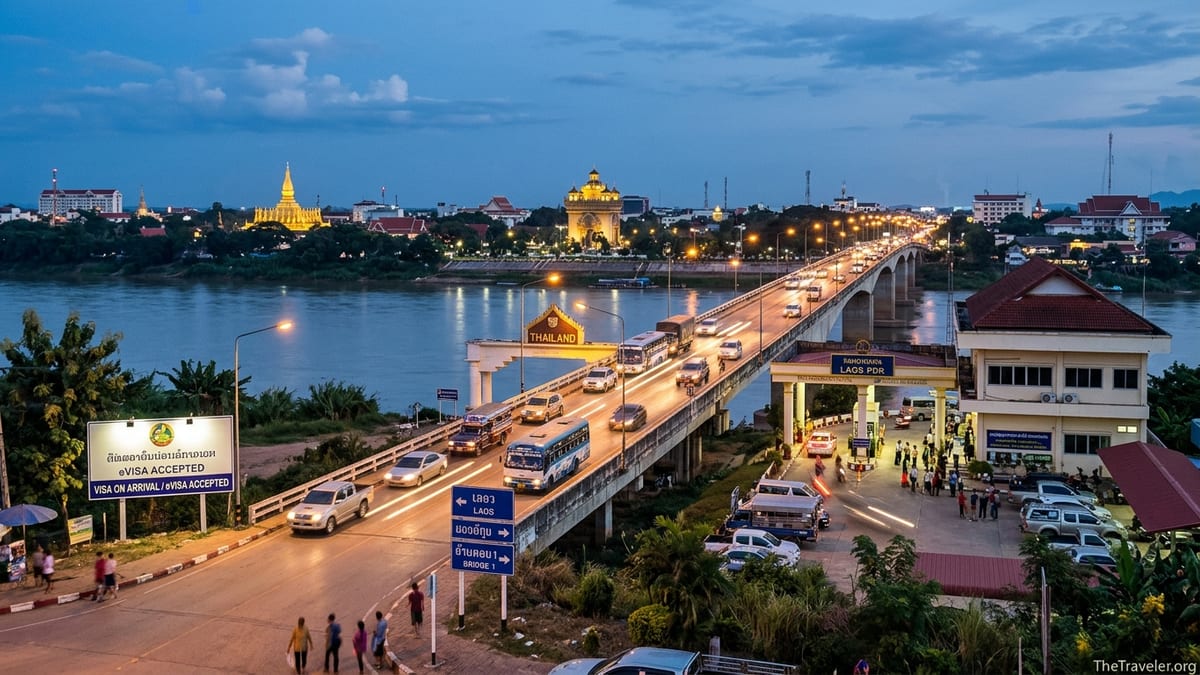
The busiest overland route into Laos is still the Thai–Lao Friendship Bridge I between Nong Khai in Thailand and Vientiane. From Nong Khai town or train station, local tuk-tuks and songthaews run to the Thai border, where you complete Thai exit formalities and board a shuttle bus that crosses the Mekong. On the Lao side, Visa on Arrival counters and eVisa desks sit just before the immigration booths. Queues peak mid-morning when tour buses from Bangkok and Udon Thani arrive. Travelers with printed eVisa approval letters often clear formalities noticeably faster than those filling forms on the spot, particularly around regional holidays such as Lao New Year in April or Thai long weekends.
Further north, the Chiang Khong–Huay Xai crossing at Friendship Bridge IV is a key gateway for the popular slow-boat route down the Mekong to Luang Prabang. Buses from Chiang Rai and Chiang Mai drop passengers at the Thai border, from where you take another bridge shuttle. On arrival in Huay Xai, Visa on Arrival counters and eVisa lanes service incoming tourists. Immigration here can be quiet in the early morning but fills quickly when tour groups heading for boat trips arrive. After clearing formalities, songthaews and minivans wait to take travelers into Huay Xai town or directly to slow-boat piers and bus terminals.
On the northern frontier with China, Boten International Checkpoint and Boten Railway Station serve road traffic and the cross-border Laos–China railway. The road checkpoint historically offered both Visa on Arrival and eVisa processing, but recent updates in 2026 indicate that Visa on Arrival facilities have been scaled back at the railway station itself, which now relies heavily on eVisa and prearranged visas. The rail border zone operates on fixed train timetables, so queues spike when China–Laos trains arrive from Mohan. Travelers who step off the train with approved eVisas, printed letters and completed arrival cards tend to pass more smoothly through the shared customs and immigration hall than those needing to navigate paper visa procedures against the clock.
On routes from Cambodia and Vietnam, border infrastructure is more basic and long-distance transport less frequent. The Veun Kham–Dom Kralor crossing between southern Laos and northern Cambodia is commonly used by travelers moving between Si Phan Don and destinations such as Kratie or Phnom Penh. Here, Visa on Arrival has historically been available on the Laos side, but travelers report more limited staffing after dark and on public holidays. On the Vietnamese frontier, crossings like Lao Bao–Dansavanh and Nam Phao–Cau Treo handle buses running between Hue or Vinh and Savannakhet or Vientiane. Visa on Arrival is generally available for eligible nationalities, but facilities for eVisa verification may be less developed than at the Thai bridges or Boten, so it remains essential to confirm which document you will rely on and to arrive during daylight hours if possible.
Stays longer than 30 days, passport rules and overstays
Whether you arrive on a Laos eVisa or a Visa on Arrival, the standard tourist stay is currently limited to 30 days from the date of entry. The UK and other foreign ministries noted that an earlier temporary extension to 60 days was rolled back, and tourist visas have once again reverted to 30-day stays. Travelers planning longer overland journeys through Laos must therefore either apply for extensions after arrival or structure their itinerary to exit and re-enter the country, bearing in mind that the eVisa is single entry and would require a fresh application.
Visa extensions are handled by immigration offices in major cities such as Vientiane, Luang Prabang and Pakse. Recent traveler reports, in line with earlier guidance, describe extension fees charged per additional day plus a fixed service fee. For example, an office might quote a per-day amount in Lao kip equivalent to roughly 1 US dollar, plus a processing fee equivalent to a few US dollars per extension. Exact figures fluctuate with exchange rates and inflation, so it is essential to check the current local fee schedule when you apply, but the total for a couple extending by one extra week is usually modest compared with the cost of new visas and international transport.
Your passport must be valid for at least six months beyond the date you plan to arrive in Laos. Travelers with less than six months validity may be denied boarding by airlines or refused entry at land borders, even if they hold a valid eVisa approval. For families, each child needs their own passport and, where applicable, their own visa or eVisa authorization. If you are traveling as a solo parent or with children who do not share your surname, carrying birth certificates or consent letters is prudent, particularly when crossing from neighboring countries that have their own child-travel regulations.
Overstays in Laos incur daily fines payable in Lao kip when you exit. Guidance and consular advisories warn that overstays of a few days usually result in a straightforward fine, while longer or deliberate overstays can lead to higher penalties, deportation and bans on re-entry. In late 2026, foreign travel advice notes that overstaying beyond an overall 90-day limit without proper extension risks fines equivalent to thousands of US dollars and removal from the country. Given these stakes, overlanders should track their permitted stay carefully, especially when planning multi-country trips that combine time in Thailand, Vietnam and Cambodia.
Cost examples for couples and families crossing key borders
To understand how fees and logistics add up, consider a US couple crossing from Nong Khai to Vientiane in January 2027. If they decide to rely on Visa on Arrival, they might each pay around 40 US dollars at the Lao border, assuming clean bills are accepted, plus perhaps 1 US dollar each in small service charges. The Thai shuttle bus to cross the Friendship Bridge costs a modest additional amount per person in Thai baht, and a shared tuk-tuk from the Lao side into central Vientiane may come to the equivalent of 5 to 10 US dollars, depending on bargaining and time of day. In total, the couple can expect border and immediate transfer costs in the region of 90 to 110 US dollars, excluding onward domestic travel.
The same couple using eVisas would pay the online visa fee and processing charge in advance, which in many cases is comparable to or slightly higher than the Visa on Arrival fee once card processing costs are factored in. However, they might save 20 to 30 minutes at the border by skipping Visa on Arrival queues, an advantage if they are aiming to catch an afternoon bus onward to Vang Vieng or Luang Prabang from Vientiane’s bus station. For some travelers, this time saving and certainty are worth a modest extra cost paid online before departure.
For a family of four traveling from Chiang Rai to Huay Xai for the two-day slow boat to Luang Prabang, Visa on Arrival fees alone might total roughly 160 US dollars if each parent and child pays around 40 US dollars. Add bridge shuttle tickets, a short minivan ride into Huay Xai and perhaps a tuk-tuk to the river pier, and the total cost from Thai departure point to Lao guesthouse can climb toward the equivalent of 190 to 210 US dollars. Families working with a tight budget may therefore choose cheaper guesthouses near the border for the first night and arrange shared transfers rather than private taxis.
On the China–Laos route, costs depend heavily on rail fares, which are set separately from immigration fees. A Chinese family arriving at Boten Railway Station from Kunming will have paid their train tickets in yuan, then present either eVisas or visas obtained in advance from a Lao consulate. If Visa on Arrival is not offered at the rail checkpoint on the day they arrive, travelers without eVisas could find themselves turned back to Mohan or facing complex detours to alternative crossings. In that scenario, the most predictable and cost-effective choice is to secure eVisas ahead of time, even if consular visas might be slightly cheaper for those living near a Lao embassy.
Choosing the right checkpoint, avoiding fraud and final recommendations
When choosing between eVisa, Visa on Arrival and visa-exempt entry, start with your nationality. ASEAN passport holders generally benefit from visa-free stays of 14 to 30 days and can prioritize the most convenient border for their route, such as Friendship Bridge I for Bangkok–Vientiane trips or Veun Kham–Dom Kralor when moving between Phnom Penh and southern Laos. US, UK, EU, Australian, Canadian, Chinese and Indian passport holders, who lack ordinary visa exemption, should then consider whether their planned checkpoint is on the official eVisa list and whether Visa on Arrival is reliably available there in the season and time of day they intend to cross.
In practical terms, eVisa is usually the safest choice for travelers entering at Wattay Airport, Luang Prabang Airport, Pakse Airport, Friendship Bridges I, II and IV, Boten International Checkpoint, Boten Railway Station and Khamsavath Railway Station. Visa on Arrival works well at heavily trafficked borders with clear procedures and multiple counters, especially from Thailand and Vietnam, but becomes more unpredictable at remote crossings that may suffer staff shortages or limited opening hours during national holidays. Overlanders who value flexibility and decide to rely on Visa on Arrival should carry spare photos, crisp US dollars in various denominations and at least one alternative plan in case the first-choice border is unexpectedly busy or temporarily closed.
To avoid fraud, always use the official Lao government eVisa portal when applying online and be wary of third-party sites that add untransparent “service fees” without clearly stating that they are not official. At land borders, expect modest service charges and shuttle bus tickets, but treat any unusually high “mandatory” payments, pressure to exchange money at unfavorable rates or offers to “speed up” processing for a private fee with healthy suspicion. Where possible, ask to see a printed fee notice or check recent traveler reports for your exact border crossing before you travel.
Before setting off, confirm three details for your specific itinerary: first, whether your nationality is visa-exempt or must use eVisa or Visa on Arrival; second, whether your chosen border supports your preferred option; and third, whether your passport and travel dates fall within the six-month validity and 30-day stay rules. With a printed eVisa approval letter or enough cash and time to obtain a Visa on Arrival, most overland journeys into Laos from Thailand, Vietnam, Cambodia and China remain straightforward and rewarding. Travelers who prepare for checkpoint differences, holiday crowds and potential extra charges will be well positioned to enjoy the landscapes and slow pace that draw visitors to Laos in the first place.
Last checked: 13 November 2026.