


Designing an Egypt trip around archaeology rather than general sightseeing means thinking in corridors, connections and pacing, not just ticking off famous monuments. Cairo’s necropolises, the great temple belt between Luxor and Aswan, and a handful of more remote sites all compete for your days. The art is deciding how far to stretch without turning your journey into a rushed sequence of transfers in extreme heat.
Get the latest updates straight to your inbox!
The Main Archaeological Corridors to Consider
Most archaeology-focused itineraries in Egypt orbit three main corridors. The first is Cairo and its surrounding necropolises: Giza, Saqqara and Dahshur. This is where you combine museum context with Old Kingdom and later tomb landscapes, and it is usually the intellectual starting point for understanding Pharaonic Egypt. The second corridor is the Upper Egypt stretch of the Nile between Luxor and Aswan, where the great monuments of Ancient Thebes cluster around Luxor and the major Nubian temples sit around Aswan and Philae. A third group of extensions includes Abu Simbel near the Sudanese border, the Greco-Roman and underwater remains of Alexandria, the early monastic and biblical landscape of the Saint Catherine Area in Sinai, and the fossil-rich desert basin of Wadi Al-Hitan.
All of these areas sit within recognized heritage frameworks, including multiple UNESCO World Heritage listings, which reinforces their global significance but does not make them equally practical for a first visit. For a one- or even two-week archaeology trip, the real trade-off is depth in the Cairo and Luxor–Aswan corridors versus the time and effort required for desert or Sinai detours. Reaching Wadi Al-Hitan, Saint Catherine or the remote oases typically adds full travel days that could otherwise be spent inside tombs and temples.
When planning, think of your route as a backbone of two or three primary hubs, with side trips radiating out as time allows. Cairo, Luxor and Aswan are the natural anchors: they have the airports, rail links and most Nile cruises. Abu Simbel, Alexandria, Wadi Al-Hitan and Sinai then become optional “appendices” that you might add only if you are extending beyond roughly 12 to 14 days or you are a repeat visitor with specific niche interests.
How Long to Stay: Itinerary Archetypes by Duration
For travelers with 7 to 8 days on the ground, a realistic archaeology-first itinerary usually means choosing two main hubs. A classic first-timer pattern is five nights split between Cairo and Luxor, with one or two nights buffered for flights and inevitable delays. That allows roughly two full days for Cairo’s museum and the Giza–Saqqara–Dahshur triangle, and two full days around Luxor to divide between the West Bank necropolises and key East Bank temples. Aswan, Abu Simbel and the more distant sites are harder to justify in such a short window unless you compress Cairo or skip Luxor’s second day, which most archaeology enthusiasts later regret.
With around 10 to 12 days, you can more comfortably link Cairo, Luxor and Aswan in a single north–south arc. One common pattern is three or four nights in Cairo, three in Luxor and two in Aswan, with an overnight transfer night or a 3-night Nile cruise bridging Luxor and Aswan. This opens space for Abu Simbel as a very early morning side trip from Aswan, and for an extra half-day among lesser-visited tombs on Luxor’s West Bank. Alexandria or Wadi Al-Hitan can be added as long day trips from Cairo, but including both usually leaves the Nile Valley feeling rushed.
Once you reach 14 days or more, you can slow the pace and consider genuine extensions. Some travelers spend a full week shuttling between the Cairo necropolises and specialist collections, then a week in Upper Egypt that might include a 4-night Nile cruise, nights in both Luxor and Aswan, and a side flight to Abu Simbel. At this length, a long-day or overnight to Alexandria becomes more reasonable, and repeat visitors can think about devoting two or three days to Wadi Al-Hitan’s fossil desert or to Sinai’s Saint Catherine Area for the blend of early Christian archaeology and high-mountain landscapes.
Domestic Transport: Flights, Trains and Cruises
Any archaeology itinerary in Egypt depends heavily on how you move between Cairo, Luxor and Aswan. As of late 2026, Cairo–Luxor and Cairo–Aswan are served by multiple airlines, including EgyptAir as the flag carrier and other Egyptian carriers that operate frequent domestic services. Typical non-stop flight times are around one hour between Cairo and Luxor and about 1 hour 20 to 30 minutes between Cairo and Aswan, with dozens of weekly departures on the Cairo–Aswan route alone according to recent route summaries. Actual frequencies on specific days and seasons vary, and schedules can change with little notice, so you should always verify times directly with your airline when booking.
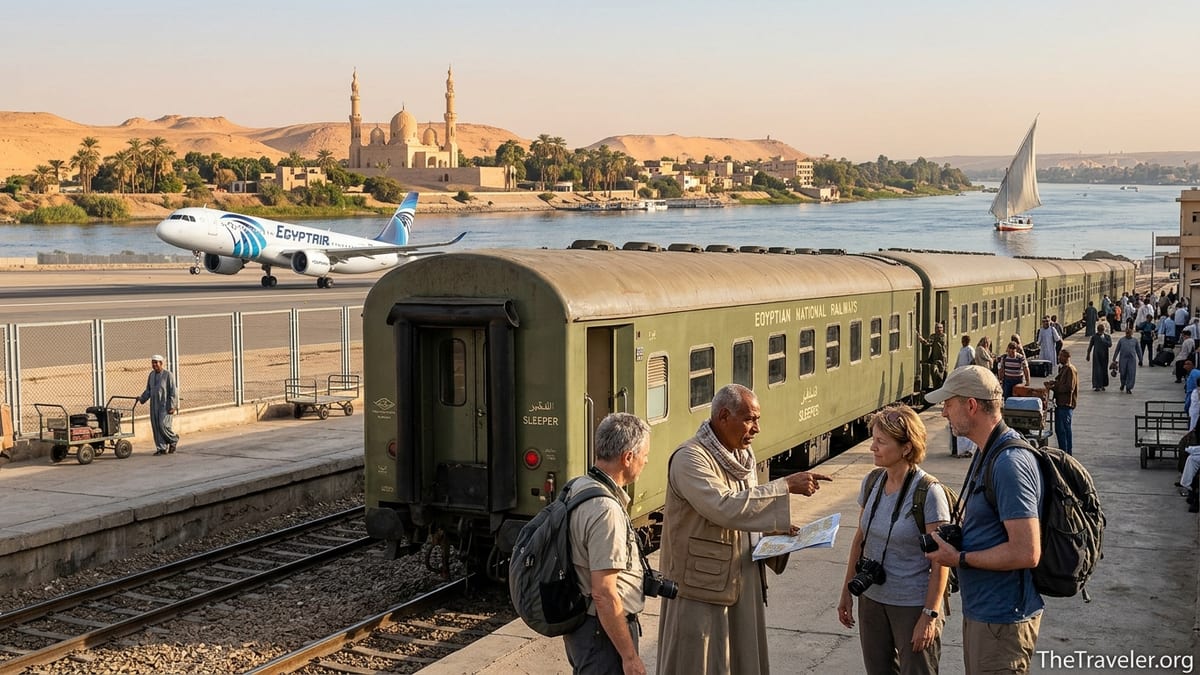
Along the Nile, trains remain the main overland alternative. Egyptian National Railways timetables and independent aggregators indicate that roughly thirty or more trains operate daily on the Cairo–Luxor corridor, with the fastest daytime services scheduled around 8 hours 40 minutes and slower ones taking 9 to 11 hours or more. There are also overnight trains, including seat-based air-conditioned services and separate private sleeper services sold through a concessionaire, which typically take 10 to 12 hours between Cairo and Luxor on sample 2026 schedules. Similar patterns apply on the Cairo–Aswan route, with longer overall journey times and a mix of daytime expresses and night trains. Timetables, rolling stock and booking rules change, so treat any specific departure time you see as illustrative rather than permanent.
Between Luxor and Aswan, travelers can use daytime trains or road transfers that generally take around three hours for the 200-kilometre stretch, traffic and checks permitting. However, most visitors focused on archaeology consider this stretch as the domain of the Nile cruise. Dozens of vessels operate 3-night Aswan–Luxor and 4-night Luxor–Aswan itineraries that effectively bundle transport, accommodation, guided temple visits and many meals. Cruise fact sheets published for the 2026–2027 seasons consistently highlight these 3- and 4-night patterns as the standard, with a minority of boats offering longer 7-night programs.
Choosing Between Flights, Trains and Nile Cruises
Flights are usually the most time-efficient way to connect Cairo with Luxor or Aswan. For a one-week or 10-day itinerary where every daylight hour among monuments counts, many travelers fly south on morning departures and back north on late afternoon or evening flights. The trade-off is reduced scenic experience and less flexibility if weather or operational issues delay or reschedule flights. It is wise to buffer at least part of a day in Cairo before any long-haul departure rather than counting on a same-day domestic–international connection, especially in peak seasons when airports are crowded and delays more likely.
Trains along the Nile are more atmospheric and, depending on class, can be cost-effective. Day trains let you see rural Upper Egypt sliding past, but they consume most of a day that could otherwise be spent at archaeological sites. Overnight trains recover some of that time by folding transport into sleep, though comfort and punctuality vary significantly by train type and operator. Safety and booking conditions on particular overnight routes have also evolved over the years, and occasional accidents make headlines, so anyone considering these services should check recent news and official railway announcements shortly before travel.
Nile cruises fall somewhere between a moving hotel and a curated archaeology program. On a typical 3- or 4-night itinerary, you sail the Luxor–Aswan stretch while stopping for key temple complexes, which reduces the need to arrange transport and guides piecemeal. The advantages include unpack-once convenience, predictable costs if many meals and site entries are bundled, and extended time on deck watching the river landscape, which many travelers describe as a highlight of their trip. The disadvantages are reduced flexibility in choosing exactly which tombs or minor sites to focus on, tightly scheduled group visits that can feel rushed at headline temples, and the need to commit to fixed embarkation days that can constrain how you structure the rest of your itinerary.
Seasonality, Heat and Crowds
Upper Egypt, where Luxor, Aswan and Abu Simbel are located, experiences extreme summer heat. From roughly May through September, daytime highs commonly rise well above 35 degrees Celsius, and exposed temple courtyards and tomb approaches can feel significantly hotter. In those months, archaeology-focused itineraries must be built around early mornings and late afternoons, often with a long rest in the middle of the day. If your time frame is fixed in high summer and you are particularly sensitive to heat, consider concentrating more days in Cairo and Alexandria, which can still be hot but usually slightly less intense than the south, and reducing the number of consecutive full days spent among Upper Egyptian temples.
Conversely, the most pleasant temperatures for intensive site visits usually fall between roughly late October and March, with January and February often busy despite cooler evenings. These months coincide with peak international tourism demand, particularly around late December and early January, as well as major religious and school holidays in key source markets. That combination typically tightens availability on domestic flights, popular Nile cruise departures and hotels in Luxor and Aswan. It can also mean heavier crowds at major sites such as the Giza Plateau, the Valley of the Kings and Abu Simbel’s temples.
For archaeology travelers, the implication is that seasonality shapes not just comfort but logistics. In the coolest, busiest months, pre-booking key domestic legs is highly advisable, especially any specific Nile cruise departure you have structured your itinerary around. In shoulder seasons, you may have more flexibility to adjust your route or add a day in Luxor or Aswan at short notice, but you should still avoid relying on last-seat availability on the exact train or flight you want.
Pacing Your Days Among Tombs and Temples
Immersive archaeology days are physically demanding in Egypt, even for fit travelers. Heat, dust, uneven surfaces and long stretches of standing and walking all add up. As a planning rule of thumb, many visitors find that two major complexes plus a smaller stop in a single day is about the upper limit before fatigue dulls the experience. Around Luxor, for example, a morning focusing on the Valley of the Kings followed by an early afternoon visit to Hatshepsut’s temple, and a short stop at the Colossi of Memnon, already makes for a full, rich day.
In Cairo, a balanced day might combine the key galleries of the main national museum you choose with an afternoon on the Giza Plateau, while leaving Saqqara and Dahshur for another early start. Trying to squeeze Giza, Saqqara and a full museum visit into a single day is technically possible, especially in winter, but often leaves little mental space to absorb what you are seeing. Likewise in Aswan and Abu Simbel, a pre-dawn departure for Abu Simbel and a full tour there can be exhausting; pairing it that same day with long museum or temple visits in Aswan itself is rarely enjoyable.
On cruises, much of the pacing is pre-determined by the ship’s schedule and the convoy of buses that fan out at each stop. If you know that you quickly tire in the heat, consider cruise options that emphasize fewer but deeper stops, or plan extra nights in Luxor or Aswan before or after your sailing so you can revisit key sites in a more leisurely way. Building one lighter day roughly every three days, even if that only means a late start and a single major temple, makes a notable difference on a 10- to 14-day archaeology trip.
Sample Route Logics: Where to Start and in What Order
Many travelers prefer to start in Cairo. Beginning in the capital allows you to acclimatize to Egypt’s rhythms, traffic and bargaining culture before diving into the denser clusters of temples in Upper Egypt. It also lets you set a chronological foundation by exploring the main national museum collections and the older pyramid fields of Giza, Saqqara and Dahshur, then carrying that framework south along the Nile. A typical flow is Cairo to Luxor to Aswan, with an optional onward excursion to Abu Simbel, followed by a flight back to Cairo for your international departure.
There are, however, good reasons to invert the sequence. Some long-haul schedules make it easier to connect directly onto a domestic flight to Luxor or Aswan on arrival, especially overnight flights arriving in Cairo early in the morning. Starting in Luxor can also reduce the psychological pressure to “understand everything” at the museum on day one; instead, you meet the monuments first and then see objects and sarcophagi in Cairo that feel more familiar. For certain travelers, ending in Cairo with a final flexible buffer day also adds peace of mind, allowing for contingencies if an earlier train or flight in Upper Egypt runs late.
Whatever the direction, it is usually wise to cluster similar experiences. Group your main necropolis days rather than interleaving them randomly with city sightseeing, and cluster museum or indoor days when extreme heat or rare rainy spells make outdoor visits difficult. Resist the temptation to insert every possible side trip: for most first-time archaeology-focused visitors, including both Abu Simbel and Alexandria in a 10-day route already creates a packed schedule, and more distant options such as Wadi Al-Hitan or Sinai are best reserved for longer or repeat trips.
Budgeting for Archaeology-Focused Travel
Archaeology-heavy itineraries in Egypt tend to accumulate more site entry costs than general beach or city trips. Each major complex, from the Giza Plateau and Saqqara to the Valley of the Kings, Karnak and Philae, charges its own entrance fee, and many offer separate supplemental tickets for special tombs, pyramids or photo permits. Over the span of a 10- to 14-day trip, this can amount to a substantial portion of your budget, so it is sensible to build a rough allowance for entrances and a handful of premium add-ons such as select royal tombs rather than deciding purely ad hoc once on site.
Guiding and tipping also feature more heavily in archaeology-centered travel. While it is possible to visit some sites independently, many travelers find that hiring licensed Egyptologists, either privately or through small-group tours, greatly enhances understanding, especially when visiting layered complexes such as Saqqara’s necropolis or Luxor’s West Bank. Guide rates vary by language, season and whether you book directly or through an agency, and tipping practices also shift over time. A reasonable approach is to factor guide fees and gratuities into your core trip budget, then confirm current customary ranges shortly before departure using up-to-date local advice rather than fixed figures quoted far in advance.
Transport and accommodation choices tie closely to cost. Domestic flights are typically more expensive than standard-class train tickets but can free entire days for site visits, which may be more valuable on shorter itineraries. Nile cruises span a wide range of price points, from basic large-ship cabins to intimate higher-end dahabiya sailings; listed per-night rates often include meals and some entry fees, but not always all of them, so scrutinize what is covered. Because fares, taxes and fuel surcharges change regularly, any specific price example you see in brochures or recent trip reports should be treated as indicative rather than guaranteed.
Matching Itinerary Complexity to Traveler Type
The right archaeological route through Egypt depends as much on who you are as on how many days you have. First-time visitors with a strong interest in ancient history but limited time are often best served by a relatively simple pattern: Cairo plus either Luxor alone or Luxor and Aswan linked by a short cruise or train ride. This keeps logistics manageable and minimizes the risk that missed connections or heat fatigue will disrupt your core goals of experiencing the key necropolises and temple complexes.
Families and mixed-interest groups, especially those traveling with children or older relatives, may want to prioritize fewer hotel changes and more pool or rest time between temple days. For them, a 4-night Nile cruise flanked by a couple of nights in Cairo at each end can provide a comfortable structure, with the ship handling most logistics and an on-board base to retreat to after each archaeological excursion. More niche side trips such as Wadi Al-Hitan’s fossil fields or long days in minor tombs might be better reserved for adults who are already engaged with the subject.
By contrast, repeat visitors or dedicated archaeology enthusiasts who relish long hours in tombs and ruins can embrace more complex routes. They might anchor in Cairo for specialized museum work, then spend extended time on Luxor’s West Bank exploring less-visited tombs, with targeted forays to Abu Simbel or the desert monasteries and fossil sites. Even for them, however, the same principles apply: confirm current train, flight and cruise operations at the time of booking; build in margins for delays; limit each day to a sustainable number of major sites; and remember that this article provides a planning framework, not a live timetable. Treat Egypt’s great archaeological corridors as canvases and your route as a considered line across them, shaped by season, stamina and curiosity above all else.