


Prague’s Václav Havel Airport has no direct metro or train line yet, so new arrivals often face a choice: use the special Airport Express (AE) bus straight to the main railway station, or save money by combining regular buses, trolleybuses and the metro. The best option depends on your schedule, luggage, and where in the city you are heading. This guide explains how the Airport Express works in 2025–2026, who it suits, and when you are usually better off with standard Prague public transport.
Get the latest updates straight to your inbox!
What the Airport Express Bus Actually Is
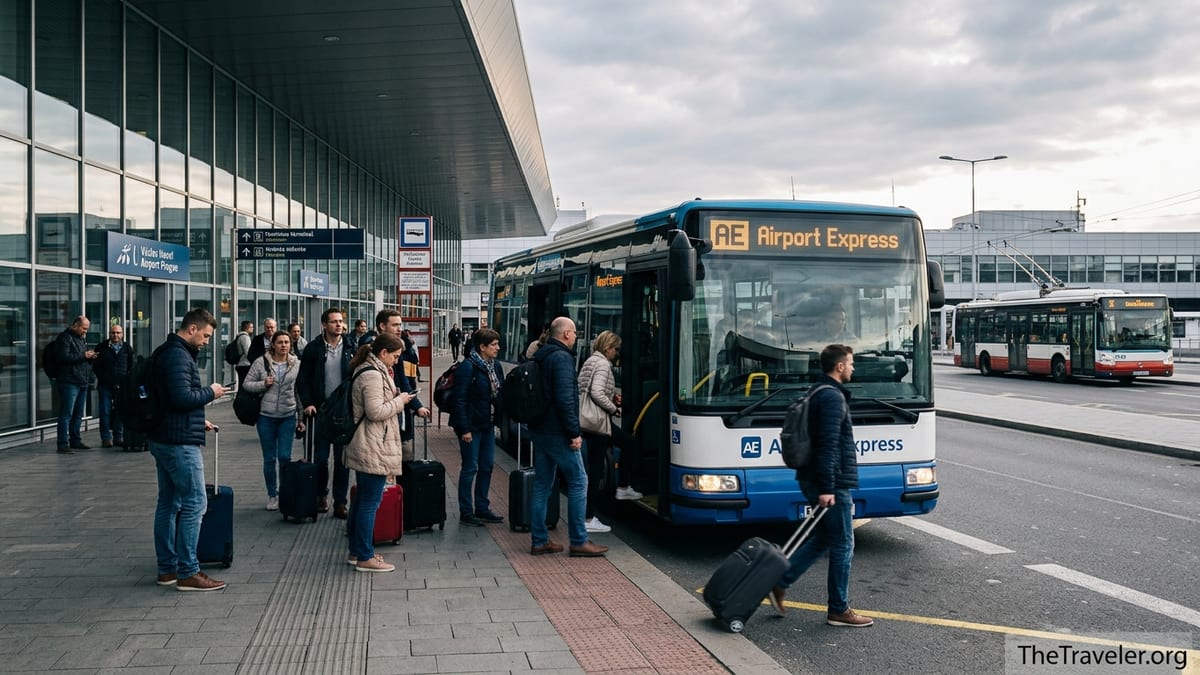
The Airport Express, usually marked simply as “AE,” is a special bus service linking Václav Havel Airport Prague with Praha hlavní nádraží, the city’s main railway station. It is operated under Czech Railways and Prague Integrated Transport but runs on its own special tariff, separate from regular trams, buses and metro. You will see AE buses waiting directly outside Terminals 1 and 2, and their only purpose is to connect the airport with the main station for both arriving and departing passengers.
The AE is designed to be a straightforward rail–air link. At the airport, stops are right in front of the terminal buildings. In the city, the bus stops at the upper level of Praha hlavní nádraží, near the historic entrance; from there you can take escalators or elevators down to the concourse, international and domestic trains, or to metro line C. For many travelers connecting to trains to cities like Brno, Dresden or Vienna, this simple one‑seat ride is its main appeal.
Unlike trolleybus line 59 or buses 100 and 191, the Airport Express is not treated as regular public transport. You cannot simply use a standard 40–90 minute PID ticket or a 24/72‑hour pass on board, and long‑term passes on a Lítačka card are not valid. That difference in tariff, and the higher price that comes with it, is the key trade‑off you need to understand before choosing the AE over other options.
In recent years Prague has also introduced trolleybus line 59 from the airport to Nádraží Veleslavín on metro line A, which effectively replaced the old bus 119. This means that the AE is now very much a niche service. It is convenient in some scenarios, particularly rail connections, but no longer the default choice for budget‑conscious visitors.
Route, Frequency, and Journey Time
The Airport Express runs directly between the airport and Praha hlavní nádraží with no intermediate stops. At the airport, buses serve both Terminal 1 (non‑Schengen) and Terminal 2 (Schengen). In the city, they terminate at the main railway station, usually signed as “Hlavní nádraží (Wilsonova)” on timetables. This direct routing avoids neighborhood detours and keeps the journey relatively predictable compared with some multi‑change routes.
Typical travel time is around 30 to 40 minutes, depending on traffic on the expressway and in the city center. In lighter traffic, early morning or late evening, the bus can be closer to the 30‑minute mark. At busy times, particularly weekday rush hours or on summer weekends when locals are leaving town, the same trip can take closer to 40 minutes. When deciding between the AE and a combination of trolleybus 59 plus metro, assume that total door‑to‑door times are broadly similar unless you hit heavy congestion on the surface.
The AE generally operates from early morning to late evening, with departures about every 20 to 30 minutes. For example, in a typical current timetable, the first buses leave Praha hlavní nádraží around 5:30–6:00 and the last ones near 22:30–23:00. From the airport in the evening, that means you can usually catch an AE bus until around 23:00. However, if you land on one of the last arrivals of the night or are heavily delayed, you may find that the AE has stopped running and will need to rely on regular night buses instead.
Because service times and intervals can shift slightly with timetable changes, it is wise to quickly check the live schedule in the PID Lítačka app or on Prague Integrated Transport’s journey planner on the day you travel. This is particularly important if you are trying to catch an evening train connection at Praha hlavní nádraží and cannot afford to miss a scheduled AE departure.
Tickets, Prices, and Where to Buy Them
The most important thing to understand about the Airport Express is that your regular Prague public transport ticket is not valid. Single PID tickets, 24‑ or 72‑hour tourist passes and long‑term passes on a Lítačka card all exclude the AE. You must buy a separate Airport Express ticket whenever you use this bus, even if you already hold a valid Prague travel pass for trams, metro and standard buses.
As of early 2026, a one‑way AE ticket for an adult from the airport to Praha hlavní nádraží costs roughly the equivalent of several standard 90‑minute tickets. In local currency that means you are spending in the low hundreds of Czech crowns for the AE, compared with around 40–50 CZK for a regular 90‑minute PID ticket covering routes like trolleybus 59 plus the metro. The exact AE fare has recently increased, which is one reason many travelers now opt for the cheaper trolleybus‑plus‑metro combination unless they specifically need the rail connection.
You can buy AE tickets directly from the driver in cash, usually in Czech crowns, and in many cases payment by card is possible, although this is not something to rely on absolutely if you are arriving late at night. At Praha hlavní nádraží, tickets for the AE are also sold at Czech Railways ticket counters and selected machines; if you are continuing by train, you can often buy a through train ticket that includes the AE segment, which simplifies your connection from the train straight to the airport.
To understand the real cost difference, consider a concrete example. A couple arriving from London could buy two AE tickets at the airport and pay around four to five times the price of two integrated 90‑minute PID tickets. Alternatively, they could purchase two standard 90‑minute tickets from a yellow PID machine in the arrivals hall, validate them at the bus stop, and take trolleybus 59 to Nádraží Veleslavín followed by metro line A to Muzeum or Můstek in the city center. Travel time would be similar, but the total cost much lower, and the same tickets would remain valid for local trams if they walk the last few stops to their hotel.
Luggage, Comfort, and Accessibility
One of the key selling points of the Airport Express is its suitability for travelers with luggage. AE buses are low‑floor, designed with extra luggage space, and boarding is at street level. If you are arriving with a large suitcase and a cabin bag after a long‑haul flight, being able to roll everything straight into a bus bay without stairs or tight corners can make a noticeable difference compared with a crowded regular city bus or metro.
Large luggage is generally expected on the AE and there is space set aside for it. On regular Prague public transport, especially in rush hour, big suitcases can feel awkward, and in some cases you may need to pay an additional luggage fare for very bulky items if you are using standard PID tickets. Recent Prague Integrated Transport rules allow some large luggage for free when you hold a 24‑hour or longer ticket, but this does not change the fact that the AE itself uses a special tariff. In practice, for a family with two or three big bags each, the AE often feels less stressful than maneuvering everything through metro escalators and crowded platforms.
Accessibility is another strength. Both airport stops and Praha hlavní nádraží have step‑free access. From the AE stop at the station, elevators can take you down to the main concourse, platforms and metro, which is essential for travelers with mobility issues, prams, or very heavy luggage. On alternatives such as trolleybus 59 or bus 100 plus the metro, stations like Nádraží Veleslavín and Zličín are generally accessible but may involve more walking between platforms and more vertical movements via escalators or lifts, which some travelers find tiring after a long flight.
That said, the AE shares city streets with regular traffic, so comfort also depends on the time of day. In peak hours you might experience stop‑and‑go driving and standing passengers, while late‑morning and late‑evening rides are usually calmer. If you are particularly sensitive to crowds but still want to save money, another option is to wait for a less busy trolleybus 59 or bus 100 and sit near the doors where moving luggage is easiest.
Who the Airport Express Suits Best
The Airport Express makes the most sense for travelers whose top priority is a simple, direct connection between the airport and Praha hlavní nádraží. This includes anyone catching or arriving on long‑distance or international trains. For example, if you are flying in to Prague and have a reserved seat on a RegioJet or EuroCity train to Brno, Vienna, or Berlin about two hours after landing, the AE gives you a predictable ride straight to the right station concourse without needing to navigate the metro system first.
It is also a good fit for visitors who are not price‑sensitive but want to minimize mental effort. Business travelers on expense accounts, older visitors who are nervous about ticket validation rules, or families arriving late in the evening after a long‑haul flight are often happy to pay the extra cost to avoid changing between trolleybus and metro with tired children and large bags. In those situations, the AE feels like a simple airport shuttle: walk out of baggage claim, follow “Airport Express” signs, buy a ticket from the driver, and ride it all the way to the main station.
Another typical use case is departing passengers whose hotel is near Praha hlavní nádraží or metro line C. A guest staying at a hotel a few minutes’ walk from the station can simply wheel their suitcase to the upper station entrance, board the AE, and arrive directly at Terminals 1 or 2 in around half an hour. The premium over regular public transport might be modest compared with the convenience of not changing at Nádraží Veleslavín or Zličín during the morning rush.
Finally, the AE can be useful if you are connecting between air and bus services that also use the main station area. While Praha Florenc is the principal long‑distance bus terminal, some domestic and international buses stop near the main railway station or at adjacent stops along Wilsonova street. If you have a heavy backpack and a fixed departure time, taking the AE rather than managing multiple local modes reduces the risk of confusion.
When Metro and Regular Buses Are the Better Choice
For many travelers, especially those heading to central Prague, regular public transport is both cheaper and often just as fast as the Airport Express. Trolleybus 59 connects the airport to Nádraží Veleslavín on metro line A, from which you can ride directly to stations like Malostranská for the Castle district, Staroměstská for Old Town, or Můstek and Muzeum for Wenceslas Square and the main shopping areas. With a single 90‑minute ticket costing a fraction of the AE fare, this option is particularly attractive if your hotel is near metro line A or line B, which you can reach with one cross‑platform change at Můstek.
Another efficient combo is bus 100 from the airport to Zličín on metro line B. This route suits travelers staying in Anděl, Nové Butovice, Smíchov or Karlín, all easily reached on line B. For example, a traveler whose apartment is a two‑minute walk from Anděl can buy a 90‑minute ticket at the airport, take bus 100 to Zličín, ride metro line B to Anděl, and still have time left on their ticket to jump on a tram if the final walk feels long. The entire journey typically takes 40 to 45 minutes in normal traffic and costs roughly the price of a single integrated ticket.
Regular buses and trolleybuses become the clear winners if you plan to buy a day or multi‑day pass. A 24‑hour PID ticket covers unlimited travel on metro, trams, city buses, the airport trolleybus 59 and urban sections of many trains. For a visitor staying in Prague for a couple of days, it often makes sense to buy such a pass immediately at the airport. You can then ride 59 or 100 into town, use trams and metro freely throughout your stay, and travel back to the airport the same way, all for less than the cost of a few AE rides.
Finally, regular public transport offers more flexibility if something goes wrong, such as a missed connection or a late‑night arrival when AE stops running. Night buses cover the airport after the metro closes, and while they are slower and less direct, they use the same tickets and passes. In practice, locals rarely take the AE; they rely on the integrated system instead. If you are comfortable reading basic route maps and can handle one or two changes, the metro‑plus‑bus solution is usually the smarter everyday choice.
Real‑World Itineraries: AE vs Metro & Bus
To see how this works in practice, consider an evening arrival from Paris at around 18:00. A solo traveler with one medium suitcase is staying in a guesthouse near Old Town Square. Option one is the Airport Express: buy a ticket from the driver, ride to Praha hlavní nádraží in about 35 minutes, then transfer to metro line C for one stop to Muzeum and line A to Staroměstská, or walk around 15–20 minutes through the city center from the station. Option two is to buy a 90‑minute PID ticket, take trolleybus 59 from the airport to Nádraží Veleslavín, then metro line A directly to Staroměstská. Total travel time is similar, but the integrated ticket costs far less and remains valid if the traveler chooses to take a tram closer to the hotel.
In a second example, a family of four is flying to Prague on a weekend and immediately catching a reserved train to Brno from Praha hlavní nádraží, departing 90 minutes after their scheduled landing time. Each person has one large suitcase. Here, time and simplicity are more critical than saving money. The family might walk directly to the AE stop, buy four AE tickets, and ride straight to the main station with no mode changes. Inside the station, they use elevators to reach their platform in just a few minutes. Taking trolleybus 59 plus the metro would be cheaper, but it would mean transferring with heavy luggage and watching the clock more anxiously.
Now imagine a budget traveler staying in Žižkov, near the Lipanská tram stop. They plan to use Prague’s trams extensively and are staying for three days. At the airport arrivals hall, they buy a 72‑hour PID ticket or a 24‑hour ticket followed by a longer pass, then board trolleybus 59 to the metro and continue to Hlavní nádraží on line C or Muzeum on line A, finishing with a short tram ride to Lipanská. The same pass covers all their local trips during the stay and the return journey to the airport. Choosing the AE would have added a special fare each way without improving the final door‑to‑door experience.
These examples highlight a simple rule of thumb: if your destination or origin is essentially “the main railway station itself,” the AE often makes sense. If not, the added cost usually buys you little time savings once you factor in transfers within the city. For most hotel locations in the historic center, Vinohrady, Smíchov or Karlín, the integrated combination of trolleybus 59 or bus 100 and the metro is either equally fast or just a few minutes slower while costing far less.
The Takeaway
The Airport Express bus is a useful but specialized tool in Prague’s transport toolbox rather than a universal airport shuttle. It is priced on a special tariff, separate from standard Prague tickets and passes, and is best thought of as a dedicated rail–air link to Praha hlavní nádraží. If you are catching or arriving on long‑distance trains, are traveling with heavy luggage, or simply value a very straightforward route between the airport and the main station, the AE can justify its higher cost.
For many visitors, especially those heading to hotels in the historic center or planning to use public transport extensively, the combination of trolleybus 59 or bus 100 with the metro is the smarter choice. Regular PID tickets and day passes are inexpensive, widely available from machines and apps, and cover almost all urban transport including the airport trolleybus. With a bit of advance planning and a basic understanding of the metro map, you can move between the airport and the city comfortably without paying the Airport Express premium.
When deciding, think about three factors: where you are going, how much luggage you have, and how confident you feel about transfers. If your journey effectively starts or ends at Praha hlavní nádraží itself and you are time‑pressed, the AE makes sense. If you are going anywhere else in the city and are willing to change once or twice, regular metro and bus combinations will typically be better value, and in many cases just as quick.
Whichever option you choose, Prague’s airport connections are safe, well signposted and comparatively affordable by European standards. Spending a few minutes at the airport to compare the AE with trolleybus 59 or bus 100 can easily save you the cost of a good meal in town while still getting you into the city in under an hour.
FAQ
Q1. Can I use a regular Prague public transport ticket on the Airport Express bus?
No. The Airport Express (AE) runs on a special tariff, so standard Prague tickets and passes, including day tickets and Lítačka passes, are not valid on this bus.
Q2. How much does the Airport Express cost compared with regular public transport?
An AE ticket costs several times more than a standard 90‑minute Prague ticket, which makes alternatives like trolleybus 59 plus the metro much cheaper for most journeys.
Q3. Where does the Airport Express stop in the city?
The AE runs directly between Václav Havel Airport and Praha hlavní nádraží, the main railway station. In the city it stops at the upper level of the station near the historic building.
Q4. How often does the Airport Express run?
The AE typically runs every 20 to 30 minutes from early morning until late evening. Exact times vary by day and season, so it is worth checking the current timetable.
Q5. Is the Airport Express faster than taking trolleybus 59 or bus 100 plus the metro?
In normal traffic, total travel time is often similar. The AE can be slightly quicker if you are going directly to the main station, but in heavy traffic it offers no time advantage.
Q6. When is it worth paying extra for the Airport Express?
The AE makes sense if you have a tight connection to a long‑distance or international train at Praha hlavní nádraží, or if you value a simple, direct route with heavy luggage.
Q7. What is the best option from the airport to Old Town or Wenceslas Square?
For most travelers, a regular 90‑minute ticket on trolleybus 59 to Nádraží Veleslavín plus metro line A to stations like Staroměstská or Můstek is cheaper and just as practical as the AE.
Q8. Is the Airport Express suitable for people with limited mobility?
Yes. AE buses are low‑floor and both the airport and Praha hlavní nádraží stops offer step‑free connections via elevators, which is helpful for passengers with reduced mobility or heavy luggage.
Q9. What should I do if my flight arrives after the last Airport Express departure?
If you land late at night after AE service ends, use regular night buses and, when available, late metro or tram connections. Standard Prague tickets and passes are valid on these services.
Q10. Do I need a separate ticket for my luggage on the Airport Express?
Large luggage is expected on the AE and typically does not require a separate ticket. On regular buses and the metro, some very large items may need a paid luggage fare, depending on your ticket type.