


Sri Lanka’s visa rules have changed several times in recent years, which leaves many visitors unsure what is free, what must be paid, and whether they can still obtain a visa on arrival. For 2027 trips in particular, it is essential to understand the current Electronic Travel Authorisation system, who qualifies for the new free 30 day tourist ETA, and the remaining fees for other nationalities before you book flights to Colombo or Mattala.
Get the latest updates straight to your inbox!
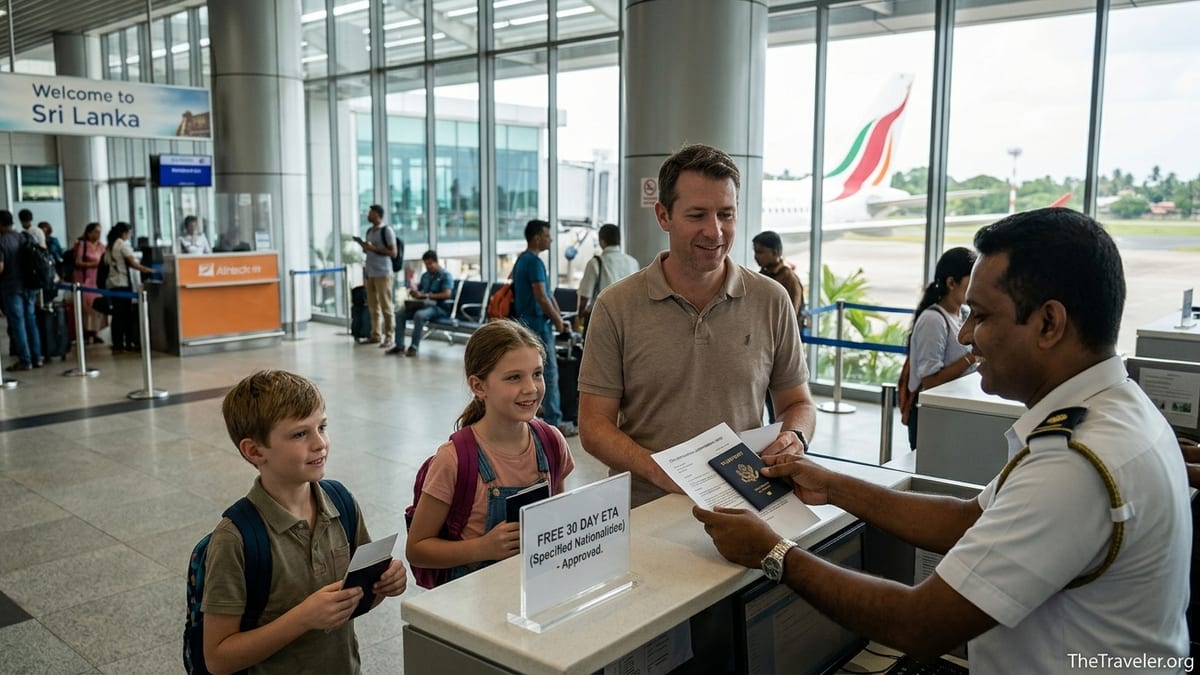
The May 25, 2026 free 30 day ETA and its status for 2027
On 25 May 2026 Sri Lanka introduced a significant policy change for short term tourists. Nationals of 40 specified countries, including the United States, United Kingdom, Canada, Australia, India and many European states, became eligible for a free 30 day tourist Electronic Travel Authorisation. This was confirmed both on the official ETA portal and in Department of Immigration notices, which describe a tourist ETA issued free of charge for stays up to 30 days for those passport holders.
As of mid November 2026, the official ETA site still presents this free 30 day ETA scheme as in force, and Sri Lankan embassies abroad continue to refer to it in their guidance for 2027 travel. There is no published end date or replacement scheme on official channels. For trip planning in early 2027, travelers can therefore work on the basis that the free tourist ETA for the 40 listed nationalities remains available, while still checking again shortly before travel in case of further changes.
It is critical to separate the idea of a “free visa” from arriving without paperwork. Even if there is no fee, the authorization itself is still mandatory. Official guidance repeats that all tourists, including those from the 40 free ETA countries and from Maldives, Seychelles and Singapore, must obtain an ETA before arrival. Airlines at boarding gates in London, New York or Melbourne normally check for this pre approved ETA alongside passports and onward tickets.
For example, a family of four from Chicago traveling on United States passports in March 2027 can expect to pay nothing for their 30 day tourist ETAs, but each adult must still fill out an online application on the official eta.gov.lk platform and receive an approval confirmation email. Turning up at Colombo Bandaranaike International Airport with no ETA because it is “free” risks denial of boarding by the airline or delays at immigration.
Who gets the free ETA and who still pays: nationality based structure
The list of 40 countries entitled to the free 30 day tourist ETA includes most major tourism source markets. Official materials and airline advisories name Australia, Austria, Bahrain, Belarus, Belgium, Canada, China, Czech Republic, Denmark, Finland, France, Germany, India, Indonesia, Iran, Israel, Italy, Japan, Kazakhstan, Kuwait, Malaysia, Netherlands, New Zealand, Norway, Oman, Poland, Qatar, Russia, Saudi Arabia, South Korea, Spain, Sweden, Switzerland, Thailand, Turkey, United Arab Emirates, United Kingdom and United States among the beneficiaries.
For these travelers, the ETA processing and visa fee for a 30 day tourist visit is waived when they apply through the official ETA website. They still receive a standard tourist ETA with double entry for up to 30 days in total. There is no additional discount for children on top of this, because the fee is already removed for the entire passport holding family.
Nationals outside the 40 country list remain subject to the fee schedule published by the Department of Immigration and, in some cases, to South Asian Association for Regional Cooperation (SAARC) concessionary rates. In previous fee tables, SAARC country passports such as those from Bangladesh or Nepal often attracted a lower tourist ETA price than non SAARC passports. After mid 2024 fee revisions, public documents indicated charges around 20 US dollars for SAARC tourists and around 50 US dollars for other nationalities for a 30 day tourist ETA applied online, with still higher prices if obtained on arrival. Although more recent notices focus on the new free ETA scheme and do not always restate the exact paid amounts, travelers from non listed countries should budget in this approximate range until they verify their precise fee on the official portal at the time of application.
An example illustrates the difference. A Brazilian couple planning a 14 day surf trip to Arugam Bay in July 2027 does not appear on the free 40 country list. When they check the online ETA system, they are likely to see a payable tourist ETA fee in the region of 50 US dollars per adult for a 30 day authorization. By contrast, two friends flying from Paris for the same trip would see a zero fee at the payment stage, because France is inside the 40 country group.
Special rules for Singapore, Seychelles and Maldives
Singapore, Seychelles and Maldives have long standing bilateral arrangements with Sri Lanka that set them apart in the visa schedule. Historically these three nationalities either enjoyed visa free entry for short visits or reduced fees for certain stay lengths. At the same time, policy documents and embassy advisories consistently emphasize that these travelers still use the ETA system to register their trip, even if a fee is not always collected.
At the time of writing, the official ETA information page explains that all foreign nationals except a small group of transit and diplomatic categories, including nationals of Maldives, Seychelles and Singapore, are required to obtain an ETA before arrival for tourism or business. That means a Maldivian family flying from Male to Colombo for shopping in April 2027 should still submit an online ETA application in advance, rather than assuming their bilateral relationship alone will cover entry.
Permitted stay durations for these three countries have shifted over time between 30 and 90 days for certain visit types. Recent practice indicates that tourists from Maldives, Seychelles and Singapore visiting on short holiday itineraries are treated similarly to other tourists with a 30 day stay on arrival, extendable on payment of fees. For instance, a Seychellois traveler flying in for two weeks of diving off Trincomalee would typically receive a 30 day entry stamp linked to their ETA and could extend in Colombo if they later decide to remain longer. Because these bilateral arrangements can change, travelers from these three countries should always check the ETA site and the nearest Sri Lankan mission for any longer stay entitlements or fee waivers current at their time of travel.
In practical terms, nationals of Singapore, Seychelles and Maldives should approach the process exactly like other tourists. They gather their passport, flight details and accommodation addresses, apply on the official portal, note any fee displayed for their nationality and intended stay, and travel with a printed or saved confirmation email, even if the payment section shows zero for a basic 30 day trip.
Understanding the 30 day tourist ETA, double entry and extensions
The standard tourist ETA is designed for short visits of up to 30 days and is usually issued as a double entry authorization. Official descriptions explain that the ETA is valid for 30 days from the date of first arrival and that the second entry is permitted only for the unused portion of that initial 30 day period. In other words, the ETA does not reset on the second entry.
A concrete example helps. A Canadian traveler arrives in Colombo on 1 February 2027 with a free tourist ETA, stays 20 days exploring Kandy and Ella, then departs to the Maldives on 21 February. They decide to return to Sri Lanka on 25 February for another beach week in Mirissa. On re entry they are granted only the remaining 10 days up to 2 March, even though the calendar gap between visits is longer. If they need longer in Sri Lanka, they must apply for an extension.
Extensions are handled inside Sri Lanka through the Department of Immigration, with online options increasingly available via the same government e services portal used for ETAs. Notices for tourists repeatedly state that those who wish to remain beyond 30 days may apply for an extension on payment of the applicable fee. Fees for extensions have varied over the last few years, but public documents around 2024 mention charges of roughly 35 US dollars for extension periods between 31 and 180 days, with higher amounts in some categories. By 2027 you should always confirm current extension pricing either on the ETA site or at the Department’s head office in Colombo before committing to a very long stay.
Travelers planning a two month Ayurvedic retreat or digital nomads intending to base themselves in Sri Lanka for a few months should factor an in country visit to the Department’s visa division into their plans. For instance, a German remote worker arriving in January 2027 could enter on the free 30 day ETA, then apply in Colombo for an extension to cover their full 90 day stay. Leaving the extension until very near the end of the first 30 days can cause anxiety, so it is advisable to apply well in advance.
How to apply: official ETA process step by step
The official ETA platform remains the central channel for tourist authorizations. Applications can be submitted directly through the government’s eta.gov.lk system or via Sri Lankan missions abroad, but the online route is the one most tourists use. To avoid confusion with commercial intermediaries, travelers should type the address carefully into their browser rather than following online advertisements that sometimes lead to third party sites.
Before starting the application, you should have your passport, travel dates, a provisional itinerary and a contact address in Sri Lanka. The passport must be valid for at least six months beyond your first day in the country, and it must have blank pages for entry and exit stamps. During the ETA form, you are asked to enter personal details exactly as shown on your passport, including full name, date and place of birth, nationality and passport number, together with the passport issue and expiry dates.
The form also requests your intended arrival date, point of entry, purpose of visit and the address of the first night’s accommodation. For tourists staying in multiple hotels, listing the first confirmed booking in Colombo, Negombo or wherever you land is sufficient. A working email address is essential, because ETA approvals and any queries are sent electronically. You should check your spam or junk folder after submitting, as travelers frequently report that confirmations can be filtered there.
Where a fee applies, payment is normally made by international credit or debit card during the final step. The system will display the applicable fee for your nationality and travel purpose before you commit. Once submitted, most straightforward tourist ETAs are approved within minutes to a few hours, although the Department advises applying at least several days before departure in case additional checks are required. You can verify your status on the ETA portal using your reference number if the email appears delayed.
Arrival procedures, airports and entry requirements
Most international visitors to Sri Lanka arrive at Colombo Bandaranaike International Airport, with a smaller number using Mattala Rajapaksa International Airport in the south or seaports linked to cruise itineraries. Regardless of entry point, immigration officers follow the same overall ETA based process. Airlines will usually check for an approved ETA before boarding, particularly at major hubs such as Dubai, Doha, London Heathrow or Singapore Changi.
On landing, passengers follow signs to immigration, where they present their passport and, if asked, a printout or digital copy of the ETA approval. Some travelers report that officers can see the ETA in their system without needing to see a copy, but having one available helps if there are technical glitches. At Colombo, the volume of arrivals can be high during peak season, so keeping documents ready speeds up processing.
Besides the ETA, immigration rules require evidence of an onward or return ticket, proof of accommodation and sufficient funds for the stay. For example, a British couple arriving for a 14 day tour with a return ticket to London, confirmed hotel vouchers for Sigiriya and the south coast, and access to the equivalent of at least a few hundred US dollars per person in bank cards or cash is likely to satisfy officers. Travelers who cannot show a booked exit from Sri Lanka may be refused boarding by airlines or questioned on arrival, particularly if they come from countries with higher overstay rates.
Procedural differences between Colombo and Mattala are generally minor and relate more to the scale of operations than to formal requirements. Mattala handles far fewer flights, so immigration queues are often shorter, but the same ETA approval and documentary checks apply. Cruise passengers entering at approved seaports will have their ETAs checked either on board or in terminal buildings, with port agents sometimes pre coordinating passenger lists with immigration in advance of arrival.
Costs for families and children: worked examples
Family pricing depends heavily on nationality and whether the family falls under the free 40 country group. Children have occasionally been exempt from ETA fees in earlier versions of the policy, but current guidance focuses on country based rather than age based waivers. Always check the official portal for updated statements on children’s fees before applying.
Consider a family of four from the United Kingdom planning a 21 day circuit in August 2027. Both parents and their two children aged 9 and 11 hold British passports, which are on the free ETA list. All four apply together using the group application option on the official site. At the payment stage the system shows a total of zero, and within a short time they receive four separate approval confirmations. Their ETA cost for the entire family is therefore zero, although they still had to complete the online process.
Now imagine a similar family of four from South Africa, which is not on the published list of 40 countries. The parents and two children intend to stay 10 days in Sri Lanka before flying on to the Maldives. When they apply for a tourist ETA, they see a payable fee displayed, which past fee tables suggest may be in the region of 50 US dollars per adult, with reduced or possibly equal charges for children depending on the latest policy. If the fee is 50 US dollars per person and applies equally to all passengers, their total ETA cost would be around 200 US dollars for a single 30 day authorization that covers their 10 day stay.
A mixed scenario also occurs. For instance, an Indian national married to a non free list spouse might find that their own ETA is free under the 40 country arrangement, while their partner’s passport attracts a charge. In that case, submitting two separate applications using the correct nationality settings avoids confusion, even if both travelers appear on the same flight booking into Colombo.
Errors, missing confirmations and avoiding commercial visa agents
Some tourists encounter problems such as payment errors, incomplete applications or missing confirmation emails. The official ETA portal allows users to check the status of an application using the reference number and passport details, which is valuable if an email never arrives. It is also common for mainstream email services to classify automated government messages as spam, so checking these folders is an important early step before assuming that the application has failed.
If you realize after approval that your passport has been renewed or its number has changed, you should submit a fresh ETA application with the new document details. Immigration officers link the ETA to the passport number used in the form, so arriving with a different passport can cause delays or refusal of boarding. For example, a traveler from Norway who receives a free ETA on an old passport that then expires should reapply after getting a new passport, even if they are still within the original ETA’s 30 day validity window.
The growth of commercial visa agent sites has created additional confusion. Many of these services use website addresses and page designs that resemble the official portal but charge significant service fees on top of the government’s own charges. Travelers on online forums frequently report being billed two or three times the official price, or paying a large fee for an application that could have been submitted free under the 40 country scheme.
Using a third party does not grant special priority or influence over the Department of Immigration. Government officers assess ETA applications according to the same criteria whether they arrive directly from the applicant or via an agent. Paying more to an intermediary cannot force a faster decision, override refusals or guarantee approval. The safest and most economical approach is to apply yourself through the official system, or if you need assistance, work with a reputable travel agent who simply guides you through the official form without adding unreasonably high surcharges.
Nationality specific fee overview, preparation checklist and key dates
Exact visa pricing is subject to periodic revision, so travelers should always confirm the amount shown on the ETA site on the day they apply. Nonetheless, the broad structure as Sri Lanka heads into 2027 can be summarized as follows. Nationals of 40 listed countries, including the United States, United Kingdom, Canada, Australia, India, much of the European Union, several Gulf Cooperation Council states and major Asian partners such as China, Japan and South Korea, receive a free 30 day double entry tourist ETA when applying online. Other nationalities typically pay around 20 US dollars under SAARC concessionary arrangements or about 50 US dollars for a standard 30 day tourist ETA if no special discount applies, with higher charges if they choose to obtain a visa on arrival instead of applying in advance.
For Singapore, Seychelles and Maldives, bilateral arrangements historically reduced or removed some fees, but current practice still expects an ETA application before travel and treats most short term holidays as 30 day stays that may be extended on payment of a fee. Longer stays, business visits and multiple extensions can attract higher or separate visa categories, so business travelers should always consult the detailed schedules on the immigration site or contact a Sri Lankan mission.
Before departure, every traveler should work through a simple preparation checklist. Confirm that your passport is valid for at least six months beyond your arrival date in Sri Lanka and that it contains blank pages. Apply for an ETA through the official portal several days or weeks before your flight, using a reliable email address and carefully checking spelling of your name and passport number. Keep copies of your approval, hotel or guesthouse bookings, onward or return tickets and evidence of sufficient funds, such as recent bank statements or international credit cards.
Finally, remember that Sri Lanka’s visa rules are reviewed regularly as the government balances tourism promotion with border control. This guide is based on official information available up to 13 November 2026 for travel planning into 2027. Before you fly, recheck the ETA portal and the website of the Department of Immigration and Emigration or the nearest Sri Lankan mission to confirm that the free 30 day ETA scheme and the fee levels for your nationality remain unchanged.