


Choosing between Hakuba and Nozawa Onsen is already a strong start for a first Japan ski trip. The next, more practical decision is where exactly to stay and what kind of lodging will keep your days simple rather than stressful. Both destinations offer excellent snow and plenty of charm, but their accommodation layouts and styles are quite different, which has a big impact on how your trip will feel.
Get the latest updates straight to your inbox!
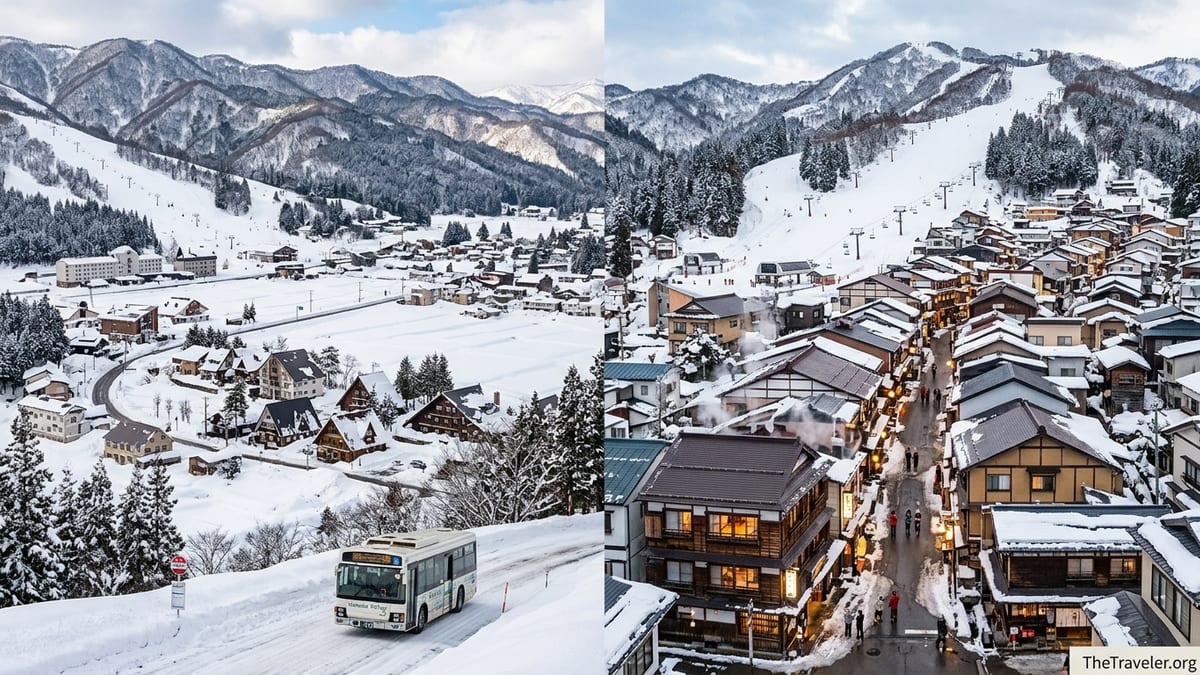
Hakuba vs Nozawa Onsen: How the Lodging Landscapes Differ
Hakuba is a long valley in Nagano with multiple ski areas and several distinct villages spread along the base, including Happo, Wadano, Echoland and Goryu. Official Hakuba Valley maps and recent accommodation guides show clusters of lodging around these base areas rather than one continuous town. Shuttle buses link the resorts, and the main Hakuba Happo Bus Terminal acts as a hub, especially for Happo One, Iwatake and Goryu. This means your choice of neighborhood decides how much you will rely on shuttles, how far you will walk in ski boots and how easy it is to find dinner.
Nozawa Onsen, by contrast, is a compact hot spring village built on the lower slopes of a single main ski area, Nozawa Onsen Snow Resort. Recent town and ski maps show a tight grid of streets rising uphill from the village center to the Nagasaka and Hikage base areas, with most pensions, ryokan and small hotels within walking distance of a lift or the Yu Road moving walkway. Public bathhouses are spread throughout the village, so onsen access is woven into daily life.
This article does not attempt to list every hotel or lodge. Instead it focuses on how the accommodation areas are laid out, the types of lodging you are likely to find and how to choose a base that minimizes stress on a first-time ski trip. Because shuttle routes, dining hubs and even what counts as “walkable” evolve, you should always confirm exact distances, winter bus timetables and current services at the time of booking.
Key Hakuba Areas for First-Time Skiers
For a first visit to Hakuba, most travelers end up choosing between three or four core areas that have been consistently described in recent seasons as practical bases: Happo, Wadano, Echoland and, for some families, Goryu. All sit near Hakuba Happo One or the Hakuba 47 and Goryu complex, which together offer extensive beginner and intermediate terrain. Current valley and shuttle maps show that most resort shuttle lines converge on the Happo Bus Terminal, so staying near Happo keeps transfers relatively simple.
Happo, sometimes called Happo Village or Happo One base, sits directly below Hakuba Happo One. Many lodgings here are within a 5 to 15 minute walk of lifts such as the Happo gondola or Nakiyama area, though the exact walk varies by property. The area has a dense cluster of restaurants, bars and rental shops around the bus terminal and main intersections, making it one of the two most convenient dining hubs in the valley. Accommodation ranges from small pensions and mid-range hotels to some serviced apartments. Noise levels can be moderate, especially near the main streets at night.
Wadano lies on the wooded slope above and beside Happo, between lift bases like Kokusai and Sakka. Official tourism descriptions and recent guides describe it as quieter and more forested than central Happo, with a mix of lodges, higher-end hotels and chalets. Many properties advertise a 5 to 10 minute walk to the nearest Happo lifts, though some guests still use the shuttle in ski boots, particularly families with children. Dining options in Wadano itself are more limited than in Happo or Echoland, so you may eat in-house more often or rely on short transfers for wider choice.
Echoland is a separate accommodation strip in the valley floor between Happo and Hakuba 47. Updated area guides repeatedly describe it as Hakuba’s main restaurant and bar district, with the highest concentration of evening options packed along its central street. The trade-off is that Echoland is not directly on a ski slope. Walking to the nearest Happo lifts typically takes 15 to 20 minutes or more, and most skiers rely on shuttle buses or private transfers each morning. Lodging types lean towards lodges, guesthouses, small hotels and a growing number of apartments aimed at groups. Nightlife can be lively and noisy in peak season, so light sleepers should confirm room location.
Goryu, at the southern end of the main village, sits beside the ABLE Hakuba Goryu resort, which connects on snow with Hakuba 47. Recent resort information confirms that Goryu continues to operate as a full base area with beginner-friendly slopes and its own restaurants at Escal Plaza, though the village itself is quieter at night than Happo or Echoland. Accommodation here includes lodges and small hotels, often a short walk to lifts, making it attractive for families who prioritize easy slope access and do not mind fewer standalone dining and bar options.
Hakuba: Walking Distances, Slopes and Everyday Convenience
In Hakuba, “walking distance” can mean very different things depending on the neighborhood and the exact property. In Happo and parts of Wadano, a 5 to 10 minute walk to the closest lift is realistic for many lodgings, but in snow and ice that can feel longer, especially for children or adults carrying gear. Footpaths are often cleared along main roads, yet side streets can remain packed snow. First-time visitors planning to walk should confirm both the stated distance and the elevation change between their accommodation and the lift base.
Echoland is a classic example of why shuttle details matter. While some energetic guests do walk from central Echoland to the lower Happo slopes, recent guidance from local operators suggests allowing 15 to 20 minutes or using the valley shuttles that run between Echoland stops and the resorts. Those buses are designed for skiers, with racks and monitored schedules, but routes and frequency can change year to year. Before booking, check that your intended lift is on a current shuttle line and note the walk from your lodging to the nearest stop.
For beginners, having easy access to gentle terrain reduces logistical stress. Happo One, Goryu and Iwatake all offer beginner-friendly slopes, and many ski schools operate from their main bases. Staying in Happo or Goryu generally gives the most straightforward access to these areas without multiple bus changes. Families often appreciate Goryu’s arrangement of base facilities clustered around Escal Plaza, while Happo’s central position makes it easier to sample different resorts on different days.
Restaurant density and noise differ sharply between areas. Echoland and Happo remain the main dining hubs, with a wide range of Japanese and international options. Wadano and Goryu are quieter after dark, with a smaller selection of local restaurants and more reliance on in-house dining. For a first-time trip, it can be helpful to think of Hakuba as a trade-off triangle between walking to lifts, walking to dinner and nighttime atmosphere, then picking the base that matches your priorities.
Nozawa Onsen: Compact Village and Slopeside Access
Nozawa Onsen’s village is compact and steep, wrapped around the base of Nozawa Onsen Snow Resort. Recent village and resort maps show two main base areas, Nagasaka and Hikage, above the town. Many lodgings line the narrow streets that climb from the lower village up towards these bases. Distances are typically short in pure meters, but gradients can be significant, and winter conditions mean that anything uphill with gear in hand feels harder than the map suggests.
Most first-time visitors stay in the central village grid, within a 5 to 15 minute walk of either the Nagasaka gondola or the Yu Road moving walkway. The Yu Road, a covered moving walkway roughly 300 meters long, connects the village to the Hikage base area and ski school zone. This infrastructure allows guests to stay in the atmospheric center near shops and onsen while avoiding the steepest on-foot climbs in ski boots. Slopeside and upper-village lodgings closer to Nagasaka naturally reduce morning travel but can sit on steeper streets.
Nozawa Onsen is famous for its network of public hot springs. Official town maps list a dozen or more free-entry communal bathhouses spread across the village, each with its own character. Many ryokan and minshuku are within a few minutes’ walk of at least one of these soto-yu baths, while some hotels and ryokan also have their own in-house onsen. For many travelers this setup is a key reason to choose Nozawa over a larger resort town, since an onsen visit becomes part of the daily routine before or after skiing.
Because the village is compact, dining and shopping are generally an easy walk from most accommodations. Streets can be narrow and icy, and cars share the space with pedestrians. First-time ski travelers should plan footwear and clothing for walking on packed snow every evening, and families with very young children or mobility concerns may find that slopeside properties or lodgings near the Yu Road reduce effort.
Lodging Types and Cultural Experience in Both Destinations
Hakuba and Nozawa Onsen share some lodging categories but present them quite differently. Hakuba’s valley structure and international visitor base have encouraged the development of a large stock of Western-style hotels, self-contained apartments and chalets, alongside Japanese pensions and a handful of ryokan. First-timers in Hakuba can expect a broad choice of ensuite rooms, Western beds and private bathrooms, especially in mid to upper-tier hotels and apartments in Happo, Echoland and Wadano. Many chalets are stand-alone houses with full kitchens and living spaces, well suited to families and groups who value privacy and self-catering.
Nozawa Onsen, by contrast, remains more traditionally Japanese in its lodging stock. Village maps and booking platforms show a predominance of family-run ryokan, minshuku and small pensions, many in wooden or low-rise concrete buildings. Tatami rooms with futon bedding are common, and bathrooms may be shared, especially in older or budget-oriented properties. Staying here often means following Japanese guest routines: taking off shoes at the entrance, bathing in a shared onsen or ofuro area before dinner and eating set-course meals at fixed times.
A ryokan stay typically includes half-board, with kaiseki-style or multi-course dinners and Japanese breakfasts served in the dining room or occasionally in the guest room. Minshuku operate more like homestays or simple inns, often with home-style meals and fewer amenities. In both Hakuba and Nozawa, some pensions and minshuku still bundle dinner and breakfast into the rate by default, especially in high season, which reduces evening restaurant hunting but locks you into the property’s schedule. Travelers who prefer to explore local restaurants should look specifically for bed-and-breakfast or room-only plans.
For visitors interested in cultural experience, Nozawa Onsen’s concentration of ryokan and easy access to public baths make it stand out. Hakuba offers Japanese-style stays too, but the overall feel is more of an international mountain town where English-language signage, Western dining and global ski culture are prominent. Choosing between them is partly a question of how much you want to lean into Japanese daily rhythms versus a more familiar alpine resort style.
Price Expectations, Booking Windows and Stay Requirements
Price levels vary by exact dates, room category and inclusions, but some consistent patterns emerge from current checks across major booking channels. Hakuba, especially in Happo, Wadano and prime chalets, generally offers a wider top end of pricing than Nozawa Onsen. Large modern chalets or luxury apartments with multiple bedrooms in Hakuba can command premium rates in January and February, particularly around New Year and other holiday weeks. Mid-range hotels and pensions in Happo and Echoland span a broad range, while quieter areas or station-side lodgings can offer comparatively lower nightly costs.
Nozawa Onsen’s accommodation is more skewed toward small to medium-sized establishments, and while there are upmarket ryokan, the overall feel at village level is a notch more modest than Hakuba’s priciest chalets. Half-board ryokan stays that include elaborate dinners may appear expensive at first glance, but when you factor in the cost of eating out in a ski town, they often provide good value. Budget-conscious travelers can look for simple minshuku or pensions with shared facilities a short walk from the lifts, which usually price lower than slopeside hotels.
Across both destinations, minimum-stay rules are common in peak winter, especially for January and early February and around Christmas to New Year. Many chalets and apartments in Hakuba require stays of five to seven nights in these periods, while smaller hotels may impose two or three night minimums. In Nozawa Onsen, ryokan and minshuku sometimes prefer multi-night bookings and can be reluctant to accept single-night stays in the busiest weeks. These policies are not universal, so you need to check each property’s current conditions at the time of booking.
For first-timers planning a high-season trip in January or February, starting accommodation searches six to nine months in advance is sensible, particularly for Hakuba’s most popular areas and Nozawa’s central village ryokan. New Year weeks and long weekends tied to domestic holidays typically sell out first. Flexibility with arrival day and willingness to consider neighboring areas within the same destination can open up more options at better value.
Language Support and Check-in Logistics
Language support and arrival logistics differ slightly between these two destinations and also across property types. In Hakuba, the long history of international ski tourism means that English-speaking staff are relatively common in mid-range and upmarket hotels, major rental shops and many chalets, especially in Happo, Echoland and Wadano. Budget lodges and more traditional Japanese inns may rely on basic English or translation apps, but overall communication tends to be manageable for English speakers, particularly around the main bus terminal and ski school areas.
Nozawa Onsen accommodates many foreign visitors as well, yet retains more of a Japanese village atmosphere. Larger hotels and several well-known ryokan advertise English-speaking staff, while smaller family-run minshuku may have limited English. Travelers who choose the latter should be prepared to rely on simple phrases, printed reservation details and translation tools. The flip side is a more intimate local experience, with hosts often living on-site and personally preparing meals.
Check-in times in both destinations usually fall in the mid-afternoon, often from around 3 pm, with check-out around 10 am. Many ryokan and minshuku emphasize punctual arrival, especially when dinners are included and served at fixed times such as 6 pm or 6:30 pm. Late check-in may be possible by advance arrangement, but it is not guaranteed, and arriving too late can mean missing the evening meal without a refund. Self-contained apartments and chalets in Hakuba sometimes use key codes or lockboxes, which give more flexibility for late arrivals, but snow conditions and limited evening transport still make it wise to arrive before nightfall whenever possible.
For both Hakuba and Nozawa Onsen, it is best to confirm in advance how you will reach the property from the nearest train or bus stop, especially if you are carrying large bags. Some accommodations provide scheduled pick-up services, while others expect guests to walk or use local taxis. Winter taxi availability can be stretched in peak periods, so knowing the walking distance and route, including any steep sections, will help avoid last-minute stress.
Which Destination and Area Suits Your Travel Style
Couples prioritizing atmosphere and onsen access often find Nozawa Onsen especially rewarding. A central-village ryokan or minshuku within a short walk of several public baths offers quiet streets, traditional rooms and the chance to build evening onsen visits into a daily ritual. Couples who prefer Western-style accommodation and a forested, quieter setting with on-site onsen might also consider Wadano in Hakuba, where several hotels and chalets sit among the trees yet remain reasonably close to lifts.
Families with young children usually benefit from minimizing morning logistics. In Hakuba, this often points toward staying in Happo or near the Goryu base, where beginner-friendly areas and ski schools are clustered close to accommodation and services. In Nozawa Onsen, families may appreciate lodgings either close to the Nagasaka gondola or near the Yu Road, which eases the climb to the Hikage beginner zone. In both destinations, confirm that your chosen property offers convenient access to rental shops, ski school meeting points and child-friendly meals.
Groups seeking nightlife and a wide choice of restaurants typically lean toward Echoland or central Happo in Hakuba. Echoland in particular is known for its concentration of bars and eateries in a compact strip, suiting groups willing to rely on shuttles for morning slope access. In Nozawa Onsen, nightlife exists but is lower key, with a handful of bars and izakaya scattered through the village; the focus is more on relaxed evenings after onsen rather than late-night partying.
Strict budget travelers have viable options in both destinations. In Hakuba, more affordable pensions and basic lodges can be found in and around Echoland, parts of Happo and areas closer to Hakuba Station, often trading slopeside convenience for price. In Nozawa Onsen, simple minshuku and older pensions with shared facilities can deliver good value, especially on midweek dates outside the absolute peak. For any budget stay, current reviews and maps are crucial for checking actual walking distances, winter shuttle access and the condition of shared facilities.
Ultimately, both Hakuba and Nozawa Onsen work very well for a first-time ski trip if you match your base area and lodging style to your expectations. Hakuba suits travelers who want resort choice, modern apartments and a lively international atmosphere spread across distinct neighborhoods. Nozawa Onsen suits those who prefer a single-resort focus, traditional village life and easy immersion in onsen culture. Once you have chosen your destination, use recent maps, shuttle timetables and booking information to verify distances, access and services for your specific property before you commit.