


More news on this day
American Airlines flights at Charlotte Douglas International Airport faced widespread delays and cancellations after a brief systemwide technology outage on Tuesday, disrupting one of the carrier’s busiest hubs and stranding travelers across the network.
Get the latest news straight to your inbox!
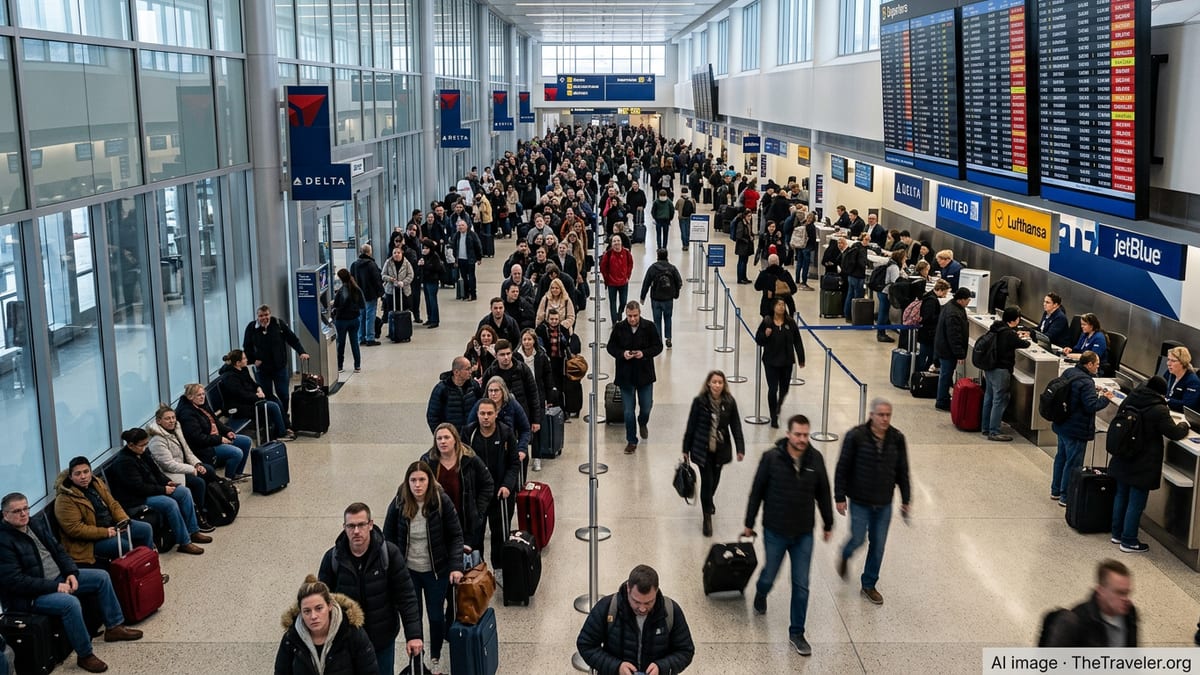
Disruptions ripple through a major American hub
The outage, reported on Tuesday, July 28, prompted ground stops and boarding halts at Charlotte Douglas International Airport as American’s check-in, gate and crew-management systems were affected. Passengers described being held on aircraft, deplaned back into the terminal or unable to complete basic transactions such as check-in and new bookings while systems were restored.
Charlotte Douglas functions as one of American’s largest domestic hubs, handling extensive connecting traffic across the eastern United States. When operations slowed, the impact spread quickly across the network as inbound aircraft were held, outbound departures were paused and flight crews timed out on duty limits while waiting for clearance to depart.
Published coverage and firsthand accounts point to a period in which flights at Charlotte were unable to push back from the gate, with some aircraft held on taxiways while crews waited for digital dispatch and maintenance sign-offs. Travelers connecting through Charlotte reported cascading delays as missed connections forced mass rebookings onto later flights and alternate routings across the network.
Even after the immediate outage window closed, Charlotte’s role as a high-volume connecting hub meant residual disruptions continued into the evening, with extended lines at customer-service counters and congested gate areas as passengers waited for seats on remaining services.
Ground stop, delays and cancellations across the network
According to publicly available information, the technology problem affected American’s operation systemwide, not only at Charlotte. Flights in multiple cities were reported on the ground awaiting updated clearances, while some customers attempting to book or modify travel online encountered failures and error messages.
At Charlotte, the system outage combined with afternoon and evening congestion to create a backlog of flights waiting for departure slots once limited functions came back online. Passengers on social platforms described seeing departure boards filled with “delayed” status messages, as well as scattered cancellations where rotations could not be reestablished in time.
When core systems were restored, reports indicate that operations at Charlotte resumed gradually rather than all at once. Aircraft that already had crews and completed boarding were among the first to depart, while flights requiring new crew assignments, aircraft swaps or complex connections often faced longer waits or cancellation.
The combination of a hub ground stop, missed connections and equipment being out of position translated into downstream disruptions across American’s route map. Travelers originating in smaller markets that rely on Charlotte for onward connections reported facing overnight stays, reroutes through other hubs or full cancellations when no seats remained.
Passengers face long waits and changing plans
Travelers at Charlotte described a familiar pattern seen in previous airline IT disruptions: terminals filling with passengers seeking information, rebooking options and hotel arrangements while systems were only partially available. For much of the outage window, self-service kiosks and mobile tools provided limited relief when they, too, were affected by the underlying technology issue.
As is common in hub-wide disruptions, those with tight connections were among the hardest hit. Reports from Charlotte indicated that travelers arriving from one delayed flight often missed their onward departure by minutes, only to find that later services were already full with other disrupted passengers. In some cases, travelers turned to rental cars or alternate airlines to complete regional journeys when same-day rebooking was not available.
Families traveling with children or pets, along with passengers heading to time-sensitive events, shared accounts of stressful waits and uncertain itineraries. With hotel availability near the airport tightening as the delay window extended, some travelers reported settling in for overnight stays on concourse seating while they waited for morning departures.
Travelers connecting through other American hubs reported similar scenes, though Charlotte’s status as a major connecting point in the Southeast meant its disruption was particularly visible. As operations improved, reports suggested that rebooking lines gradually shortened and more passengers were able to secure seats on later flights.
Technology outages highlight aviation’s digital dependence
The American Airlines outage at Charlotte comes amid a wider trend of technology incidents affecting global aviation, where a single software or systems failure can quickly cascade across tightly timed hub-and-spoke networks. Modern airline operations rely on complex digital tools for functions ranging from crew scheduling and aircraft dispatch to maintenance sign-off and passenger handling.
Recent years have seen several high-profile technology disruptions across the airline industry, including incidents tied to external software providers and internal system upgrades. These events have repeatedly underscored how dependent large carriers are on uninterrupted digital infrastructure to keep flights moving and connections intact.
Operational analysts note that hubs like Charlotte, which handle dense banks of arrivals and departures, are particularly vulnerable when technology goes offline, even for a short period. Once flights are delayed beyond their scheduled windows, the knock-on effects can persist for hours as crews reach duty limits, aircraft fall out of position and airspace capacity is reallocated.
While airlines have invested in backup systems, redundancy and more robust recovery playbooks, the latest outage shows that even brief interruptions can upend carefully constructed schedules. For travelers, this translates into an ongoing need to anticipate potential disruption, build longer connection buffers and maintain flexible plans when connecting through major hubs such as Charlotte.
What travelers through Charlotte should know now
Following the outage, published flight-tracking and airport information suggest that American’s operations at Charlotte have moved into a recovery phase, with many flights operating but some residual delays still possible as aircraft and crews are repositioned. Travelers with near-term itineraries through CLT are being encouraged by publicly available guidance to monitor their flight status frequently on official channels.
Travel experts often recommend that passengers affected by disruptions check in early, confirm that their contact details are up to date in airline profiles and use multiple channels, such as mobile apps, airport agents and phone support, to secure the best rebooking options. In major hub disruptions like the one seen at Charlotte, seats on alternative routings can disappear quickly once an outage becomes widely known.
For travelers yet to begin their journeys, flexible ticket options and travel insurance with disruption coverage may offer additional protection when itineraries depend on tight connections through a single hub. While systemic outages of this scale remain relatively rare, their impact can be severe for those caught mid-journey, particularly during peak travel periods.
As American works through the operational aftershocks of the latest outage, Charlotte’s experience highlights how a brief digital failure can quickly be felt in terminals and on taxiways far beyond a single airport. For passengers, the episode serves as another reminder that in an age of highly automated, precisely timed airline operations, a margin of flexibility remains an essential part of modern air travel.