


More news on this day
A rapidly intensifying Thanksgiving nor’easter along the U.S. East Coast has turned one of the year’s busiest travel days into a test of the region’s transport network, bringing widespread flooding, power outages, and significant flight, rail and road disruption on Thursday, November 26, 2026, and prompting New York City to postpone the 100th Macy’s Thanksgiving Day Parade to Saturday for the first time in its history.
Get the latest news straight to your inbox!
Storm track, impacts and scale of disruption
Forecasters had been tracking the coastal low since early in the holiday week, but the system deepened markedly as it moved from the Southeast toward the Mid Atlantic on Wednesday, November 25, before racing north along the Eastern Seaboard on Thanksgiving Day. The National Weather Service issued coastal flood warnings, wind advisories and storm warnings for much of the New Jersey and Delaware coasts and adjacent waters, with meteorologists highlighting the unusual strength and easterly angle of the winds driving water into bays and estuaries.
By Thursday afternoon, the storm was delivering bands of heavy rain, embedded thunderstorms and gusts generally in the 40 to 55 mile per hour range along exposed coastal areas from Virginia northward into New York and southern New England. Localized higher gusts were recorded along barrier islands and capes. These conditions coincided with high tides in several locations, contributing to significant coastal flooding in parts of southern New Jersey and the New York metropolitan area, including street flooding and stalled vehicles in low lying neighborhoods.
The combination of saturated ground and strong winds toppled trees and power lines across multiple states. Tracking site PowerOutage.us and federal briefings indicated that more than 900,000 customers nationwide were without electricity at times on Thursday, with outages heavily concentrated along the mid Atlantic and Northeast corridor as the coastal storm overlapped with a separate winter system affecting interior parts of the Midwest. Some hospitals, transit facilities and airports reported brief power interruptions but generally remained operational with backup supplies and priority restoration.
Hydrologists and emergency managers warned that, although the storm’s most intense conditions were expected to be relatively short lived, water levels on some tidal rivers and back bays could approach or exceed those seen during a damaging nor’easter earlier in autumn 2026. In response, local authorities closed or restricted access to particularly vulnerable parkways, causeways and coastal routes during peak high tide windows, further complicating road travel for holiday motorists.
Flight delays, cancellations and strain on major hubs
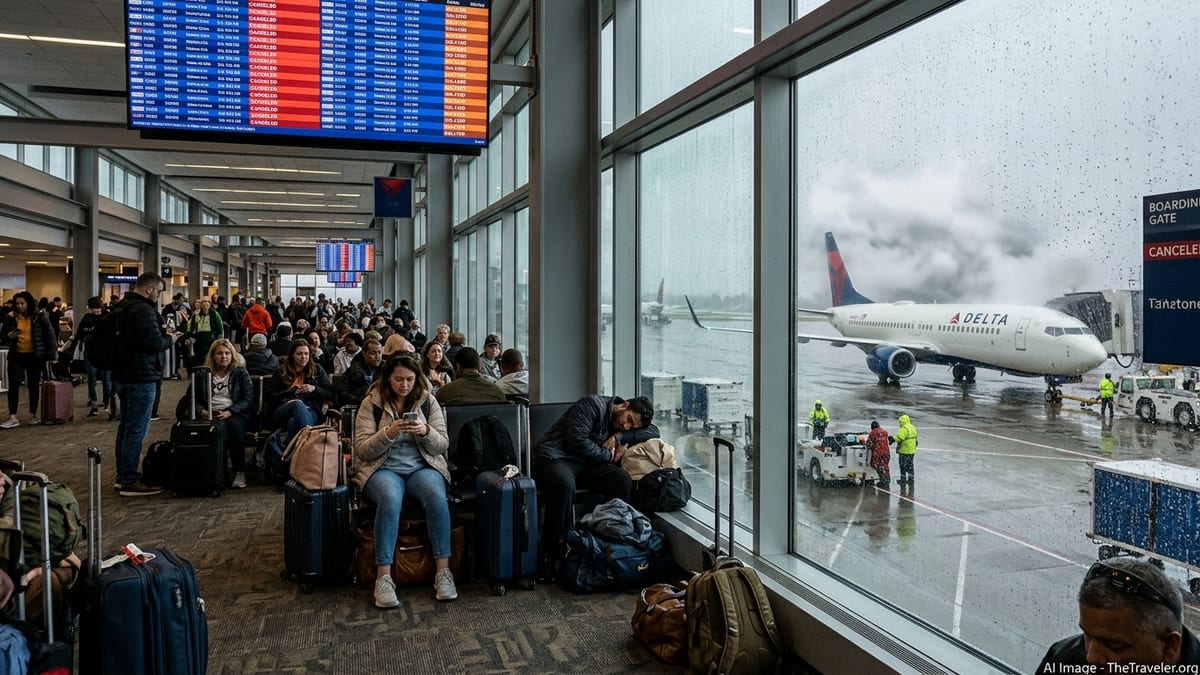
The nor’easter arrived at a time when airlines were already managing near record Thanksgiving passenger volumes. Data snapshots from flight tracking services on Thursday showed that, by mid to late afternoon Eastern time, more than 2,300 flights involving U.S. airports had been delayed and around 400 to 500 had been canceled, with disruption most pronounced at airports along the Interstate 95 corridor, including New York’s John F. Kennedy, LaGuardia and Newark, Boston Logan, Philadelphia, Washington National and Baltimore/Washington.
At these hubs, a mix of low clouds, heavy rain, wind shear and standing water on runways forced air traffic managers to implement spacing programs that reduced the hourly number of landings and takeoffs for safety. The Federal Aviation Administration issued temporary ground delays and, in some cases, ground stops, particularly for inbound traffic to the New York area when crosswinds or visibility fell below preferred thresholds. That, in turn, led airlines to proactively cancel some flights, especially shorter regional services, to keep congestion within manageable limits and preserve longer haul itineraries.
Because large U.S. carriers still run tightly interconnected hub and spoke networks, the East Coast bottlenecks quickly created knock on delays at inland airports far from the storm. Aircraft that were scheduled to operate multiple legs through the day arrived late into their next cities, and crews hit duty time limits designed to prevent fatigue. Even in parts of the country where skies were clear, passengers encountered late departures that could be traced back to weather difficulties along the Atlantic seaboard earlier in the schedule.
Operationally, airlines and airport authorities focused on safety measures that inevitably slowed the pace of ground handling. Ramp operations were periodically paused when lightning was reported in the vicinity or when gusts made it unsafe for ground staff to work near aircraft and equipment. Where temperatures at higher elevation airports dropped enough to support icing, de icing queues built up as the northern edge of the storm pulled colder air southward. Wet taxiways and the need for increased separation between aircraft added further minutes to each movement.
Rail, road and urban transport under pressure
The storm’s timing on a major U.S. holiday meant that rail networks and highways were also carrying unusually heavy loads when adverse conditions hit. On the busy Northeast Corridor, Amtrak and commuter rail operators announced advance plans to watch for coastal flooding on low lying segments near bays and rivers, particularly in New Jersey and along stretches of the Connecticut shoreline. As water levels rose on Thursday, some routes faced speed restrictions to reduce the risk of spray affecting electrical systems, and passengers were advised to expect longer than normal journey times as dispatchers threaded trains through congested sections at reduced speeds.
Urban transit systems around New York City and other regional centers encountered scattered flooding and debris issues. Local agencies reported water entering some subway and commuter rail stations in low lying districts, along with service changes where downed trees blocked tracks on outlying branches. While there were no reports of large scale, systemwide shutdowns attributable solely to the nor’easter, the disruptions added uncertainty for travelers attempting to connect between long distance trains, airports and city centers.
Road travel was hampered throughout the day by poor visibility, ponding on highways and localized flash flooding. State transportation departments and highway patrols in coastal mid Atlantic and Northeast states repeatedly urged drivers not to attempt to cross flooded underpasses or coastal roads where waves and surge were overtopping barriers. Some bridges, including selected spans in coastal New Jersey and along exposed causeways, saw temporary closures or restrictions for high profile vehicles during peak wind periods. For motorists trying to reach or depart from airports, these interventions sometimes proved more disruptive than the conditions within the terminals themselves.
Trucking regulators and permit offices in several states had already introduced holiday travel restrictions on oversize loads, and these remained in force or were tightened where the storm’s worst impacts were expected. That helped reduce the number of slow moving vehicles on key interstates at a time when both weather and passenger traffic were putting the network under strain, but also meant that time sensitive freight faced its own delays north and south along the coast.
Macy’s parade postponement and implications for visitors
One of the most visible cultural consequences of the storm has been the unprecedented decision to postpone the 100th Macy’s Thanksgiving Day Parade from Thursday, November 26, to Saturday, November 28, 2026. New York City officials announced the move on Wednesday evening after consulting meteorologists and safety experts, citing forecasts of potentially dangerous wind gusts and heavy rain along the parade route during the original time slot. Macy’s, the city and broadcast partner NBC agreed that rescheduling was preferable to attempting to scale back or conduct the event under marginal safety conditions.
It is the first time in the parade’s century long history that weather has forced a postponement to a different day. The event did not take place at all during several years in the 1940s because of World War II, but had previously proceeded on Thanksgiving Day itself even in challenging weather, with balloon heights sometimes reduced or flights canceled when winds were borderline. This year, organizers opted instead to shift the entire spectacle to Saturday morning, with a planned start time of 8:30 a.m. Eastern, in hopes of taking advantage of calmer, drier conditions behind the departing nor’easter.
For the tourism economy, the last minute calendar change has created a complicated logistical puzzle. Hotel operators in Midtown and other visitor heavy neighborhoods have reported guests attempting to extend stays by one or two nights so that children and families can still see the parade in person. Airlines serving the New York area have had to field additional change requests from passengers wishing to push back return flights to accommodate the revised schedule, compounding the rebooking workload already generated by weather related cancellations. At the same time, some travelers with fixed itineraries will now leave the city without experiencing the centennial parade they had planned their trip around.
Macy’s has said publicly that it is working with performers, marching bands and balloon teams to rebuild the lineup for Saturday, recognizing that not every out of town school band or guest star will be able to adjust. While many elements of the parade are expected to go ahead broadly as originally announced, visitors who intend to attend in person or watch the live broadcast have been encouraged to check for updated schedules as the weekend approaches, particularly for specific performances and appearances that may shift or be dropped depending on travel logistics and artist availability.
How this Thanksgiving travel week compares and what travelers should do next
This year’s nor’easter struck during what was already shaping up to be another extremely busy Thanksgiving travel period for U.S. aviation and intercity transport. Early Transportation Security Administration figures through midweek indicated that passenger screening volumes from Tuesday, November 24, onward were broadly in line with or slightly below record counts from 2025, pointing to crowded airports and high load factors on flights even before the storm disrupted operations. In practical terms, that means airlines have relatively few empty seats with which to reaccommodate displaced travelers when weather forces cancellations.
In the days leading up to Thanksgiving, several large U.S. carriers had also acknowledged isolated technology issues affecting reservation or dispatch systems, with some reporting brief outages and delays as software was restored. While those glitches had generally been resolved by Wednesday, they reduced operational buffers just before the arrival of disruptive weather. Industry data and federal statistics show that, in such peak periods, severe weather, airline controlled causes and late arriving aircraft interact to amplify knock on delays across networks more quickly than in quieter seasons.
Looking ahead, meteorological guidance and official briefings suggest that the nor’easter will continue to move northeastward into Atlantic Canada through Thursday night and Friday, with rain and wind gradually easing across the mid Atlantic and Northeast. However, lingering showers, elevated river levels and residual coastal flooding may persist into Friday, November 27, in some areas, and it will take time for airlines and rail operators to return equipment and staff to normal positions. Travelers booked on early morning departures on Friday and Saturday should be prepared for continued delays if aircraft arrive late from prior segments or if crew rest rules require substitutions.
Passengers whose flights are canceled or significantly delayed during the storm period are being offered varying degrees of flexibility depending on the airline and fare type. Major U.S. carriers have issued weather waivers for many affected East Coast airports, typically allowing one change to a later date within a defined window without change fees, and in some cases without a fare difference if rebooked in the same cabin. Where flights are canceled outright, customers are generally entitled to a refund if they choose not to travel, although same day alternative flights may be scarce until after the weekend peak has passed.
For travelers still planning to move over the remainder of the holiday period, the most practical steps involve relying on airline and rail operator apps or text alerts for gate and schedule updates, verifying whether a weather waiver applies before making changes, and allowing more time than usual for journeys to and from airports and stations, especially where localized flooding or debris may linger on access roads. Those hoping to attend the rescheduled Macy’s parade on Saturday should pay attention to the latest city advisories on street closures and arrival times, and consider that any new minor weather disturbances could still have outsized effects on already stretched transport systems while aircraft and crews are being repositioned.