


More news on this day
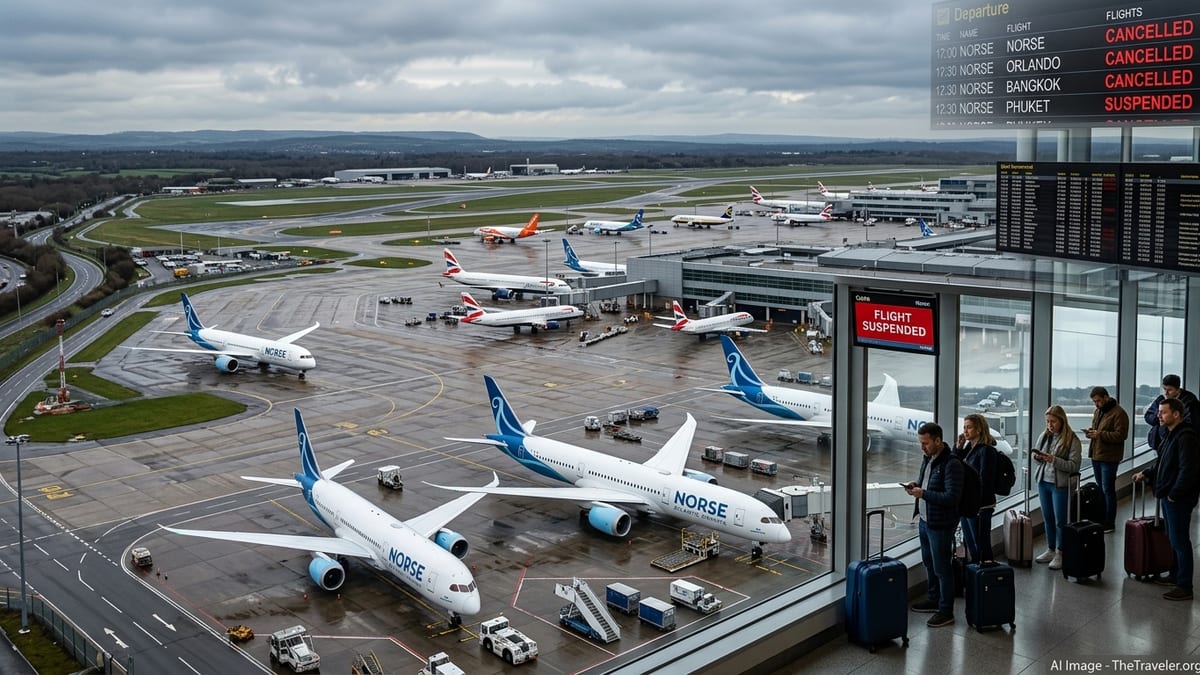
Long-haul budget airline Norse Atlantic Airways has suspended all flights as of Thursday 26 November 2026 while it seeks emergency financing, disrupting multiple routes from London Gatwick and raising the risk of a bankruptcy filing if new funding cannot be secured.
Get the latest news straight to your inbox!
What Norse Atlantic has suspended and when
Norse Atlantic Airways confirmed on the morning of 26 November 2026 that it had suspended all flights scheduled for the day while it tries to agree what it calls a viable financing solution. The pause affects the entire network, not just services at London Gatwick, although Gatwick is one of the airline’s key long-haul bases. In notices to investors and public statements, the airline has warned that without urgent short-term funding it expects to file for bankruptcy, and its shares slumped after it described its financial position as critical on 25 November.
The carrier’s wording specifies that all of today’s flights are suspended rather than explicitly cancelling future dates. However, industry briefings and consumer-rights advisories have made clear that the airline’s ability to resume operations remains uncertain and depends entirely on securing new capital. As of the afternoon of 26 November, there had been no confirmed restart schedule, and flight-tracking and airport information screens showed Norse services as cancelled or unavailable for booking over the short term on routes that had been active this autumn.
Norse operates as a long-haul low-cost airline using Boeing 787 aircraft, with operations split between its Norwegian parent and a UK unit, Norse Atlantic UK, which is based at Gatwick. The current suspension applies to flights marketed and operated across the Norse Atlantic group, meaning that passengers ticketed on both UK- and Norway-registered aircraft are affected. The company has not announced any formal cessation of trading, administration filing or liquidation so far, but its repeated references to the possibility of bankruptcy underline that this is more than a routine operational hiccup.
Impact on London Gatwick and affected destinations
For Gatwick, the immediate effect is the grounding of Norse’s long-haul routes that were operating from the South Terminal. These have included services to Orlando in Florida, Bangkok and Phuket in Thailand and Cape Town in South Africa. Flight listings for 26 November show Gatwick departures and arrivals for Norse, including the Gatwick–Orlando rotation, as cancelled, and the airport has advised passengers with Norse bookings to check directly with the airline or their travel provider rather than travelling to the airport with unconfirmed flights.
In the UK–US market, the key exposure is the Orlando to London Gatwick route, which recent schedule data indicates was Norse’s only active United States service at the time of the suspension. That leaves leisure travellers and families heading to or from central Florida particularly affected, especially at the start of the peak winter holiday period when alternative non-stop seats can be hard to find at short notice. Other carriers do link Orlando with the UK, primarily to London Heathrow and Manchester, but capacity on Gatwick–Orlando specifically was significantly reliant on Norse’s presence after previous long-haul budget competitors retrenched.
On the Gatwick–Asia and Gatwick–Africa sectors, the suspended Norse routes had added seasonal capacity rather than providing the only link to those cities. Bangkok, Phuket and Cape Town all retain service from other airlines, either from Gatwick or via Heathrow, but passengers booked on Norse now face rerouting, new bookings or itinerary changes, often at higher last-minute fares. The disruption will also be felt at Manchester Airport, where Norse had planned a seasonal long-haul service to Bangkok for mid-December that is now in doubt unless the airline’s finances are stabilised in the coming days.
Financial crisis and what is known so far
Norse’s suspension of operations follows a sharp deterioration in its financial outlook that the company itself has described in stark terms. On Wednesday 25 November it told investors that its financial situation was critical and that it required fresh funding to continue trading through the winter season. Its stock then dropped heavily, with local market reports citing a fall of more than 80 percent in the share price by the close of that day’s trading. The next morning it followed up with a formal notice that all flights scheduled for Thursday 26 November were suspended while it attempts to agree short-term financing.
The airline’s public statements state that it is exploring options for new capital but do not set a deadline for securing this or clarify whether any binding offers exist. Travel-industry analysis notes that Norse had been operating a relatively small long-haul network compared with established legacy carriers, focusing on price-sensitive leisure routes that are highly exposed to seasonal demand swings and fuel and financing costs. In its most recent updates before the crisis, the airline had signalled that it was already trimming its network and seeking partnerships to improve its load factors and revenues.
There has been no official confirmation yet of a formal insolvency process such as administration or liquidation, and regulators have not announced any suspension of Norse’s operating licences. At this point, the key confirmed fact is the blanket suspension of the day’s flights alongside the airline’s explicit warning that it may file for bankruptcy if a funding deal does not materialise. Until either a restructuring plan, a rescue investor or an insolvency filing is announced, the situation remains fluid, and both passengers and airports are planning on the basis that a near-term restart cannot be assumed.
What stranded and future Gatwick passengers can do
Travellers who were due to fly on 26 November are the first group directly hit by the suspension. Consumer-rights specialists advise that those who booked directly with Norse and paid by credit card should keep all documentation, including booking confirmations and evidence of cancellation, as they may need to pursue chargebacks or claims under card-protection rules if the airline formally becomes insolvent. If a rescue package is agreed and flights resume, the airline could choose to rebook affected passengers, but at present there is no confirmed policy beyond the general suspension announcement.
Passengers who bought Norse flights as part of a package holiday from a UK-based tour operator may have stronger protection under package-travel regulations and, where applicable, the UK’s Air Travel Organiser’s Licence scheme. In those cases, the tour operator is typically responsible for providing alternative transport or refunds if the airline element of a package fails. Travellers in this position should contact their tour company as the primary point of reference rather than Norse itself or Gatwick Airport, which is not a contracting party to their booking.
Future passengers booked on Norse flights after 26 November face a more ambiguous situation. The airline has not formally cancelled all future services but has acknowledged that without new financing it does not expect to be able to continue operations. Industry advisories are therefore recommending that travellers with upcoming Norse tickets do not rely solely on their original booking. Instead, they are encouraged to monitor official announcements closely and consider arranging backup travel on other airlines, particularly on busy leisure routes from Gatwick where alternative non-stop options are limited and fares can rise quickly as seats sell out.
Your rights from the UK and what to check next
For flights departing from the UK, including all Norse services out of Gatwick, passengers’ minimum entitlements are set by UK passenger-rights rules often referred to as UK261. When a flight is cancelled for reasons within an airline’s control, such as its own financial difficulties, travellers are normally entitled to a refund of the unused ticket and, in many cases, compensation if the cancellation occurs less than 14 days before departure. However, if Norse enters formal insolvency, claiming those rights in practice may become more complex and may depend on whether any successor entity assumes liability for existing tickets.
Travel insurance can play an important role in this scenario, but cover for airline insolvency varies considerably between policies. Some policies include scheduled airline failure or end-supplier failure as standard, while others treat it as an optional extra or exclude it altogether. Passengers affected by the Norse suspension should review their policy wording carefully and, if necessary, contact their insurer to check whether they can claim for replacement flights, accommodation costs or lost elements of a trip that depended on the cancelled flights. Where cover exists, insurers will typically require evidence of the cancelled booking and proof that the airline is unable to provide the service purchased.
Looking ahead from Gatwick, the next key developments will be any formal statement from Norse about either new financing or a bankruptcy filing, and any subsequent updates from the airport or package providers on replacement capacity. Until that happens, the practical steps for travellers remain the same: check the status of any Norse booking before leaving for the airport, avoid relying on unverified social media rumours, keep records of all communications and payments, and consider securing alternative travel options on other carriers where journeys are time-sensitive or involve onward connections that would be heavily disrupted by a prolonged grounding of Norse Atlantic’s fleet.