


More news on this day
A nationwide ground stop of US flights on 13 November triggered an estimated 50,000 delayed bags over the following three days, underscoring how quickly routine disruptions can snowball into a baggage backlog and raising urgent questions for holiday travelers about how to keep track of their luggage and what to do when things go wrong.
Get the latest news straight to your inbox!
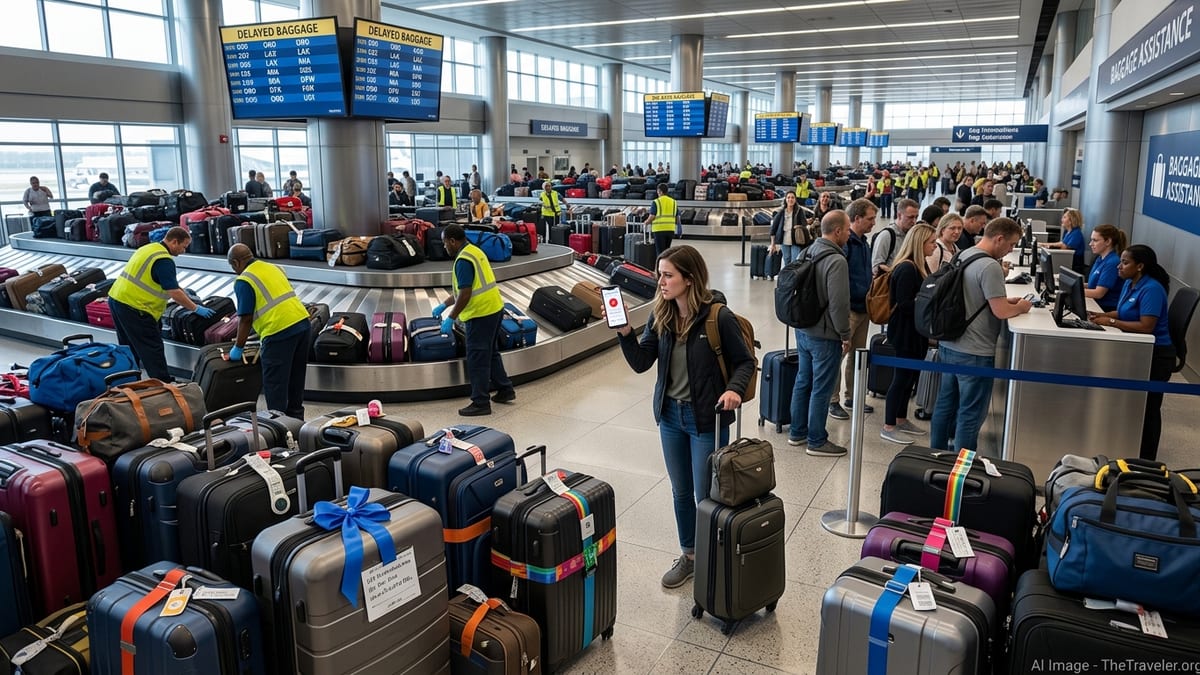
How a five-hour ground stop turned into days of baggage delays
The 13 November ground stop, ordered after a nationwide telecoms failure affected air traffic systems, effectively halted most US departures for nearly five hours. The shutdown did not just delay passengers; it also broke the finely tuned sequencing airlines rely on to move checked bags through hubs and onward connections. In a letter sent on 16 November, US senators said the event “disrupted air travel across the country,” and demanded an explanation from the Department of Transportation and the Federal Aviation Administration about how a network fault could cascade so widely.
Behind the scenes, bag-handling systems struggled to keep up as aircraft and crews went out of position and flights later resumed in bunches rather than at scheduled intervals. Reunitus, which runs the NetTracer tracking platform used by a number of US carriers, reported that the disruption translated into roughly 50,000 delayed bags over the following three days. On Sunday 15 November, NetTracer still showed around 12,000 active delayed-bag files, about four times a typical Sunday volume, indicating that many customers endured multi-day waits for luggage to catch up.
Although most delayed bags are normally delivered within 24 to 48 hours after being misrouted, major irregular operations like this take longer to unwind. When a hub experiences a sudden glut of arrivals after a prolonged ground stop, local baggage facilities can run out of space and ground staff must resort to manual sorting, slowing the process further. For travelers heading into the peak Thanksgiving and December holiday periods, the episode is a reminder that even a relatively short nationwide outage can ripple through the baggage system for days.
Why some bags are more vulnerable than others
Not every checked bag faces the same level of risk when systems are strained. Bags that start their journey at a hub, travel on nonstop flights, and are checked early in the departure process are generally the least likely to go astray. Once a bag is tagged, scanned, and loaded directly into the hold of its sole flight, its path through the system is relatively simple. By contrast, bags that are transferred between multiple flights or tight connections must be unloaded, sorted, and reloaded in a compressed window, increasing the chance that a delay or gate change will leave them behind.
Gate-checked bags sit in an especially vulnerable category during disruptions. Industry guidance from Unclaimed Baggage, the company that purchases truly unclaimed items from carriers, notes that bags taken from passengers at the gate are more prone to routing problems because they may skip the usual check-in counter procedures. When ramp staff are under pressure during irregular operations, these last-minute items can be loaded onto the wrong aircraft or miss the flight altogether. If that happens and the bag was never scanned through the main tagging system, its digital trail may be incomplete, forcing airline staff to rely more heavily on manual descriptions and photos from the passenger to locate it.
Short check-in times also raise the risk. During the recent ground stop recovery, several airlines warned customers that late-checked bags might not travel with them, particularly on complex itineraries. When aircraft depart out of sequence after a pause, ramp teams may have just minutes to reconcile what was checked in during the downtime with what can physically be loaded. Bags checked at or near cutoff are more likely to be left to follow on a later flight, especially when weight-and-balance limits are tight or crews are working through a backlog.
Practical steps to reduce your chances of a lost or delayed bag
Travelers cannot control air-traffic outages, but they can influence how traceable their luggage is when something goes wrong. The most effective step is to simplify your routing where possible. Choosing nonstop flights, or itineraries with the fewest connections and at least an hour between flights, gives both you and your bags more margin if delays build during busy holiday travel days. If you must connect through a hub that is already congested, consider avoiding the last flight of the day on your onward leg so a missed connection does not automatically strand your luggage overnight.
Arriving at the airport early enough to check bags well before cutoff times is equally important. During peak periods, airlines encourage travelers to be at the airport at least two hours before domestic flights and three hours before international departures, with bags checked at least 45 minutes before departure domestically and often earlier for long-haul routes. That extra buffer gives airport systems more time to route bags to the correct belt and aircraft, which becomes critical after large-scale outages when sortation areas are under strain.
Clear external identification can make the difference between a quickly reunited bag and one that lingers in storage. Travelers are advised to attach a sturdy tag with their name, mobile number, and email address to the outside of each checked item and to place a second card with the same details inside, ideally in an easily accessible pocket. Adding a distinctive marker such as a brightly colored strap, ribbon, or sticker can help both airline staff and passengers pick out a particular suitcase among many similar-looking black roller bags during manual searches or in crowded claim halls.
Digital tools now provide an additional layer of reassurance. Many travelers place Bluetooth or other small tracking devices inside their checked bags to monitor their progress independently of airline systems. While these tags do not replace the carrier’s official tracking and cannot speed a bag through customs or handling facilities, they can give passengers an early indication that a bag has missed a flight or been left at a prior airport. That information can be helpful when working with airline staff to pinpoint a bag’s location and arrange delivery once it is recovered.
What to do immediately if your bag is delayed or missing
If your luggage does not appear on the carousel, acting quickly increases the chances of a fast reunion. Industry and consumer protection guidance is consistent that passengers should report a missing or delayed bag before leaving the airport. Most airlines require travelers to file an irregular baggage report in person at a baggage service desk in the arrivals hall, where staff can check scans, verify routing, and create a reference file. This report typically generates a file number and a written or digital receipt that you should keep, as it will be needed for follow-up and any eventual compensation claims.
When filing the report, be prepared to show your boarding pass and checked bag receipt, if available. If your bag was gate checked, ask the gate agent or baggage staff to confirm that the tag number and destination airport printed on the tag match your itinerary, and take a photo of the tag before the bag is taken away. During the ground stop recovery, carriers highlighted that passengers who had photos of their bag tags could be reconnected with luggage more quickly when automated tracking had gaps, because staff could manually cross-check tag numbers in their systems.
Providing detailed descriptions, photos of the bag and its contents, and any tracking device location data can help baggage agents distinguish your luggage from others in large holding areas. Once a file is open, airlines typically send updates by text or email, and many allow customers to monitor their bag’s status through the airline app. Under US Department of Transportation rules, domestic carriers must reimburse passengers for reasonable, verifiable expenses that result from delayed checked bags up to the applicable liability limits, though airlines may assess claims differently depending on whether the bag is merely delayed or deemed lost after a set period.
For international itineraries covered by the Montreal Convention, compensation rules follow that treaty’s standards, which cap liability at a specific amount converted from Special Drawing Rights and may differ from domestic limits. Travelers should keep receipts for essential replacement items and be aware that airlines rarely reimburse for certain valuables such as cash, jewelry, or fragile electronics in checked luggage. If an airline disputes or denies a claim, passengers can escalate through the carrier’s customer relations department or file a complaint with the Department of Transportation, which tracks patterns of baggage performance and consumer reports.
How new airline services may change the baggage and inflight experience
As airlines work through the aftermath of large-scale disruptions, some are also revisiting how they package seat and connectivity options for frequent travelers. United Airlines, for example, offers an Economy Plus subscription that allows customers to reserve extra-legroom seats, when available, for a flat annual fee instead of paying per flight. Recent pricing examples shared with customers show domestic plans starting around 799 dollars for a single traveler within the continental United States, with higher tiers that include companions or global itineraries priced in the low to mid four figures per year. The subscription does not include additional checked baggage allowances but is designed to simplify advance seat selection for those who value more space.
In parallel, the carrier is expanding the reach of its Starlink inflight Wi-Fi, which uses low Earth orbit satellites to provide faster connectivity than many legacy systems. In mid-November, United said that Starlink was available on more than half of its daily departures and that installation work across its mainline and regional fleets was around 46 percent complete. The airline expects to equip nearly 64 percent of its daily flights with the service by the end of 2026 and has reiterated plans to complete installations across almost all scheduled flights by the end of 2027, subject to operational and regulatory factors. The rollout is framed as a competitive differentiator, particularly on routes where passengers are likely to work, stream video, or manage smart-home devices while airborne.
United customers can now check whether their specific flight is expected to offer Starlink using a dedicated tracker, accessible through the airline’s website and app within three days of departure. The tool reflects real-time changes in aircraft assignment, which is especially relevant when earlier disruptions or maintenance swaps lead to a last-minute change of aircraft type. While this service does not directly affect baggage handling, it illustrates a broader trend of airlines giving travelers more granular, flight-specific information about onboard amenities and operations, something many passengers now expect for both seats and luggage.
Some travelers also turn to specialized comfort items to mitigate the stress of irregular operations and extended time in transit. Products such as lightweight, packable travel blankets that double as pillows and include pockets for small items are increasingly marketed to people expecting long days in terminals or on backup flights. One such example, the Explorer Travel Blanket from Puffer Hug, measures roughly 66 by 40 inches, includes snap closures so it can be worn without slipping, and is sold at around 80 dollars. While these accessories do not influence whether a bag makes it onto a flight, they can make overnight waits for missing luggage or rebooked departures more tolerable.
What holiday travelers should watch for in the weeks ahead
With the Thanksgiving peak and December holidays approaching, aviation authorities and airlines are under pressure to show that the failures that led to the 13 November ground stop are being addressed. Senators have asked the Department of Transportation and the Federal Aviation Administration for a detailed account of what caused the telecom outage and how the agencies intend to modernize critical systems to prevent a recurrence. Until that work is completed and tested, travelers should assume that large-scale, systemwide interruptions, while uncommon, remain possible and plan their luggage strategies accordingly.
For trips in the coming weeks, passengers can take a few practical steps to prepare for potential baggage disruptions. Building extra time into connections, particularly at large hubs, and considering nonstop routes where available reduces the stress on both travelers and their bags. Placing essentials such as medication, travel documents, a change of clothes, and key electronics in carry-on luggage ensures that a delayed checked bag is an inconvenience rather than a crisis. Those checking bags should arrive at the airport earlier than usual during peak days, verify that airline-generated tags list the correct final destination, and keep digital copies or photos of those tags handy.
After the recent backlog, baggage operations are returning to typical levels, and most delayed bags are once again being reunited with owners within a day or two. But the scale of the November disruption has highlighted where the system remains vulnerable and how quickly even a few hours of nationwide downtime can translate into tens of thousands of displaced suitcases. Until infrastructure upgrades and resilience measures are fully in place, travelers who take simple precautions, document their checked bags carefully, and act promptly when problems arise will be best positioned to navigate future disruptions and shorten the time it takes to see their luggage again at the carousel.