


More news on this day
Key United Arab Emirates carriers including Emirates, Etihad Airways, Air Arabia and flydubai have cancelled or suspended flights to Kuwait as renewed Gulf tensions trigger fresh disruption across some of the region’s busiest short-haul routes.
Get the latest news straight to your inbox!
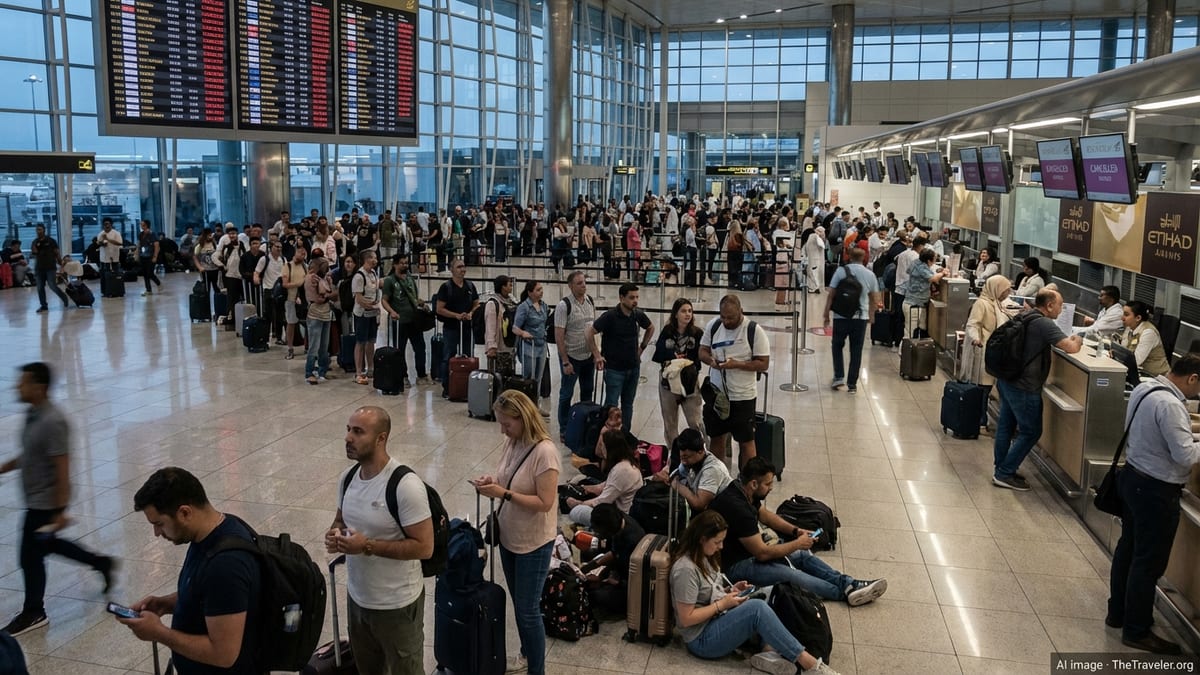
Wave of cancellations hits UAE–Kuwait corridor
Publicly available flight information and regional media coverage show that multiple services between Dubai, Abu Dhabi, Sharjah and Kuwait City were cancelled on July 19 and 20, with some airlines extending changes into July 21. Kuwait International Airport, a key hub for short-haul traffic across the northern Gulf, has seen several round trips removed from schedules with little advance notice.
Reports indicate that Emirates cancelled a series of flights between Dubai International Airport and Kuwait International Airport over the weekend, affecting both outbound and inbound services. Etihad Airways listed its Abu Dhabi to Kuwait flights EY653 and return EY654 as cancelled on July 19 and 20, while Air Arabia removed selected Sharjah–Kuwait rotations over the same period. Regional coverage also notes that flydubai has adjusted parts of its Kuwait schedule, although the carrier has kept the majority of its broader network operating.
The Kuwait suspensions add to a pattern of targeted route adjustments by Gulf airlines as they navigate a fluid security environment and changing airspace restrictions. While the cancellations are concentrated on short sectors, they have knock-on effects for connecting passengers using Kuwait as a transit point or starting long-haul journeys from the country.
Regional tensions and airspace concerns shape decisions
News outlets across the Gulf region link the latest Kuwait disruptions to heightened tensions involving Iran and the United States and to broader concerns about military activity near key air corridors. Previous alerts from aviation regulators have highlighted risks in parts of the northern Gulf and around Kuwait’s airspace, prompting carriers to continually reassess routings and schedules.
According to published coverage, fighting that flared again in early July has already led airlines to trim services to certain airports in Kuwait and southern Saudi Arabia, including Abha. Air Arabia and flydubai have previously reduced frequencies on routes into conflict-adjacent areas, while keeping core trunk routes to major Gulf hubs running. The renewed Kuwait cancellations fit into that pattern of selective adjustments rather than wholesale shutdowns.
Industry analysts cited in regional business media note that commercial airlines have limited flexibility when key waypoints become constrained, especially on short-haul sectors where detours are less practical. In such circumstances, carriers may opt to cancel individual flights or temporarily suspend specific city pairs rather than operate significantly longer routings that could add costs and complicate crew scheduling.
Impact on passengers and travel planning
The sudden changes have left some travelers scrambling to rearrange itineraries, particularly those connecting from Kuwait onto long-haul services via Dubai, Abu Dhabi or Sharjah. Passenger advisories carried by regional outlets urge anyone booked on near-term flights between the UAE and Kuwait to recheck their flight status on airline websites or apps before heading to the airport, and to allow additional time for alternative arrangements.
Travel agents in the Gulf report elevated demand for rebooking onto later flights or alternative carriers where seats are available, although capacity on popular weekend departures remains tight in the peak summer period. Some travelers have chosen to reroute via other regional hubs still operating regular Kuwait services, adding connections and travel time but preserving onward journeys to Europe, Asia or North America.
Standard rebooking and refund policies are being applied across the affected airlines, according to media summaries of carrier statements and customer updates. In many cases, passengers on cancelled flights are being offered the option to move to a different date without penalty or to request a refund, subject to original fare conditions. However, availability on preferred dates and times is limited on certain routes as demand outpaces reduced capacity.
Wider Gulf network remains largely operational
Despite the disruption on Kuwait services, most flights across the wider UAE network continue to operate on schedule. Coverage in regional business publications stresses that major hubs in Dubai and Abu Dhabi remain fully open, with long-haul links to Europe, Asia, Africa and the Americas largely unaffected so far. Airlines have instead concentrated adjustments on a small cluster of regional destinations deemed at higher operational or security risk.
For Emirates and Etihad, Kuwait typically functions as a high-frequency, short-haul spoke feeding traffic into global networks. Temporarily suspending some or all of these flights reduces connectivity for Kuwaiti travelers but does not currently appear to threaten overall network stability. Air Arabia and flydubai, which focus heavily on regional point-to-point services, face a more direct revenue impact when individual Gulf routes are trimmed, yet have diversified schedules spanning dozens of cities across the Middle East, South Asia, Central Asia and parts of Europe.
Aviation commentators observing the situation note that Gulf carriers have become adept at rapid schedule changes after several years of regional volatility. Experience gained from previous airspace closures and conflict-related advisories has given operations teams well-tested playbooks for rerouting aircraft, consolidating frequencies and communicating changes to customers at short notice.
Outlook: short-term uncertainty, close monitoring
How long the Kuwait cancellations will continue depends largely on the trajectory of regional tensions and any further guidance from aviation regulators. Some carriers have so far only removed Kuwait flights from schedules for a limited window through July 21, while others have signaled that services remain “under review,” leaving open the possibility of short-term extensions or a gradual resumption as conditions permit.
Travel industry observers expect that airlines will keep their approach highly flexible, restoring flights as soon as security assessments support normal operations, but moving quickly to cancel or reroute if risk levels rise. Passengers planning travel between Kuwait and the UAE over the coming days are advised in public advisories to monitor official flight-status tools closely and to maintain up-to-date contact details in their bookings so they can receive notifications about any last-minute changes.
For now, the situation underscores the vulnerability of dense regional air networks to sudden geopolitical shocks. Even limited suspensions on short sectors such as Kuwait to Dubai or Abu Dhabi can ripple through connecting banks of flights and complicate summer travel plans. As the Gulf’s role as a global aviation crossroads continues to grow, the balance between maintaining connectivity and managing security-driven disruptions is likely to remain a central challenge for airlines and passengers alike.