


The United Kingdom’s electronic travel authorisation, or ETA, is a digital pre-travel clearance that is electronically linked to the passport used in the application. Airlines, ferry companies and Eurostar check that ETA in the background through your passport details, not by scanning a printed approval email. That means any error in the application or any change of passport can leave a traveller unable to board. Because you must have confirmation of an approved ETA before you travel to the UK, avoiding mistakes and knowing how to fix them is now as important as booking your ticket.
Get the latest updates straight to your inbox!
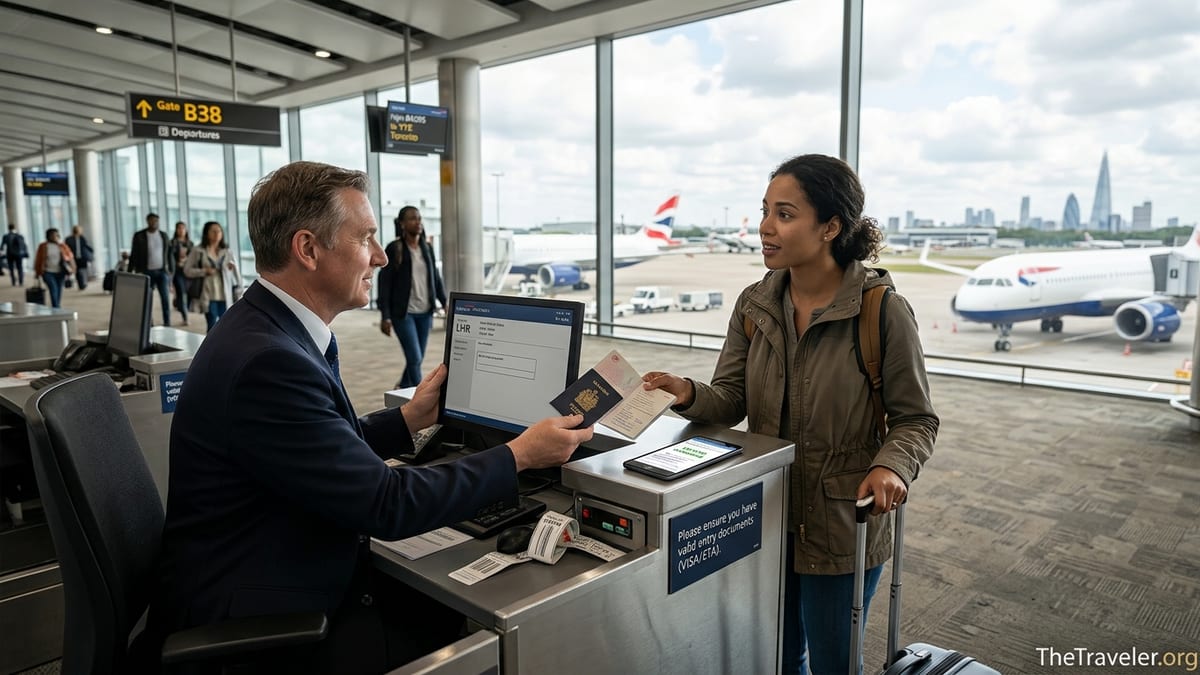
Key facts: fee, timing and what ETA approval actually means
As of November 13 2026, the official UK ETA application fee is £20 per person, whether you apply on the UK ETA mobile app or on the GOV.UK website. The Home Office confirms that you cannot get a refund after you submit the application, even if it is refused or you later discover a mistake and need to apply again. This flat £20 fee has replaced earlier pilot pricing such as £10 or £16 that appeared during the early roll-out to specific nationalities; any lower figures quoted on old blogs or social posts are now outdated and should be ignored.
The UK government states that most applicants receive a decision by email within about one day of applying, but that it can take up to three working days. Weekends and UK public holidays do not count as working days, so a Friday evening application might not be fully decided until the following Wednesday in a worst case scenario. Travellers are explicitly advised to wait for the email confirming that an ETA has been granted before they travel, and not to assume that “in progress” is enough.
If you have not received any decision after three working days, the current guidance is to check your spam and junk email folders and then contact UK Visas and Immigration (UKVI) if there is still no message. There is no “automatic approval” if the system is silent. A pending application is not permission to travel, and carriers are instructed to refuse boarding if they cannot verify a valid ETA, visa or immigration status linked to the presented passport.
An ETA is permission to travel to the UK, not permission to enter. Border Force officers can still refuse entry or grant a shorter stay on arrival. For many travellers, though, the critical step is simply being allowed to board a flight from, for example, New York JFK to London Heathrow or a ferry from Calais to Dover. That boarding decision is based on whether the digital ETA is correctly attached to the passport details transmitted by the airline.
Why outdated prices and “priority” websites are misleading
During the initial phased introduction of the ETA scheme, some nationalities paid a lower fee, such as £10, as part of testing periods. Later announcements occasionally referenced £16. The current Home Office guidance is unambiguous: the charge is £20 for all applicants who use the official mobile app or the GOV.UK online form. Any articles, comparison tables or YouTube videos that still highlight cheaper amounts are referencing short-lived pilot phases that have since been replaced.
Because the ETA is a government decision recorded in the UK immigration systems, no private company can legitimately speed up the underlying assessment. The official guidance states that you cannot obtain a faster decision by applying through another website or app. Some commercial visa agencies market “express” or “priority” packages, often charging £50, £80 or more, but what they can actually do is limited to submitting the same official form on your behalf and answering basic queries. They cannot cause the Home Office to process your case before anyone else’s.
A practical example illustrates the point. A Canadian family of four planning to visit London in December might see one website offering “48-hour ETA approval” for a premium fee and another quoting the standard £20 government charge. Both services must pass through the same UK ETA system. The family would still wait up to three working days for a decision per person, even if they paid a private intermediary. The risk is that travellers misunderstand what they are buying and assume they have paid for guaranteed fast-track processing, only to discover at the airport that one application is still pending.
Using the official channels also avoids additional data-sharing risk. Some third-party sites are legitimate travel agents, while others are lightly regulated businesses collecting passport images and biometric-style photos. Given that the official app and website are mobile-friendly and available in English and Welsh, most travellers are better off applying directly unless they have particular accessibility needs.
How the ETA links to your passport and why small errors matter
The ETA is digitally linked to the exact passport used in the application. Airlines and other carriers transmit your passport details to UK systems in advance, and the system checks for a matching ETA. This is why even a one-character mistake in a passport number or a swapped day and month in a date of birth can cause the system to return “no valid ETA found,” leaving the check-in agent unable to complete your boarding pass for a flight to the UK.
Common technical errors include entering the wrong passport number, missing letters, or confusing the letter O with the digit 0. Travellers with passports that contain both a main number and an additional personal ID field sometimes type the wrong string of characters. For example, a traveller from Germany transiting through London on their way to Vancouver might accidentally enter their national ID number instead of the alphanumeric passport number printed near the bottom of the photo page. The ETA would then be granted for a document that does not exist in airline records.
Name formatting is another source of trouble. The application must match the name as it appears in the passport’s machine-readable zone. Problems often occur for travellers from countries where multiple family names or patronymics are used, or for people who recently married and changed their surname but have not updated their passport. If your passport says “SINGH GARCIA” as the surname and “PRIYA” as the given name, entering “Priya Garcia” as your only name risks a mismatch when the airline sends passenger data to the UK system.
Date of birth and nationality selection can also be mis-typed. An American applicant might inadvertently select “United States Minor Outlying Islands” in a long drop-down menu instead of “United States of America,” or a traveller born on 05/11 could choose 11 May rather than 5 November if they are used to a different date format. These look small on screen but become major obstacles once your passport chip tells a different story to the ETA database.
Photos, document quality and expired or changed passports
Applications fail or are delayed not only because of text errors but also due to poor image quality. The UK ETA process requires a digital photo of the applicant’s face that meets rules similar to passport photo standards. Photos that are heavily filtered, taken in dim lighting, cropped from a party selfie or show large shadows on the face can trigger an automatic rejection or a request to reapply. For example, a traveller using a warm-toned social media portrait with blurred background might find that the system cannot verify their features, resulting in processing delays just days before departure.
Blurred passport scans and reflections from glossy laminates are another technical pitfall. When you photograph the passport’s biographical page in low light or with a cracked phone camera, the app may struggle to read the machine-readable lines at the bottom. Some applicants report that this leads to multiple failed attempts and, in some cases, to applications that appear lodged but never complete automated checks. It is safer to retake the image in bright, even light, on a dark flat surface, before pressing submit.
Using an expired passport or applying with one passport while intending to travel on another is a more fundamental error. The UK government is clear that the ETA is linked to the passport you applied with and that if your passport expires or you obtain a new one, you must apply for a fresh ETA. Imagine a New Zealand traveller who receives an ETA using a passport that expires in March 2027 but then renews their passport in early 2027 ahead of a May trip to Manchester. They cannot transfer the existing ETA to the new document; a new £20 application is required.
Similarly, dual citizens should be careful to apply using the passport they will actually present at check-in. A US and Italian dual national who applies using their US passport but later books a ticket with their Italian passport details stored in an airline profile may find that the carrier cannot see any ETA for that second passport, even though one exists for the first. For smooth travel, the passport used on the ETA, on the ticket booking and at the departure gate should be the same.
Pending, technically rejected or refused: what happens and what you can fix
It is important to distinguish between three different statuses. A submitted application that is still pending is simply awaiting a decision. In this period, you cannot travel relying on an ETA, but you may not need to do anything unless three working days have passed. A technical rejection usually arises when the system cannot process your images or picks up inconsistent information. In such cases, the Home Office guidance explains that you must submit a new application and pay the fee again if you still wish to travel.
A substantive refusal occurs after an assessment finds that you do not meet the requirements for an ETA, for example because of certain immigration or security concerns. The refusal email will state that the ETA has been refused and that you may be able to apply for a different type of UK visa instead. An authorization refused after assessment cannot be corrected by editing details; the only options are to seek a visa or, if you believe there has been an error, to follow any review or complaint routes explained in the refusal notice.
Where you spot a minor typo after submission but before a decision, such as a wrong middle initial, you generally cannot edit the live application. The current system does not provide an “amend” button through the app or website. In practice, many travellers choose to wait for the outcome and, if granted but containing incorrect data, then apply again with accurate information, accepting the extra £20 fee. This is especially common when the mistake involves core elements like passport number or date of birth, where airlines are likely to detect a mismatch.
You can check whether an ETA has been issued and when it expires using the official “check ETA” online service, which requires the passport used in the application. The service confirms if there is an active electronic travel authorisation and its validity dates. It does not show works-in-progress, so recent applicants who have not yet received a decision cannot use it as a shortcut to see if the ETA is coming; they must wait for the email or contact UKVI after three working days.
Duplicates, family applications, children and new passports
Each traveller must have their own ETA, including babies and children. There is no concept of a “family ETA.” However, the UK ETA mobile app and the online form do allow one person to submit multiple applications in a session. A parent in Chicago, for example, can apply for themselves and their two children using one smartphone, capturing each child’s photo in turn. The Home Office notes that decisions for people applied for together can arrive at different times, so parents should not worry if one child’s approval email arrives several hours later than another’s.
Duplicate applications for the same person using the same passport are not recommended. Submitting repeated forms in an attempt to speed up processing can confuse matters and generate additional payments without any benefit. In most circumstances, the system will only treat one ETA as current, and repeated submissions may even increase the chance of technical mismatch if you type something slightly differently each time. Travellers should focus on getting one clean, accurate application submitted well in advance.
When a passport changes after an ETA has been granted, there is currently no facility to transfer the approval. The original ETA remains tied to the old passport number. A traveller who legally changes their name, renews an almost full passport, or must replace a lost document will need to pay £20 again for the new passport even if the previous ETA still has months of validity remaining. For a family of five where both parents renew passports in the same year, this could mean an extra £40 in ETA fees beyond the three children’s authorisations.
Children who hold dual nationality need particular care. A teenager with both Australian and Hong Kong Special Administrative Region passports might be tempted to mix documents, using one to apply for the ETA and the other to enjoy visa-free access elsewhere in Europe. For travel to the UK, they should pick one passport, apply for the ETA on that document and always use it when transiting or entering the UK for the two-year life of the authorisation.
Step by step: applying through the official app or website
Whether you choose the UK ETA mobile app on a smartphone or the GOV.UK online form on a laptop, the sequence is similar. You need the passport you will travel with, an email address you can access, and a way to pay the £20 fee by credit card, debit card, Apple Pay or Google Pay. On the app, you typically start by scanning the passport’s photo page and, where supported, reading the chip with your phone’s NFC function. On the website, you upload a clear photo of the photo page instead.
Next you provide biographical details and travel-relevant information, then capture or upload a photo of your face. The UK digital photo rules require a plain, light background, neutral expression, eyes open and clearly visible, and no heavy shadows or glare. Glasses are allowed if the eyes are fully visible and there is no reflection. Taking the photo during the day facing a window, with the phone held at eye level, is often enough to meet the standard. Avoid filters, hats, earbuds hanging across the face or busy backgrounds like patterned curtains.
After you review the information and pay, the system submits your application. Within minutes to hours, you receive a confirmation email that the application has been received, followed later by another email with the decision. If the ETA is granted, the message includes a 16-digit reference number along with validity dates. These emails sometimes land in spam or “promotions” folders, especially for users of large providers such as Gmail or Outlook, so you should check there carefully before assuming no message has arrived.
Applying on a stable internet connection is important. Travellers in hotels with unreliable Wi-Fi or on limited mobile data have reported failed uploads or timeouts. If you are on the move, consider waiting until you are in a café or co-working space with steady broadband, particularly at the stage where you upload photos and make payment.
When the airline cannot see your ETA: immediate steps
Occasionally, travellers reach the airline check-in desk only to be told that no valid ETA is attached to their passport, even though they have a confirmation email on their phone. In this situation, the first step is to verify that the passport you are using is the same one you used when applying and that all data on the booking matches it. If you changed passports after approval, there will be no valid ETA linked to the new document, and the airline is usually correct to refuse boarding.
If you have the same passport but discover a discrepancy, such as your ticket showing your married name while your passport and ETA show your maiden name, the best option is usually to update the flight reservation to match the passport or, if that is not possible, to reapply for an ETA that matches the identity on the ticket and passport. Some carriers can correct minor name errors on a booking for a fee, which might be faster and cheaper than a new ETA application if departure is imminent.
Where everything appears to match, you can recommend that the airline agent double-check their system and, if necessary, contact their immigration help desk or carrier liaison using the channels provided by the UK authorities. The Home Office also publishes guidance for carriers and offers a process for confirming digital immigration status when a carrier’s systems cannot automatically verify it. However, these behind-the-scenes checks take time and are not guaranteed to succeed before the flight closes, so travellers should not rely on them as a last-minute rescue.
If, after three working days, you still have no decision email and the airline cannot see any ETA, you should contact UKVI using the official support routes listed in the ETA guidance. Keep your passport, application reference and travel dates to hand. Call centre staff cannot grant an ETA over the phone but may be able to clarify whether an application exists, whether any further information is required, or whether you need to submit a new application.
Timelines: applying weeks ahead, three days ahead and same-day
For a relaxed experience, travellers should treat the ETA as part of early trip planning. Several weeks before departure, ideally at the time of booking flights, apply for an ETA for every person in your party. For example, a Brazilian couple planning a honeymoon in Edinburgh in April could apply as soon as they have renewed their passports and purchased tickets, even if the trip is five months away. Because an ETA lasts for two years or until the passport expires, whichever comes first, early applications often cover multiple trips within that period.
Three working days before departure is the minimum safe buffer suggested in official guidance. If you find yourself inside that window, you should still apply immediately but understand that you are now relying on the typical “about one day” processing time rather than a guaranteed deadline. A US-based business traveller flying on a Wednesday afternoon who applies on the preceding Friday lunchtime might receive approval by Friday evening, but in an outlier case the decision could arrive as late as Wednesday morning. In such circumstances, it is wise to consider flexible or changeable tickets.
Same-day applications are possible, and many are approved within hours, but they are not assured. A traveller transiting through Heathrow on a Sunday morning who remembers on Saturday afternoon that an ETA is required might submit an application and receive an approval email on Saturday night. Another traveller in the same position could still be pending when check-in opens, in which case the airline should refuse boarding. The ETA system is not a last-minute express service and should not be treated as one, especially around peak travel periods such as Christmas or major sporting events.
If your ETA is refused well before travel, and you still wish to visit the UK, you may in some cases be able to apply for a Standard Visitor visa instead. Visa processing takes significantly longer and has higher fees than an ETA, so early planning becomes even more critical if you suspect any factor in your history might lead to an ETA refusal.
Special cases: dual citizens, existing UK status and airside transit
Dual citizens must choose the passport they will use for UK travel and stick with it for each journey while the ETA is valid. If you hold, for example, both Canadian and Japanese passports, you might decide to apply for the ETA on your Canadian passport and use that whenever you fly to or via the UK. If you later try to use the Japanese passport at check-in for a London flight, the airline systems will not find any ETA linked to it, regardless of the approval attached to your Canadian document.
Travellers who already hold UK immigration status, such as a work visa, student visa, or settled or pre-settled status under the EU Settlement Scheme, do not need an ETA to travel within the validity of that permission. The guidance explains that an ETA is not required for people who already have permission to live, work or study in the UK. These travellers should instead make sure that their existing digital status or visa vignette is valid and that the carrier can verify it. In some cases, you may need to carry a biometric residence permit card or access an online share code service.
Airside transit is a fluid area that has recently evolved. Current Home Office guidance notes that ETA-eligible nationals who transit airside without passing through UK border control are temporarily exempt from the ETA requirement, although this is kept under review. However, if you will go through UK border control during your layover, even briefly, you may need an ETA or a transit visa depending on your nationality. For example, a visitor planning an overnight connection at Heathrow who intends to collect luggage and stay at an airport hotel on the landside will usually need permission equivalent to any short-term visitor.
Visa nationals from certain countries remain subject to transit visa rules even if they are only changing aircraft without entering the UK. The UK publishes detailed carrier guidance listing those nationalities. Having an ETA in those cases may remove the need for a transit visa, but only where the nationality is eligible for ETA in the first place. Travellers whose citizenship is not yet covered by the ETA scheme must continue to follow the transit visa requirements.
Troubleshooting table: mistakes, consequences and remedies
Incorrect passport number, including missing or transposed characters, usually results in the airline system reporting that no valid ETA is found for the passenger at check-in. The practical remedy is to submit a new application with the correct passport number and pay another £20, then wait for approval before attempting to travel. Similarly, using the wrong nationality field, for example choosing a territory that does not match your passport, can lead to technical rejection or an authorisation that cannot be used.
Submitting a low-quality face photo, such as a shadowed image taken in a car or a heavily filtered selfie, often leads to delayed processing or technical refusal. To remedy this, applicants should retake the image against a plain, light background with clear lighting and reapply if necessary. Blurred or obscured passport scans can trigger requests for resubmission or outright failure of automated checks; in many cases, the fastest fix is deleting poor images, taking new ones in good lighting, and starting a fresh application session.
Using an expired passport, changing passport after approval or switching to another passport at the airport almost always means the ETA cannot be used. The consequence is that boarding is refused unless the traveller holds another valid permission such as a visa. The remedy is straightforward but sometimes costly: renew the passport if needed and apply for a new ETA linked to the new document, allowing up to three working days for processing.
In cases where the application is refused on substantive grounds, the consequence is that you cannot travel to the UK using an ETA at all. The remedy, if any, involves exploring whether a different visa route is open to you and following that separate application process, often through a visa application centre and with biometric enrolment. Technical rejections, by contrast, are usually resolved by fixing the underlying error and reapplying, as long as there are no underlying immigration concerns.
Checklist, fraud warnings, costs and conclusion
Before pressing submit, run through a quick pre-submission checklist. Confirm that the passport number, name order, date of birth and nationality all match the passport’s machine-readable zone exactly. Check that the passport will still be valid on the date you arrive in the UK and, ideally, for the entire length of your stay. Review the face photo to ensure it is sharp, evenly lit and compliant with digital photo rules, and verify that you have used a stable email address you can access on your phone throughout your journey.
Fraud risk is a growing concern as more countries adopt electronic travel authorisations. Look out for unofficial websites that mimic government branding while adding service fees on top of the £20 official charge. Some may provide minimal value beyond copying your data into the genuine form, while others may be outright scams that take payment but never submit an ETA application. To protect yourself, only use the official UK ETA app from recognised app stores or the GOV.UK online service referenced in government communications, and be suspicious of anyone promising guaranteed same-day approval for an extra fee.
The costs for families and groups can add up quickly. A family of four parents and two children, each needing an ETA for a summer holiday in Cornwall, will currently pay £80 in total at the official rate. If both parents later renew their passports before a second trip to the UK within two years, they would need to spend an additional £40 to obtain new ETAs for their new passports, bringing their total ETA spend to £120 over the period. This is still significantly cheaper and simpler than repeated short-stay visa applications in many cases, but it is worth factoring into travel budgets.
Handled correctly, the UK ETA should be a routine part of modern travel, similar to airline check-in or advance passenger information. By applying early, double-checking passport data, using high-quality photos and relying on official channels, most travellers will receive quick approvals that quietly sit in the background of their journeys. The key is to remember that the ETA lives on your passport record, not on a piece of paper in your hand, and that even small discrepancies can prevent you from starting your trip at all.