


More news on this day
Air travel across the United States remained deeply disrupted on Saturday as airlines worked to recover from a rare nationwide ground stop ordered by the Federal Aviation Administration, leaving thousands of passengers stranded or rebooking trips after more than 12,000 flights were canceled or delayed heading into the weekend.
Get the latest news straight to your inbox!
System back online, but recovery remains uneven
The FAA lifted the nationwide ground stop on Friday evening after roughly four hours, saying normal airspace operations had resumed. Publicly available flight-tracking data and airline status boards on Saturday, however, showed a lagging recovery, with cancellations and rolling delays still affecting major hubs from Boston and New York to Chicago, Dallas and Los Angeles.
Coverage from national broadcasters and wire services indicated that more than 12,500 flights in the United States were canceled on Friday and Saturday combined, as the initial halt to departures rippled through tightly choreographed airline schedules. The disruption hit both domestic and international routes, with some long haul services operating but many connecting passengers unable to make onward flights.
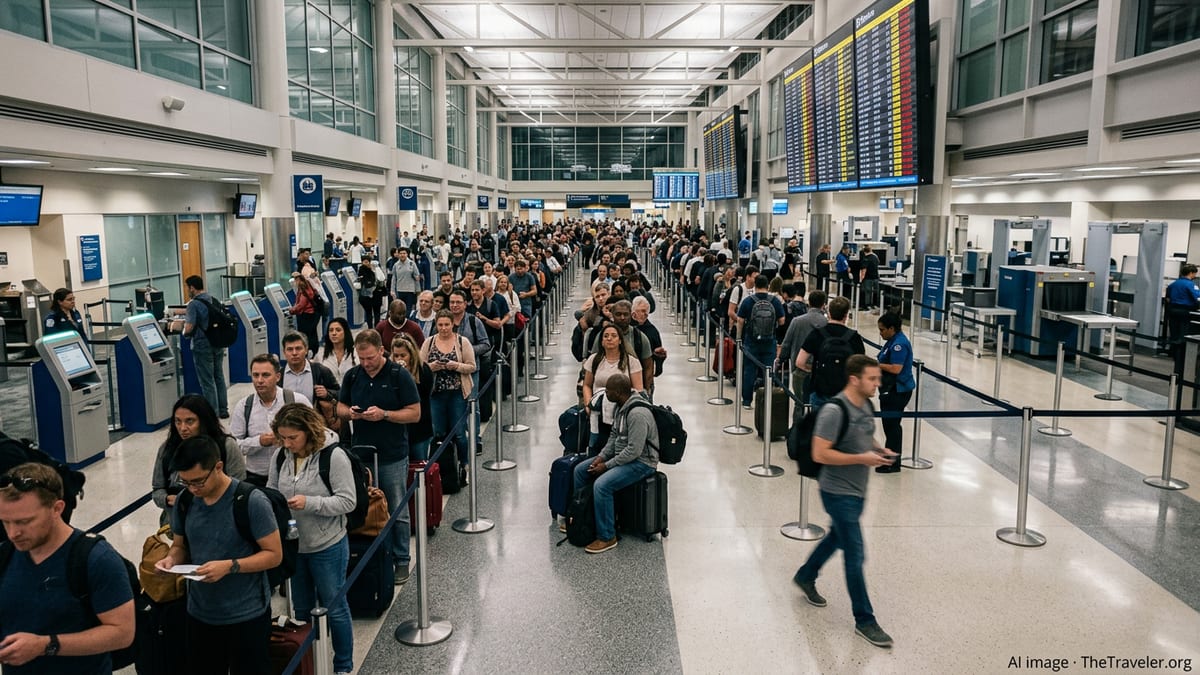
Reports from airports such as Newark Liberty International, Boston Logan and Washington Dulles described long lines at customer service desks and departure boards filled with red cancellation notices. Travelers were advised in airline statements and local news coverage to check their flight status before heading to the airport and to expect limited same-day rebooking options on busy routes.
Regional carriers feeding larger networks also continued to experience knock-on impacts, particularly in the Northeast and Midwest, where aircraft and crews ended Friday out of position. Airline operations teams were using the weekend to reposition planes and staff in order to start Monday’s business travel period on a more regular footing.
What triggered the nationwide ground stop
According to public briefings and published analyses, the ground stop was ordered on Friday afternoon after serious communications problems affected multiple regional air traffic control centers. Transportation officials described this as an extraordinary safety event that required halting departures nationwide while controllers verified they could maintain reliable contact with aircraft and with each other.
Subsequent coverage of the incident indicated that communications equipment connecting the 22 en route air traffic control centers across the country became overloaded, leading to instability in both voice and data links. The issue emerged shortly after the FAA began integrating a new generation of traffic management tools, intensifying scrutiny of how legacy and modern systems interact.
In separate reporting, aviation and technology experts noted that nationwide ground stops remain extremely rare in the United States. The last comparable event occurred in January 2023, when a malfunction in the system that distributes safety notices to pilots prompted a pause in departures. Before that, the only other modern precedent was the shutdown of U.S. airspace following the September 11, 2001 attacks.
Officials speaking at televised briefings emphasized that there was no evidence of malicious interference in Friday’s disruption. Instead, publicly available information pointed to an infrastructure failure inside the national airspace system, with investigators still working to pinpoint the precise sequence of technical events that forced controllers to stop flights.
Airlines waive fees as rebooking stretches into Sunday
Major U.S. airlines introduced travel waivers to give affected passengers more flexibility as the scale of Friday’s disruption became clear. Public advisories from several carriers indicated that change fees were being waived for customers willing to move their trips to later in the travel window, and fare differences were in some cases being relaxed for rebookings within a specified date range.
United, Delta, American, Southwest, JetBlue and other large carriers all reported elevated levels of cancellations and delays on Friday evening, followed by additional disruptions on Saturday as aircraft and crews were reassigned. Some airlines advised that they expected to operate close to normal schedules by late Sunday, but noted that availability on popular routes would remain tight until more aircraft cycles worked through the system.
Low cost and leisure-focused airlines faced their own challenges, particularly on point to point routes with less frequent service. Travelers whose Friday flights were canceled sometimes found that the next available seat on the same route was not until early next week, prompting many to seek alternate routings, drive to other airports, or switch to train and bus services where available.
Passengers who booked through online travel agencies or with separate tickets for connecting itineraries encountered added complexity, as they often needed to work with multiple companies to secure new arrangements. Consumer advocates quoted in coverage of the event encouraged travelers to document expenses, keep boarding passes and confirmation emails, and review each airline’s published policies on compensation and accommodation.
Stranded travelers face long waits and limited options
From the East Coast to the West Coast, local news outlets captured scenes of packed concourses, families camped out near power outlets and travelers refreshing airline apps as they waited for updates. At airports in the New York metropolitan area, including Newark Liberty and Westchester County Airport, morning flights on Saturday showed a mix of on time departures, rolling delays and residual cancellations.
In Boston and Washington, public information from airport operators and airlines showed similar patterns, with transatlantic flights operating but many shorter domestic legs delayed while aircraft repositioning continued. At major hubs such as Chicago O’Hare, Atlanta and Dallas Fort Worth, travelers reported long lines at baggage services as bags continued to arrive from flights that reached their destinations hours after passengers had already rebooked or abandoned their trips.
Some travelers were able to secure hotel vouchers, meal credits or ground transportation assistance from airlines, while others, particularly those on discounted fares or basic economy tickets, reported paying out of pocket for overnight stays. With large events, college and professional sports games, and autumn weekend travel all converging, hotel availability near some airports tightened rapidly on Friday night.
Publicly available guidance from airlines reiterated that customers who no longer wished to travel could in many cases request refunds when their flights were canceled, in line with federal regulations. However, processing times for refunds and travel credits were expected to vary, and customer service centers continued to experience heavy call volumes on Saturday.
What travelers should know for the rest of the weekend
For those scheduled to fly on Saturday evening or Sunday, aviation agencies and airlines advised monitoring flight status frequently and arriving at the airport earlier than usual, especially at large hubs. With security lines, check in queues and boarding procedures all affected by the compressed schedule, a longer buffer was recommended to reduce the risk of missing a newly retimed departure.
Travelers making tight connections were encouraged by public advisories to look for alternative routes with longer layovers or to consider overnight stops if their itinerary involved multiple connections through busy hubs. Those traveling for time sensitive events such as cruises, tours or international meetings were urged to stay in close contact with the companies organizing their onward travel to confirm any changes.
Analyses published by aviation specialists suggested that once the immediate disruption passes, attention is likely to turn to the resilience of the U.S. air traffic control network, the pace of technological upgrades and the funding needed to prevent similar outages. Lawmakers signaled that hearings and reviews of the incident would follow, but no specific timetable for those steps had been announced by Saturday afternoon.
In the meantime, the most practical advice for passengers remained straightforward: verify flight status directly with the airline before leaving home, build extra time into airport plans, and be prepared for schedules to continue shifting as the system works through the backlog created by the nationwide ground stop.