


More news on this day
A rare nationwide ground stop of U.S. flights on Friday continues to ripple through the air travel system on Saturday, with thousands of passengers still stranded and airlines warning that disruptions could stretch into Sunday as they race to rebuild shattered schedules.
Get the latest news straight to your inbox!
Recovery slow as cancellations and delays mount
Publicly available flight tracking data shows that airlines canceled more than 9,000 flights and delayed over 7,000 across the United States on Friday after the Federal Aviation Administration halted departures nationwide because of an air traffic control communications failure. By Saturday morning, reports from airline tracking services indicated several thousand additional cancellations and delays as carriers struggled to reposition aircraft and crews.
Although the FAA lifted the nationwide ground stop on Friday evening, government briefings and airline statements indicate that operations remain far from normal at some of the country’s busiest hubs. Major connecting airports including Atlanta, Chicago O’Hare, Dallas Fort Worth, Denver, New York area airports and Los Angeles are still reporting heavy congestion, long lines at customer service desks and tight seat availability on remaining flights.
According to published coverage, federal transportation officials say they expect flight operations to stabilize gradually through the weekend, with most airlines targeting Sunday for a return to more typical schedules. However, the scale of Friday’s disruption means many travelers are facing multi day delays, overnight stays far from home and rebooked routings that add extra stops or long layovers.
Airline network planners are prioritizing core domestic routes and high demand corridors, leaving some smaller regional airports with only limited service until aircraft and crews can be rebalanced. Data from disruption tracking services on Saturday morning showed formal ground stops lifted nationwide, but delay management programs still in effect at several large airports where backlogs remain significant.
What caused the nationwide ground stop
The FAA has stated in public updates that the nationwide halt to departures on Friday afternoon was triggered by a telecommunications problem affecting communications and radar data at multiple Air Route Traffic Control Centers. These facilities manage high altitude traffic across vast swaths of U.S. airspace between major airports, and instability in their systems made it difficult for controllers to track aircraft and safely coordinate new departures.
According to a briefing released by the U.S. Department of Transportation, the issue emerged during work to migrate parts of the air traffic network from older copper based connections to fiber infrastructure. A faulty router or configuration error caused abnormal data flows that overwhelmed other network equipment, creating intermittent communications gaps and radar dropouts across sections of the system. As the problem spread, the FAA issued a nationwide ground stop as a safety measure while technicians isolated and corrected the fault.
Experts cited in technical and aviation industry reports note that this is the first nationwide ground stop since January 2023, when a malfunction in the NOTAM safety notification system briefly halted U.S. departures. Before that, a broad shutdown of U.S. airspace had occurred only in the aftermath of the September 11, 2001 attacks. The rarity of such an event underlines both the severity of Friday’s outage and the scale of its impact on travelers.
The disruption has renewed scrutiny of the age and complexity of U.S. air traffic control technology. Recent reporting on modernization efforts highlights ongoing projects to replace decades old information displays and communications systems at hundreds of facilities, with timelines stretching toward the end of this decade. Travel and technology analysts say the outage is likely to intensify debates over funding and the pace of upgrades.
Airports under strain as travelers seek scarce seats
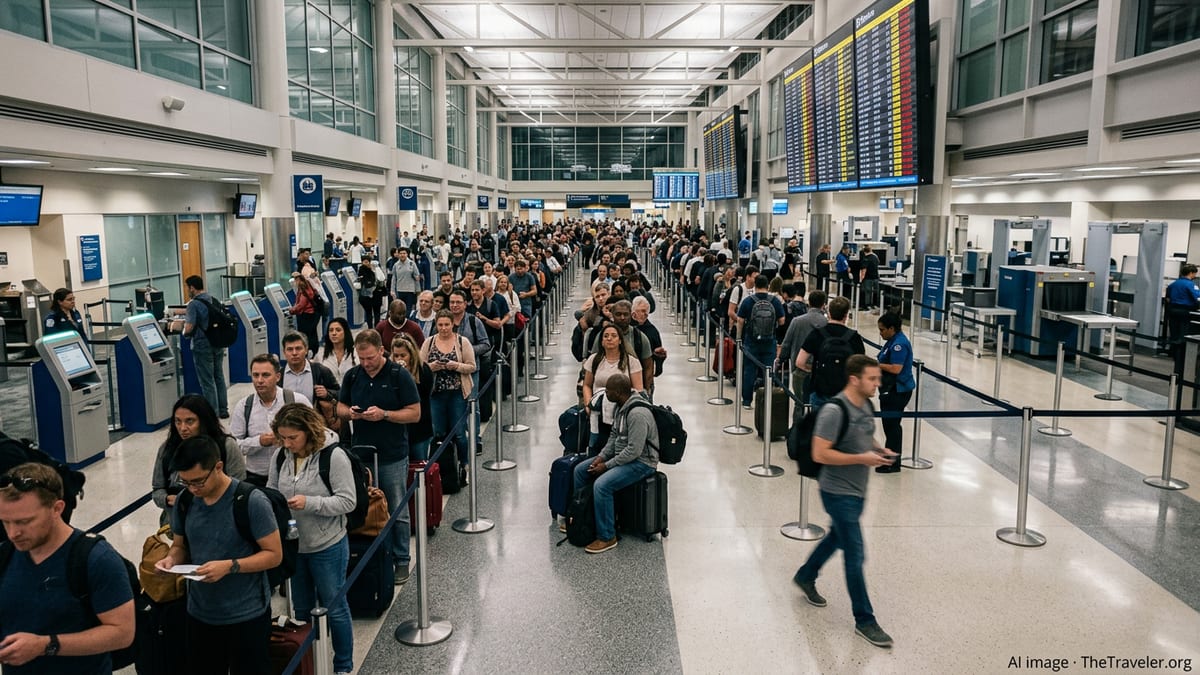
Scenes from airports across the country on Friday and Saturday show crowded terminals, full customer service lines and passengers camped out near gates as they wait for rebooking options. Regional coverage from cities such as Boston, Houston and Montgomery, Alabama, describes travelers learning of the ground stop only after arriving at the airport, then facing hours of uncertainty as cancellations mounted.
At large hubs including Hartsfield Jackson Atlanta International Airport, Chicago O’Hare and Dallas Fort Worth, departure boards on Saturday still showed clusters of cancellations and rolling delays, particularly on routes that require aircraft from disrupted parts of the network. Airport social media feeds and public statements emphasize that the ground stop itself has ended, but acknowledge that airlines will need much of the weekend to work through stranded passengers.
Hotel capacity around major airports has tightened as travelers search for last minute rooms, especially in markets hosting large events or with already high weekend occupancy. Some airport operators have indicated through public updates that they are coordinating with local tourism and hospitality partners to direct travelers toward available accommodation, while also reminding passengers that airlines are generally not required to cover hotel costs when disruptions are caused by air traffic control issues rather than carrier controlled problems.
In addition to leisure travelers, the disruption has affected professional and sports travel. News coverage notes that NBA, NHL and college football teams faced altered plans as charter and commercial flights were grounded, with some teams forced to delay departures or adjust game preparations while waiting for the airspace to reopen.
What stranded passengers can expect from airlines
According to consumer guidance published by federal transportation authorities and major airlines, passengers whose flights were canceled due to the ground stop are entitled to a refund if they choose not to travel, even if the cause lies outside the airline’s control. Travelers who still wish to make their trip are being offered free rebooking on later flights, subject to seat availability.
Several large U.S. carriers have issued systemwide travel waivers for affected dates, allowing customers to change their itineraries without change fees and, in some cases, without paying fare differences if they travel by a specified new date. Publicly available information on these waivers indicates that they typically cover tickets scheduled for November 13 and 14, with rebooked travel allowed into the following week on the same route or region.
Because the disruption stems from an FAA directed ground stop, airlines are generally classifying it as an event outside their control. Under current U.S. rules, that means carriers are not obligated to provide hotel rooms, meal vouchers or ground transportation for stranded travelers, though some may offer assistance as a gesture of goodwill. Passenger rights dashboards published by federal regulators outline, on a carrier by carrier basis, what amenities each airline voluntarily pledges in cases of major delays and cancellations.
Travel experts recommend that stranded passengers first use airline mobile apps or websites to seek rebooking options, since phone centers and in airport customer service desks are experiencing heavy demand. In some situations, checking alternative airports within driving distance or accepting connections through less busy hubs can open up additional options. Those who booked through online travel agencies may need to work through those channels for changes, which can add additional steps and waiting time.
Tips for travelers flying later this weekend
While federal officials and airlines expect operations to improve steadily through Sunday, published travel advisories suggest that passengers scheduled to fly later this weekend should still plan for potential knock on effects from the ground stop. Aircraft and crews remain out of position on some routes, and any new weather or technical issues could trigger further delays on already strained schedules.
Travel industry guidance advises passengers to check their flight status frequently, beginning the day before departure and again before leaving for the airport, since last minute schedule changes remain possible as airlines continue to rebalance fleets. Arriving earlier than usual can help travelers navigate longer than normal check in and security lines, particularly at major hubs that are processing backlogged passengers.
Those with tight connections may want to explore options to move to earlier flights or connect through less congested hubs, if available, to reduce the risk of missed onward segments. For essential trips, some travelers are considering backup plans such as refundable train tickets or rental car reservations on key corridors in case air disruptions persist into Sunday.
Aviation analysts note in weekend coverage that the nationwide ground stop is likely to be studied closely in the coming months, both to understand the technical chain of events and to refine contingency planning for future outages. For now, the priority for airlines and airports remains working through the large number of stranded passengers and restoring confidence in a system that, for a few hours on Friday, came to an extraordinary standstill.