


Vancouver International Airport’s South Terminal operates like a small regional airport tucked just a few minutes away from the main YVR complex. For many travelers connecting to coastal communities, small towns in British Columbia or floatplane services, it is the real departure point. Yet it is also one of the most commonly misunderstood parts of the airport, and every week passengers arrive at the wrong building, miss shuttles, or scramble across Sea Island trying to make a tight connection. This guide explains exactly how Airport South works, how to get there by shuttle and bus, and how to avoid the classic wrong-terminal mistakes.
Get the latest updates straight to your inbox!
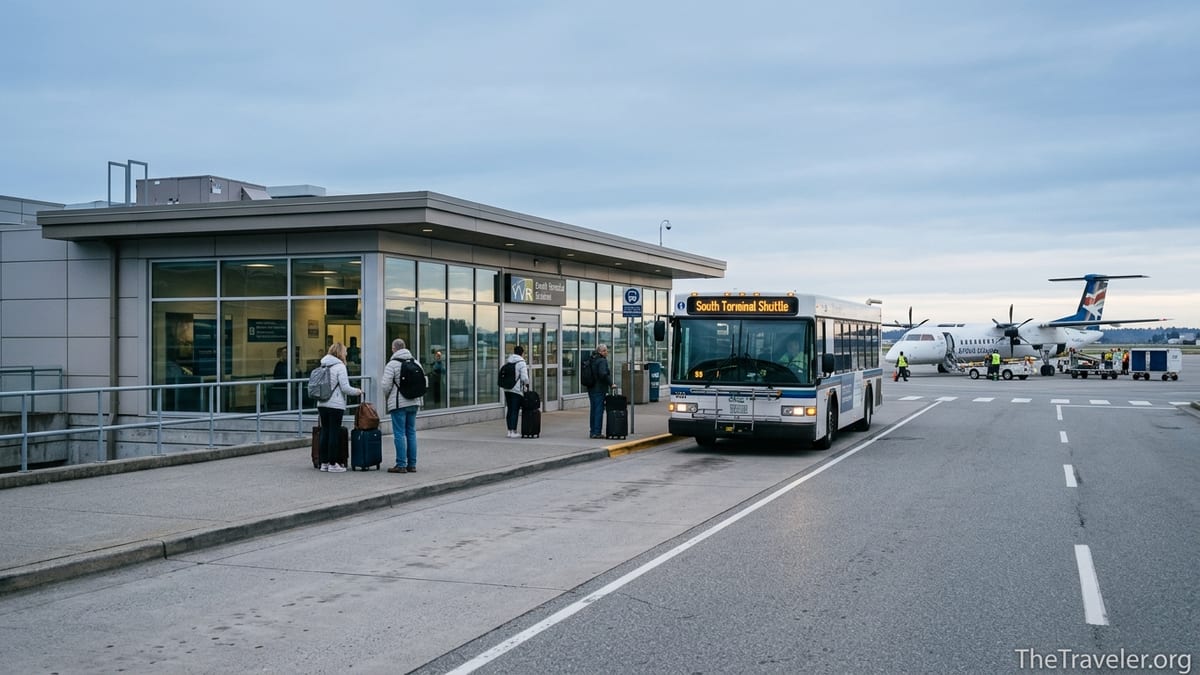
What and Where Is YVR’s South Terminal?
Airport South is a separate cluster of facilities at Vancouver International Airport that includes the South Terminal building and the public floatplane docks on the Fraser River. While the Main Terminal handles the big names like Air Canada, WestJet and international carriers, South Terminal focuses on regional and coastal services. It feels more like a relaxed regional airport than a major hub, with one compact check-in hall, short walking distances and quick security.
The South Terminal sits along Cowley Crescent on the south side of Sea Island, a short drive from the Main Terminal’s departures level. For context, it is roughly a 5 to 10 minute drive under normal traffic. That means you cannot simply walk there with luggage from the Main Terminal in any practical way; you will need a shuttle, taxi, rideshare or local bus.
Most scheduled flights at South Terminal are short-haul routes within British Columbia. Pacific Coastal Airlines, for example, bases its operations here and flies to communities such as Powell River, Bella Bella and Comox. Central Mountain Air uses the terminal for services to places like Campbell River and Quesnel. Smaller carriers, corporate charters and some mining or fishing camp flights also move in and out of this building throughout the day.
Along the riverbank, still counted as part of Airport South, floatplane operators such as Seair Seaplanes and other coastal carriers connect YVR to destinations like Nanaimo, the Gulf Islands and Sechelt. Floatplane passengers generally check in at separate docks a few minutes’ walk or a brief shuttle ride from the South Terminal itself, but for ground access they rely on the same general Airport South transport options.
Airlines and Flights That Actually Use South Terminal
The most important step in avoiding wrong-terminal headaches is knowing whether your airline uses the South Terminal or the Main Terminal. If you are flying a regional route booked through a smaller carrier, always double-check the confirmation email: if it says “Terminal South” or “South Terminal,” you must plan to go to Airport South and not the big glass Main Terminal building.
As of 2026, South Terminal’s scheduled traffic is dominated by regional airlines operating within British Columbia. Pacific Coastal Airlines runs many of its routes from here, including popular links between Vancouver and communities on Vancouver Island, the Sunshine Coast and the Central Coast. Central Mountain Air uses the same building for routes to interior towns and resource communities. Other operators such as North Cariboo Air and Iskwew Air may run charter or scheduled services tailored to work crews, Indigenous communities or remote destinations.
Floatplane services linked to Airport South typically operate from their own docks. Seair Seaplanes, for instance, flies to island destinations that are not served by runways, while Harbour Air and other operators maintain bases nearby. These companies will spell out whether you need the “YVR South” floatplane base or downtown Vancouver’s harbour terminal, but many travelers glance at the word “Vancouver” and assume they should go to the Main Terminal attached to the SkyTrain. That is one of the most common and costly mistakes.
Real-world example: a traveler booked a Pacific Coastal flight from Vancouver to Bella Coola and took the Canada Line all the way to YVR-Airport Station, following signs to Domestic Departures. Only at the check-in screens did they realize that their flight number was not listed. Airport staff then explained that Pacific Coastal departs from South Terminal, not from the Main Terminal. By the time the traveler caught the courtesy shuttle across Sea Island, check-in had closed and they had to pay a change fee to travel the next day. Simply noticing “Terminal: South” on their ticket could have saved an entire day of vacation.
How to Reach South Terminal from the Main YVR Terminal
If you land at YVR’s Main Terminal and need to catch a regional or floatplane connection from South Terminal, the standard option is the free South Terminal Courtesy Shuttle. The airport operates this service between the Domestic and International check-in areas and Airport South, circling roughly every 20 to 30 minutes across most of the day. Schedules can vary slightly by day of the week and season, so always allow margin rather than timing it to the minute.
From the Main Terminal, the shuttle pick-up points are on Level 3, the same level as departures. One stop is near the Domestic check-in counters and another near the U.S. transborder and International check-in zone. Inside the terminal, follow overhead signs that mention “Courtesy Shuttles” or ask any airport volunteer in a green jacket to point you toward the South Terminal bus. Outside, you will see several different hotel and parking shuttles; the one you want is clearly marked “South Terminal” or “Airport South,” often labeled A1 on its route card.
The ride itself usually takes about 10 to 15 minutes, depending on traffic and how many intermediate stops the driver makes, such as at airport parking or the floatplane dock. At busier times or during construction, the loop may take a little longer. Travelers on recent routes have reported that luggage pickup at South Terminal can take around 10 minutes after landing, and then a further 15 minutes to ride the shuttle back to the Main Terminal when connecting to a larger airline. Translated into connection planning, that means you should not schedule a self-connecting itinerary that leaves only 60 minutes between a regional arrival at South Terminal and an onward international departure from the Main Terminal.
If you are tight on time, taxis and rideshares are readily available outside both terminals and can cover the distance in well under 10 minutes in light traffic. For example, if a South Terminal arrival was delayed and you suddenly have only 75 minutes to clear security at the Main Terminal for a transborder flight, a taxi may be worth the approximate 10 to 20 Canadian dollars it will cost, depending on time of day and demand. The courtesy shuttle is free, but under real pressure many experienced travelers opt for a cab to remove uncertainty.
Getting to South Terminal via Bridgeport and Local Buses
Some travelers, especially locals or budget-conscious visitors, reach South Terminal directly without going into the Main Terminal at all. The most practical way to do this is to take the Canada Line SkyTrain to Bridgeport Station, in Richmond, and then transfer to the 412 Sea Island South bus. This bus runs between Bridgeport and the industrial and airport facilities on Sea Island, including stops near the South Terminal area.
At Bridgeport Station, bus bays are just outside the fare gates. Look for signs listing local routes and find the bay for the 412. This service is designed to connect workers and passengers to Sea Island South; it generally operates on weekdays with limited or no service on Sundays and some holidays, and often has modest frequency. Because schedules can change, travelers should check same-day times using TransLink’s trip-planning tools or customer service before relying on this option, especially for early morning or late evening flights.
Once on the bus, travel time from Bridgeport to the Airport South area is usually around 10 to 15 minutes. The stop closest to South Terminal is a short walk from the building along Cowley Crescent. This approach is particularly useful if you are coming from Richmond by bus or driving to a park-and-ride near Bridgeport, or if you want to avoid taking the Canada Line branch out to the Main Terminal just to backtrack on the courtesy shuttle.
For example, a traveler staying in downtown Vancouver might take the Canada Line to Bridgeport, ride the 412 to Sea Island South and then walk to South Terminal, arriving in about 40 minutes from the city center for the cost of a standard two- or three-zone transit fare. That is often cheaper than a taxi from downtown, which can easily exceed 40 to 50 Canadian dollars at peak times, and still avoids navigating the busy Main Terminal building entirely.
Parking, Drop-offs and Onward Ground Connections at South Terminal
Unlike the multi-level parkades at the Main Terminal, parking at South Terminal is straightforward and close to the building. YVR provides surface lots adjacent to the terminal itself as well as additional parking near the floatplane docks. Signage on Sea Island directs drivers to “Airport South” and then to specific lots for South Terminal or the Floatplane Facility. Rates at these lots have historically been lower than prime parking at the Main Terminal, though they can change and are usually posted at the lot entrance and on the airport’s official information channels.
Because the parking is only a short walk from check-in, many locals use South Terminal as an affordable base when flying to remote communities for work rotations or fishing trips. A contractor heading out on a Pacific Coastal flight to a Central Coast camp, for instance, might park for several days at the South Terminal lot and return directly to their car without ever setting foot in the Main Terminal. Floatplane passengers to the Gulf Islands often do the same, leaving a vehicle near the docks and using the airport shuttle only if they need to connect to a larger airline later.
At curbside, drop-offs and pick-ups work much like any small regional airport. Vehicles can stop briefly at the front doors to unload bags, and taxis typically line up in a small rank nearby. Rideshare pickup zones may be designated in the immediate vicinity or a short walk away, depending on current regulations. If you are connecting from South Terminal to an international flight at the Main Terminal and have plenty of time, you can take the free shuttle. If time is tight or you are managing bulky gear, such as fishing coolers or industrial equipment, pre-booking a taxi or larger rideshare vehicle can smooth the transfer.
On arrival at South Terminal, baggage claim is only steps from the exit. This compact layout means that door-to-curb time can be just a few minutes. However, the apparent simplicity sometimes lulls travelers into underestimating the onward journey. A guest landing on a late afternoon Central Mountain Air flight from the Interior, for example, might assume that connecting to a 6 p.m. WestJet departure from the Main Terminal is easy because “the airport is small.” In reality, luggage, shuttle wait times, traffic and security queues can quickly evaporate that cushion. Treat the journey between terminals as a genuine transfer, not just a quick stroll.
Classic Wrong-Terminal Mistakes and How to Avoid Them
By far the most common problem related to Airport South is simply turning up at the wrong terminal. This usually unfolds in a few predictable ways. One scenario is a traveler who books a ticket on a regional airline through a third-party website, sees “Vancouver” as the departure city and assumes all flights leave from the Main Terminal. They ride the Canada Line to YVR-Airport Station, check the departure boards, and cannot find their flight number. Only then do they discover that “Terminal South” was printed on the booking, often in small type towards the bottom of the confirmation.
A second recurring mistake involves floatplanes. Passengers see that their ticket says “Vancouver – Nanaimo” or “Vancouver – Ganges Harbour” and correctly understand they are on a seaplane, but they do not realize that YVR has a separate floatplane facility at Airport South. Many end up at the downtown Vancouver harbour floatplane terminal by mistake, or at the Main Terminal by SkyTrain, only to discover they should actually be at the South Terminal docks on the Fraser River. Fixing this error can require an expensive last-minute taxi or even rebooking if check-in closes.
The third common issue is underestimating transfer times between Main and South. Travelers sometimes construct self-connecting itineraries with only 60 to 90 minutes between a big-airline arrival at the Main Terminal and a separate ticket on a regional carrier from South Terminal. If the first flight is even slightly late, or if baggage claim and immigration take longer than hoped, the courtesy shuttle window can close quickly. Online discussions are filled with stories of people who missed their onward legs to the Central Coast or northern BC because they assumed a 10-minute drive meant a low-risk connection.
To avoid these pitfalls, always check three details when booking: first, which airline you are flying; second, which terminal is listed on your confirmation; and third, whether your itinerary is a protected connection on one ticket or two separate bookings. If you see Pacific Coastal, Central Mountain Air, Seair or other smaller carriers and the words “South Terminal” or “YVR South,” plan your journey to Airport South specifically. Build in at least two to three hours between an international or transborder arrival and a separate South Terminal departure, especially if you must collect and recheck luggage. Finally, when in doubt, contact the airline or YVR information desk in advance rather than assuming both terminals are the same place.
Practical Tips for Smooth South Terminal Connections
Successful use of Airport South comes down to preparation and a few realistic assumptions. First, treat any transfer between the Main Terminal and South Terminal as if you were changing airports within a city. The distance is short, but the variables are the same: vehicle availability, traffic lights, and security queues at the next departure point. If you would not book a 60-minute self-transfer between two airports on separate tickets, do not do it here either.
Second, always factor in shuttle frequency, not just travel time. While the ride might be 10 to 15 minutes, the courtesy shuttle typically runs every 20 to 30 minutes. If you happen to arrive just as it is leaving, your transfer suddenly doubles in length. Some travelers avoid this risk by defaulting to taxis when connections are under two hours. Others simply build in more time and use any surplus minutes at the Main Terminal to have a meal, visit a lounge or shop before clearing security.
Third, remember that Airport South functions at a smaller scale. This is usually an advantage: check-in lines are shorter, security feels calmer, and the gate area is compact. A family flying from YVR South to a fishing lodge, for example, can often arrive 60 to 75 minutes before departure and still clear formalities in good time. The drawback is that services such as cafes and shops are more limited and may close earlier in the evening, particularly outside peak summer season. If you are arriving hungry on a late flight, do not assume you will find the same variety of open restaurants as in the Main Terminal.
Finally, if you have mobility needs or bulky equipment, contact your airline in advance to confirm assistance arrangements at South Terminal and on the shuttle. The courtesy buses are designed to handle wheelchairs and mobility aids, but coordinating help before you arrive can make tight transfers more manageable. Many regional airlines serving Airport South are used to handling oversized gear, from fishing rods to industrial tools, yet their aircraft have tighter weight and size limits than larger jets. Clarifying what you can bring avoids last-minute repacking in the small departures hall.
The Takeaway
Vancouver International Airport’s South Terminal is one of the most important gateways to coastal and rural British Columbia, yet it remains invisible to many travelers until something goes wrong. Understanding that Airport South is a separate complex, served by its own regional airlines and floatplane docks, is the first step in planning a smooth journey. The free courtesy shuttle, the 412 bus from Bridgeport and straightforward parking options all make accessing the terminal relatively easy once you know where you are going.
Where travelers run into trouble is when they assume “Vancouver” means only the Main Terminal, ignore the words “Terminal South” on their ticket, or compress their transfer times to unrealistic levels. In practice, a bit of extra planning, a comfortable time buffer and a clear mental picture of how Sea Island is laid out are all it takes to avoid missed flights and last-minute taxi dashes.
Whether you are heading to a remote fishing lodge, visiting family in a small BC community, or crossing the Strait of Georgia on a floatplane, YVR’s South Terminal can be a stress-free starting point. Respect the distance between terminals, use the shuttles and buses wisely, and treat Airport South as its own airport within an airport. Do that, and this quiet corner of YVR quickly becomes one of the most user-friendly parts of your trip.
FAQ
Q1. How do I know if my flight uses Vancouver’s South Terminal?
Check your booking confirmation for the words “Terminal South” or “South Terminal,” and note the airline name. Carriers such as Pacific Coastal Airlines and Central Mountain Air generally operate from South Terminal, while larger airlines like Air Canada and WestJet use the Main Terminal. When in doubt, contact your airline or YVR information before you travel.
Q2. How long does the South Terminal shuttle take and how often does it run?
The free courtesy shuttle between the Main Terminal and South Terminal typically takes about 10 to 15 minutes of driving time. It usually runs roughly every 20 to 30 minutes during operating hours, though exact times can vary by day and season. Always allow for a possible wait rather than counting on a specific departure.
Q3. Where do I catch the South Terminal shuttle at the Main Terminal?
From Arrivals, go up one level to Departures (Level 3) and follow signs for “Courtesy Shuttles.” There are pick-up points near both the Domestic and International check-in areas. Outside, look specifically for the shuttle marked for “South Terminal” or “Airport South,” rather than hotel or parking shuttles.
Q4. Can I walk from the Main Terminal to South Terminal?
In practical terms, no. Although the distance is only a few kilometers, the route follows busy airport roads that are not set up for pedestrians with luggage. For safety and efficiency, you should use the free courtesy shuttle, a taxi, rideshare or the local 412 bus from Bridgeport Station instead.
Q5. Is 90 minutes enough time to self-connect between Main and South Terminal?
Ninety minutes can work in perfect conditions, but it is risky, especially if you must collect and recheck baggage or clear immigration. Many experienced travelers aim for at least two hours for domestic-to-domestic self-connections and three hours if an international arrival or departure is involved. Extra time provides a buffer for shuttle waits, traffic and security queues.
Q6. How do I get to South Terminal using public transit?
Take the Canada Line SkyTrain to Bridgeport Station in Richmond, then transfer to the 412 Sea Island South bus, which serves the Airport South area. The bus ride is usually about 10 to 15 minutes. Because schedules can change and some days have limited service, check same-day times with TransLink before relying on this route.
Q7. What are parking options at South Terminal?
South Terminal has surface parking lots located a short walk from the terminal and near the floatplane docks. These lots typically offer hourly and daily rates that are often lower than prime parking at the Main Terminal. Exact prices can change, so verify current rates via YVR’s official information channels or posted signs when you arrive.
Q8. Do airport hotels run shuttles to South Terminal?
Many nearby hotels operate courtesy shuttles to and from the Main Terminal, but fewer serve South Terminal directly. Some properties specifically note that their shuttles do not go to Airport South. If you are staying overnight before a South Terminal flight, confirm with your hotel whether they serve South Terminal or whether you will need a taxi, rideshare or to connect via the Main Terminal shuttle.
Q9. How early should I arrive at South Terminal before my flight?
For most regional flights, arriving 60 to 90 minutes before departure is usually adequate, as the terminal is small and queues are shorter than at the Main Terminal. However, if you are checking bags, traveling at peak holiday times or carrying special equipment, your airline may recommend arriving earlier. Always follow the guidance in your booking documents.
Q10. What happens if I show up at the wrong terminal for my flight?
If you reach the Main Terminal but your flight leaves from South Terminal, head immediately to the Level 3 courtesy shuttle stops or consider a taxi if time is very tight. If you arrive too late for check-in or security at South Terminal, airline staff will advise you on options, which may include same-day standby, rebooking or change fees. Acting quickly and explaining what happened gives you the best chance of salvaging your itinerary.