


Rome Fiumicino Airport, officially Leonardo da Vinci International Airport, is Italy’s busiest hub and the main gateway for long-haul flights into the country. Whether you are starting an Italian vacation, connecting between flights, or heading home after a few days in Rome, knowing what to expect at security, immigration, and customs can save you time, stress, and in some cases money. This guide walks you through each stage with real-world details, from where lines typically form to how the red and green customs channels work in practice.
Get the latest updates straight to your inbox!
How Rome Fiumicino Airport Is Laid Out
Rome Fiumicino Airport (FCO) currently operates mainly with Terminal 1 and Terminal 3, which are connected landside by indoor walkways and share a central rail station outside Terminal 3. Terminal 1 handles most domestic and Schengen-area flights, while Terminal 3 manages many non-Schengen and long-haul services, including routes to North America and Asia. This matters because your experience of security and passport control will differ slightly depending on which terminal and boarding area you use.
For example, if you fly ITA Airways from New York to Rome and then connect onward to Florence, you will typically arrive into Terminal 3, clear passport control and customs there, then follow the signs to domestic departures which lead you toward Terminal 1. By contrast, a traveler on a morning flight from Paris to Rome who is ending their journey in the city will arrive as a Schengen passenger and skip immigration, reaching baggage claim more quickly.
Most ground transport into Rome is centered on Terminal 3. The Leonardo Express train to Roma Termini, regional FL1 trains to stations like Trastevere and Tiburtina, and many coach services all depart from the rail station attached to Terminal 3 via covered walkways. In practical terms, even if you arrive or depart from Terminal 1, you will likely pass through the public areas of Terminal 3 at some point, especially when catching a train or meeting a pre-booked car service.
Understanding this layout makes the later stages much less confusing. If your boarding pass only lists “FCO Terminal 1” but your security fast track or QPass booking mentions “T3 Boarding Area E,” that usually means you will clear security and passport control in Terminal 3 before walking to your gate, even if check-in took place in Terminal 1.
Security Screening: What Actually Happens
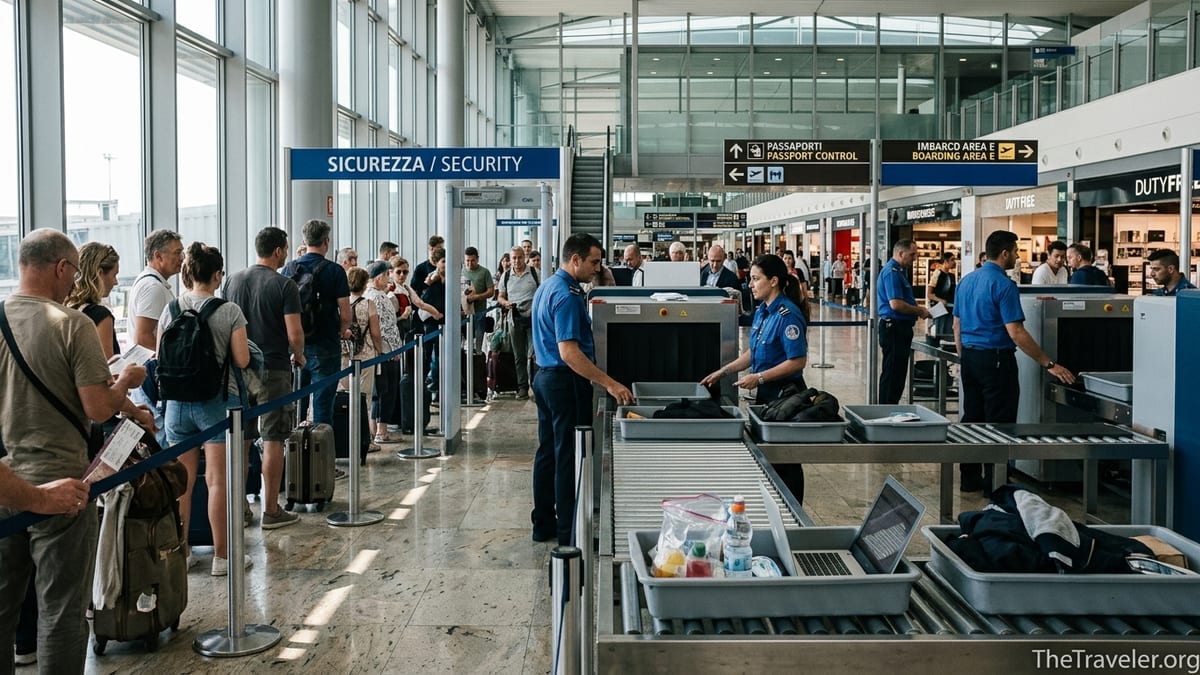
Security at Fiumicino follows standard European rules, but small details can vary depending on when the airport upgrades equipment in different lanes. As of mid-2026, most passengers should still expect the familiar 100-milliliter liquid limit in carry-on bags, packed in a clear plastic bag, along with the requirement to remove laptops and larger electronics from your luggage at the checkpoint. Travelers regularly report that security officers ask for laptops and tablets separately, and may request that you remove cameras or power banks from overly cluttered bags.
In a very practical sense, if you arrive for a morning flight to London from Terminal 1, you might encounter a busy but fast-moving security hall. You place your cabin bag, jacket, belt, and electronics in trays, walk through a metal detector or body scanner, and wait at the other end for your items. If your bag looks dense on the X-ray, staff may open it and ask questions such as whether you are carrying liquids, a large camera lens, or food products like jars of sauce or spreads. This process can take a few extra minutes, so keeping cables and gadgets organized helps speed things up.
Fast track and QPass services are widely advertised at Fiumicino. Fast track access is often included with business-class tickets or elite status, and dedicated lanes are located in Terminal 1 for Schengen flights and Terminal 3 for non-Schengen departures. QPass is a free reservation system offered by the airport operator that allows you to pre-book a time slot for an expedited security lane in Terminal 1 or 3. In practice, a traveler with an 08:30 QPass booking at Terminal 3 could arrive at Terminal 1 at around 07:30, follow the clearly marked corridor to Terminal 3 in 10 to 15 minutes, and then access the special lane indicated on their reservation.
Wait times vary. On a quiet weekday afternoon, some travelers report clearing security in under 10 minutes, while on peak summer Saturdays queues can snake back through the pre-checkpoint area, particularly for non-Schengen flights in Terminal 3. For most long-haul departures, arriving at the airport 3 hours before departure remains a sensible guideline, while 2 hours is usually sufficient for short-haul Schengen flights, unless you are traveling at peak holiday times such as August weekends or the Christmas and New Year period.
Immigration on Arrival: Schengen vs Non-Schengen
Your immigration experience at Fiumicino depends on whether you are arriving from within the Schengen Area or from a non-Schengen country such as the United States, the United Kingdom, Canada, or most parts of Asia and Africa. Passengers flying in from Schengen countries like France, Germany, or Spain are treated as domestic arrivals for border purposes and walk straight from the gate to baggage claim, passing only through doors marked “Arrivi / Arrivals” without a passport control checkpoint.
Non-Schengen passengers, by contrast, must pass through passport control before reaching the baggage hall. After disembarking from, say, an overnight flight from Boston or a midday arrival from Dubai, you follow the large “Passport Control” signs. Lines are usually separated into “EU / EEA / CH” for European citizens and another lane for “All Passports” or “Non-EU.” On busy mornings, lines for non-EU citizens can stretch significantly, and many recent travelers have reported waits of 45 to 90 minutes in peak hours, especially when several wide-body flights land close together.
Rome Fiumicino has been preparing for the European Entry/Exit System, an automated biometric registration process for non-EU visitors. While aspects of this system are being tested and gradually phased in, implementation has at times been paused or adjusted during busy travel waves to prevent excessive queues. In practice, that means you may see e-gates and fingerprint scanners in use on some days and traditional booths with human officers on others. If you are directed to a machine, typically you will scan your passport, have your face captured, and in some cases provide fingerprints before being cleared; if the system cannot complete your registration, staff will send you to a manual booth.
Passports are still generally stamped for non-EU arrivals, although occasional travelers have reported instances of biometric processing without a visible stamp. If you are concerned about documenting your stay for visa purposes, you can politely ask the officer to stamp your passport, but be aware that staffing conditions and system tests on the day may influence how strictly procedures are applied. Once cleared, you descend toward the baggage carousels, where large screens list flight numbers and belt assignments in both Italian and English.
Immigration on Departure and Transit Connections
On departure, whether you face passport control depends on your destination. If you are flying from Rome to another Schengen country, such as Germany or Portugal, you usually clear only security before going directly to your gate in a Schengen boarding area. When you fly to a non-Schengen country, such as the United States, the United Kingdom, or Japan, you go through security, then passport control, and finally enter the non-Schengen boarding area, most notably Boarding Area E in Terminal 3.
A typical example: a traveler flying Rome to Chicago with a scheduled departure at 12:00 might arrive at Terminal 3 at 09:00. They clear security in 20 minutes, then join a separate line for “Passport Control / Polizia di Frontiera.” Depending on how many long-haul flights depart around the same time, this line can sometimes be short, taking only 10 to 15 minutes, or quite long during mid-morning waves. After an officer checks and stamps the passport, the traveler walks through to the duty-free and restaurant zone of Boarding Area E and finds their gate.
For connecting passengers, Fiumicino has both airside and landside transfer flows. If you arrive from a non-Schengen country and connect to another non-Schengen destination without entering Italy, you may find yourself going through a simplified transfer security check and passport control in a dedicated area, then moving straight into the departure gates. If your connection involves moving from a non-Schengen flight to a Schengen one, you must clear normal immigration on arrival, then proceed to the Schengen departures area for your onward flight. Airlines typically schedule at least 90 minutes for such connections, but in busy seasons, a cushion of 2 hours or more is prudent.
One quirk at Fiumicino is that many passengers, even those connecting airside, may have to pass through security screening again when changing terminals or boarding areas. For instance, if you land from Madrid into a Schengen gate and connect onward to New York, you will typically pass immigration, follow transfer signs, and then encounter another security checkpoint before heading into the long-haul departure zone. This is normal at many European hubs and is not a sign that something has gone wrong with your connection.
Baggage Claim and Customs: Red and Green Channels in Practice
Once through immigration, all arriving passengers converge in the baggage hall. After collecting checked luggage from the assigned carousel, you move toward the exit where Italian customs officers operate a dual-channel system. One corridor is marked in green, typically with signs such as “Nothing to Declare,” while another is marked in red with wording along the lines of “Goods to Declare.” Choosing a lane is considered a legal declaration regarding what you are carrying.
In practice, most leisure travelers leaving Rome Fiumicino walk through the green channel with their suitcases, souvenirs, and duty-free wine below the allowed limits. A traveler who bought two bottles of Chianti Classico and some vacuum-packed cheese for personal use will almost always be fine in the green lane. Officers may watch passengers pass, occasionally pulling someone aside for a random inspection or questioning, but many people simply walk through and find themselves immediately in the public arrivals hall where shops, car-rental desks, and train connections are located.
You should choose the red channel if you are carrying large quantities of alcohol or tobacco beyond duty-free allowances, high-value new goods above tax thresholds, or any items that could be restricted or prohibited, such as certain animal products, large sums of undeclared cash, or commercial merchandise. For example, if you are returning from a trip where you purchased several luxury handbags in non-EU duty-free shops and your total exceeds the EU allowance, declaring them at the red channel allows customs to calculate any duties or taxes owed. While it may be tempting to walk through the green lane, doing so with goods that should be declared can result in fines and seizure of items if you are checked.
Customs controls at Fiumicino are usually low-key, but officers retain broad powers. That means that even in the green lane, you might be stopped and asked about the contents of your bags. Travelers have occasionally reported questions about expensive electronics in sealed boxes, large numbers of cigarette cartons, or multiple identical items that look like stock rather than personal purchases. Keeping receipts easily accessible and packing restricted food items in one place can reduce delays if you are selected for an inspection.
Timing Your Arrival at the Airport
Deciding when to arrive at Fiumicino before a flight is one of the most practical concerns for travelers. As a rule of thumb, 2 hours before departure for Schengen flights and 3 hours for non-Schengen or long-haul routes is sensible. However, during peak travel periods such as late June through August, long weekends, and Christmas holidays, many experienced travelers give themselves extra buffer time, especially for early morning or mid-morning departures when dozens of flights can be scheduled within a short window.
For instance, a family on a summer Saturday flight from Rome to Toronto at 10:30 might plan to reach Terminal 3 by 07:30. That allows time to check bags, navigate a potentially crowded security area, process through passport control, and still have a short break before boarding. If everything goes smoothly and lines are minimal, it simply means more time for a sit-down breakfast or a last Italian espresso in the departure lounge. Conversely, if something goes wrong, such as a temporarily suspended biometric system or an understaffed security hall, the extra hour could make the difference between catching the flight and missing it.
Passengers using fast track or QPass can often safely trim these margins a little, but they should still be conservative on days when travel demand is obviously high. Remember that traffic on the highway between central Rome and Fiumicino can be unpredictable in the early morning or late afternoon, and trains such as the Leonardo Express, while usually reliable, can occasionally be delayed or temporarily suspended, creating backlogs at the airport station. Checking transport conditions the night before and allowing a cushion for unexpected disruptions remains wise.
On arrival, the time required to leave the airport and reach central Rome depends heavily on immigration queues and baggage delivery. On a quiet afternoon flight from within the Schengen Area, a traveler with only hand luggage might walk from the aircraft door to the Leonardo Express train platform in under 25 minutes. On the other hand, a full wide-body arrival from North America in summer, with long passport-control lines and checked bags, can easily stretch that to 60 to 90 minutes before you even reach the train station. Planning dinner reservations or onward trains accordingly can save frustration later.
Common Pitfalls and How to Avoid Them
Many frustrations at Fiumicino are avoidable with a bit of preparation. One frequent issue is underestimating security lines at peak times, particularly for non-Schengen departures to North America. Travelers who arrive less than two hours before scheduled departure during busy summer mornings sometimes find themselves sprinting through the terminal as boarding begins. Booking an earlier train or taxi, checking the terminal information on your ticket, and keeping documents ready at each checkpoint reduces last‑minute stress.
Another pitfall involves liquids and food in carry-on bags. Tourists often buy last-minute gifts such as jars of pesto, truffle spreads, or limoncello in central Rome, then forget they count as liquids at security. If you place a 200‑milliliter jar of sauce in your cabin luggage, chances are high it will be removed at screening unless it was purchased airside after the checkpoint. Buying these items in the duty-free area near your gate, or checking them in hold luggage, avoids awkward conversations and forfeited purchases at the scanner.
Some visitors misinterpret the customs green lane as a guarantee that they will not be inspected. While most passengers do pass straight through, customs officers still make spot checks, particularly on travelers pushing heavily loaded trolleys stacked with identical boxes or bags from high-end boutiques. If you have made substantial purchases, it is safer to choose the red channel and ask. Likewise, carrying restricted animal products such as large quantities of cured meats or unpasteurized cheeses can lead to confiscation even if they were legally sold in shops elsewhere in Italy.
Finally, anxiety about the evolving Entry/Exit System can lead travelers to overreact to news stories about long queues. While there have been days with extended waits at immigration, authorities at Rome’s airports have shown a willingness to adjust or temporarily suspend parts of the system to keep lines moving. From a practical standpoint, the best response is not to panic but to build extra time into your schedule and bring small comforts such as water (purchased after security or filled from fountains), a snack, and patience for the final formalities before your holiday truly begins.
The Takeaway
Rome Fiumicino is a large, busy, and generally well-organized airport, but like any major European hub, it can feel overwhelming when you are jet-lagged or racing a tight connection. Understanding the basic layout of Terminals 1 and 3, the difference between Schengen and non-Schengen flows, and how the red and green customs channels work will help you move with confidence instead of confusion.
Security checks follow familiar European patterns, with liquids and electronics still attracting attention, while immigration procedures vary depending on your passport and origin or destination. Customs is typically a formality for most tourists, though it remains important for anyone carrying duty-liable or restricted items. Across all stages, arriving earlier than you think you need to, organizing your bags, and keeping documents handy are small steps that pay off in reduced stress.
With realistic expectations and a little planning, Rome Fiumicino becomes less of an obstacle and more of a final or first taste of Italy: an espresso at the gate, a glimpse of the runways from the glass walkways, and, before long, a smooth journey into the city or onward to your next destination.
FAQ
Q1. How early should I arrive at Rome Fiumicino before my flight?
For most Schengen flights, aim for at least 2 hours before departure; for long-haul or non-Schengen flights, 3 hours is advisable, and more during peak summer or holiday periods.
Q2. Are the 100‑milliliter liquid rules enforced at Fiumicino security?
Yes, you should still assume standard European liquid rules apply, meaning containers up to 100 milliliters in a clear bag, with larger containers placed in checked luggage or bought airside.
Q3. Do I always have to go through passport control when I land in Rome?
You pass through passport control if you arrive from a non-Schengen country; if you fly in from within the Schengen Area, you typically go straight to baggage claim without an immigration check.
Q4. How long do immigration lines usually take at Fiumicino?
Waiting times vary widely, from around 15 minutes on quiet days to 60–90 minutes during busy periods when several long-haul flights arrive close together, especially for non-EU passport holders.
Q5. What is the difference between the red and green customs channels?
The green channel is for passengers with nothing to declare and goods within personal allowances, while the red channel is for travelers carrying items that may require declaration, such as high-value purchases or large quantities of alcohol or tobacco.
Q6. Is fast track or QPass at Fiumicino worth using?
For early morning or peak-season departures, fast track or a QPass reservation can significantly shorten security queues, making them particularly useful if you value extra time airside or are traveling with children.
Q7. Will I have to pass security again if I am connecting through Rome?
Often yes; many transfer routes at Fiumicino involve re-clearing security, especially when changing from one terminal or boarding area to another, so plan your connection time accordingly.
Q8. Are passports still stamped at Rome Fiumicino?
Non-EU travelers are generally still stamped on entry and exit, although increased use of biometric systems means some procedures are evolving; if you need a visible stamp, you can politely request one at the booth.
Q9. Can I bring Italian wine and food through customs when I leave?
You may usually take modest quantities of wine, spirits, and packaged food for personal use, but check your home country’s import rules and use the red channel if you are carrying large amounts or high-value goods.
Q10. What is the best way to get from Fiumicino into central Rome after clearing customs?
Most travelers use the Leonardo Express train to Roma Termini, regional FL1 trains to other stations, or pre-booked car services and taxis from the ranks outside Terminal 3, choosing based on budget, luggage, and final destination.