


The Bay of Kotor concentrates a remarkable range of stays in a compact space: medieval lanes inside the old city walls, quiet stone villages facing glassy water, and modern marina hotels near the airport. Choosing the right base can shape everything from how often you sit in traffic to whether you wake up to church bells or cruise ship engines. This guide compares the main areas where visitors actually stay around Kotor today, with a focus on real walking times, parking realities, views, cruise crowds, nightlife and how user friendly each area is for families.
Get the latest updates straight to your inbox!
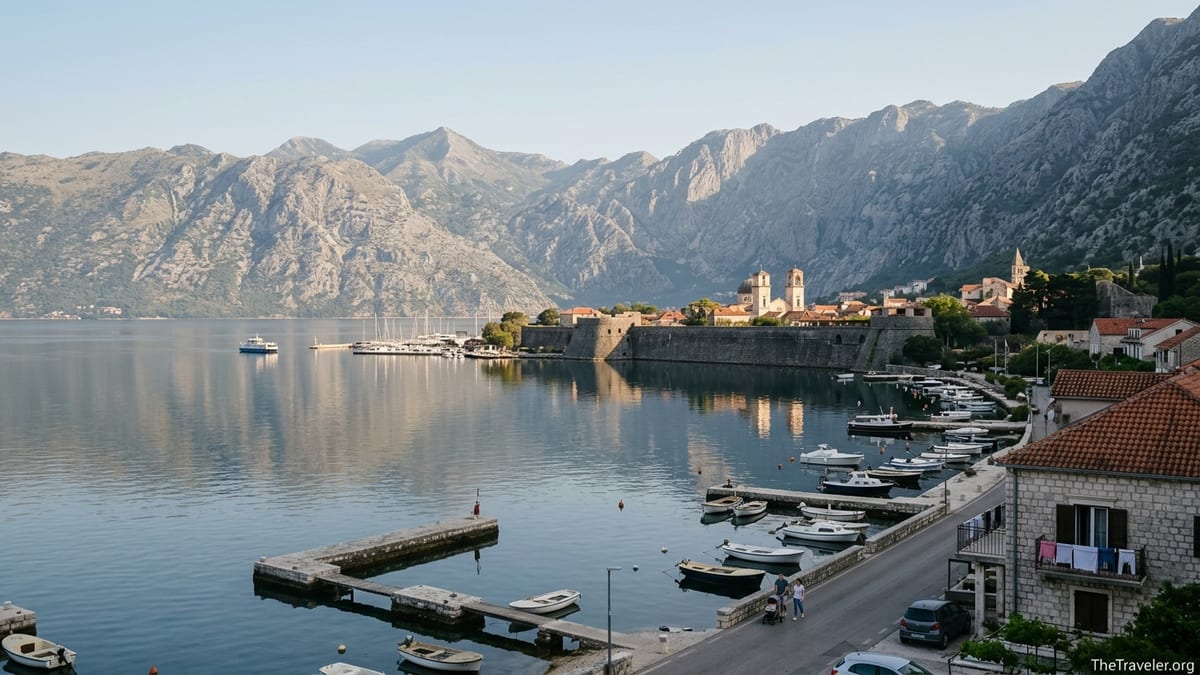
How Kotor Is Laid Out and Why Your Base Matters
Kotor itself sits at the very back of the bay, enclosed by steep grey mountains and ringed by a narrow strip of waterfront development. The medieval Old Town is small and walled, pressed between the hillside and the sea. Immediately outside the walls is the marina and waterfront strip with a few hotels and parking lots. From here, the main coast road runs north toward Dobrota and Perast, and south and west toward Muo, Prčanj and eventually Tivat.
Because the bay road is single carriageway and often congested in summer, distances that look short on a map can take 20 to 40 minutes by car. A village that is only a few kilometres away in a straight line can mean a long, slow loop by road, especially when cruise ships are in port and tour buses are queued at the Old Town gates. That is why many local guides advise first deciding whether you want to be inside the walls, on the immediate waterfront, or in one of the car friendly villages like Dobrota, Muo, Prčanj, Perast or Tivat rather than just looking at price.
Public transport does exist, mostly in the form of the Blue Line minibus that runs along the bay between Kotor, Dobrota and Perast, and regional buses that continue to Herceg Novi or Budva. There are also seasonal eco boats shuttling between Kotor, Prčanj and Tivat. In practice though, many visitors with luggage or children rely on a mix of walking, taxis and occasional buses. If you are driving, hotel parking rules the decision, because official parking around the Old Town is limited, almost always paid, and can fill quickly on peak summer days.
In broad terms, Old Town is best for short stays and atmosphere, the immediate waterfront is a compromise option when you want fast access with fewer steps, Dobrota is the all rounder for views and family friendly swimming, Muo and Prčanj are for peaceful retreat across the water, Perast is the upmarket romantic choice, and Tivat works well for airport access, marinas and families who also want beaches and playgrounds.
Staying Inside Kotor Old Town: Atmosphere vs Noise and Parking
Sleeping inside Kotor’s UNESCO listed Old Town suits first time visitors, history lovers and anyone happy to trade some comfort for setting. The area inside the walls is fully pedestrianised; you enter through one of the stone gates and wheel your suitcase over polished cobbles past the Cathedral of Saint Tryphon and tiny piazzas lined with cafes. At night, once cruise ship excursion groups leave, the lanes empty out and you get the cinematic experience of strolling the ramparts or grabbing a late drink under softly lit church towers.
Old Town hotels are mostly small boutique properties or converted stone houses, such as Hotel Astoria or Villa Duomo, along with numerous apartments on platforms like Booking and Airbnb. Mid range doubles in shoulder season typically start somewhere in the range of 90 to 150 euros, rising higher in July and August for well reviewed places with larger rooms. Rooms are often compact, with thick stone walls but relatively little sound insulation, and some look onto internal alleys rather than the bay. You are paying for atmosphere and location more than facilities like pools or private parking.
The trade off is noise, stairs and logistics. Church bells start early, and in high season music from bars can echo until after midnight, especially near squares like Trg od Katedrale. There is no on site parking inside the walls; hotels rely on the paid municipal lots outside, such as the large parking area near the main Sea Gate or smaller lots along the waterfront. Prices can change but guests frequently report allocating a daily budget for parking during the summer. If you are arriving by rental car and staying in Old Town, it is worth emailing your accommodation in advance for the most reliable parking suggestion and directions, then packing light so one person can park while the other wheels bags in.
Walking distances from inside the Old Town are excellent for sightseeing. The main bus station is roughly 10 to 15 minutes on foot, the lower fortress trailhead is inside the walls, and almost all restaurants are under a ten minute stroll. For a short city break of one or two nights without a car, Old Town is the most convenient choice, especially outside of peak summer when cruise crowds thin and evenings are quieter.
Waterfront Just Outside the Walls: Fast Access and Short Walks
Immediately outside Kotor’s walls is a narrow strip of waterfront that includes the marina, a line of cafes and a cluster of hotels and apartments. This area suits travelers who want to be within a 5 to 10 minute flat walk of the Old Town gate but prefer slightly easier luggage access and potentially a little more space. It is also where day boats leave for trips to Our Lady of the Rocks and speedboat tours along the bay, so you can roll out of bed and onto the dock.
Typical examples in this zone include larger hotels like Hotel Porto In behind the marina and various waterfront apartments facing the large cruise berth. Many of these properties advertise private parking or at least reserved spaces in nearby lots. Having a guaranteed spot is a significant advantage if you are using Kotor as a base to day trip to places like Lovćen, Budva or Lake Skadar, because you avoid doing laps looking for an open space every evening.
Views from the waterfront vary. On one hand, you enjoy the drama of the bay and the illuminated city walls at night. On the other, if a large cruise ship is docked, your balcony may look directly at steel hull rather than water for part of the day. Cruise arrivals also mean more coach traffic right in front of these hotels in the morning. By late afternoon and evening the road usually quietens, and you regain more of the waterside charm.
For families with strollers or travelers with limited mobility, this strip can be more comfortable than staying up and down Old Town staircases. Sidewalks are still narrow and the road is busy by Mediterranean standards, but it is mostly flat, and you are close to supermarkets, bakeries and the bus station without climbing steep lanes. The downside is that nightlife is modest; you will generally be walking into Old Town for most dining and bars, which is easy enough given the short distance.
Dobrota: The Practical All Rounder for Views, Swimming and Families
Dobrota begins just north of Kotor and runs for several kilometres along the inner bay. It is effectively Kotor’s waterfront suburb, with a mix of traditional stone captain’s houses, mid rise apartment buildings and modern boutique hotels. For many repeat visitors, it is the sweet spot: quieter than Old Town at night, with wide open bay views and more swimming spots, yet still close enough that you can walk or hop on a quick bus into town.
Accommodation here covers everything from simple waterside studios around 50 to 80 euros in shoulder season to high end boutique hotels like Forza Mare with private docks and small pools. Many apartments and guesthouses come with on site parking, which is ideal if you have a rental car. The bayfront road can still be busy, but there is usually a narrow promenade or path at the water’s edge where people stroll in the evening, children ride bikes and locals swim from stone jetties.
Walking time from lower Dobrota to Kotor Old Town is roughly 20 to 30 minutes for most visitors, depending on where exactly you stay. Some travellers treat the walk as a highlight: a scenic, flat stroll along the sea at sunset, passing small churches and waterside bars. Others find it long after a hot day of sightseeing, particularly with younger children, and prefer to use the local Blue Line bus or a short taxi ride, which is usually reasonably priced for such a short hop.
Dobrota works well for families and longer stays. You can combine lazy bay days with old town visits, and you are slightly removed from the peak cruise ship crowds. It is easier here to find supermarkets with parking, self catering apartments with kitchens, and child friendly swimming spots right in front of your accommodation. If you are visiting in July or August and want a balance of convenience, parking and sleep quality, Dobrota is often a safer bet than the enclosed alleys of the Old Town.
Muo and Prčanj: Quiet Villages Across the Water with Big Views
Across the bay from Kotor and Dobrota are the small villages of Muo and Prčanj. They face the Old Town head on, which means many accommodations here offer some of the most dramatic postcard views in the area: Kotor’s walls climbing the mountain, the bell towers, and the curve of the inner bay all in one frame. If you are seeking a quiet base with a strong sense of being in a small community rather than a tourist hub, this side of the bay is appealing.
Muo is the closer of the two to Kotor, essentially a ribbon of houses along the water with the mountains rising steeply behind. Depending on where exactly you stay in Muo, walking into Kotor Old Town typically takes somewhere between 20 and 35 minutes at a normal pace. The road is narrow and traffic can be steady, so some visitors prefer to use taxis, especially after dark. Properties in Muo range from simple waterfront apartments to small hotels like Sind, many with parking and terraces directly over the water where people swim and sunbathe.
Prčanj lies further along the same road, about 5 kilometres from Kotor. It is a historically important maritime town with a striking baroque church, stone palaces and long lines of jetties. In practical terms, staying here means accepting that you will not stroll into Kotor; the road has limited pavements, and with children or at night it is more realistic to take the bus, boat or a taxi. Many regular visitors recommend Prčanj for those with a car who want peaceful evenings, bay breezes and local konoba restaurants, and are happy to turn Kotor Old Town into a planned outing rather than a casual wander.
Both Muo and Prčanj score highly for parking compared with central Kotor. Most villas and guesthouses offer on site spaces, sometimes on terraces cut into the hillside above the house. Families appreciate quieter nights, space for children to play by the water and easier access to swims without crossing busy roads. On the downside, there is almost no nightlife beyond a few low key bars and seaside restaurants, and public transport is thinner than in Dobrota. If you are travelling without a car and want to go out frequently in Kotor at night, Dobrota or the immediate waterfront is usually more convenient than this side of the bay.
Perast: Romantic Base with Limited Parking and Less Old Town Access
Perast, about 15 minutes’ drive north of Kotor, is often described as the most beautiful town on the bay. It is a compact strip of stone palaces and churches along the water, facing the small islands of Sveti Đorđe and Our Lady of the Rocks. Cars are not allowed to drive along the main waterfront in the centre, which keeps it atmospheric and relatively calm even in high season. Visitors park at lots on either side of town and then walk in or use small electric carts and boats arranged by their accommodation.
The upside of staying in Perast is romance and quiet. Luxury conversions like Heritage Grand Perast occupy historic palazzi with terraces looking across to the islands, while mid range guesthouses and apartments often have shared stone terraces or small private jetties. Evenings tend to be low key; the main activity is dining on the waterfront and watching the light shift on the mountains. Families with older children often enjoy the boat trip out to Our Lady of the Rocks and swims from the concrete platforms and tiny shingle beach.
Practical downsides include parking and distance from Kotor’s Old Town. In peak summer, day visitors fill the public lots quickly and daily parking fees apply. Some hotels and apartments hold a small number of private spaces, but it is vital to confirm this before booking if you are driving. Without guaranteed parking, you may find yourself walking uphill with bags from whichever lot has space. In addition, Perast does not have the same frequency of buses as Dobrota; there are services along the bay road, but for evenings in Kotor you are usually looking at a taxi or driving yourself, which takes time and requires a sober driver if you enjoy wine with dinner.
For many travelers, Perast works best as a one or two night romantic splurge or as a day trip from Kotor or Dobrota rather than a base for exploring the wider region. If your priority is to wake up to island views, swim from a stone dock and avoid cruise crowds as much as possible, Perast is an excellent choice, particularly outside July and August. If you want easy, repeated access to Kotor Old Town and the flexibility to come and go without thinking about parking, it is less ideal.
Tivat: Airport Access, Marinas and Family Convenience
Tivat sits on the outer bay, about 20 to 30 minutes by car from Kotor depending on traffic and ferry timings. It has Montenegro’s coastal airport, a growing marina development and a more modern waterfront feel compared with medieval Kotor. While it lacks the fortified charm of the Old Town, Tivat is increasingly popular with families and travelers who prioritise easy arrivals, beaches and resort style facilities over sleeping under ancient stone.
Stays here range from apartment blocks in residential neighbourhoods to upscale marina hotels with pools and kids’ clubs. Many properties have on site or underground parking, and streets are generally wider than in Kotor’s inner bay villages. There are small pebble and concrete beaches within walking distance of central Tivat, as well as playgrounds, green spaces and a traffic free promenade where children can cycle and scooter safely. For visitors flying into Tivat Airport for a short break, basing here can mean being by the water within minutes of landing.
The trade off is that you are no longer looking straight at Kotor’s cliff hugging walls; the scenery is still impressive, but in a broader, more open bay. Reaching Kotor Old Town without a car involves regional buses or seasonal boat services, both workable but slower than simply being able to stroll in from Dobrota or the waterfront opposite the walls. With a car, it is straightforward to day trip to Kotor, Perast, Lustica Peninsula beaches or up into the mountains, and in the evening you return to a town with more space, modern supermarkets and less medieval charm but often more practical amenities.
Tivat suits several types of traveler. Families who want playgrounds and level promenades, sailors and yacht crews, and anyone catching early or late flights from Tivat Airport will find it convenient. It is less suited to visitors who dream specifically of waking up inside a walled town and wandering cobbled alleys before breakfast. For many, a good compromise is to split a trip: a couple of nights in Kotor or Dobrota for history and fortress hikes, and a couple of nights in Tivat or on nearby beaches for a more classic seaside break.
Parking, Traffic, Cruise Crowds and Nightlife: What to Expect
Parking and traffic are the most underestimated factors in planning a stay around Kotor. Inside the Old Town there is no parking at all, while the adjacent waterfront lots operate on paid daily or hourly rates and can fill by late morning on cruise ship days. Dobrota, Muo, Prčanj and Perast mostly rely on on street parking and private spaces belonging to guesthouses, with a few public lots. Tivat has a more conventional coastal town layout with a mix of street and garage parking, generally easier to manage than Kotor’s inner bay villages.
In high season, cruise ships can disgorge thousands of passengers for several hours. The immediate area around the Sea Gate and waterfront cafes becomes crowded with tour groups and coaches. If you are staying inside the walls, mornings and early afternoons can feel busy, but crowds fade toward evening as day trippers depart. In Dobrota, Muo, Prčanj and Perast you will notice surges at mid morning and mid afternoon as boat tours come and go, but the general rhythm is calmer. Tivat, being slightly removed, feels the least affected by Kotor’s cruise schedule.
Nightlife in Kotor is modest rather than wild. Old Town concentrates most of the bars and late opening cafes, with occasional live music and DJs in summer. Noise sensitive travelers may want to avoid rooms directly overlooking main squares. Outside the walls, the waterfront strip, Dobrota, Muo and Prčanj offer mostly low key seaside bars and restaurants where evenings revolve around dinner and drinks by the water rather than clubs. Perast is subdued at night and largely couples focused. Tivat has a handful of marina bars with a more polished, international feel but still nothing on the scale of large party resorts elsewhere on the Adriatic.
Families, especially those with young children, often report feeling most comfortable in Dobrota or Tivat. Both offer reasonably flat promenades, easier parking, more supermarkets and a range of self catering apartments. Old Town can work well for a short stay with older children who enjoy climbing the fortress and exploring narrow lanes, but strollers and very early bedtimes can be a challenge with noise and stairs. Villages like Muo and Prčanj give you peaceful nights and safe swimming off jetties but require more planning for transport and dining options.
The Takeaway
Choosing where to stay around Kotor is less about finding a single “best” area and more about matching the bay’s distinct personalities to your own travel style. If you value medieval atmosphere, walking access and short stays without a car, sleeping inside the Old Town or just outside the walls delivers that enclosed, historic feel at the cost of noise and parking. If you want views, swimming and easier logistics for a week with family, Dobrota’s long waterfront, mix of apartments and hotels, and relative calm after dark make it a strong all rounder.
Those who dream of seeing Kotor’s skyline from across the water, and who like quiet evenings punctuated only by church bells and waves, may gravitate toward Muo or Prčanj, ideally with a car and a willingness to treat Kotor as a deliberate outing rather than a casual evening stroll. Couples looking for a romantic escape might choose Perast, trading distance from Kotor for island views and car free lanes. Travelers flying into Tivat or wanting more modern amenities and a softer introduction to Montenegro’s coast could base themselves there, folding Kotor and the inner bay into day trips rather than the other way around.
Whichever area you choose, it is wise to check in detail whether your accommodation includes on site parking, how far it is on foot to the Old Town gate, and whether there is a safe promenade or only a busy road outside the door. Those small, concrete details often matter more than the label on the map. With a bit of planning, you can wake to the version of the Bay of Kotor that fits you best, whether that is a quiet jetty in a stone village or a bell tower chiming above a medieval square.
FAQ
Q1. Is it better to stay in Kotor Old Town or Dobrota?
For a short, car free stay focused on history and nightlife, Old Town is better because everything is at your door. For longer visits, especially with a car or children, Dobrota usually wins with easier parking, quieter nights and more space while still being a walk or short bus ride from the Old Town.
Q2. Can I stay in Kotor without renting a car?
Yes. If you stay in or just outside the Old Town, or in lower Dobrota, you can walk to most sights and use local buses, boats or taxis for Perast and nearby villages. A car becomes more useful if you base yourself in Muo, Prčanj or further along the bay, or if you plan many day trips into the mountains.
Q3. How hard is it to find parking near Kotor Old Town?
Parking near the Old Town is limited and usually paid, and in July and August the main lots can fill by late morning when cruise ships are in port. Many visitors prefer to book accommodation that includes its own parking in Dobrota, Muo or Prčanj and then walk or taxi into the Old Town to avoid parking stress.
Q4. Which area has the best views of Kotor’s walls and bay?
The strongest panoramic views are from across the water in Muo and Prčanj, where many balconies and jetties face directly toward Kotor’s walls and the curve of the inner bay. Parts of Dobrota also have excellent views, but not always with the same straight on angle toward the Old Town skyline.
Q5. Is Perast a good base for visiting Kotor?
Perast works as a base if you value romance, island views and quiet nights more than frequent visits to the Old Town. It is roughly 15 minutes’ drive from Kotor, and public parking fills quickly in summer, so you will likely rely on a car or taxis and plan your visits to Kotor rather than popping in spontaneously.
Q6. Where should families with young children stay around Kotor?
Dobrota and Tivat are often the most practical choices for families. Both offer relatively flat promenades, easier parking, more supermarkets and plenty of apartment style accommodation. Old Town can be fun with older children but involves stairs, crowds and more evening noise, while Muo and Prčanj are quieter but require more transport planning.
Q7. What area is best if I want some nightlife?
Most of Kotor’s nightlife is concentrated in the Old Town, with bars and cafes that stay open late in summer. Staying inside the walls or just outside them makes it easiest to walk back to your room at night. Dobrota has a few waterfront bars but is generally calmer, while Muo, Prčanj, Perast and Tivat are more about low key evenings than clubbing.
Q8. How far is the walk from Dobrota to Kotor Old Town?
From lower Dobrota, many visitors report a walk of roughly 20 to 30 minutes along the waterfront to the Sea Gate of Kotor Old Town. The route is mostly flat and scenic but can feel long in the heat or with small children, so some people mix walking one way with a short taxi or local bus ride the other.
Q9. Is Tivat a good alternative to staying in Kotor?
Tivat is a good alternative if you are flying into its airport, traveling with family, or prefer a modern marina town to a medieval walled city. You get beaches, promenades and easier parking, and can visit Kotor Old Town as a day trip. If your dream is to be inside historic alleys, however, Kotor or Dobrota will feel more atmospheric.
Q10. Do I need to worry about cruise ship crowds when choosing where to stay?
Cruise ship crowds mainly affect the area immediately around Kotor’s Old Town and waterfront during late morning and early afternoon. Staying in Dobrota, Muo, Prčanj or Perast puts you slightly away from the heaviest foot traffic. If you do sleep in Old Town, you can still avoid the worst of the crowds by exploring early in the morning or later in the evening.