


As of November 13, 2026, the South Korean government has extended its temporary Korea Electronic Travel Authorization (K-ETA) exemption for selected nationalities through December 31, 2026. This means that many travelers can still enter visa free without obtaining a K-ETA during 2026. However, this extension explicitly lasts only until the end of 2026 and does not, by itself, decide what will happen from January 1, 2027. Any reliable 2027 K-ETA guidance must therefore be based on a fresh official announcement from the Korean Ministry of Justice or the official K-ETA portal that confirms either a new extension or a return to standard K-ETA requirements.
Get the latest updates straight to your inbox!
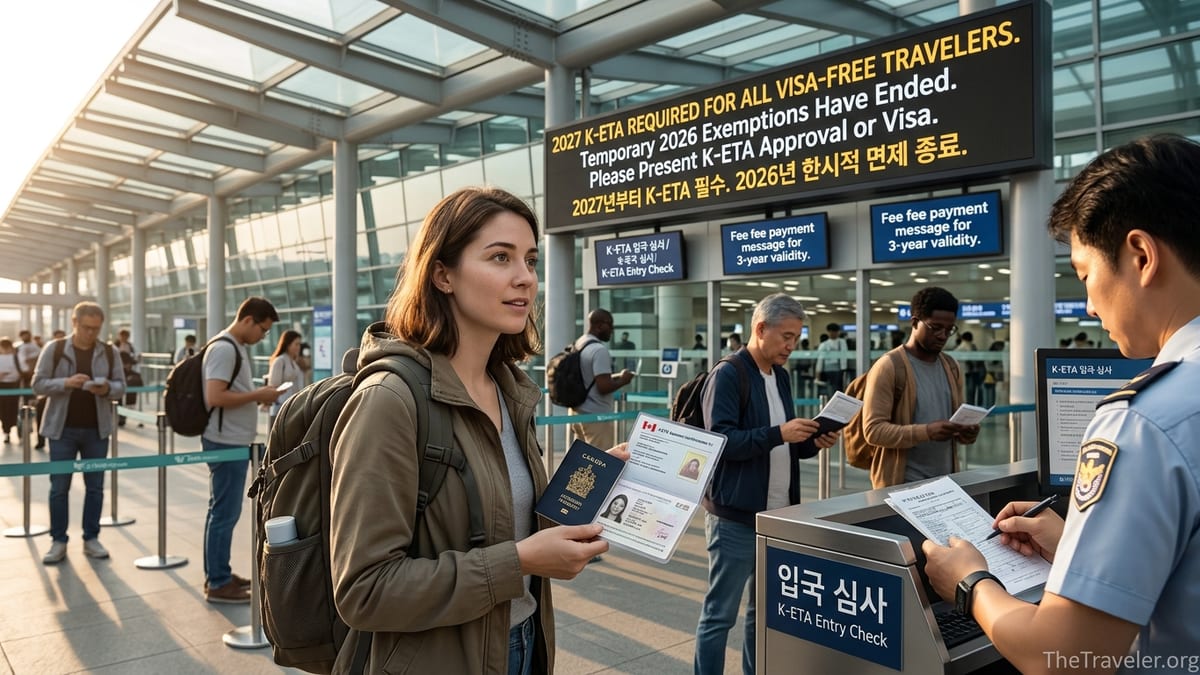
Where 2026 Leaves Off and Why 2027 Requires Fresh Confirmation
South Korea introduced the K-ETA system to pre screen visitors from visa exempt and visa waiver countries. Since 2023 the government has repeatedly issued temporary exemptions for selected nationalities to stimulate tourism during the multi year Visit Korea campaign. An official notice on the K-ETA portal and supporting government and tourism sites confirms that this temporary exemption, which covers citizens of countries such as the United States, Canada, the United Kingdom, Australia, Japan, Singapore, Germany, France and Italy, currently runs through December 31, 2026.
The key point for anyone planning a 2027 trip is that the existing waiver has a clearly defined end date. The fact that travel industry summaries, embassy notices and the K-ETA portal itself frame the exemption as valid “until December 31, 2026” signals that normal K-ETA rules are expected to apply again once the waiver period finishes, unless the Ministry of Justice publishes a new decision. Travelers cannot safely assume that a 2026 style exemption will automatically roll forward into 2027.
For a 2027 focused guide like this to remain accurate, a new official K-ETA announcement must be checked immediately before publication. The baseline assumption in the absence of such an announcement is that, from January 1, 2027, citizens of visa exempt and visa waiver countries will once again need an approved K-ETA before boarding a flight or ship to Korea, unless they already hold a valid Korean visa or residence status that covers their trip.
Because immigration policy can change on relatively short notice, anyone booking a 2027 trip should make two checks: first, verify whether your nationality is visa exempt or requires a conventional visa; second, confirm on the official K-ETA portal whether your passport still benefits from any temporary exemption or must follow the standard K-ETA application process for that year.
Who Was Exempt in 2026 and How That Shapes 2027 Expectations
The Ministry of Justice extended the K-ETA temporary exemption through December 31, 2026 for a group of more than twenty jurisdictions. Public summaries by professional immigration firms and embassy notices list core beneficiaries as Hong Kong, Japan, Macao, Singapore, Taiwan, Australia, New Zealand, Austria, Belgium, Denmark, Finland, France, Germany, Italy, the Netherlands, Norway, Poland, Spain, Sweden, the United Kingdom, Canada and the United States, among others. During the exemption period, citizens of these places could enter Korea visa free for short stays without applying for K-ETA, as long as they otherwise met visa waiver conditions.
Several European Union nationalities that are part of Korea’s broader visa waiver program but are not explicitly named in early exemption lists have reported receiving on screen messages on the K-ETA site confirming that they are temporarily exempt when they attempt to start an application. This reflects the Korean government’s practice of using the K-ETA portal itself as the most up to date authority for which passport holders are currently waived. For 2026, this created a practical split between exempt and non exempt visa free countries even though both categories could normally visit without a visa.
Travelers from countries that are visa free to Korea but were not included in the temporary exemption, or from countries that require a visitor visa regardless of K-ETA, still need either a K-ETA approval or a conventional visa in 2026. Typical examples include many Latin American, African and some Asian passports that remain outside the waiver list. For these travelers, the 2027 landscape is likely to look very similar to 2026 unless Korea separately changes its broader visa policy.
Looking ahead to 2027, the simplest provisional rule is this: if your passport was in the 2026 K-ETA exemption group, you should expect to start needing a K-ETA again for arrivals dated January 1, 2027 or later, unless a new Korean government decision extends the waiver. If your passport was never exempt, you should plan on continuing to follow normal K-ETA or visa procedures in 2027.
Visa Exempt with K-ETA, Temporary Waiver and Full Visa: What Is the Difference?
South Korea’s entry framework combines two layers. First is basic visa policy, which decides whether a nationality is eligible to visit without a visa for tourism or short business. Second is the K-ETA system, which applies an electronic authorization requirement on top of visa free entry for certain nationalities. The temporary exemptions affect only this second layer, not the underlying visa waiver itself.
Visa exempt entry with an approved K-ETA describes the standard, non exempt situation. For example, in a normal K-ETA year a tourist from the United States flying from Los Angeles to Seoul for ten days would enter visa free but must hold a valid K-ETA before boarding. The airline checks K-ETA approval in its system along with passport details. Immigration officers in Incheon Airport can then reference that pre cleared information and usually waive the paper arrival card.
Visa exempt entry during a temporary K-ETA waiver applies when the government suspends the K-ETA requirement for listed nationalities. An Australian family visiting Seoul and Busan for a two week holiday in July 2026 can board their flight and clear immigration with only their passports and arrival cards because Australia is in the exemption group. The underlying permission to enter visa free remains the same; the only change is that K-ETA pre authorization is temporarily not required.
Entry that requires a conventional Korean visa is a separate route altogether. Nationals of countries without a visa waiver arrangement, or travelers of any nationality who wish to study, work, stay long term or visit for other non tourist purposes, must apply for a visa through a Korean embassy or consulate. A visa in your passport overrides K-ETA: if you hold a valid Korean visa that covers your intended stay, you do not need K-ETA, whether or not your nationality is in an exemption group.
How K-ETA Works: Eligibility, Fees, Validity and Processing
The official K-ETA portal states that the government fee for a K-ETA application is 10,000 Korean won. The site notes that an additional online payment processing charge, typically around 3 percent of the fee, may be added by card processors. The K-ETA fee is non refundable, even if the application is refused or the approved traveler later changes plans. For a family of four applying together, this translates into a government charge of around 40,000 won in total, plus a small combined card fee.
According to official guidance, a K-ETA approval is normally valid for three years from the date of authorization, or until the passport expires, whichever comes first. Some embassy notices still reference slightly shorter sample periods, but current K-ETA portal language confirms a three year validity. During this period, travelers can re enter Korea multiple times for short visits as long as each stay stays within the permitted visa free duration for their nationality, which for many Western passports is up to 90 days per entry.
The normal processing timeframe indicated on the K-ETA portal is within 24 hours, although applications can occasionally take longer if manual review is required. Travelers are therefore encouraged to apply several days before departure. In practice, many visitors report near immediate approvals when applying during Korean business hours, but this is not guaranteed, especially during peak travel seasons around cherry blossom, summer holidays or major festivals.
Payment is made online at the end of the application. The K-ETA site accepts major international credit and debit cards. Travelers using virtual cards, prepaid cards or corporate cards should ensure that international online transactions are enabled and that any fraud detection systems on their bank side do not block the payment.
Arrival Cards, e Arrival Card, K-ETA and Q Code
South Korea requires most foreign visitors to submit an arrival card with personal details, address in Korea and travel purpose. Traditionally this has been a paper form handed out on planes or available in the arrival hall. The Immigration Service now offers a free electronic arrival card submitted through an official portal within three days before arrival. This system allows travelers to enter passport, flight and accommodation information online and then pass through immigration using automated or staffed counters without filling out the paper card.
The e arrival card portal states that foreign nationals with a valid, approved K-ETA do not need to submit an e arrival card or paper arrival card when entering Korea. In other words, K-ETA status replaces the arrival card requirement for short stay visitors who are eligible for and hold K-ETA. The same exemption generally applies to travelers with certain long term residence permits or e group visas recorded in the immigration system.
During K-ETA temporary waiver periods, such as 2026, many exempt travelers do not hold K-ETA and therefore still need to provide arrival information. They can choose either the traditional paper form distributed on board or the free e arrival card within 72 hours before landing. This is why some frequent visitors from exempt countries still choose to apply for K-ETA voluntarily during the waiver period: holding a K-ETA lets them skip the arrival card entirely and can streamline airport processing.
Q Code procedures are separate. Q Code was introduced during the COVID 19 pandemic as an online health declaration and quarantine related system. While the requirement to use Q Code has been scaled back, there have been periods when specific groups of travelers, such as those arriving from areas with particular health concerns, were asked to submit health information in advance. Q Code has nothing to do with visa free, visa or K-ETA eligibility, and it does not replace either K-ETA or the arrival card system.
Who Does Not Need an Arrival Card and How Optional K-ETA Works in Waiver Years
According to the Korea Tourism Organization and Korean immigration guidance, several categories of travelers are exempt from submitting arrival cards. These include foreigners who are staying longer than 91 days and hold valid residence cards, such as registered students or workers, holders of certain e group visas issued for group travel, and those with valid K-ETA approvals recorded in the immigration system. For these travelers, immigration officers can retrieve necessary information electronically.
During the 2026 exemption period, travelers from waived countries have a choice. They can rely entirely on the waiver, enter Korea with just their passport and a paper or electronic arrival card, and avoid paying the K-ETA fee. Alternatively, they can voluntarily apply for K-ETA even though it is not strictly required. Reasons to apply may include frequent future trips, a desire to skip arrival cards, or concern that the exemption rules might change between booking and travel. Once issued, a K-ETA obtained in a waiver year remains valid until its normal expiry, even if the exemption later ends.
An example helps illustrate this. Consider a Japanese business traveler who expects to visit Seoul and Busan four or five times a year between 2026 and 2028. Even though Japan is exempt from K-ETA through the end of 2026, the traveler might apply for K-ETA in late 2026. The 10,000 won fee then buys up to three years of multiple entries, likely covering all trips well into 2029, and removes the need to complete arrival cards for each visit.
By contrast, a Canadian family planning a single two week holiday in October 2026 might simply rely on the temporary exemption. They can submit a free e arrival card within three days of their flight to Incheon and avoid the K-ETA fee entirely, since they do not expect to return soon and the waiver fully covers their dates of stay.
Step by Step: Checking Eligibility and Applying for K-ETA
The first step for any 2027 traveler is to verify nationality based eligibility. This should be done on an official Korean government platform, such as the K-ETA portal, the Korea Visa Portal or a Korean embassy site. Travelers select their nationality and intended purpose of visit. If the system shows that they are visa exempt and K-ETA required, they must plan a K-ETA application. If it shows they are visa required, they should contact the nearest Korean consulate to apply for the appropriate visa instead of K-ETA.
Once K-ETA eligibility is confirmed, the traveler prepares their passport, a working email address and a payment card. The K-ETA process includes an automatic passport scanning stage. Applicants either upload an image of the passport biographical page or allow the mobile app to read passport details. The system extracts the name, passport number, nationality and expiry date. Travelers must carefully check that the scanned data matches the passport exactly, including middle names and any diacritics, because errors here are a common cause of boarding problems.
After confirming personal details, applicants enter travel and contact information such as intended address in Korea, phone number, airline and flight number. Those on multi country trips, such as a United Kingdom couple flying London to Tokyo, spending a week in Japan, then continuing to Seoul for ten days before returning home, can still input their Korean accommodation and entry flight once confirmed. The system generally does not require proof of onward travel at the application stage, but travelers should keep their full itinerary handy in case an airline agent or immigration officer later requests it.
Finally, the applicant reviews a summary screen, pays the 10,000 won fee plus any processing charge and submits the form. A confirmation email is sent to the registered address. Applicants can log back into the K-ETA portal to check status. Once approved, the authorization is electronically linked to the passport number, so there is no separate document to print, though keeping a screenshot of the approval page can be helpful if airline staff need reassurance.
Families, Children, Dual Citizens and Common Problem Scenarios
Every traveler, including children and infants, must be covered by their own K-ETA if their nationality requires it and no waiver is in place for their passport at the time of travel. For a family of four from the United States visiting Seoul for ten days in March 2027, this likely means four separate K-ETA applications at 10,000 won each, for a total government fee of 40,000 won plus a modest card charge. Parents can complete applications on behalf of minors, using the child’s passport details but a parent’s email and contact phone where appropriate.
Age based exemptions are limited. The K-ETA system does not waive authorization based purely on a traveler being very young or very old. However, some health or disability conditions might influence the type of visa a traveler applies for in special cases. For most tourists and families, the rule is simple: if your nationality needs K-ETA, then every member of the group, regardless of age, must either hold K-ETA or fall within an active temporary exemption at the time of entry.
Dual citizenship and changed passports are frequent sources of confusion. K-ETA links to passport number and nationality, not to the person in the abstract. If a traveler holds both Italian and Brazilian passports, the K-ETA must be obtained for whichever passport they will actually use to enter Korea. If they apply with their Italian passport, then change their mind at the airport and present their Brazilian passport, the airline system will not find a matching K-ETA, which can lead to denial of boarding. Similarly, if a passport is renewed after a K-ETA is approved, the traveler usually needs to re apply, because the passport number has changed.
Refusal scenarios do happen, though they are rare for straightforward tourists with clean travel histories. Reasons can include inaccurate information, prior visa overstays, security flags or using K-ETA to attempt work or study activities not permitted under visa free status. A refusal typically cannot be appealed through the K-ETA system itself; instead, the traveler may need to apply for a visa at a Korean consulate, where they can provide additional supporting documentation and explanations.
Real World Trip Examples, Transit and Cost Comparisons
Consider a United States family of four planning a ten day April 2027 visit to Seoul. Assuming no new waiver applies in 2027, they will likely each apply for K-ETA in February. Their combined government fees total 40,000 won. If their card issuer charges equivalent to a 3 percent processing fee, the extra cost is about 1,200 won, bringing the total charge to around 41,200 won. In exchange, the family receives up to three years of authorization, so if they return for a winter trip in 2028, no new K-ETA fees are needed.
Another common itinerary is a multi country East Asia trip. For example, a Canadian couple may fly from Vancouver to Tokyo, spend eight days in Japan, then fly to Busan and depart home through Incheon. If their arrival in Korea takes place after the 2026 waiver period, they must ensure they hold K-ETA approval before boarding the flight from Japan. Because K-ETA links only to the passport, not to a specific flight, it is irrelevant that they started the trip in a different country; the key check is whether the Canadian passports carry K-ETA on the date they check in for Busan or Seoul.
Transit passengers at Incheon Airport face different rules depending on whether they pass Korean immigration. A traveler from France flying Paris to Sydney via Incheon, remaining in the airside international transit area and boarding a connecting flight within a few hours, usually does not need K-ETA or a Korean visa, because they are not formally entering Korea. By contrast, a traveler from the same flight who wants to leave the airport for a half day Seoul city tour and then return for an onward flight would be considered an entering passenger and would therefore need to be eligible for visa free entry, including K-ETA if required.
These cost and scenario comparisons highlight why travelers should not wait until check in day to think about K-ETA. Small government fees and a bit of advance planning can prevent costly last minute ticket changes if an airline agent refuses boarding due to missing authorization.
Fraud Risks, Official Portals and 2027 Eligibility Matrix
The official K-ETA portal and the official e arrival card portal are free to access and clearly display the government fee or, in the case of the arrival card, the fact that there is no fee. Numerous unofficial sites mimic the look of official portals, charge higher service fees or store personal data insecurely. Some of these sites offer “express” or “guaranteed” approvals that they cannot, in reality, deliver because final decisions rest only with Korean immigration authorities. Travelers should avoid websites that hide their total fees until the final step or that charge amounts significantly higher than the 10,000 won government rate.
Similarly, paid services that attempt to charge money for submitting the free electronic arrival card should be treated with caution. The Korean government does not charge for the arrival card itself. While legitimate travel agencies may charge a reasonable service fee to handle documentation for clients, they should be transparent that the underlying government service is free. If in doubt, travelers can always complete the e arrival card themselves or fall back on the paper form in the airport.
For 2027 planning, an eligibility matrix is useful, though it must be read together with the latest official announcements. In a scenario where no further waiver is announced beyond December 31, 2026, most travelers from visa exempt countries such as the United States, Canada, the United Kingdom, Australia, Japan, Singapore, Germany, France and Italy would be classified as visa exempt but K-ETA required. Travelers from jurisdictions that are visa required for Korea would remain visa required, with no role for K-ETA. Only in the event that the Korean government publishes a new temporary exemption covering 2027 would some of these visa free nationalities move into a visa exempt and K-ETA waived category.
Because this article is designed for 2027 travel, readers should treat it as a structured framework rather than a final verdict. Before locking in flights or non refundable hotels, check the official K-ETA portal for any 2027 specific announcements, confirm whether your nationality is currently visa exempt or visa required, and then apply for K-ETA or a visa accordingly. Keeping screenshots or printouts of official guidance close to your travel date can also help if check in staff or immigration officers have questions about which rules apply.
Common Mistakes and Final Checks for 2027 Travelers
Several recurring mistakes catch visitors out. One is assuming that a past exemption, such as the widely publicized 2026 waiver, will still be in force months or years later. Another is mistyping passport numbers or names during K-ETA application, leading to mismatches when airline systems read the machine readable zone on the passport. Travelers also sometimes misunderstand the relationship between K-ETA and visas, thinking that K-ETA is a kind of visa in itself, when in fact it is an authorization layered on top of existing visa free rules.
Families occasionally overlook applying for children, especially infants who do not yet travel independently. Each family member must be considered separately in the eligibility matrix: Does this person’s passport have visa free access? If yes, is K-ETA required for that nationality this year? If yes, does this individual hold a valid K-ETA that covers the dates of travel and matches the passport they will present? Running through these questions for every traveler in the group helps prevent last minute surprises at the airport.
As of the time this guide was prepared, the most reliable facts are that the K-ETA temporary exemption for designated nationalities runs until December 31, 2026, the standard K-ETA fee is 10,000 won plus a small processing charge, approvals are usually valid for three years or until passport expiry, and valid K-ETA or residence status can exempt travelers from arrival card requirements. What remains unknown is whether Korea will extend some or all of the K-ETA waiver into 2027, tighten eligibility or revert fully to pre exemption rules.
Last checked: November 13, 2026. For any 2027 trip, travelers should re check the official K-ETA and Korean government immigration portals shortly before departure to confirm the latest eligibility rules, fee details and any new temporary measures.