


Planning a loop through Vietnam and its neighbors in 2026, such as Vietnam–Cambodia–Vietnam or a side trip to Laos or Thailand, is far easier now that Vietnam issues 90 day electronic visas with single and multiple entry options. The official eVisa system, operated by Vietnam’s immigration authorities, charges 25 US dollars for a single entry eVisa and 50 US dollars for a multiple entry eVisa, payable online through the government portal. These fees are confirmed in current immigration guidance and on the official application form and remain non refundable if your application is refused.
Get the latest updates straight to your inbox!
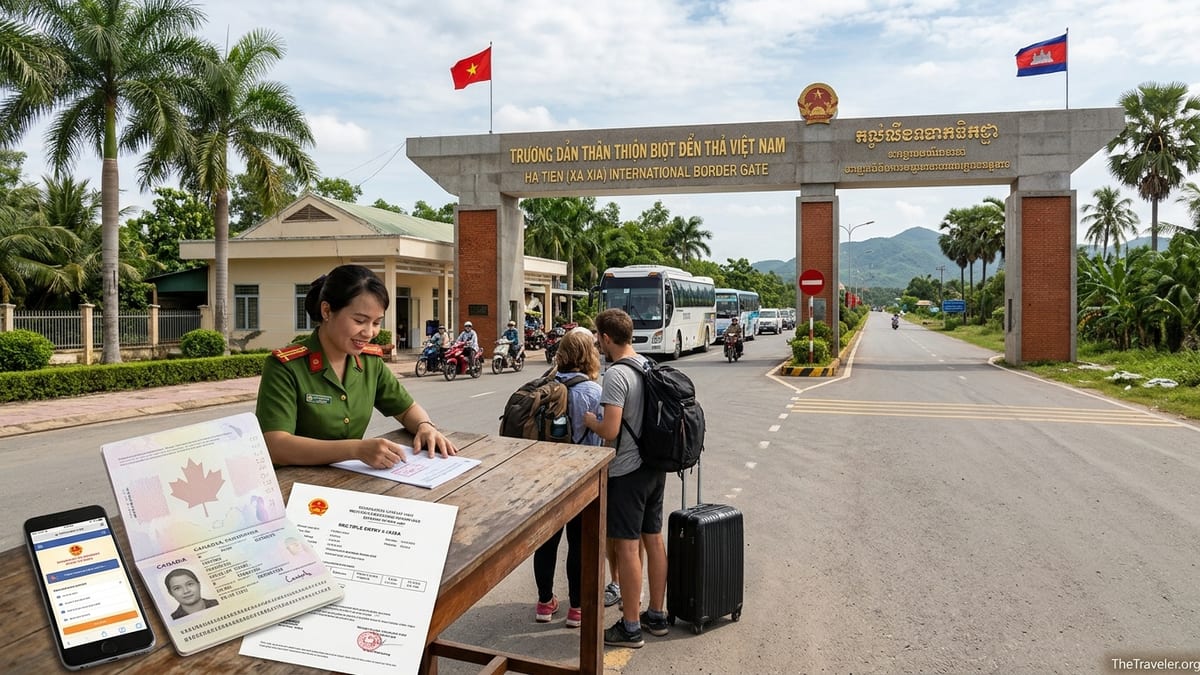
Understanding Vietnam’s 90 day eVisa and why multiple entry matters
Vietnam’s national immigration portal confirms that the Vietnam eVisa can be issued for a maximum validity of up to 90 days, with either single entry or multiple entry, and that it is available to citizens of all countries and territories, subject to standard security checks. The same resource and accompanying fee schedule state that the official government fee is 25 US dollars for a single entry eVisa and 50 US dollars for a multiple entry eVisa, with payment made electronically inside the online application. These amounts are set by Vietnamese regulations and applied globally, regardless of nationality.
The multiple entry version is especially valuable if your itinerary involves leaving Vietnam and then coming back within the same 90 day window. A common real world pattern is flying into Ho Chi Minh City, traveling north overland, crossing into Cambodia at the Ha Tien or Moc Bai border gates, spending a week in Phnom Penh and Siem Reap, then re entering Vietnam to fly home from Da Nang or Hanoi. Another frequent case is crossing from central Vietnam into Laos at Lao Bao or Cau Treo, touring the Lao towns of Savannakhet or Pakse, and then returning to Vietnam at a different land border or airport.
Without a multiple entry eVisa, each return to Vietnam normally requires either a new eVisa application or relying on visa free entry if your passport is eligible. That means another 25 US dollars fee, another processing wait, and some risk if the new approval is delayed. With a multiple entry eVisa, you pay 50 US dollars once and can exit and re enter Vietnam repeatedly within the 90 day validity, provided you always use an approved international border gate and respect the overall validity period printed on your eVisa.
It is important to distinguish the multiple entry eVisa from simply buying two separate single entry visas. Two single entry visas can cost at least as much or more if your plans change and you have to reapply, and you might be forced to shorten or rearrange your trip if the second eVisa is not approved in time. For travelers planning clearly defined regional loops, such as a 30 day trip including Vietnam, Cambodia, and Thailand, the multiple entry option provides predictable access back into Vietnam and usually works out cheaper and less stressful than juggling several separate visas.
Visa exemptions and when you may not need an eVisa
Alongside its global eVisa scheme, Vietnam maintains a list of nationalities that can enter visa free for a limited stay when traveling on an ordinary passport. In late 2026 this list includes, among others, citizens of many European Union states such as France, Germany, Italy and Spain, several Nordic countries, the United Kingdom, Japan, South Korea, Russia and a number of ASEAN members. The allowed visa free stay typically ranges from 14 to 45 days depending on the passport, and Vietnam has gradually lengthened some of these periods in recent years.
For example, British, French and German passport holders currently benefit from visa free entry for up to 45 days per visit when entering Vietnam for tourism or similar short stays. Travelers from some ASEAN countries, including Thailand and Singapore, enjoy even longer visa free allowances that can extend to 30 days or more. These waivers apply only to the first entry and do not automatically grant multiple entries, so you need to think carefully if you plan to leave and return within the same broader trip.
If your itinerary involves a single, relatively short visit to Vietnam, a visa exemption might be all you need. A French traveler flying into Hanoi, spending 20 days exploring the country, and then flying onward to Bangkok without returning to Vietnam does not usually need to pay for an eVisa at all. Likewise, a Japanese traveler planning a 10 day business visit to Ho Chi Minh City with no side trips will often enter visa free if their passport and travel purpose meet the exemption conditions.
However, if your plan is Vietnam–Cambodia–Vietnam over 30 days and your nationality grants only 15 days of visa free stay, your second entry would not be covered by the initial exemption. In this case a 90 day multiple entry eVisa provides coverage for the entire loop. Travelers whose nationalities are not on the exemption list, including most Americans, Australians, Indians and many Latin American citizens, will generally need an eVisa or consular visa for every entry, which again makes a multiple entry eVisa the most practical tool for multi country Southeast Asia routes.
How to apply on the official portal and avoid unnecessary fees
Vietnam’s immigration authorities operate their own online eVisa system, accessed through the national eVisa portal managed by the Ministry of Public Security. This is the only site that collects the 25 or 50 US dollars government fee directly and issues an official application code and PDF eVisa. To begin, you complete a secure form, upload your documents, select your intended first entry date and the type of visa, then pay by international card. Many travelers from the United States, Europe and Australia complete this process themselves without using any agent or intermediary.
There are many commercial websites and travel agencies that will offer to arrange a Vietnamese eVisa on your behalf. These services typically add a handling or service charge on top of the 25 or 50 US dollars official fee, sometimes doubling or tripling the total cost. In some cases they also reuse the same government portal behind the scenes. If you choose to use an intermediary for convenience or because of payment issues, it is essential to distinguish clearly between the fixed government fee and any additional service charge you are paying to a private company.
For most independent travelers with a standard itinerary and a common passport, applying directly on the official government portal is usually the safest and cheapest option. The interface is basic but available in English, and you retain full control of the data you enter. You also avoid the risk of phishing sites that imitate the government branding but collect inflated fees or inaccurate personal information. Before submitting payment, double check that the fee shown matches one of the two official amounts and that the page identifies the Vietnamese immigration authority rather than a private brand.
Once payment is successful, the portal will issue an application or registration code, along with the email address you used. You will later use this code, your email and your date of birth or passport details to download the approved eVisa PDF. Keep a screenshot of the confirmation screen in case the email is delayed or filtered into spam, as this code is your main way to check status and reprint the visa if needed.
Completing the application: documents, data fields and common pitfalls
The eVisa application requires a clear digital image of your passport biodata page and a separate recent portrait style photograph. The passport page image must show your full name, passport number, nationality, date of birth, passport issue and expiry dates, and your photo, with no glare or fingers covering the machine readable code at the bottom. A simple smartphone photograph taken in good light on a plain background usually works if the text is sharp and legible. The portrait photo should resemble a standard passport photo, with your face centered, no heavy shadows, and no hats or sunglasses.
When entering your personal information, replicate your name and passport number exactly as they appear in the machine readable line of your passport. Many passports show names in the order SURNAME followed by GIVEN NAMES, while some travelers are used to writing their given name first in everyday life. Use only standard Latin letters without additional punctuation or adding middle names that are not shown on the passport. If your family name contains a space or hyphen, follow the passport layout as closely as the form allows, and avoid nicknames or abbreviations.
You must also confirm your nationality, date and place of birth, sex, passport number and passport expiry date. Date formats can be a source of mistakes, since Vietnam commonly uses day month year order while some applicants are accustomed to month day year. On the English language portal, the calendar widget helps reduce errors, but you should still verify that the chosen day and month match your actual passport details before moving on. A single digit error in the passport number or date of birth can render your eVisa unusable at the border, since the officer will check every field against your passport.
Other key fields include your intended point of first entry, intended date of entry, intended length of stay and contact details such as your email address. Even though Vietnam has relaxed how strictly it enforces the chosen border gate in practice, it is still advisable to select the airport or land crossing that best reflects your real plan, for example Tan Son Nhat International Airport for Ho Chi Minh City or Noi Bai International Airport for Hanoi. Enter an email address that you check frequently, as all status messages and the approval notification will go there, and consider adding the portal’s domain to your safe sender list to prevent delays.
Dates, validity and time spent in Vietnam
The Vietnam eVisa asks you to choose an intended date of entry, and the approved visa will then show a validity period, usually expressed as “valid from” and “valid until” dates, with a total span of up to 90 days. You are permitted to enter Vietnam on or after the “valid from” date and must leave the country on or before the “valid until” date. The eVisa does not automatically grant a stay of 90 days if your arrival is late in the window; the number of days you can physically stay inside Vietnam depends on when you actually cross the border.
For example, suppose your multiple entry eVisa is valid from 1 March to 29 May, a total of 90 days. If you enter on 1 March and never leave, you can stay continuously until 29 May. If instead you enter for the first time on 15 April, your maximum continuous stay would be from 15 April until 29 May, about 45 days. The same validity frame covers all your entries, so when you exit to Cambodia and later return, the second entry still has to fall before 29 May and you still must depart again no later than that date.
This distinction is critical, because some travelers mistakenly believe that each separate entry on a multiple entry eVisa grants a fresh 90 days in Vietnam. In reality, the multiple entry function allows several entries within a single, fixed validity period. If your plans stretch beyond that period, for example a five month backpacking trip with several Vietnam segments, you will need either a second eVisa for later dates or a different type of long stay visa obtained through a Vietnamese embassy or a sponsor in Vietnam.
Overstaying an eVisa, even by a few days, can result in fines at the border and difficulties with future entries. While Vietnam’s exit officers may allow you to pay an administrative penalty and leave, they can also record the overstay, which might complicate later applications. For that reason, it is safer to build a small buffer into your itinerary or to apply for a new visa if your plans grow longer than the remaining days on your existing eVisa.
Ports of entry, common routes and why the border gate list matters
Vietnam’s eVisa is valid only at specific international airports, land border gates and seaports that the government has designated for electronic visa entry and exit. Government resolutions issued since 2023 expanded this network significantly, and as of 2026 the official list used on eVisa forms includes 83 ports: 17 international airports, 27 land crossings and 39 seaports. Examples of the main airports on this list include Noi Bai in Hanoi, Tan Son Nhat in Ho Chi Minh City, Da Nang International Airport, Cam Ranh near Nha Trang, Phu Quoc International Airport and Can Tho International Airport.
On land, popular crossings with Cambodia include Moc Bai in Tay Ninh Province, used on the bus route between Ho Chi Minh City and Phnom Penh, Ha Tien in Kien Giang Province for travel between Phu Quoc or the Mekong Delta and southern Cambodia, and Tinh Bien or Vinh Xuong for certain Mekong river and bus itineraries. For Laos, important land gates include Lao Bao in Quang Tri Province, Cau Treo in Ha Tinh and Nam Phao or Dansavanh on the Lao side, which link to routes between Hue, Dong Hoi or Da Nang in Vietnam and Savannakhet or the Lao central region.
Vietnam’s seaport list covers the international cruise and cargo terminals that see foreign ships, such as Ha Long in Quang Ninh Province, Hai Phong, Da Nang Port, Nha Trang, Quy Nhon, Ho Chi Minh City’s ports and several smaller coastal gateways. If you are joining an ocean cruise that calls in at Ha Long Bay and Ho Chi Minh City, your cruise line may either arrange a group visa or advise passengers to secure individual eVisas that match these ports. Always verify in advance that the ship will dock at a seaport listed on Vietnam’s current eVisa port schedule.
Border gate eligibility matters because you cannot normally use an eVisa to enter through domestic only airports or minor land tracks that are not on the list. A traveler planning to cross from southern Laos into Vietnam at a little used local checkpoint that only handles citizens of the two countries would be refused entry on an eVisa and might need a different type of visa. Similarly, if your bus ticket advertises arrival at “Ho Chi Minh City” without specifying the exact border crossing from Cambodia, confirm with the operator whether you will use Moc Bai, Xa Mat or another official gate and check that this gate appears among the eVisa ports.
Processing time, troubleshooting errors and document handling
Vietnam’s immigration authorities state an indicative processing target of three working days for standard eVisa applications once payment is confirmed. In practice, many travelers report receiving approval in two to four working days, while others, especially those applying close to major Vietnamese holidays such as Tet (Lunar New Year) or national days, can wait a week or longer. Because weekends and Vietnamese public holidays are not counted as working days, an application submitted on a Friday before Tet may not be reviewed until well into the following week.
If the immigration system identifies a problem with your application, such as unclear passport images or mismatched data, it may either refuse the application or leave it pending without immediate explanation. There is no routine mechanism to correct errors once an application is submitted, so in most cases you will need to file a fresh application with the correct data and pay the fee again. This reality makes it essential to slow down and double check each field before payment, especially your name, passport number, dates and intended validity.
When your eVisa has been approved, you should download the PDF document and print at least one paper copy, preferably two, in case airline staff or border officers request a physical page. Some carriers at departure airports in Europe or North America still ask to see a printed visa confirmation at check in. Keep a copy on your phone or tablet as well, since Vietnamese border booths sometimes scan the printed QR code while others refer to their internal system using your passport number and application code.
If you discover that your approved eVisa contains a spelling mistake in your name, an incorrect passport number or wrong validity dates that do not match your ticket, do not assume the officer will ignore the discrepancy. Where the error is minor and clearly a typo, such as one missing accent or a transposed letter in a long surname, some travelers have been allowed to enter after brief questioning. However, where the passport number or nationality is incorrect or where the error makes it look like a different person, the safer course is to submit a new, correct application and use the new eVisa, even if it means paying the fee again.
Sample 30 day loop and when extensions or new visas are needed
Consider a concrete 30 day Southeast Asia itinerary planned for April. A Canadian traveler flies from Vancouver to Ho Chi Minh City on 1 April, spends ten days exploring the Mekong Delta and the beaches near Mui Ne, then takes a bus to Phnom Penh via the Moc Bai crossing on 11 April. After visiting Phnom Penh and Siem Reap, they fly from Siem Reap to Da Nang on 21 April to spend eight days in central Vietnam, visiting Hoi An and Hue, before flying from Da Nang to Bangkok on 29 April to finish the trip. This schedule requires entering Vietnam twice within a 29 day calendar window.
If that traveler holds a passport that does not qualify for visa free entry and initially buys a single entry eVisa for 25 US dollars covering 1 to 15 April, they will be able to enter Vietnam the first time but will have no valid permission to re enter on 21 April. They would need to submit a second eVisa application from Cambodia, pay another 25 US dollars and hope for approval before the Siem Reap to Da Nang flight. A multiple entry 90 day eVisa valid from 1 April to 29 June, obtained before departure for 50 US dollars, would instead cover both entries and allow for unexpected changes, such as re routing through Hanoi or adding a brief side trip to Laos.
Vietnam’s eVisa framework does not provide a straightforward in country extension for tourists in most cases. Once you are inside Vietnam on an eVisa and approach the “valid until” date, your main options are to depart the country and apply for a new eVisa for later dates or to obtain a different category of visa through a sponsor, such as a Vietnamese employer, educational institution or close family connection. Service agencies in major cities sometimes advertise extension services, but these usually involve converting to other visa types and may carry high fees and longer processing times.
Crucially, holding a multiple entry eVisa does not grant permission to stay past the printed expiry date, even if you happen to be in the country on your second or third entry. If your multiple entry eVisa is valid until 29 May and you re enter on 25 May, you still must leave by 29 May unless you acquire a new visa. If your travel plans now require a longer stay, for example because you decide to attend a course in Hanoi or extend a beach holiday in Phu Quoc, you should arrange an appropriate new visa in advance rather than relying on the multiple entry eVisa beyond its validity.
For many short and medium length itineraries that combine Vietnam with neighboring countries, the most practical strategy is to map out every planned border crossing on a calendar, choose a 90 day window that neatly covers all expected entries, and apply for a multiple entry eVisa for those dates. If your plans are highly flexible or extend close to three months in multiple segments, consider leaving a buffer of several days at the end of the validity to accommodate flight changes or overland delays.
Checklist, fraud awareness and final notes by nationality
Before applying, confirm your passport’s visa status for Vietnam. Travelers from visa exempt countries who plan a single short visit may not need an eVisa at all, saving both time and money. If you are from a country such as the United States, Canada, Australia or India that does not benefit from ordinary passport visa exemptions, you should expect to need an eVisa or consular visa for every entry into Vietnam and plan accordingly, particularly for multi stop trips that involve Cambodia, Laos or Thailand.
Verify that the entry and exit points in your itinerary appear on Vietnam’s current list of 83 eVisa ports. For air travel, this usually means checking that airports like Hanoi Noi Bai, Ho Chi Minh City Tan Son Nhat, Da Nang, Cam Ranh or Phu Quoc are in the system, which they are. For land travel, pay close attention to which crossing your bus or private transfer will use, especially on routes such as Ho Chi Minh City to Phnom Penh or Hue to Savannakhet, and make sure that names like Moc Bai, Ha Tien, Lao Bao or Cau Treo match the immigration list. For cruise and ferry plans, verify the exact seaport where your ship docks.
When you apply, prepare a clear passport biodata image, a suitable portrait photo, and accurate details for your name, passport number, passport expiry date, date of birth and nationality. Choose the correct visa type, single or multiple entry, and a validity window that covers your entire planned presence in Vietnam, including any returns after visits to neighboring countries. Double check your email address and keep your application code safe so that you can download the visa later and reprint it if needed.
To avoid fraud, always distinguish the official government fee of 25 US dollars for single entry or 50 US dollars for multiple entry from any extra handling fees that private companies might charge. Be wary of websites that promise “guaranteed” faster approval for very high prices, or that ask you to send passport scans by unsecured email instead of using a proper online form. If anything on the payment page seems inconsistent with Vietnamese government branding or the expected fee levels, stop and recheck that you are on the genuine national immigration portal.
Finally, remember that this guidance reflects the situation as checked in November 2026, and visa policies can and do change. Before you submit your application or book non refundable tickets, reconfirm your own nationality’s visa exemption terms, Vietnam’s latest eVisa rules and the current list of ports of entry with Vietnamese government sources or a local embassy or consulate. With a little careful planning, especially around multiple entries and timing, Vietnam’s 90 day eVisa system can support smooth, flexible journeys across Vietnam, Cambodia, Laos and Thailand in a single memorable trip.