


More news on this day
Two of the world’s busiest hubs, Atlanta Hartsfield-Jackson and Chicago O’Hare, have emerged as the focal points of global flight disruptions in 2026, as rising demand, extreme weather and capacity limits combine to push already strained aviation networks to their breaking point.
Get the latest news straight to your inbox!
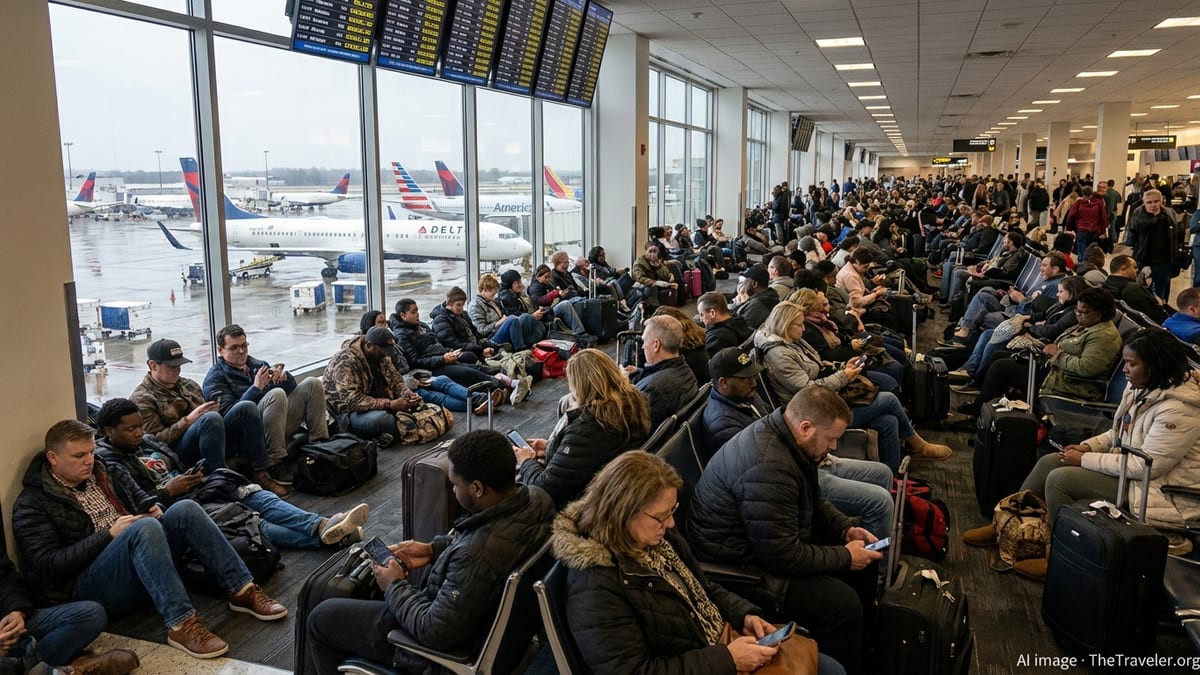
Heavy traffic hubs now disruption epicenters
Publicly available traffic data highlight how Atlanta and Chicago have become indispensable to the global aviation system while simultaneously serving as major sources of disruption ripple effects. Airports Council International’s 2026 World Airport Traffic Dataset shows that Hartsfield-Jackson Atlanta International Airport retained its position as the world’s busiest airport for passengers in 2025, while Chicago O’Hare ranked at or near the top globally for aircraft movements, alongside Atlanta.([en.wikipedia.org](https://en.wikipedia.org/wiki/List_of_busiest_airports_by_passenger_traffic?utm_source=openai))
The concentration of traffic helps explain why disruption at either hub is quickly felt across multiple continents. Industry analyses of delay performance rank both airports among the most operationally challenging major hubs, with on-time arrival and departure rates that lag behind smaller competitors despite extensive infrastructure and air traffic control resources. A 2026 flight-delay index that aggregates regulatory and tracking-service data notes that large North American hubs remain over-represented among the world’s least reliable major airports, and specifically identifies U.S. megahubs as key drivers of knock-on delays.([destination.com](https://www.destination.com/research/flight-delay-index-2026?utm_source=openai))
At Atlanta, a city built as a connecting gateway for the southeastern United States, disruption risks are amplified by the sheer volume of domestic connections. A 2026 briefing pack prepared for airport stakeholders reported that more than a quarter of flights at ATL in 2025 arrived late and just over 1 percent were canceled, despite the airport handling more than 52 million passengers that year.([slcairport.com](https://slcairport.com/assets/pdfDocuments/AABoard/11March2026AABPacket.pdf?utm_source=openai))
Chicago O’Hare, meanwhile, sits at the intersection of transcontinental and transatlantic flows. Federal regulators have flagged the airport’s schedule intensity as a particular vulnerability, describing its traffic levels as a source of nationwide disruption when weather or staffing issues arise.([govinfo.gov](https://www.govinfo.gov/content/pkg/FR-2026-03-18/pdf/2026-05325.pdf?utm_source=openai))
New federal caps underscore scale of O’Hare delays
In 2026, federal transportation authorities took the unusual step of directly limiting scheduled flights at Chicago O’Hare in an attempt to contain delays. A March 2026 notice in the Federal Register outlined a proposal to cap operations during the summer season at 2,800 flights per day, after determining that the airport’s existing schedule exceeded its “manageable capacity” and contributed to widespread disruption across the national airspace system.([govinfo.gov](https://www.govinfo.gov/content/pkg/FR-2026-03-18/pdf/2026-05325.pdf?utm_source=openai))
Subsequent announcements in April confirmed that about 300 flights per day would need to be cut on peak days to reduce congestion. According to published coverage, the decision followed a summer in which less than 60 percent of O’Hare arrivals and departures operated on time and the airport recorded one of the worst delay records in the United States.([transportation.gov](https://www.transportation.gov/briefing-room/trumps-transportation-secretary-sean-p-duffy-takes-action-prevent-endless-delays?utm_source=openai))
Short-term data from flight-tracking services underscore how often O’Hare has led daily disruption tallies in 2026. On several days in July, reports citing FlightAware indicated that O’Hare recorded more delays than any other airport in the United States, with one analysis highlighting more than 280 delayed flights and dozens of cancellations at the hub on a single day, as nationwide delay totals climbed past 6,000.([travelerstoday.com](https://www.travelerstoday.com/articles/60423/20260717/chicago-ohare-tops-us-flight-chaos-friday-3195-delays-141-cancellations.htm?utm_source=openai))
The decision to impose flight caps reflects broader concerns about the resilience of high-volume hubs in a period of strong demand and stretched air traffic control staffing. Macroeconomic outlooks from industry bodies project that North American airlines will remain profitable in 2026, but note that chronic controller shortages and infrastructure constraints are likely to sustain elevated disruption risks at key airports such as O’Hare.([iata.org](https://www.iata.org/en/iata-repository/publications/economic-reports/global-outlook-for-air-transport-december-2025/?utm_source=openai))
Atlanta disruptions intensify amid storms and staffing strains
Atlanta’s role in 2026 disruption patterns has been shaped by both extreme weather and operational bottlenecks. In March, a powerful storm system and a partial federal government shutdown combined to snarl operations at Hartsfield-Jackson, where more than 230 flights were canceled and about 770 were delayed in a single day, according to Associated Press reporting based on flight-tracking data.([apnews.com](https://apnews.com/article/f485f93852f31ab2fbd0513a117c7e20?utm_source=openai))
That episode followed a January winter storm that forced airlines to cancel more than 1,000 flights at Atlanta’s hub over several days, as snow and ice swept across large swaths of the United States.([en.wikipedia.org](https://en.wikipedia.org/wiki/January_23%E2%80%9327%2C_2026_North_American_winter_storm?utm_source=openai))
The spring and summer brought further strain. Local coverage drawing on FlightAware statistics documented long security lines and staffing shortages at Atlanta in March 2026, with more than 140 delays and 180 cancellations recorded in a single day. A subsequent July thunderstorm prompted a temporary ground stop and led to additional cancellations and lengthy delays, underlining how quickly convective weather can overwhelm even the world’s largest hub.([cbsnews.com](https://www.cbsnews.com/atlanta/news/long-tsa-lines-and-flight-cancellations-continue-to-disrupt-travel-at-atlanta-airport/?utm_source=openai))
These incidents align with broader analyses that describe the 2026 summer travel season as one of heightened disruption risk. Reporting from aviation and business outlets has linked this pattern to a combination of stronger storms in a warming climate, dense scheduling at major hubs, and the compounding impact of delays once early flights fall behind schedule.([axios.com](https://www.axios.com/2026/08/18/air-travel-summer-disruption?utm_source=openai))
Global knock-on effects from U.S. megahub disruptions
Because Atlanta and Chicago O’Hare function as primary connectors between domestic U.S. routes and long-haul international services, disruptions at these airports can quickly acquire global significance. Flights that miss connection windows can strand passengers far from their final destinations, while aircraft and crew displaced by cancellations can reduce capacity on routes linking North America with Europe, Latin America and Asia.
Analysts tracking global airspace disruptions note that bottlenecks at a few large hubs can account for a disproportionate share of missed connections and extended passenger journey times worldwide. A January 2026 disruption report, which examined 2025 patterns and their implications for 2026, described how concentrated hubs amplify vulnerability to weather and staffing shocks, even as overall traffic continues to recover.([flysafe.zone](https://flysafe.zone/reports/2025-annual-airspace-disruption/?utm_source=openai))
At the same time, Europe’s own network reports show rising airport weather delays in early 2026 and increasing use of crisis coordination mechanisms, highlighting that North American hubs operate within a global system already under stress.([eurocontrol.int](https://www.eurocontrol.int/archive_download/all/node/15850?utm_source=openai))
Industry studies also warn that high summer travel demand, geopolitical tensions affecting key air corridors, and the ongoing integration of new technologies in air traffic management are likely to keep disruption risks elevated through the remainder of 2026. For travelers, the prominence of Atlanta and O’Hare in recent delay statistics serves as a reminder that flight reliability increasingly hinges on the resilience of a small number of global megahubs.([en.wikipedia.org](https://en.wikipedia.org/wiki/2026_in_aviation?utm_source=openai))
What the patterns mean for travelers in 2026
For passengers planning itineraries through Atlanta or Chicago in the second half of 2026, the disruption patterns observed so far suggest that schedule buffers and flexible plans may be especially important. Research on delay propagation indicates that first departures of the day consistently achieve the highest on-time performance, while late-afternoon and evening services are more exposed to cascading delays from earlier disruptions.([destination.com](https://www.destination.com/research/flight-delay-index-2026?utm_source=openai))
Travelers connecting through these hubs may therefore benefit from earlier departure times, longer connection windows and attention to airlines’ rebooking and compensation policies in the event of cancellations. Consumer-rights guidance points out that U.S. rules require cash refunds when airlines cancel flights and passengers choose not to travel, even as hotel and meal coverage remains subject to individual carrier policies.([engine.com](https://engine.com/industry-news-tips/as-thanksgiving-approaches-airport-delays-and-flight-cancelations-are-getting-worse?utm_source=openai))
Looking beyond 2026, regulatory actions at O’Hare and ongoing investments at both airports suggest that authorities and operators are attempting to balance growth with reliability. However, with Atlanta and Chicago likely to retain their roles as top global hubs, the latest data point to a future in which these airports continue to shape not only U.S. travel experiences, but the reliability of the global aviation network as a whole.([globenewswire.com](https://www.globenewswire.com/news-release/2025/09/24/3155565/0/en/Atlanta-and-Chicago-Shine-in-OAG-s-2025-Megahubs-Rankings.html?utm_source=openai))
Federal Register notice on Chicago O’Hare summer 2026 scheduling limits
Associated Press coverage of federal flight cuts at Chicago O’Hare
Associated Press reporting on March 2026 U.S. storm-related flight disruptions
Salt Lake City Airport board packet summarizing 2025 performance at Atlanta