


More news on this day
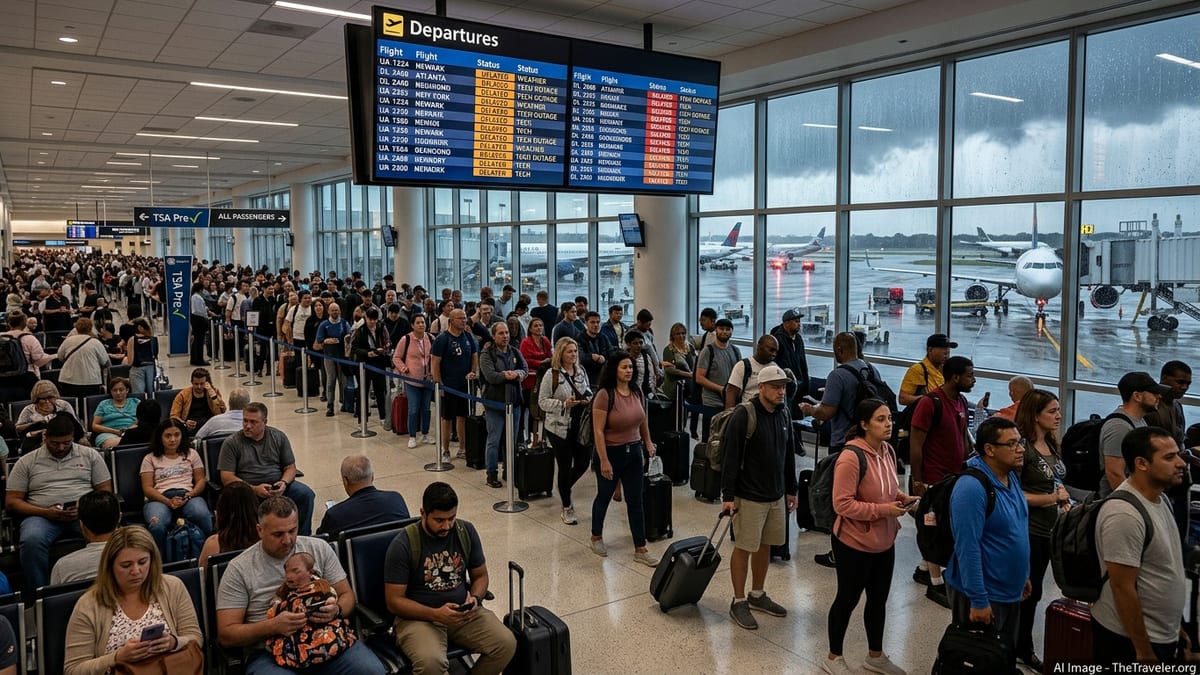
Millions of Americans heading out for Thanksgiving between November 24 and November 30 face a complicated mix of coastal storms, recent airline technology failures and the highest holiday airfares in a decade, even as overall trip volumes hover just below last year’s near‑record levels.
Get the latest news straight to your inbox!
Near-record travel demand despite cost and reliability worries
AAA projects that 81.5 million people in the United States will travel at least 50 miles from home between Tuesday, November 24, and Monday, November 30, 2026, only a marginal decline from the 81.6 million who traveled over Thanksgiving in 2025. Within that total, about 5.96 million travelers are expected to fly on domestic routes, leaving air travel volumes effectively flat year on year but still comfortably above pre‑pandemic levels in 2019.
Federal Aviation Administration planning data obtained by several U.S. outlets indicate that roughly 417,000 to 418,000 flights are scheduled nationwide over the nine‑day period from November 23 through December 1, a 2 to 3 percent increase compared with Thanksgiving week last year and around 7 percent higher than 2019. That means more aircraft in the sky even though passenger counts are only slightly off their 2025 peak, increasing the sensitivity of the system to both weather and operational disruption.
Price pressure is adding to traveler unease. Forecasts issued in late October by airfare tracking services, including Hopper, show round‑trip domestic tickets for the Thanksgiving window running more than one third higher on average than at the same point in the booking curve last year. Analysts attribute the jump primarily to higher jet fuel costs following this year’s conflict involving Iran, combined with carriers holding capacity relatively tight on some peak‑day departures.
Recent tech outages expose fragility of U.S. aviation systems
The current travel week follows a sequence of high‑profile failures in both government and airline technology systems. On November 13, the FAA’s air traffic control network suffered a technical malfunction that produced the longest nationwide ground stop in roughly a quarter century, forcing hundreds of departures to be held at gates and cascading delays through major hubs into the evening. The Department of Transportation has not yet released a full causal report, and the agency has said only that engineers isolated the problem and restored service the same day.
Less than ten days later, on Sunday, November 22, an automated system used by Delta Air Lines to calculate aircraft weight and balance experienced a malfunction during one of the busiest pre‑Thanksgiving travel days. More than 1,000 Delta flights were delayed on Sunday as dispatchers and crews reverted to manual procedures, and the FAA briefly issued a ground stop for some flights into Hartsfield‑Jackson Atlanta International Airport, Delta’s primary hub. Delta stated on Monday that operations had stabilized and emphasized that flights would not depart until correct weight and balance data were confirmed.
The Delta disruption came on the heels of a separate outage at United Airlines earlier in November that temporarily prevented some departing flights from being dispatched. While individual carrier systems differed, the episodes have collectively drawn renewed attention to the reliance of U.S. aviation on tightly integrated software platforms. Industry data in the Department of Transportation’s most recent Air Travel Consumer Report, covering performance through September, show that delays have generally increased relative to pre‑pandemic norms, even as scheduled capacity has grown.
Orlando and other hubs brace for heavy passenger flows
In Central Florida, Orlando International Airport expects nearly 1.9 million passengers over its 12‑day Thanksgiving travel period, according to projections released by the Greater Orlando Aviation Authority on November 23. Local outlets report that this figure is broadly in line with last year’s total, though slightly higher on the busiest days, confirming Orlando’s position as one of the country’s most heavily used holiday gateways.
Airport planners in Orlando anticipate the single heaviest day to be Monday, November 30, with around 187,000 arriving and departing passengers combined. In practical terms, that will translate into sustained pressure on security checkpoints, baggage systems and curbside access through the end of the long weekend. MCO is advising travelers to arrive at least three hours before departure for domestic flights, pre‑book parking where possible, and use the airport’s mobile app to monitor checkpoint wait times and gate changes.
Other large U.S. hubs are publishing similarly strong outlooks. Seattle–Tacoma International Airport has told local media it expects roughly 875,000 travelers between Wednesday and Monday, with peaks of about 164,000 passengers on both the outbound Wednesday and return‑peak Sunday. Kansas City International is forecasting close to 390,000 passengers from November 20 to November 30, while Denver International expects its checkpoints to process more than 87,000 passengers on Sunday alone. Collectively, the figures underscore that, even with a slight national dip in overall trip numbers, crowding at major airports will still be intense on traditional peak days.
Storm systems threaten both coasts and iconic holiday events
Weather has emerged as the largest immediate variable for Thanksgiving travelers in 2026. The National Weather Service’s Weather Prediction Center is tracking an intensifying coastal storm expected to run up the Eastern Seaboard from Wednesday night into Friday. Current forecasts call for heavy rain and strong winds to reach the Carolinas late Wednesday, move into the Mid‑Atlantic overnight, impact the New York City region on Thursday and arrive in coastal New England by Friday.
For New York City specifically, local forecasts from broadcast meteorologists and the National Weather Service anticipate that the heaviest rain associated with the system may hold off until after the Macy’s Thanksgiving Day Parade concludes late Thursday morning, although confidence remains limited. Winds are the greater concern for the event. City regulations prohibit full‑size parade balloons from flying if sustained winds exceed 23 miles per hour or if gusts surpass 34 to 35 miles per hour along the route. Over the past 48 hours, some forecast models have indicated the potential for gusts in the 40 to 60 mile per hour range at times on Thursday, leading organizers and city officials to reiterate that final decisions on balloon height or grounding will be taken on parade morning.
The same coastal storm could also disrupt road and rail travel along the I‑95 corridor, particularly from Washington to Boston, if bands of heavy rain coincide with peak departure or return periods. In Charlotte, a separate Thanksgiving‑eve parade scheduled for Wednesday was canceled outright earlier this week due to expectations of high winds and lightning. Transportation analytics firms such as INRIX still expect the worst traffic congestion on many urban corridors to occur Tuesday and Wednesday afternoons outbound and Sunday afternoon inbound, but warn that heavy rain and low visibility could lengthen those peaks.
At the same time, the Pacific seaboard faces its own weather complications. A series of storm systems over the Pacific Northwest and California are combining with seasonal “king tides” to produce unusually high coastal water levels. The National Weather Service has warned of moderate to major coastal flooding from Washington state to Southern California over the first half of the week, with the highest risk in low‑lying bays and estuaries. In San Francisco, city officials are preparing for potential flooding along waterfront areas through Thursday, and San Francisco International Airport has described steps such as testing pump stations, clearing drainage channels and pre‑positioning temporary flood barriers to protect runways and access roads.
Snow in the interior, king tides on the coasts and what travelers should do
Beyond the headline coastal storms, the National Weather Service expects a varied mix of precipitation across the interior United States that could affect specific air and road corridors. Early‑week forecasts called for rain in the Pacific Northwest spreading into northern and central California by Wednesday, with accumulating snow over higher passes in the Cascades and northern Sierra Nevada. Farther inland, light to moderate snow is anticipated at times over portions of the Rockies, the Upper Midwest, and the lake‑effect snow belts of western New York and northwestern Pennsylvania, potentially affecting smaller regional airports and interstate routes.
Coastal communities on both the Pacific and Atlantic seaboards are also preparing for king tides, the colloquial term for the highest astronomical tides of the year. On the West Coast, meteorologists note that this week’s tides could challenge decades‑old records in parts of the San Francisco Bay Area and along sections of the Oregon and Washington coasts, especially where strong southerly winds pile additional storm surge on top of elevated sea levels. King tides are similarly expected in South Florida, from Palm Beach through Miami, where they may cause periodic saltwater flooding of low‑lying streets even in the absence of heavy rain.
For travelers, the practical implications vary by mode and route. Airline passengers connecting through major hubs such as Atlanta, Newark, San Francisco or Seattle are being urged by carriers and airports to pay close attention to flight notifications, keep mobile apps updated and build longer connection buffers where itineraries allow. On the ground, AAA and state transportation departments recommend that drivers in storm‑prone areas allow extra time, avoid attempting to cross flooded roads, and plan departures for mornings where possible to bypass the worst afternoon congestion identified in INRIX’s Thanksgiving traffic forecasts.
Conditions will evolve rapidly through the holiday period. Travelers with time‑sensitive trips are advised to monitor updated forecasts from the National Weather Service and local meteorologists, check for airport‑specific advisories and, where feasible, confirm rebooking and refund options with airlines, rail carriers or bus operators before departure. With storms timed to peak on Thanksgiving Day itself and ripple effects potentially lingering into Friday morning, the most resilient plans will be those that assume some degree of disruption while taking advantage of relatively benign conditions on the early‑week outbound days.