


More news on this day
UK MPs have intensified scrutiny of airlines and National Air Traffic Services (NATS) after a 9 November air traffic control failure triggered widespread flight disruption, demanding clearer information for passengers, stronger enforcement of compensation rules and faster progress on fixing vulnerabilities in the country’s aviation infrastructure.
Get the latest news straight to your inbox!
What happened on 9 November and how services were affected
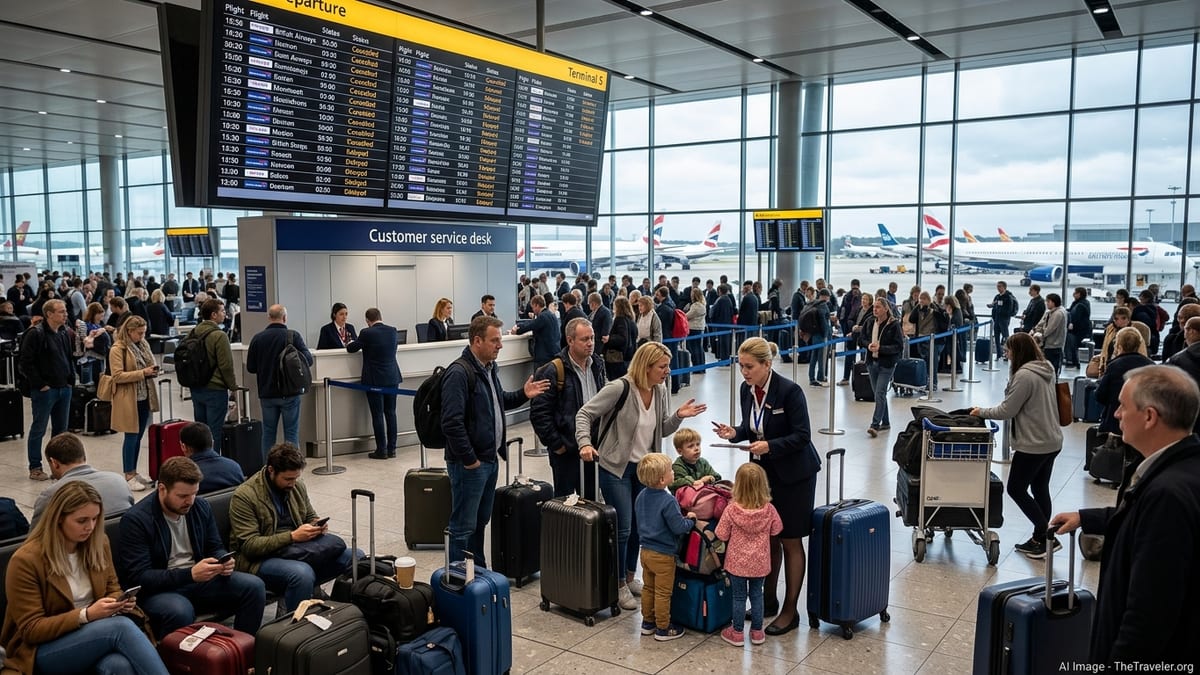
The disruption under scrutiny stems from a technical failure in the UK’s air traffic management network on 9 November, which led to delays and cancellations at multiple airports and affected passengers both entering and leaving UK airspace. According to evidence provided to Parliament and statements from NATS, the problem originated in a fault within a flight data processing system that forced capacity restrictions while engineers worked to restore normal operations. Although safety was maintained, the knock-on effect across a tightly scheduled European network meant disruption continued well beyond the initial incident window.
MPs on the Transport Committee highlighted that, as with previous air traffic control outages, the impact was felt most acutely at the UK’s busiest hubs, where early-morning and peak-time traffic banks are heavily used by leisure travellers and those making key onward connections. Passenger groups and airports reported that a significant number of customers missed holidays, business meetings and cruise and rail connections after their flights were either cancelled outright or heavily delayed. The Committee has asked NATS for detailed data on the number of aircraft movements affected and the duration of restrictions at each major airport in order to quantify the full impact.
Although the 9 November failure has clear similarities with earlier events, such as the 28 August 2023 NATS technical outage and a further system failure in September 2026, NATS has stressed in evidence to government that each incident had a distinct technical cause. In previous investigations, software defects and unexpected data inputs into complex, safety-critical systems have been identified as key triggers rather than cyber attacks or deliberate interference. MPs are now examining whether enough of the lessons from earlier incidents were implemented before the latest disruption occurred.
Transport Committee concerns on passenger rights and airline responses
The Transport Committee’s Chair has focused heavily on what the 9 November disruption meant for individual passengers, rather than the technical details alone. Drawing on the framework of retained EU Regulation 261/2004, which sets out air passenger rights in the UK, the Chair reiterated that airlines have clear duties to provide care and assistance when flights are cancelled or subject to long delays. These obligations apply regardless of whether the underlying cause, such as an air traffic control failure, is classified as an “extraordinary circumstance” for the purpose of compensation.
In previous committee sessions considering air traffic control disruption, senior Department for Transport officials and regulators have explained that while compensation for delays is generally not payable where the cause lies outside an airline’s control, airlines must still offer rebooking, refunds and, where necessary, meals and overnight accommodation. The Committee has heard repeated complaints from consumer organisations that many travellers are unaware of these entitlements or struggle to secure them in practice when disruption occurs on a large scale. The Chair has therefore pressed both airlines and the Civil Aviation Authority on how they are monitoring performance against these obligations during major incidents.
MPs have also linked the 9 November event to wider work on a Civil Aviation Bill that aims to give the regulator stronger enforcement powers over passenger rights. Recent government statements, originally prompted by the August 2023 NATS failure and renewed after the nationwide disruption on 8 September 2026, highlight an intention to ensure passengers do not face a repeat of the confusion and inconsistent treatment seen in earlier crises. The Committee is now asking whether the Bill, and parallel work by the regulator, will be sufficient to ensure that airlines quickly provide food, accommodation and clear rebooking options during any future system failures, rather than leaving passengers to rely on after-the-event claims processes.
NATS accountability and the push for stronger system resilience
Alongside passenger rights, the Committee Chair has questioned NATS executives about the resilience of the UK’s air traffic control systems and the pace at which recommendations from earlier reviews are being implemented. After the 28 August 2023 failure, the Civil Aviation Authority commissioned an independent review that produced dozens of recommendations relating to software robustness, contingency planning, staffing and communication with airlines and airports. The Department for Transport confirmed in late 2024 that it expected NATS and industry partners to act on those findings in full.
Subsequent events, including the large-scale air traffic control disruption of 8 September 2026, have already prompted further inquiries by Parliament and government into how quickly NATS has strengthened its infrastructure. Early reports into that 2026 incident, submitted to the Secretary of State and the CAA, identified a separate software defect within the flight data processing system and led to interim mitigation measures. The 9 November disruption will now be assessed in the context of this series of failures, with MPs examining whether the organisation’s approach to testing, redundancy and system change has kept pace with the demands of a growing flight network.
The Committee is particularly interested in whether a single technical failure can still cascade into network-wide disruption, despite previous pledges to improve redundancy and reduce single points of failure. Written answers from ministers on earlier incidents confirm that software problems within the national airspace system can still significantly restrict traffic flows while systems revert to fall-back modes or are restarted. The Chair has asked NATS to set out in detail how its architecture and operating procedures have been modified to prevent a repeat of events where one malfunction leads to hundreds or thousands of delayed or cancelled flights.
Implications for travelers: what 9 November tells passengers to check
For travelers, the Committee’s scrutiny of the 9 November disruption underlines several practical points. First, official statements and past investigations make clear that safety remains the overriding priority when there is any doubt about the integrity of air traffic control systems. This means that passengers should expect capacity restrictions, delays and diversions whenever a serious technical fault occurs, even if weather conditions appear benign and other parts of the journey, such as airport security and ground handling, seem to be operating normally. In effect, the system is designed to err on the side of caution while engineers confirm that all data being used to guide aircraft is correct.
Second, the ongoing parliamentary focus on passenger rights suggests that travelers caught up in future disruption will be expected to receive better and clearer information from airlines about their options. When failures are classed as outside airlines’ control, as with previous NATS incidents, immediate cash compensation for delay is unlikely. However, passengers remain entitled under UK rules to a choice between re-routing at the earliest opportunity, refund of the unused ticket portion and, where necessary, hotel rooms and meals while they wait. The Committee has repeatedly reminded airlines of these obligations and urged regulators to intervene swiftly where carriers fail to provide assistance on the day of disruption.
Third, the frequency of air traffic control failures significant enough to warrant parliamentary debate and formal investigation, although still low relative to the overall volume of flights, may encourage some travelers to build additional flexibility into itineraries. Government answers on the September 2026 failure recognise that knock-on disruption can persist for more than a day while aircraft and crews are repositioned. For those with time-sensitive connections to cruises, rail departures or major events, leaving a larger margin between international arrivals and onward travel remains a prudent step that does not depend on any specific outcome of current inquiries.
What happens next: investigations, potential reforms and traveler checks
The Transport Committee has indicated that its examination of the 9 November disruption will feed into broader oversight of aviation resilience and consumer protection. Following previous air traffic control incidents, the government has typically required NATS to produce preliminary investigation reports within days and more detailed analyses within weeks, shared with both the Civil Aviation Authority and Parliament. It is expected that a similar sequence will follow here, with MPs scrutinising whether proposed fixes are genuinely preventative rather than narrowly targeted at the specific failure mode seen on 9 November.
Parallel to NATS’ technical work, ministers and regulators are likely to use the latest disruption as further evidence in support of reforms already in train. The Civil Aviation Bill being considered by Parliament is designed to strengthen enforcement of passenger rights, while the CAA has separately worked on clearer guidance for airlines about when disruption counts as “extraordinary” and how care obligations must be met regardless. Previous written statements to Parliament show that ministers intend to ensure that passengers are better informed of their rights in real time, particularly during large-scale incidents when call centres and airport desks are under strain.
For travelers planning journeys in the coming months, the most practical step remains to check bookings, contact details and airline notifications closely before and on the day of travel. When major airspace or air traffic control issues arise, they are normally reflected quickly in live departure and arrival boards and in airlines’ own apps and websites. The pattern of recent incidents suggests that, while outright airspace closures remain rare, sizeable delays and schedule changes can occur at short notice when technical systems enter degraded modes. Keeping plans flexible where possible, understanding the difference between compensation and care rights, and retaining receipts for any reasonable expenses incurred during disruption will position passengers to respond effectively should they be caught up in any future event of the kind now being examined by MPs.