


More news on this day
Millions of Americans are setting off for Thanksgiving trips this week amid near-record travel volumes, fresh memories of a nationwide aviation tech outage and a series of coastal storms that threaten to snarl flights, driving and ferry links on some of the country’s busiest travel days.
Get the latest news straight to your inbox!
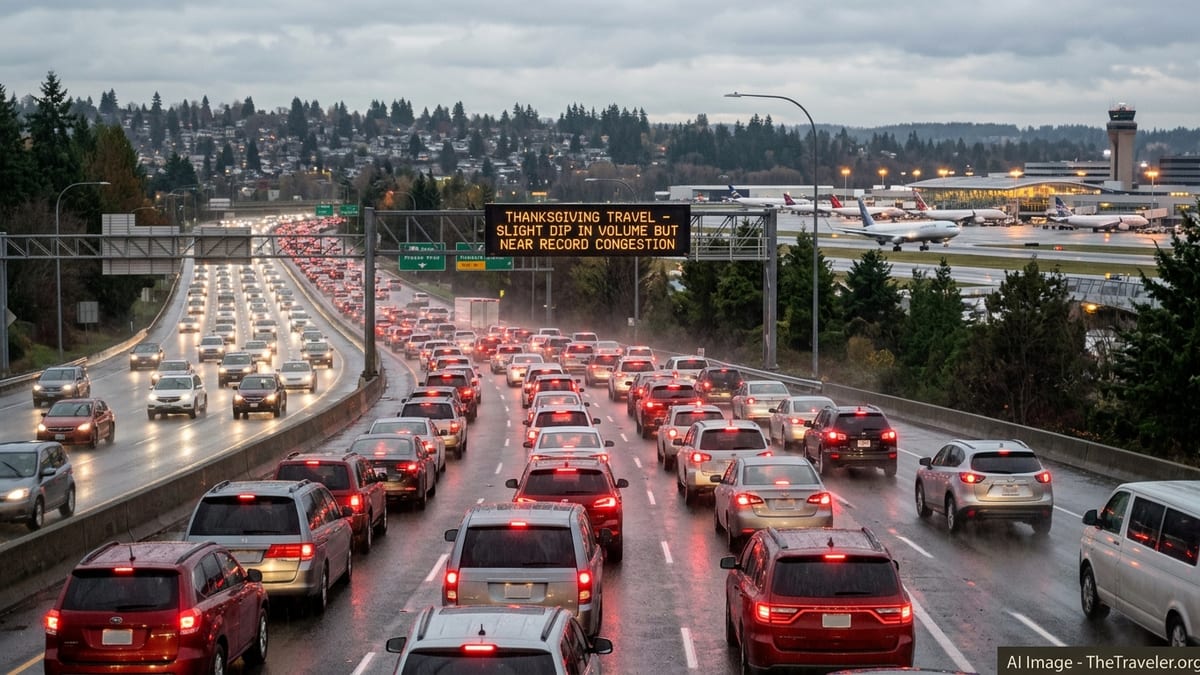
Holiday volumes remain near record levels despite slight dip
AAA forecasts that about 81.5 million people in the United States will travel at least 50 miles from home over the extended Thanksgiving period in 2026, a marginal 0.1% decline from last year’s record but still near all-time highs. The forecast covers trips by road, air and other modes between Tuesday November 24 and the Monday after Thanksgiving, and would mark the fourth straight year with more than 80 million Thanksgiving travelers nationwide.
Driving remains the dominant way Americans are getting to their holiday gatherings. AAA expects roughly 72.9 million travelers to go by car, slightly fewer than the 73.1 million estimated last year. The small dip follows several years of steadily rising Thanksgiving road travel, but forecasters stress that highways are still likely to be congested at traditional bottlenecks around major metropolitan areas during peak departure and return windows.
Air travel is also forecast to hold near last year’s very high levels. Nationwide, close to 6 million travelers are expected to fly for Thanksgiving, representing just over 7% of all holiday trips. That would be a fractional 0.2% decline compared with 2025 and still among the highest Thanksgiving air passenger totals since before the pandemic. Bus, rail and cruise travel combined are expected to account for about 2.6 million journeys, a modest increase from last year and a small but growing share of the overall mix.
Airlines and airports prepare for busiest skies in 16 years
On the aviation side, federal officials and airlines are bracing for some of the heaviest traffic the US airspace system has seen in more than a decade. The Department of Transportation, citing Federal Aviation Administration projections released on November 23, said the 2026 Thanksgiving period is expected to bring the busiest holiday skies in 16 years. According to figures reported from the FAA’s flight forecast, roughly 417,000 commercial flights are scheduled nationwide between November 23 and December 1, reflecting carriers’ efforts to meet sustained demand.
Daily checkpoint data from the Transportation Security Administration in the run-up to the holiday shows passenger volumes consistently running above 2.5 million screenings on peak days this month, with the agency warning that both the Wednesday before Thanksgiving and the Sunday after are again likely to be among the busiest air travel days of the year. Analysis of TSA records from previous years indicates that the Sunday after Thanksgiving has repeatedly been the single busiest day of the week at US airports, and planners expect a similar pattern in 2026 if weather and operations remain relatively stable.
Major hubs are already signalling substantial crowds. Seattle–Tacoma International Airport expects about 875,000 passengers between Wednesday and Monday, with both November 25 and November 29 projected to see around 164,000 travelers each. San Diego International forecasts up to 950,000 passengers over an 11-day period from November 20 to November 30, with Sunday November 29 predicted to be its single busiest day at around 100,000 passengers. Airports from Atlanta and Dallas to Denver, Boston, New York and Los Angeles have issued their own advisories urging passengers to arrive earlier than usual, allow additional time for parking and security and check real-time information on flights and terminal conditions.
Recent tech outage and coastal storms heighten disruption risk
This year’s Thanksgiving travel comes less than two weeks after a major national aviation technology outage that triggered what has been described as the longest nationwide ground stop in roughly a quarter century. The malfunction, which affected the system airlines use to file and manage flight plans, briefly halted most departures across the country for several hours and led to thousands of delayed and canceled flights. While the specific technical issue has been resolved, airlines and regulators acknowledge that any fresh problem affecting a similar system during peak holiday periods could have wide knock-on effects.
Weather is adding another layer of uncertainty. The National Weather Service’s Weather Prediction Center expects a largely rainy pattern along both the West and East Coasts around Thanksgiving, with drier conditions in much of the central United States. Forecasters say the Pacific Northwest will see rain early in the week, spreading into northern and central California by Wednesday, with snow likely at higher elevations in the Cascades and Sierra Nevada. Along the Pacific Coast, a combination of storms and so-called king tides is forecast to push water levels to heights not seen in decades in some locations, raising the risk of coastal flooding on key highways and in low-lying communities.
On the East Coast, meteorologists are monitoring a strong storm system tracking up the coast that could arrive in time for Thanksgiving Day. Depending on its exact path and strength, the system could cause heavy rain, gusty winds and localized flooding at times from the Southeast into the Mid-Atlantic and Northeast. In addition to complicating driving conditions, such a storm could disrupt flight operations at major hubs including Atlanta, Charlotte, Washington, New York and Boston, especially if low clouds and crosswinds reduce runway capacity. In Charlotte, organizers have already canceled the city’s Thanksgiving Eve parade over concerns about expected high winds and rain, highlighting how local authorities are responding conservatively to the forecast.
On the ground: highways, gas prices and regional pain points
For those driving, AAA’s travel forecast points to crowded but not unprecedentedly busy roads, with special pressure expected on certain urban and intercity corridors. State transportation departments and traffic analytics firms project significant congestion at traditional chokepoints, particularly on Wednesday afternoon and early evening as well as Sunday afternoon. In Washington state, for example, transportation officials have published hour-by-hour traffic forecasts for I-5, I-90 and US 2, showing prolonged heavy volumes over mountain passes and between major cities at peak times. Similar state-level forecasts and advisories have been issued in parts of California, Texas, the Mid-Atlantic and New England.
Gasoline prices are another factor for drivers. According to national price-tracking data, US average pump prices in late November are hovering just below the record Thanksgiving level of about $3.56 per gallon set in 2022, with some regional variation depending on local taxes and supply conditions. While prices are relatively high by historical standards, they have not spiked sharply in the immediate run-up to the holiday, which likely contributed to AAA’s assessment that overall travel will ease only marginally from last year’s peak.
Beyond highways, regional transport networks are dealing with their own challenges. In Washington state, ferry operators expect more than 300,000 passengers over the Thanksgiving period, but unusually high and low tides could complicate loading at certain docks and may require schedule adjustments. Along the Pacific Coast, potential coastal flooding and debris from storms could temporarily close or restrict sections of coastal highways that serve as both scenic routes and practical links between communities. In urban areas, transit agencies are adjusting service patterns to reflect weekday rush-hour departures on Tuesday and Wednesday followed by lighter schedules on the holiday itself, which may influence how easily travelers can reach airports and intercity rail stations.
What Thanksgiving travelers should confirm before they go
Given the combination of near-record traveler numbers, a recent system-wide aviation outage and unsettled coastal weather, officials and travel providers are emphasizing preparation and verification rather than assuming journeys will unfold as normal. The FAA is advising passengers to check with their airline for the latest flight status before leaving for the airport and to monitor the federal airspace status site for broader ground stops or flow-control programs that can ripple across multiple airports. TSA recommends arriving at least two hours before domestic flights and three hours before international departures, and many airports are urging travelers to add extra time on top of those guidelines for parking, shuttle transfers and the possibility of longer security lines at peak hours.
On the roads, AAA and state transportation agencies are encouraging travelers to build flexibility into their plans by avoiding the most congested departure windows where possible, checking real-time traffic apps for incidents and weather-related closures and preparing vehicles for winter conditions, especially on routes that cross mountain passes or more remote stretches. For coastal regions facing king tides or heavy rain, local authorities are urging drivers to stay updated via state or county emergency channels in case of sudden flooding, detours or ferry cancellations.
Rail, bus and ferry passengers are being reminded to confirm departure times and any service changes directly with operators, particularly on the days immediately around the holiday when demand is highest and weather-related disruptions are most likely. While forecasts and schedules provide a broad picture of how Thanksgiving week 2026 is expected to unfold, actual conditions will depend on how the evolving weather systems intersect with already stretched transportation networks. Travelers who stay informed about the latest advisories, leave themselves extra time and keep backup options in mind are likely to be better positioned to navigate one of the busiest and most complex travel periods of the year.