


More news on this day
Airline passengers flying to, from or within the United States now benefit from clearer federal rules that let them abandon a cancelled or heavily delayed flight and receive a cash refund, rather than accept rebooking or travel credits. The protections, shaped by an April 2024 U.S. Department of Transportation (DOT) rule and provisions of the May 16, 2024 FAA Reauthorization Act, apply regardless of the cause of the disruption and cover many significant schedule changes as well as outright cancellations.
Get the latest news straight to your inbox!
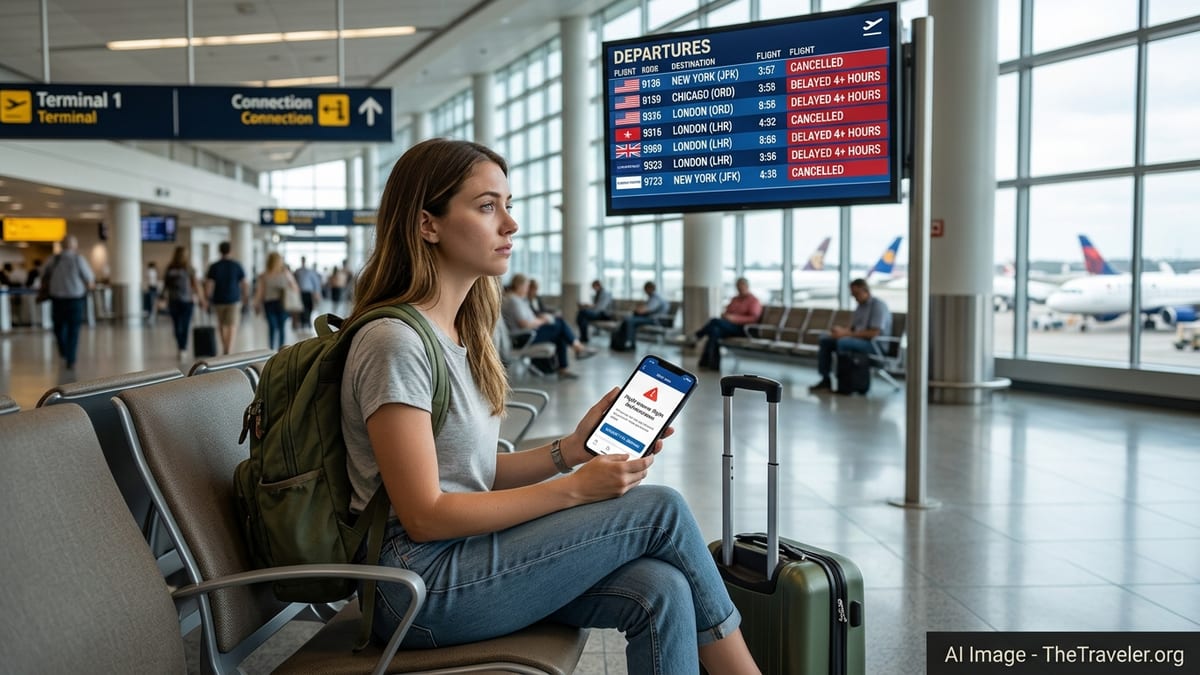
What counts as a refundable disruption on U.S.-linked flights
Under DOT regulations and the 2024 FAA Reauthorization Act, passengers holding nonrefundable tickets generally become entitled to a refund when a U.S. or foreign carrier cancels, significantly delays or significantly changes a scheduled flight to, from or within the United States and the traveler chooses not to continue the trip. For domestic itineraries, a significant delay for refund purposes typically means arrival at the final ticketed destination three hours or more after the originally scheduled arrival time. For international flights touching the United States, the threshold is six hours or more. These timing thresholds are now written into federal rules and statutory guidance rather than left to each airline’s internal policy.
Importantly for travelers, the refund right does not depend on why the disruption occurred. DOT has repeatedly confirmed that its long-standing policy applies “irrespective of the reason” for a cancellation. That means flights halted because of severe weather, air-traffic control problems, crew shortages or other operational issues can still trigger a refund obligation if the carrier cancels or significantly delays or changes the flight and the passenger opts not to travel. Airlines may still choose to offer only rebooking or vouchers initially, but under federal law eligible passengers can insist on getting their money back for the unused transportation instead.
These protections apply both to domestic tickets wholly within the United States and to international trips that either depart from or arrive in the country. For example, a nonrefundable New York–London ticket on a foreign carrier falls under the same federal refund framework as a Los Angeles–Chicago flight on a U.S. airline, so long as the disruption meets the federal criteria and the traveler declines to go ahead with the alternative arrangements that the airline proposes.
Schedule changes, partial trips and what “abandoning” a flight really means
The federal rule set does more than cover same-day cancellations. It also treats certain schedule changes as effectively equivalent to cancellations when they substantially alter the bargain the passenger bought. DOT now defines a “significant change” in a way that captures situations such as large shifts in departure or arrival times, additional connections compared with the original nonstop itinerary, changes to departure or arrival airports in the same metropolitan area, or substantial downgrades in the type of aircraft or cabin service. If such a change meets the regulatory definition and the passenger does not accept the new itinerary, the carrier must refund the unused portion of the ticket.
For many travelers, the most practical question is what happens when only one segment of a multi-leg trip is affected. The new framework clarifies that passengers are entitled to refunds for unflown portions of their ticket when a disruption affects a later leg and they decide that continuing no longer makes sense. For instance, if a weather system cancels a key connection on a three-flight domestic itinerary and the replacement options arrive a full day late, a traveler who decides to abandon the trip instead of being rebooked can claim a refund for the remaining untraveled flights. In some cases, if the earlier segments no longer provide value without the disrupted portion, DOT policy supports a refund of the full fare, though specific outcomes can depend on how the ticket was constructed.
Abandoning a disrupted flight for refund purposes generally means telling the airline that you do not want the alternative flight, credit, voucher or other form of compensation that is offered and that you instead want your money back. Once a passenger accepts rebooking on another flight under the carrier’s offer, the original refund right tied to the cancellation or delay usually ends for that ticket. Carriers are not required to provide both a full refund and an alternative itinerary for the same disruption, so travelers who need flexibility to book on a different airline or take a different route often have to choose the refund path instead of accepting reaccommodation.
Automatic cash refunds, timelines and how airlines must notify travelers
One key change introduced by DOT’s April 2024 final rule on refunds and consumer protections is the requirement for prompt automatic refunds when passengers are entitled to their money back and do not accept alternatives. Historically, many airlines issued flight credits or vouchers by default and made cash refunds available only after passengers navigated call centers or online forms. Under the updated rules, airlines must treat a cash refund as the default, with credits or miles offered only when a traveler actively chooses them.
Federal regulations set specific timelines for how quickly refunds must be processed. For tickets purchased with a credit card, airlines and ticket agents must issue refunds within seven business days of determining that the consumer is eligible and has rejected any alternatives. For tickets paid with other methods, such as cash, check or certain debit-card transactions, carriers must complete the refund within 20 calendar days. The refund must cover the full relevant amount paid for the transportation and any associated taxes and mandatory fees for the affected segment, and it must be returned to the original form of payment unless the passenger clearly agrees to another method.
The FAA Reauthorization Act of 2024 further requires airlines to proactively tell passengers when a cancellation, significant delay or significant change may qualify for a refund and to issue those refunds automatically when the traveler declines to travel under the modified plans. Carriers are also required to make their refund policies clear and accessible, and to report data to DOT that feeds into the agency’s public airline consumer dashboards, which allow passengers to compare refund practices, on-time performance and other service commitments across airlines. While some elements of the April 2024 rule have staged compliance dates, the core legal obligation to refund when a passenger chooses not to travel on a cancelled or significantly delayed or changed flight took effect with the May 16, 2024 law.
Limits of U.S. rules and how they differ from compensation regimes abroad
Although the U.S. framework around refunds is more clearly defined than in the past, it stops short of requiring airlines to pay statutory compensation when disruptions occur. Federal law focuses on returning the money passengers already paid for transportation and certain ancillary services that were not provided, such as checked baggage fees for bags that are delivered far behind schedule. It does not generally mandate that U.S. or foreign carriers reimburse hotel nights, meals or ground transportation when flights are cancelled or delayed, except where airlines have voluntarily adopted such commitments in their own customer service plans.
In practice, many large U.S. airlines publicize amenity policies that offer meal vouchers or hotel accommodations when disruptions fall within the airline’s control, such as mechanical issues or crew mismanagement. However, these commitments are not the same as the refund rights embedded in statute and regulation, and they typically do not extend to events outside the airline’s control, such as severe storms or government-imposed airspace restrictions. Recent federal guidance has also clarified that certain technical problems, such as aircraft recalls, may be treated as outside the carrier’s control for the purpose of these voluntary amenity policies, even though they do not affect a passenger’s underlying right to a fare refund when a qualifying cancellation or delay occurs.
This approach contrasts with regimes such as the European Union’s EC261 framework, which can require fixed cash compensation on top of refunds in specific disruption scenarios for flights operated by EU carriers or departing from the EU. For itineraries involving both U.S. and foreign jurisdictions, which set of rules applies can depend on the airline operating the flight and the route involved. However, travelers starting or ending in the United States can rely on U.S. refund protections regardless of whether the operating carrier is based in the country, so long as the flight in question arrives in or departs from a U.S. airport.
What travelers should do when a trip is disrupted
When a cancellation or long delay strikes, passengers who are considering abandoning the trip should pay attention to the timing and wording of any notifications they receive from the airline. Because the right to a refund is tied to factors such as whether the disruption crosses the three-hour domestic or six-hour international delay threshold and whether the airline’s proposed alternative amounts to a significant change, written evidence of the flight’s original and updated schedules, as well as any messages from the carrier, can be useful if a dispute arises. Keeping boarding passes, screenshots of delay notices and records of any offers of compensation or rebooking can help travelers demonstrate that they declined alternatives and requested a refund instead.
Travelers who decide they no longer wish to travel under the changed circumstances should explicitly communicate that choice to the airline or the ticket agent that sold the ticket, rather than simply failing to show up at the airport. Under current rules, carriers may impose deadlines for passengers to respond to offers of new flights, provided they clearly explain that failing to respond by the deadline could result in cancellation of the reservation. However, if the passenger rejects the alternative before the deadline or does not respond and therefore does not travel, and the triggering disruption meets the federal definitions, the traveler is still entitled to a prompt refund within the seven or 20 day timeframe, as applicable.
For passengers who prefer to secure a seat on another airline or take a different route, choosing the refund often makes the most sense, since accepting reaccommodation can remove the right to the original fare back. On the other hand, travelers who are mainly concerned with reaching their destination and are comfortable being rebooked, even many hours later, may prioritize the alternative transportation over reclaiming the money. Because the decision is typically a one-time trade-off, understanding the federal rules and the airline’s own commitments before responding to a rebooking offer can help passengers choose the option that best fits their situation.
Looking ahead, DOT has signaled that it may refine certain technical aspects of the refund rules and enforcement policies as it gathers more data and feedback, particularly around how to categorize different types of disruptions. Travelers booking flights now, however, can already rely on the core principle that if their flight to, from or within the United States is cancelled or significantly delayed or changed and they decide not to travel or accept a voucher or rebooking, they are generally entitled to get their money back within clearly defined federal timelines.