


More news on this day
Delta Air Lines passengers traveling through Hartsfield-Jackson Atlanta International Airport on Sunday faced widespread delays and scattered cancellations after an internal automation system used to calculate aircraft weight malfunctioned, prompting a short FAA-managed delay program for Delta flights into the carrier’s largest hub during one of the busiest travel weeks of the year.
Get the latest news straight to your inbox!
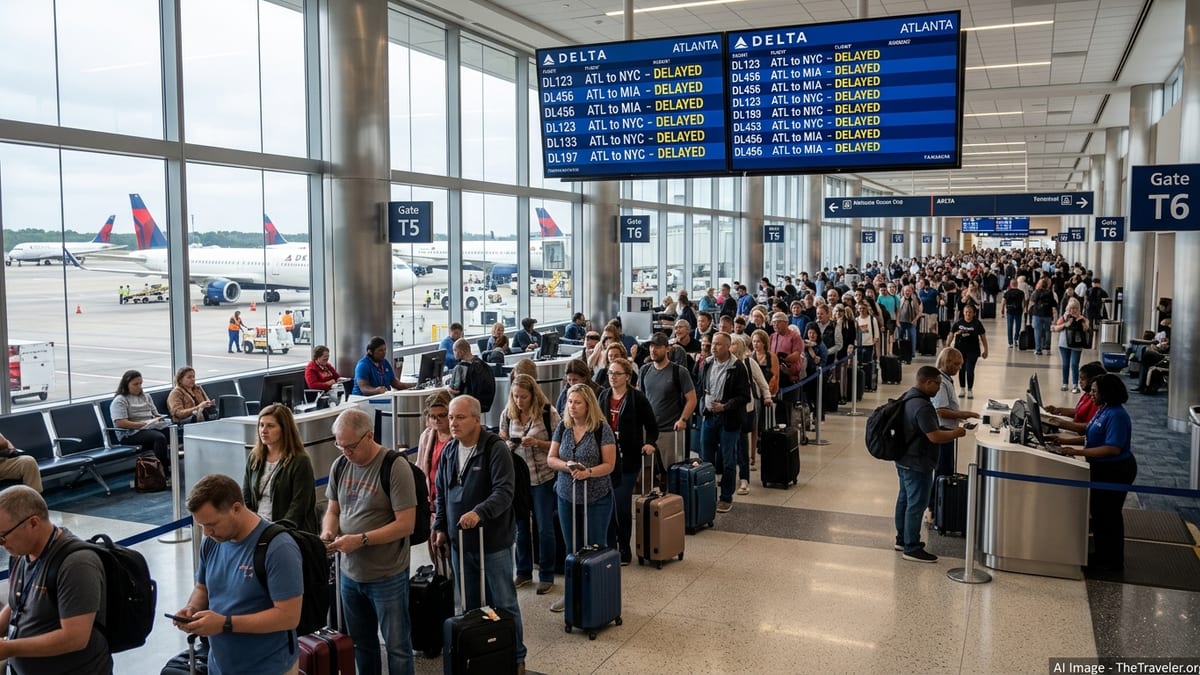
What happened to Delta’s operation in Atlanta
Delta’s disruption began early Sunday when an automated system that supplies key weight-and-balance data for its aircraft stopped functioning correctly. The system is used to determine how much an aircraft weighs before departure and how that weight is distributed, information pilots need to calculate safe takeoff performance. Without reliable data, flights could not legally depart until alternative procedures were in place, which quickly backed up the operation at Hartsfield-Jackson Atlanta International Airport, Delta’s main hub.
To manage the growing congestion, the Federal Aviation Administration implemented a ground delay program affecting Delta and its regional affiliates flying into Atlanta from the contiguous United States. The delay program required certain flights bound for Atlanta to hold at their origin airports until they were allocated an arrival slot. According to FAA advisories, that program was lifted at 11:26 a.m. Eastern, once Delta was able to stabilize its systems and traffic flows improved, but knock-on disruptions lasted into the afternoon and evening.
Data from aviation analytics firms showed that the glitch did not shut down Delta’s operation completely but did significantly degrade its reliability on a day of already heavy demand ahead of the Thanksgiving holiday. By late Sunday, Delta had canceled a few hundred flights and delayed many more across its network, with Atlanta seeing the most severe impact. Hartsfield-Jackson officials stressed that airport infrastructure and non-Delta operations were running normally and that the disruption was specific to Delta’s systems and schedules.
Impact on passengers and how Delta responded
For travelers, the most visible effects were long lines at gates, crowded concourses and departure boards filled with yellow and red delay markings. Many passengers in Atlanta and at Delta outstations reported rolling departure times as crews waited for revised weight figures or for new slots into Atlanta once the FAA’s delay program took effect. Because the underlying problem involved internal Delta systems rather than air traffic control, some flights operated normally while others sat at gates or holding points for extended periods, creating an uneven pattern of disruption.
Delta said it was rebooking customers whose flights were significantly delayed or canceled and providing meal vouchers and hotel accommodations when overnight stays were required. The airline also reiterated that passengers whose flights were canceled and who chose not to travel could request refunds, in line with U.S. Department of Transportation rules. Travelers with noncanceled but heavily delayed flights were generally offered fee waivers to change to alternative departures where seats were available, though specific options depended on fare type and route.
Airport officials in Atlanta advised all passengers, including those on other airlines, to arrive at least two hours before scheduled domestic departures and three hours before international flights. While the terminal’s security and baggage systems were not affected by the Delta glitch, irregular operations increased congestion at check-in counters, security checkpoints and rebooking desks. Passengers connecting in Atlanta were encouraged to monitor their itineraries closely, as even after the FAA lifted its delay program, aircraft and crews remained out of position, causing additional schedule changes later in the day.
How this fits into a week of U.S. aviation technology problems
Delta’s difficulty came at the end of a week in which U.S. aviation systems had already been strained by separate large-scale technology failures. On Friday, November 13, the FAA ordered a rare nationwide ground stop after its telecommunications network, which supports communications and radar feeds for air traffic control, became unstable. The agency later said a flood of unexpected data connections across parts of its network had forced it to halt departures across the country for about four hours and 45 minutes as a safety precaution while engineers worked to restore stable operations.
The nationwide ground stop ended that evening, but disruptions extended into the weekend as airlines canceled and rescheduled thousands of flights. Federal summaries and airline updates indicate that roughly 12,000 flights were canceled between November 13 and November 15, including a large share of services operated by the major U.S. carriers. Although not all of those cancellations were directly caused by the FAA issue, the scale of the stoppage made it one of the most far-reaching air traffic interruptions in the United States in recent decades.
Just three days later, on Monday, November 16, United Airlines experienced its own system outage that affected departures across North America. According to statements from United and communications from the pilots’ union, the airline temporarily lost access to a system that provides final aircraft weight data and disrupted several pilot-facing applications, including crew communications tools. United delayed hundreds of departures while the problem was resolved. The airline has said the main outage lasted around 90 minutes to an hour and a half, but, as with Delta and the FAA events, schedule disruptions continued for several hours as aircraft and crews fell out of their planned rotations.
What is known – and not yet known – about causes and safeguards
In the case of the FAA’s November 13 ground stop, federal officials have provided an initial technical explanation. The agency’s public question-and-answer documents and subsequent briefings describe how legacy communications equipment in its network became unstable when it was hit by an unusually high volume of connection attempts, traced to two locations where its network provider was deploying new routing hardware. That instability affected multiple air route traffic control centers and some terminal facilities, leaving the FAA unable to guarantee that communications and radar information would remain reliable without temporarily suspending departures.
For United’s November 16 disruption, airline and union communications point to a failure in software systems that distribute operational data such as aircraft weights and crew messages. While internal reviews are ongoing, the outage appears to have been contained to United’s infrastructure. The airline has not reported any link between its issue and the FAA’s separate network problem days earlier, and transportation officials have said they have seen no evidence that the events share a common technical root or that they were caused by a cyberattack. Investigators and regulators are focused instead on understanding vulnerabilities in complex, interconnected aviation IT systems and on whether existing safeguards and redundancy plans are sufficient.
Delta has described its Atlanta disruption as stemming from an automation problem affecting the system that calculates or transmits aircraft weight-and-balance data. As of now, public statements from the airline and the FAA do not indicate that the Delta issue was connected to the FAA’s earlier telecommunications failure or to United’s outage, and authorities have again said there is no indication of malicious activity. Instead, early indications point to separate technical faults emerging in different parts of the aviation ecosystem within a short span of time. Full investigations typically take weeks or months, and final reports often include recommendations for software changes, additional backup systems or modifications to operational procedures.
What travelers should do for upcoming trips
For passengers planning to fly with Delta in the coming days, the airline’s schedules are expected to return to normal as aircraft and crews are brought back into position. However, travelers with trips booked through Atlanta, especially during the peak Thanksgiving period, should keep monitoring their flight status through Delta’s app or website and sign up for notifications, as residual delays are still possible if weather or other factors interact with already tight schedules. If a flight is significantly changed or canceled, U.S. Department of Transportation rules entitle customers to refunds if they choose not to travel, regardless of the fare category, and airlines commonly publish temporary change-fee waivers after major disruptions.
More broadly, the cluster of technology-related problems over the past week means U.S. air travelers are facing a busier and potentially less predictable environment as the holiday season begins. The Transportation Security Administration expects to screen record or near-record numbers of passengers during the Thanksgiving travel window and continues to advise arriving at least two hours before domestic departures and three hours before international flights. That guidance is especially important at major hubs such as Atlanta, where any irregular operations can quickly lead to longer lines and missed connections because of the volume of connecting traffic.
Before heading to the airport, travelers should confirm their flight status, gate and terminal information directly with their airline and consider building in extra time for tight connections, particularly if their itinerary touches airports that were heavily affected by the recent disruptions. Those with flexible schedules may wish to avoid the single busiest travel days, typically the Wednesday before Thanksgiving and the Sunday after, when even minor issues can cascade into longer delays. While the recent Delta, United and FAA events have all been resolved, they have highlighted how quickly technical problems can ripple through a tightly scheduled system, making real-time information and contingency planning especially important for anyone flying in the weeks ahead.