


More news on this day
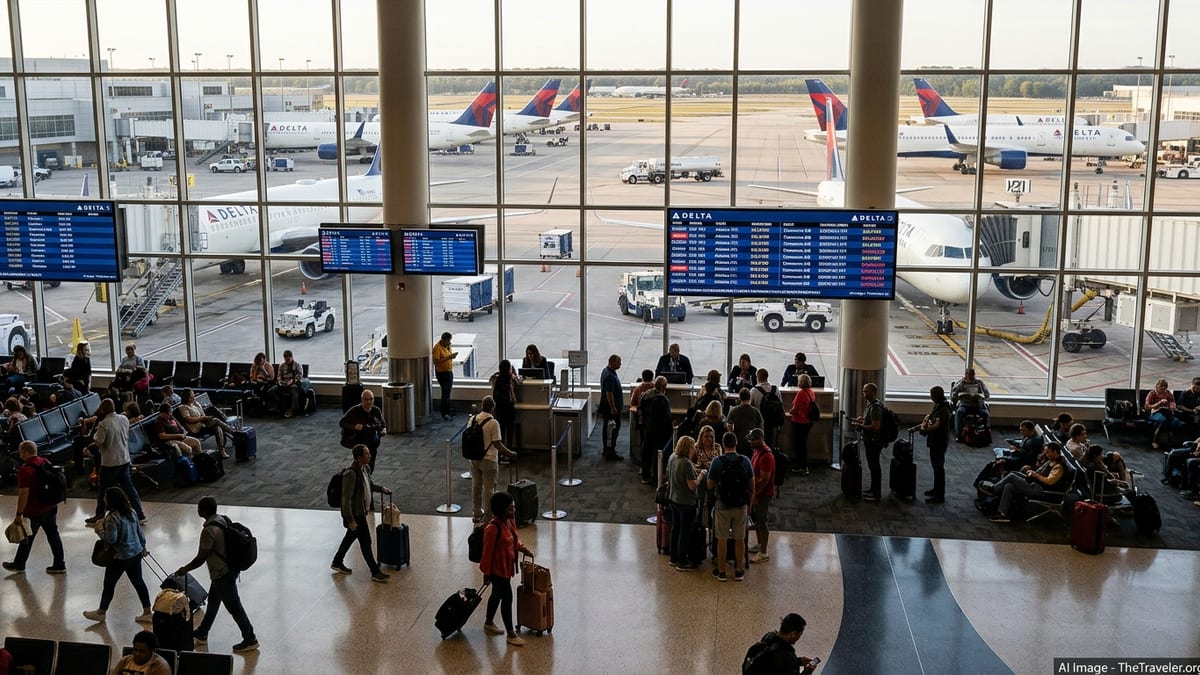
Delta Air Lines says it has restored the automated system that malfunctioned on Sunday, November 22, causing a ground stop and hundreds of flight delays at its Atlanta hub just days before the busy U.S. Thanksgiving travel period, though some residual disruptions are still affecting passengers.
Get the latest news straight to your inbox!
What happened to Delta’s operations in Atlanta
The disruption began on Sunday morning, November 22, when an automated system used by Delta to calculate aircraft weight and balance stopped functioning correctly. The system helps determine how passengers, baggage and cargo are distributed on each aircraft and is required before departure for safety reasons. When it failed, many Delta flights were unable to receive the necessary documentation to push back from gates.
As the problems mounted, the Federal Aviation Administration instituted a ground stop that temporarily halted some flights bound for Hartsfield-Jackson Atlanta International Airport, Delta’s largest hub and the world’s busiest airport by passenger numbers. The measure remained in effect for roughly an hour while Delta and federal officials assessed the scope of the outage and its implications for flight safety.
By later in the day on Sunday, Delta reported that the automation issue had been fixed and that its systems were again able to support normal operations. However, because the outage occurred during one of the busiest travel periods of the year, the recovery was not immediate and many customers continued to experience delays and schedule changes well into Monday, November 23.
Scale of delays and how quickly operations recovered
Data from flight-tracking services show that Delta suffered more than 1,000 delayed flights and several hundred cancellations across its network on Sunday, with the majority of those tied to its Atlanta hub. At one point, Delta accounted for most of the delays at Hartsfield-Jackson, although other airlines using the airport also experienced knock-on effects from air traffic control flow restrictions and congestion.
On Monday, November 23, operations at Atlanta improved but had not fully normalized. Local and national reports described passengers still encountering significant wait times, rebookings and late arrivals as aircraft and crews were repositioned. Some pilots and passengers reported that, even after the automated system was restored, weight and balance calculations and baggage handling were in some cases being completed manually, which slowed turnaround times at the gate.
By the early hours of Tuesday, November 24, Delta and Atlanta airport officials were describing conditions as largely stabilized. Flight-tracking data indicated that Atlanta was still seeing dozens of delays but at a much lower level than during the peak of Sunday’s outage. Delta has said that the automation problem itself has been resolved and that current disruptions are mainly the result of aircraft and crew being out of their planned positions rather than an ongoing technical failure.
Impact on Thanksgiving week travelers nationwide
The timing of the outage has amplified its effects. The incident came on the first major weekend of the U.S. Thanksgiving travel period, when passenger volumes are expected to reach or surpass some of the highest levels seen in more than a decade. Atlanta is a critical connecting hub in Delta’s network, meaning that a disruption there can quickly ripple across the United States and on to international routes.
Travel industry analyses indicate that Sunday’s Delta outage followed a broader pattern of recent aviation system issues in the United States, including a nationwide ground stop earlier in November caused by an air traffic control systems problem and a separate technology failure at United Airlines. For Thanksgiving week travelers, this sequence of events has raised concern about the resilience of both airline and federal systems at a time of heavy demand.
On Sunday and Monday, many passengers connecting through Atlanta reported missed connections, overnight delays and long rebooking lines, particularly for flights to smaller cities that have limited daily service. Travelers already in the air when the ground stop was issued in Atlanta sometimes experienced extended holding patterns or diversions as air traffic control managed the flow of arrivals into the hub.
Weather concerns for the Macy’s Thanksgiving Day Parade and East Coast travel
While Delta’s system issue appears to be resolved, the next potential disruption for travelers heading into the Thanksgiving holiday is weather, particularly in the Northeast. Forecasts for New York City indicate that a coastal storm could bring strong winds and periods of rain to the region on Thanksgiving Day, Thursday, November 26, when the 100th Macy’s Thanksgiving Day Parade is scheduled to take place in Manhattan.
City and parade officials plan to proceed with the event as scheduled, but the ability of the giant character balloons to fly depends on real-time wind conditions. Under New York City rules, the balloons may be grounded, lowered or flown at reduced height if sustained winds or gusts exceed specified thresholds. Forecasters currently expect that the steadiest rain may hold off until later on Thanksgiving Day, but caution that wind speeds could approach the range where balloon operations are reviewed, meaning final decisions will likely be taken early Thursday morning.
For air travelers, the same storm system could produce low clouds, gusty winds and periods of rain at major East Coast hubs, including New York-area airports, on Wednesday night and Thursday. While these conditions are not unusual for autumn, they can slow arrivals and departures and contribute to additional delays, particularly when combined with already busy schedules and lingering effects from earlier disruptions. Passengers connecting from Atlanta to Northeast airports should factor in the potential for weather-related delays on top of any remaining schedule irregularities linked to the Delta outage.
What travelers should do next
For passengers flying with Delta through Tuesday, November 24, the airline is encouraging customers to monitor their flight status frequently, use its mobile app or website to adjust itineraries where possible, and arrive at the airport with extra time. While the underlying automation issue has been fixed, aircraft rotations and crew schedules may still be recovering, and day-of-flight changes remain possible, especially at Atlanta and other major Delta hubs.
Looking ahead to Thanksgiving Day and the weekend, travelers heading to or from the Northeast, including those planning to attend or watch the Macy’s Thanksgiving Day Parade in person, should check updated weather forecasts and any advisories from local authorities or the parade organizers on Thursday morning. Parade attendees may wish to prepare for wet or windy conditions and allow additional time to reach viewing areas, particularly if street closures change in response to weather.
More broadly, passengers traveling during the Thanksgiving period may benefit from building extra flexibility into their plans. This can include scheduling longer connection times where possible, confirming seats and gate assignments in advance, and having contingency plans for severe delays, such as knowledge of later alternative flights or nearby accommodation options. With airline operations in Atlanta now largely restored but the holiday rush and an approaching East Coast storm still ahead, staying informed in real time remains the most practical way for travelers to reduce stress and respond quickly if conditions change.