


More news on this day
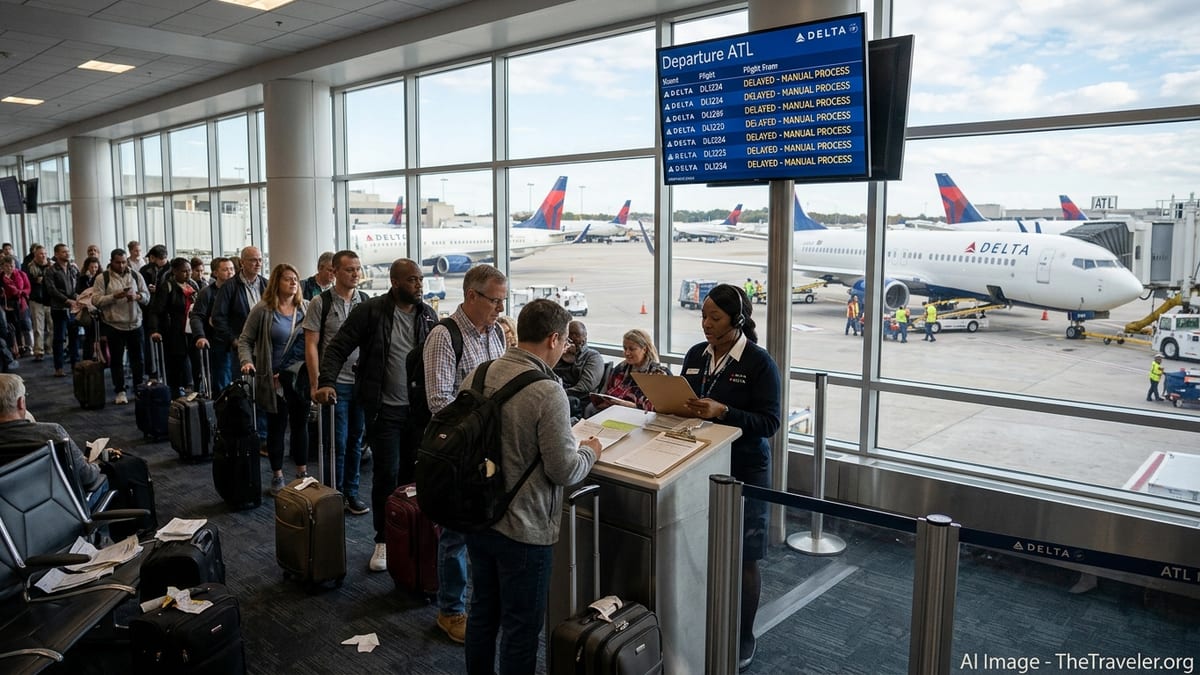
Delta Air Lines says it has restored the automated system that calculates aircraft weight and balance after a Sunday outage triggered a brief FAA ground stop for Atlanta-bound flights and widespread delays across its network at the start of the U.S. Thanksgiving travel rush.
Get the latest news straight to your inbox!
What happened to Delta’s automation system
According to statements from the airline and the Federal Aviation Administration, Delta’s problems began on the morning of Sunday, November 22, 2026, when an internal system used to generate load and balance calculations for departing flights stopped working properly. The carrier relies on an application known as the Automated Load Instruction System to determine how passengers, baggage, freight and fuel are distributed on each aircraft. When the system became unavailable, dispatchers and flight crews were instructed to switch to manual calculations to ensure each flight remained within certified weight and balance limits.
Complying with those limits is a core safety requirement. FAA guidance notes that exceeding an aircraft’s structural weight limits or operating with an improper center of gravity can degrade performance and, in extreme cases, compromise safety. With automation offline, crews needed extra time at the gate to verify loading data, complete paperwork and receive dispatch clearance, which immediately slowed departures across Delta’s network on what was already a high-traffic day ahead of Thanksgiving.
Delta has not publicly detailed the root technical cause of the outage, but both the airline and federal officials have said there is no indication that it was related to FAA air traffic control systems or to cybersecurity issues. The company characterized the failure as a problem with its internal automation and emphasized that it continued dispatching flights using established manual procedures until the system was restored later in the day.
Ground stop in Atlanta and scale of the disruption
The impact was most visible at Delta’s largest hub, Hartsfield-Jackson Atlanta International Airport, one of the world’s busiest passenger airports and a central connecting point for the carrier’s domestic and international network. At Delta’s request, the FAA issued a ground stop on Sunday morning for certain Delta flights bound for Atlanta, temporarily preventing additional departures into the already congested hub while gates and ramp areas were near capacity. The ground stop was later downgraded to a ground delay program that kept flights under control while still allowing some operations to continue.
FAA advisory data and independent flight-tracking services show that the disruption quickly rippled beyond Atlanta. Flight-tracking service figures cited by multiple outlets indicated that more than 1,000 Delta mainline and Delta Connection flights were delayed during the day, with some reports placing the number above 1,400. Operations data also show that delays and some cancellations affected airports across the United States, including major Delta stations in New York, Washington, Boston, Minneapolis and on routes along the East Coast and to the Midwest and South.
At Atlanta itself, airport status boards and tracking platforms recorded several hundred delayed flights across all airlines on Sunday, as bottlenecks in Delta’s operation reduced the number of gates available for arriving aircraft. When departing flights remained on the ground longer than scheduled while weight and balance figures were computed manually, arriving aircraft were forced to wait for gate space, compounding the disruption. Local media reports from Atlanta on Monday, November 23, indicated that Delta’s operation was stabilizing and that the airline’s automated system was again functioning normally, though some knock-on delays persisted as aircraft and crews were repositioned.
Relationship to the earlier nationwide FAA ground stop
The weight-and-balance outage came less than two weeks after a separate and much larger technology failure within the FAA’s infrastructure on November 13, 2026, that triggered a rare nationwide ground stop for all U.S. flights. Federal officials have since attributed that earlier event to a problem involving new network hardware that disrupted communications and radar data across multiple air traffic control centers. The FAA has described the November 13 incident as the most extensive nationwide ground stop in roughly a quarter-century.
While the timing raised questions for travelers, current evidence indicates that the November 22 Delta outage was operationally distinct from the FAA’s earlier nationwide problem. The FAA has said that its air traffic systems were functioning normally on November 22 and that Sunday’s restrictions applied only to certain Delta flights into Atlanta, put in place at the airline’s request to manage congestion while its internal automation was down. Delta has likewise said the disruption was not connected to FAA systems and was instead tied to its own weight and balance automation.
The proximity of the two events nonetheless heightened concern among travelers and policymakers about the resilience of aviation technology as the Thanksgiving holiday period gets underway. Airline trade groups and federal officials have repeatedly stressed that, despite recent high-profile outages, layered safety processes remain in place, including the ability to revert to manual procedures when automated tools fail, as occurred during Delta’s November 22 disruption.
How Delta responded and what affected passengers are entitled to
During the outage on November 22, Delta said it was using “manual workarounds” to safely dispatch flights, with teams in its operations center coordinating closely with local airport staff and flight crews. The carrier issued a public apology and described cancellations as a last resort, stating that it aimed to complete as much of its schedule as possible while prioritizing safety. By Sunday evening, the airline reported that automation for weight and balance calculations had been restored, and by Monday its Atlanta hub was reported to be operating more normally, although some residual delays continued as aircraft returned to planned rotations.
For passengers whose travel was disrupted, Delta has outlined a series of options. Customers whose flights were canceled can request a refund if they choose not to travel, consistent with U.S. Department of Transportation rules requiring refunds when airlines cancel or significantly change flights and the passenger declines rebooking. Delta has also been rebooking affected customers on the next available flights and has said it is providing meal vouchers and hotel accommodation where overnight stays are necessary because of the disruption.
The specific level of compensation can vary depending on the circumstances of each itinerary, local regulations and whether travelers are on domestic or international tickets. Within the United States, airlines are not obligated by law to pay cash compensation for delays caused by internal technical issues, but they commonly offer vouchers, miles or other goodwill gestures. Passengers are generally encouraged to check their booking status in the airline’s app or website, retain receipts for out-of-pocket expenses and contact Delta customer service if they believe they are entitled to additional support based on the length and cause of their delay.
Implications for travelers for the rest of the Thanksgiving period
The timing of Delta’s system failure added strain to an already busy travel window. Federal and industry forecasts point to Thanksgiving 2026 as one of the heaviest U.S. air travel periods since before the pandemic, with millions of passengers expected to pass through airports between Tuesday, November 24, and the following Sunday. Even though Delta’s weight and balance automation has now been restored and operations at Atlanta and other hubs have largely returned to normal, airlines and airports are preparing for tight margins throughout the holiday week.
For travelers, that means the risk of knock-on impacts remains higher than during quieter times, even if no further major outages occur. Aircraft and crew repositioning after the November 22 disruption may leave some routes with limited spare capacity for several days, making it harder to accommodate unexpected issues such as weather or local ground delays. Industry data from previous holiday seasons show that once schedules are heavily loaded, congestion at a single major hub can cascade throughout the network, especially when coupled with winter weather systems moving across multiple regions.
Passengers planning to fly over the remainder of the Thanksgiving period are being advised by airlines and airport authorities to build in additional time at departure airports, monitor flight status frequently through official channels and keep contact details current in airline bookings so that schedule changes or gate moves can be communicated quickly. Travelers with connections through Atlanta or other large hubs may wish to allow longer layovers than usual where possible, particularly early in the week as the system fully resets. Those whose flights were directly affected on November 22 should review their reservations, confirm any rebooked segments and, where necessary, follow up with Delta regarding refunds or travel credits before making alternative arrangements.