


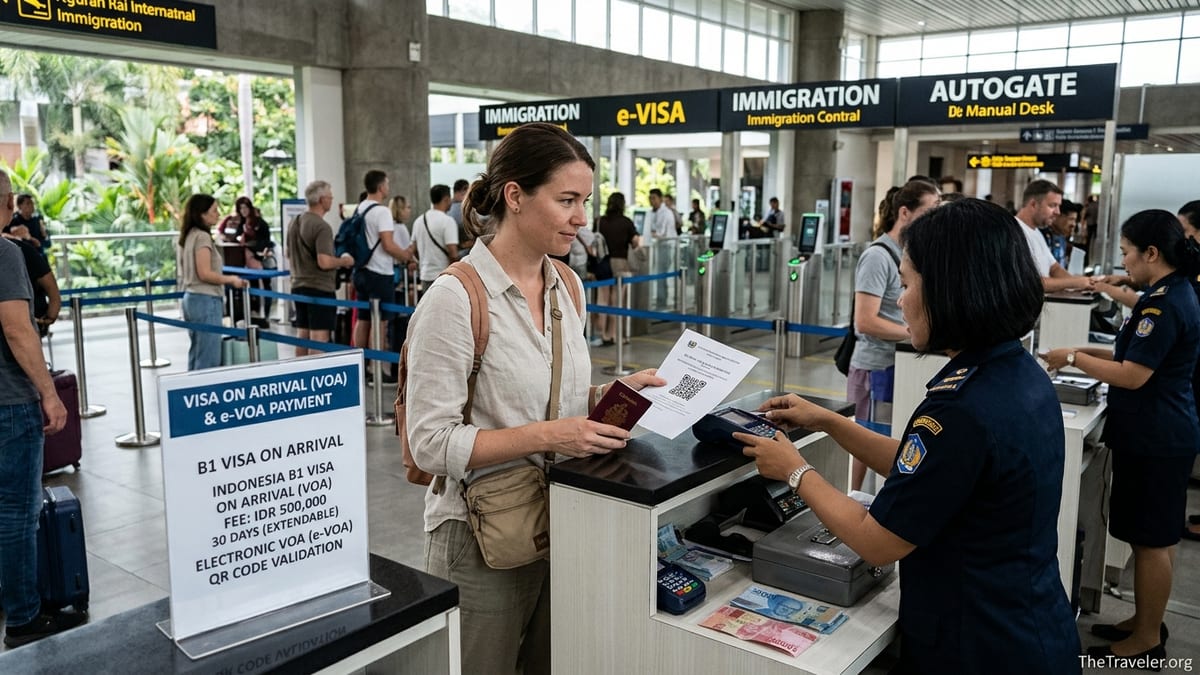
By 2027, most holidaymakers flying to Bali will still enter Indonesia on the familiar B1 Visa on Arrival, either bought at the airport or arranged electronically in advance. Both options currently grant eligible passport holders an initial stay of up to 30 days, with a single extension available in Indonesia for a total stay of up to 60 days, while the electronic version can be secured before departure. Understanding how the standard Visa on Arrival and its electronic twin really work, and how they fit alongside Bali’s separate tourist levy and Indonesia’s free arrival declaration, will make your trip through Ngurah Rai International Airport far smoother.
Get the latest updates straight to your inbox!
Core rules: what the B1 Visa on Arrival actually provides
Indonesia’s B1 Visa on Arrival is a single entry visit visa designed for short tourist and certain general visit purposes. Official guidance from the Directorate General of Immigration and supporting government publications confirm that the B1 visa grants an initial 30 days of stay, counted from the date of arrival, and can be extended once within Indonesia to allow a total permitted stay of up to 60 days. The same 30 plus 30 structure applies whether you purchase the visa at the airport counter or obtain it as an electronic Visa on Arrival through the immigration eVisa portal before travel.
The government fee for the B1 Visa on Arrival remains set at IDR 500,000. Indonesian immigration, provincial governments and even partner university guidance consistently repeat this figure, and late 2026 advisories stress that the fee has not been increased, despite occasional rumors online. The charge is the same for a visa bought in person at Ngurah Rai International Airport and for an eVOA processed through the official online system or its contracted service provider.
It is important to distinguish this fixed government fee from any extra costs. When you pay online, your bank or card provider may add a foreign transaction charge or currency conversion mark-up. Commercial visa agencies that submit applications on your behalf can also add their own service fees on top of the IDR 500,000 state charge. At the airport itself, however, you should only be paying the official B1 fee at the designated payment counter, not any additional “processing” or “expediting” surcharge.
For a typical two week Bali holiday in 2027, the B1 visa is all many travellers will need. A United States passport holder arriving in Denpasar for 14 days, for example, would either pay IDR 500,000 online before departure or at the visa counter on arrival, receive a 30 day permission to stay, enjoy the trip and depart well before any extension becomes necessary.
Who can use VOA and eVOA: nationalities, visa free cases and key nuances
Indonesia maintains an official list of countries whose citizens may obtain a B1 Visa on Arrival or its electronic version. The list is periodically updated by ministerial regulation and immigration decrees, and by late 2026 it includes most major tourist source markets such as the United States, United Kingdom, Australia, Canada, the majority of European Union member states, India and China. Official documents circulated through embassies and scholarly conferences reference this list and direct travellers back to the immigration eVisa portal for the current eligibility table.
Certain countries have separate visa free short visit arrangements. Regional agreements within ASEAN, and later regulations adding specific states and territories to Indonesia’s visa exemption schedule, give some neighbouring citizens limited visa free entry for tourism and official purposes. These agreements are subject to revision, so a Singaporean or Malaysian traveller considering a Bali weekend in 2027 should still check the most recent ministerial regulation and immigration announcements to confirm whether they qualify for visa exemption or should plan for a B1 VOA like other visitors.
Eligibility is not determined solely by nationality. The type of passport you carry and the purpose of your visit both matter. Diplomats travelling on official passports, for example, may fall under a different regime from tourists on ordinary passports. Likewise, visitors entering Indonesia primarily for journalism, paid performances, teaching, research or other non tourist activities may require a different visa category even if their nationality appears on the B1 list. A British photographer visiting Bali for a commercial fashion shoot in 2027 should not assume the tourist B1 visa is appropriate simply because it is available to UK passport holders for leisure travel.
Potential travellers from countries outside the B1 list or under special restrictions must look at alternative pathways. Some may qualify for pre arranged visit visas in other categories, issued entirely before travel. Others might be required to obtain visas only through embassies or consulates in advance. In all cases, checking the official immigration and foreign ministry channels for the latest eligibility rules before booking flights will reduce the chance of being denied boarding or entry on arrival.
How to apply for Indonesia’s electronic Visa on Arrival before departure
The Indonesian government runs its own electronic visa platform, through which travellers eligible for the B1 Visa on Arrival can apply for an eVOA before they fly. Official tourism guidance and immigration materials direct users to this portal and to an officially appointed service partner site, both of which are used for pre arrival applications. Travellers are advised to arrive at the authentic government platform, identified by the .go.id domain and standardised branding, to avoid third party imitators.
To apply, travellers first create an account on the eVisa system, providing a working email address that will receive verification messages and status updates. Once the account is activated, applicants select their nationality, choose the purpose of visit as general and then select tourism as the sub purpose before choosing the B1 Visa on Arrival product. The system will display the current fee of IDR 500,000 for a 30 day visa and confirm that the visa is single entry and extendable once after arrival.
The application process requires uploading a clear scan or photograph of the biographical page of the passport. The passport must be valid for at least six months on the date of arrival in Indonesia and should have spare space for entry stamps. Where requested, a recent colour photograph meeting the specified size and background guidelines is also uploaded. Applicants then enter personal details, home address, contact information in Indonesia, and sometimes the name and address of their first hotel or villa in Bali. Evidence of onward or return travel, such as a confirmed airline booking leaving Indonesia within the visa validity, is often requested and should match the intended length of stay.
After reviewing the application summary, travellers proceed to payment. The portal and its official partner accept major international cards, but users routinely report that banks may decline transactions without advance notification, or that additional verification steps such as one time passcodes are triggered. Some foreign issuers also add a small percentage fee for processing an Indonesian rupiah transaction. Once payment succeeds, the system typically issues an electronic visa document within hours or a couple of days, which the traveller downloads and either prints or stores in a readily accessible digital form for presentation at the airport.
Buying a Visa on Arrival at Bali airport and using immigration autogates
Travellers who choose not to apply online can obtain the same B1 Visa on Arrival upon landing at I Gusti Ngurah Rai International Airport in Bali. After disembarking, passengers follow the signs for Visa on Arrival and proceed to the payment counters located before the main immigration control zone. There, they present their passport and flight details, pay the IDR 500,000 fee in cash or by card depending on the facilities currently available, and receive a receipt or stamp confirming the purchase of the visa.
With the VOA payment complete, travellers enter the general immigration area and join the queues for foreign passport holders. At the immigration desk, officers check the passport, confirm eligibility, and verify that the visit purpose is compatible with the B1 visa. They may also ask to see a return or onward ticket and proof of accommodation. Once satisfied, the officer stamps the passport and admits the traveller for an initial 30 day stay. The experience can vary with flight arrival waves, and there is no official guarantee that queues will be shorter or longer than those for travellers holding an eVOA.
The electronic Visa on Arrival can offer a smoother path at some entry points because immigration systems can pre validate an approved eVOA against airline manifests, and in certain documented cases, travellers whose visas were issued through the eVisa portal have been authorised to use automated gates. Official eVisa documents show notes stating that the holder is eligible to use Indonesia’s autogate facilities at arrival and departure checkpoints, where available and where their passport type is compatible with the system. However, autogate access still depends on local airport configuration and operational decisions, so eVOA status alone does not guarantee that an automated lane will be open or that staff will direct each traveller to it.
For example, an Australian family of four arriving in Bali at a busy time in 2027 might find that only manual desks are available for foreigners that day, despite having obtained eVOAs in advance. In that case, they would still join the standard foreign passport queue, but would benefit from having their visas already granted, eliminating any last minute issues at the payment counter and allowing them to focus on presenting passports, printed approvals and onward tickets to immigration staff.
Extending your B1 stay and the risks of overstaying
Both airport issued VOAs and pre arranged eVOAs for the B1 category can be extended once, turning the initial 30 day stay into a total of up to 60 days. Indonesia’s official tourism and immigration information notes that eVOA holders can submit extensions online through the same eVisa platform or its official partner site, often without needing to visit a local immigration office. This online extension channel has been promoted precisely to make longer stays smoother for digital nomads, long holiday makers and visiting relatives.
Reports from travellers and immigration offices in 2026 suggest that eVOA holders are usually advised to start the extension process roughly 7 to 14 days before their initial 30 day permission expires. The extension fee is again quoted in the region of the original B1 visa fee, with immigration and ambassadorial materials pointing to a similar IDR 500,000 level, although applicants should always check the exact amount displayed when they log in to extend because fees can change by regulation. Some regional offices still require an in person visit for biometric checks or document verification during the extension process even if the initial application is made online.
Holders of a B1 visa purchased on arrival at Bali airport can also extend, often using immigration offices in Bali or through licensed visa agents who submit paperwork on their behalf. In these cases, the physical passport may be held temporarily by immigration while the extension is processed, and travellers should avoid making domestic flights or hotel check ins that require the document during that period. Using a reputable Bali based visa agent can help navigate local procedures, but the agent’s service charges sit on top of the government extension fee.
Overstaying a B1 visa is treated seriously. Indonesian immigration policy has for several years imposed a per day overstay fine in the hundreds of thousands of rupiah range, payable on exit, and serious or lengthy overstays can trigger detention, deportation and bans on re entering the country. For a 45 day Bali holiday starting with a 30 day B1, the proper approach is to secure the 30 day extension in good time rather than hoping that an extra couple of days beyond the permitted 60 will go unnoticed. Travellers who know they want to stay longer than 60 days should discuss alternative visa categories in advance with the nearest Indonesian mission.
Bali’s Love Bali tourist levy and the free All Indonesia arrival declaration
Separate from immigration visas, Bali applies a provincial foreign tourist levy known as Love Bali. Provincial regulations adopted in 2023 and subsequently amended, together with official governor messages and tourism board briefings, confirm that foreign tourists visiting Bali must pay IDR 150,000 per person. This contribution is earmarked for protecting Balinese culture and the environment and applies regardless of whether the traveller uses a B1 visa, a visa free arrangement, or another visa type to enter Indonesia.
The Love Bali system is designed for electronic payment. Official provincial regulations stipulate that payments are non cash and collected through approved electronic facilities. The Love Bali web and mobile platforms allow travellers to pay before departure, after which they receive an electronic proof of payment such as a QR code or digital receipt. Travelers who have not paid in advance are directed to pay at counters located at Ngurah Rai International Airport or Tanjung Benoa Port, again using cashless methods. Importantly, the IDR 150,000 levy is not a visa, does not grant any right of entry, and does not replace the B1 visa fee.
Certain categories of visitors are exempt, including, according to provincial regulations, some holders of diplomatic and official passports, transit passengers who remain airside, and potentially children of specified ages when accompanying parents, though the exact exemption rules can change and should be checked shortly before travel. A Canadian parent arriving with two young children, for instance, may find that each family member is required to pay the levy unless they fit into a listed exemption category. After payment, they should receive a genuine electronic receipt that clearly bears the marks of the Bali provincial government rather than a generic tourism logo.
Travellers must also complete Indonesia’s All Indonesia arrival declaration within three days before arrival. Official immigration communication directs users to a dedicated, government run platform for this purpose. The declaration, sometimes described informally as an arrival card, is free of charge and must not be confused with the Love Bali levy or the B1 visa fee. Attempts by third party websites or individuals to charge a fee for filling out the declaration on your behalf are a common source of confusion and can be a sign of non official services. Passengers flying into Bali in 2027 should expect airlines or cabin crew to remind them to show proof of completion at check in or before boarding, but should not pay any extra money simply to access the form itself.
Recognising legitimate sites and receipts is crucial. The official Love Bali platform and the All Indonesia declaration service operate under .go.id domains and are referenced by Indonesian government publications. Fake or semi official sites often mimic the look and feel of these portals but add unnecessary “service fees” or “processing charges.” As a general rule, if a site is not clearly identified as a government service and seeks to charge more than IDR 150,000 for the Bali levy or any amount at all for the arrival declaration, travellers should close it and seek confirmation from official tourism or immigration channels.
Worked examples: trip lengths, family visits and complex situations
To see how these rules work in practice, consider three common itineraries. First, a solo visitor from Germany heading to Bali for a 14 day beach and culture break in July 2027. They hold an ordinary passport, plan pure tourism and fall squarely within the B1 eligible nationalities. They decide to apply for an eVOA a week before departure, upload their passport and photo, pay the IDR 500,000 visa fee online and receive an approval by email. Next, they pay the Love Bali levy of IDR 150,000 through the provincial system, obtain the free All Indonesia arrival declaration within the 72 hour window before their flight, and arrive with both the eVOA and levy receipt on their phone. Their total Indonesian government related entry costs come to IDR 650,000.
Second, a Canadian couple planning a 45 day stay split between Canggu and Ubud in early 2027. On this itinerary, they need more than the initial 30 days that the B1 visa grants, but less than the extended 60 day maximum. They can either purchase B1 visas on arrival when they land in Bali and then extend once through a Bali immigration office or online, or apply for eVOAs before departure and use the online extension function two or three weeks into their stay. Assuming the extension fee remains equal to the original visa fee, each adult would pay IDR 500,000 for the initial visa and another IDR 500,000 for the extension, totalling IDR 1,000,000 each in visa charges, plus the one time IDR 150,000 Love Bali levy per person.
Third, a family of four from India with two school age children, visiting Bali for a three week holiday in August 2027. Indian citizens are on Indonesia’s list of B1 eligible nationalities, so each family member requires a B1 visa. The parents choose the airport VOA route to avoid online payment issues they have previously encountered with overseas card transactions. Upon arrival, they pay IDR 500,000 per person at the Ngurah Rai VOA counter, totalling IDR 2,000,000 in visa fees, and then proceed through immigration. Before travel, they have already paid the Love Bali levy for all four travellers via the official platform, adding IDR 600,000 to their total, and they have completed one free All Indonesia arrival declaration per adult including dependent details. Their combined state related entry cost is IDR 2,600,000, not including any bank or card charges.
Travel planning becomes more complicated when passport changes, dual nationality and remote work are involved. If a traveller secures an eVOA using one passport and then renews that passport before the trip, immigration may require the traveller to carry both the old and new passports to demonstrate that the visa matches the earlier document. Dual nationals should enter and exit Indonesia using the same passport on which their visa or visa exemption was granted. Remote workers intending to work online while in Bali must remember that the B1 visa is not a work permit; while casual remote work for an overseas employer may be tolerated in practice, using Bali as a base for running a local business, holding paid events or seeking Indonesian clients is likely to fall outside the permitted activities and may require a different visa category.
Multiple entry misunderstandings are also common. The B1 VOA and eVOA are single entry visas: once you leave Indonesia, that particular visa is considered used, even if its 30 day or 60 day validity period has not fully elapsed. A British digital nomad who plans to spend three weeks in Bali, fly to Timor-Leste for a week and then return to Bali for another month, for instance, would need a fresh B1 visa on the second entry or an appropriate multiple entry visa arranged in advance through a different scheme. Similarly, travellers entering Indonesia through Jakarta, Surabaya or another island that offers B1 VOA facilities can continue onward to Bali on the same visa, but if they exit Indonesia via an international flight and then return, they start again with a new entry and a new B1 visa or exemption.
Choosing between VOA, eVOA, visa free and other visas
With these rules and examples in mind, it becomes easier to choose the right entry route for a Bali trip in 2027. An eVOA is particularly attractive for travellers who value certainty and want all formalities settled before boarding their flight. United States, British, Australian, Canadian, European Union, Indian and Chinese passport holders who are comfortable with online payments and uploading documents usually find it straightforward to complete the eVisa process a week or two before departure, then enjoy a largely paperless experience on arrival backed by a pre approved visa and electronic receipt.
The standard airport VOA works well for those who prefer to keep things simple or who experience repeated problems with international card transactions online. Arriving with a passport valid for at least six months, a return or onward flight booking within 30 days, and printed accommodation details, they can confidently approach the VOA counter at Ngurah Rai, pay the IDR 500,000 fee and then clear immigration. This path may be particularly suitable for families with older relatives who are less comfortable navigating foreign language web portals, provided they are prepared for potentially longer queues if several flights land at once.
Visa free entry, where available, is best for very short trips by nationals of countries that Indonesia has expressly granted exemption to under its latest ministerial regulations. Even then, travellers must still pay the Bali Love Bali levy if they visit the island, and must still complete the All Indonesia arrival declaration. For longer stays, frequent returns, or trips that combine tourism with business meetings, performances, study or volunteer work, other visa categories may be required. In those situations, travellers should consult the nearest Indonesian embassy or consulate and pay close attention to official classification codes beyond B1.
A simple decision table for 2027 looks like this. If your nationality appears on Indonesia’s B1 list, your passport is valid at least six months and you are visiting as a tourist for 30 days or less, choose either eVOA before travel or VOA at the airport, plus the Love Bali levy and free arrival declaration. If you are staying up to 60 days and are comfortable managing an online extension, start with an eVOA and plan to extend through the eVisa portal; if you prefer in person help in Bali, purchase a VOA on arrival and use a reputable local agent or immigration office to extend. If your nationality benefits from a current visa free arrangement and your trip is short, you may use visa exemption instead of B1, but still pay the Love Bali levy and complete the declaration. If your visit purpose includes paid work in Indonesia, performances, study or other non tourist activities, investigate other visa categories, as the B1 VOA and eVOA are unlikely to be appropriate.
As with all immigration matters, travellers should treat the information above as a detailed guide rather than a substitute for official confirmation. Regulations, eligibility lists and practical procedures at Ngurah Rai and other Indonesian airports can change between now and 2027. Before booking non refundable flights or accommodation, visitors are strongly advised to verify the latest rules directly with Indonesia’s Directorate General of Immigration, Bali’s provincial government announcements and, where relevant, Indonesian embassies or consulates in their home countries.
Last checked for regulatory accuracy: 13 November 2026.