


Bali’s entry rules have changed in recent years, and by 2027 every foreign visitor needs to understand three separate costs and processes: Bali’s own provincial tourist levy, Indonesia’s national visa fees, and the free All Indonesia arrival declaration. This guide brings together the latest official information and explains, in practical terms, what you can expect to pay and complete before you land in Denpasar in 2027.
Get the latest updates straight to your inbox!
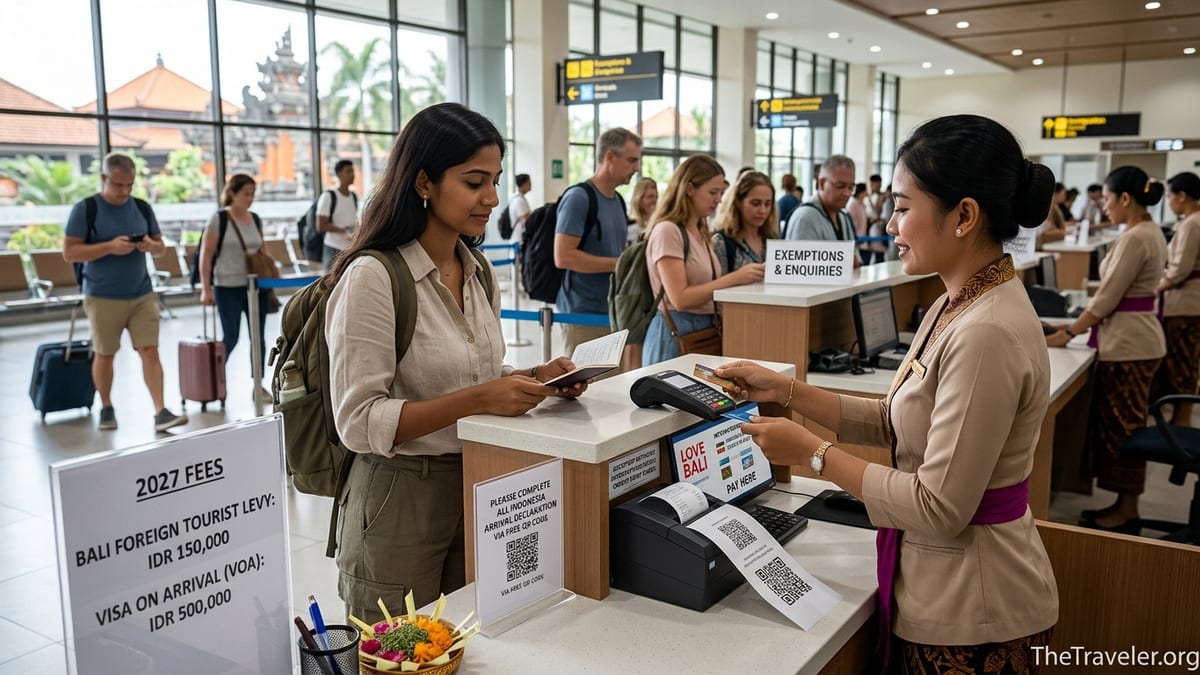
Exact 2027 cost breakdown: levy, visa and card fees
As of November 13, 2026, Bali’s foreign tourist levy is set at IDR 150,000 per person and the amount is confirmed in recent provincial publications and governor messages that reference a fixed contribution of IDR 150,000 for foreign tourists. These refer to a standing regulation rather than a temporary promotion, and there has been no official announcement of a different figure for 2027, so travelers planning for 2027 should budget IDR 150,000 unless the province publishes an updated regulation closer to departure.
Separate from the levy, Indonesia’s national Visa on Arrival and its online equivalent, the electronic Visa on Arrival, are currently set at IDR 500,000 for the standard 30-day B1 tourist visa. Recent immigration guidance and traveler reports in late 2026 show that proposals to increase this charge have not yet entered into force, and passengers at Bali’s Ngurah Rai Airport still pay IDR 500,000 at the official immigration counter or via the national e-visa portal. Any future increase would require a formal regulation, so for 2027 planning purposes the working assumption remains IDR 500,000 until an official change is announced.
Payment-processing charges are where visitors usually notice small variations. When you pay the Bali levy on the official Love Bali platform with an international credit or debit card, banks and payment gateways may add foreign transaction fees or currency conversion margins, typically amounting to a few percent on top of IDR 150,000. Similarly, some travelers paying the IDR 500,000 Visa on Arrival by card at the airport have reported being offered either a cash price at face value or a card payment with an extra percentage surcharge, while those who pay online for an e-VOA through the official portal are charged the published IDR 500,000 plus whatever fee their card issuer adds for foreign currency payments.
Putting this together for a typical tourist who needs both the Bali levy and a Visa on Arrival, the core official charges currently total IDR 650,000 per person. In late 2026 exchange rates, that is roughly 43 to 45 US dollars, 34 to 36 British pounds, 65 to 70 Australian dollars, or 3,600 to 3,800 Indian rupees, depending on market rates on the day your card is charged. These currency figures are approximate and for trip budgeting only; the actual cost in your home currency will be set by your bank when it processes the transaction.
Who must pay the Bali foreign tourist levy in 2027
Bali’s tourist levy is a provincial charge that applies to foreign tourists, not only to those flying directly from overseas. Under the Bali provincial regulations that introduced and later amended the levy framework, a foreign tourist is any non-Indonesian citizen visiting Bali for tourism purposes. This includes visitors who arrive on international flights to Denpasar, those who connect from another Indonesian city such as Jakarta or Surabaya, and those who reach the island by sea from other Indonesian islands.
Recent official explanations from the Bali government and partner tourism organizations stress that the levy is linked to entering Bali, not to specific modes of travel or to immigration counters. For example, a tourist who lands in Jakarta on an international flight, spends a week there and then flies domestically to Bali is still expected to have paid the IDR 150,000 levy before or by the time they are in Bali, even though they cleared Indonesian immigration in Jakarta. Likewise, someone arriving on a domestic ferry from Lombok or a liveaboard boat from Komodo who holds a foreign passport and is visiting for leisure falls under the levy rules.
The levy does not apply to Indonesian citizens, who are excluded from the definition of foreign tourist in the underlying provincial regulation. It is also not an additional fee for Bali residents who are Indonesian nationals returning home. However, mixed-nationality families should note that each foreign passport holder counts separately: if one parent is Indonesian and the other is Australian, only the Australian parent and any foreign-national children are subject to the provincial levy.
Because the levy is provincial, it is separate from and in addition to any national park entrance fees, village contribution charges or temple donations you may encounter while traveling around the island. Those local charges are collected by municipalities, villages or park authorities and have no impact on the requirement to pay the fixed IDR 150,000 provincial tourist contribution.
Official exemptions: who does not pay and how to apply
Bali’s governor regulations setting out the payment procedures specify several categories of foreign visitors who are exempt from the tourist levy. These include holders of diplomatic and official visas, crew members of international and domestic conveyances such as airlines and ships, holders of Indonesian Temporary Stay Permits (KITAS) and Permanent Stay Permits (KITAP), holders of family unification visas, student visa holders, Golden Visa holders and other long-stay or business visa categories recognized by Indonesian immigration and referenced in the provincial rules.
The legal texts and explanatory notes make clear that these exemptions are not applied automatically in all situations. For many categories, especially those related to official duties or long-term residence, the visitor is required to apply for an exemption in advance through the Love Bali system. The regulations state that the reason for exemption must relate to official or developmental interests and that an application can be approved or rejected by the provincial authorities, with the decision then communicated back to the traveler through the Love Bali platform.
In practice, an airline pilot regularly flying into Bali on duty under a crew member status, a foreign student enrolled at a Balinese university with a valid student residence permit, or a spouse holding a family-reunion visa tied to an Indonesian partner may all qualify to avoid paying the tourist levy, but they should be prepared to submit supporting documents. These can include a scanned passport identification page, a copy of the Indonesian visa or stay permit card (such as KITAS or KITAP), a letter from an employer or educational institution and, for diplomatic or official visas, a note or identification from the relevant embassy or international organization.
The exemption request must normally be lodged before the visitor arrives in Bali, and earlier provincial guidance referred to a lead time of up to one month before arrival for processing. While in some cases decisions appear to be made more quickly, long-term residents and those relying on an exemption for work should not assume last-minute approvals. If a visitor in an exempt category has not received confirmation by the time of travel, they may decide either to pay the levy and later seek clarification on a refund through the Bali authorities, or to postpone travel until their status is confirmed. In every case, travelers should carry printed or digital evidence of any exemption approval alongside their passport.
How to pay via Love Bali: step-by-step and inspection checks
The Love Bali system, maintained by the provincial government, is the official way to pay the tourist levy. It is available both as a website and a mobile application. To begin, visitors select the tourist levy feature, choose the option to make a new payment and enter their personal and travel details. These typically include full name as shown on the passport, passport number, nationality, date of birth, email address, intended date of arrival in Bali and accommodation information such as the name of a hotel or villa.
After submitting these details, travelers are directed to the payment stage, where they can choose from several methods. International visitors commonly use Visa or Mastercard credit or debit cards; in some cases digital wallets or regional payment systems may be supported, but availability varies by country and banking network. The system will display the charge of IDR 150,000 per person and may show an approximate conversion to major currencies. Once payment is completed, the system issues an electronic voucher containing a QR code and sends a confirmation email to the address provided.
The QR code voucher is the key proof that the levy has been paid. On arrival in Bali, airport and tourism officers conduct spot checks in the terminal and at some accommodation check-in points. Travelers can show the QR code on a smartphone screen or as a printed document. Officials scan the code to confirm that the payment is valid, linked to the traveler’s passport details and still active for the current visit. Because inspection points are not limited to the airport, it is advisable to keep the QR code accessible throughout your stay, especially if you move between hotels or visit popular attractions where checks are more likely.
According to recent provincial explanations, payment can legally be completed either before arrival or once you are already in Bali, provided it is done during your stay. However, the strongly recommended practice is to pay before departure, ideally a few days before your flight, so that you can resolve any payment errors in advance and minimize delays in the arrivals hall. Some travelers have reported making the payment while waiting at their departure gate or during a layover, but connectivity issues and time pressure can make this less comfortable than completing the process at home on a stable internet connection.
Do you pay again, and how it applies to children, families and cruises
The provincial regulation and its implementing guidance state that a single payment of the foreign tourist levy is valid for as long as that foreign tourist travels in Bali before leaving the territory of Indonesia. In practical terms, this means that if you arrive in Bali from overseas, pay the levy and then take a side trip to another Indonesian island such as Java or Flores, you should not need to pay the levy again when you return to Bali during the same overall visit to Indonesia, because you have not yet exited the country.
The situation changes once the traveler leaves Indonesia entirely. If you fly from Bali to Singapore, for example, and then return a month later on a new trip, this is considered a new arrival and you would pay the IDR 150,000 levy again. Travelers who make frequent short trips to neighboring countries should factor this into their overall cost planning and keep track of which payments correspond to which entry periods. In case of doubt, carrying previous QR codes and receipts can help you explain your situation at inspection points, although officers will primarily refer to the validity rules in the system.
Children are counted individually for the purposes of the levy. The official explanations do not list age-based exemptions, and real-world reports from visiting families confirm that children with their own passports are expected to have individual levy payments and QR vouchers. A family of four with two adults and two school-age children on foreign passports should therefore expect to pay IDR 600,000 in total for the Bali levy. Infants who are listed in a parent’s passport may be handled differently in edge cases, but since most countries now issue separate passports for children, families should plan for a per-person charge.
Cruise passengers and visitors in transit through Bali face specific scenarios. For cruise calls where the ship remains in Bali’s waters or docks for shore excursions and passengers disembark to visit attractions, the provincial government has indicated that the levy still applies because the passengers are foreign tourists enjoying Bali’s environment and services. In practice, cruise lines or their handling agents sometimes arrange bulk levy payments on behalf of passengers, while in other cases individual passengers are directed to pay via Love Bali before disembarkation. For air passengers in direct international transit who remain in the sterile transit area and do not formally enter Indonesia, the levy is not normally collected, but if you clear immigration to leave the airport, even for a short hotel stay, you are treated as an entering foreign tourist.
Visa rules for key nationalities and the All Indonesia declaration
While the provincial levy is applied uniformly to foreign tourists regardless of nationality, Indonesia’s national visa policy does differ between passport holders. Citizens of the United States, United Kingdom, Australia, India and most European Union states can currently either enter visa-free for a short stay if eligible under Indonesia’s evolving visa-waiver list, or obtain the 30-day B1 Visa on Arrival or its electronic counterpart for tourism purposes. Official immigration information and updated visa policy summaries confirm that these nationalities remain part of the wider group allowed to use the Visa on Arrival scheme, though the exact mix of visa-free versus VOA options has varied over the years and should be checked again shortly before travel in 2027.
For an American tourist flying Los Angeles to Denpasar via Singapore, the usual pattern in late 2026 is to apply for an electronic Visa on Arrival in advance or pay for a Visa on Arrival on landing, at the fixed fee of IDR 500,000. A British couple from London, a German or French visitor from the EU or an Australian holidaymaker from Sydney follow the same process, using the Indonesian immigration e-visa portal or the airport counter. Indian passport holders, who have historically relied more on pre-arranged visas or VOA rather than visa-free entry, also benefit from the B1 Visa on Arrival where eligible under current rules and pay the same IDR 500,000 fee.
Independent from both the levy and visa is the All Indonesia arrival declaration. This is a nationwide digital arrival card that integrates immigration, customs, health and quarantine data in a single system. Since 2025, Indonesian authorities have progressively rolled out the All Indonesia application across major airports, including Bali’s Ngurah Rai, and airlines such as Lion Air Group have notified passengers that they must complete the declaration before or upon arrival. The system replaces the older standalone Electronic Customs Declaration and paper forms.
The All Indonesia declaration is free. It is not a visa, not an e-VOA and not a provincial tax. Completing it does not grant the right to enter Indonesia; that right still depends on your visa status and passport eligibility. In practical terms, travelers download the All Indonesia app or access the web version, input personal details and travel information, answer questions about goods being carried, health status and quarantine-related items, then receive a QR code confirmation. On arrival, this code is scanned alongside your passport and visa, streamlining the combined immigration and customs process. Filling it out typically takes around ten minutes per traveler or family group.
Worked cost examples for solo, couple and family trips
To understand how these elements play out in real budgets, it helps to look at concrete examples using late 2026 prices and recent exchange-rate ranges. These figures assume that the Visa on Arrival fee remains IDR 500,000 and the Bali levy stays at IDR 150,000 into 2027, and they exclude airline-imposed service charges or bank-specific card fees.
Consider a solo American traveler on a two-week Bali holiday who needs a Visa on Arrival. They will pay IDR 150,000 for the Bali levy and IDR 500,000 for the VOA, totaling IDR 650,000. With late-2026 exchange rates of roughly IDR 15,000 to 16,000 per US dollar, that total works out to around 40 to 43 US dollars. If their bank adds a 3 percent foreign transaction fee, their card statement might show a final cost close to 42 to 45 dollars for both charges combined.
Now take a British couple flying from London. Each person pays IDR 150,000 for the levy and IDR 500,000 for the VOA, so the pair pay IDR 1,300,000 in official fees. With exchange rates in late 2026 around IDR 18,000 to 19,000 per British pound, this equals roughly 68 to 72 pounds in total. If they pre-pay the levy via Love Bali and obtain e-VOAs online, they will see two separate card transactions, but the combined effect on their budget is comparable to a mid-range dinner for two in a Balinese resort restaurant.
For a family of four from Australia with two school-age children on their own passports, the sums increase but remain manageable compared with flight and accommodation costs. The family’s Bali levy total is IDR 600,000, while four Visas on Arrival add IDR 2,000,000, for a combined IDR 2,600,000. At late-2026 rates of around IDR 10,000 to 11,000 per Australian dollar, that equals approximately 240 to 260 Australian dollars. Indian families and travelers from the eurozone will see slightly different figures based on INR or EUR exchange rates, but the structure remains the same: multiply IDR 150,000 and IDR 500,000 per person, then convert using your bank’s current rate.
Problems, refunds and avoiding scams in 2027
Because both the Love Bali platform and the national e-visa system are online payment services, travelers sometimes encounter issues such as failed card transactions, missing confirmation emails or mistakes in entered passport numbers. If payment appears to have gone through but no email arrives, the first step is to check spam folders and then log back into the Love Bali or e-visa system using the same email and reference details to see whether a QR code or visa approval is visible in your account. In some cases, the QR code or visa record is generated even when the email notification fails.
If a passport number is entered incorrectly when paying the Bali levy, it can cause problems at inspection when officers scan the QR code and see a mismatch between the passport and the stored data. At present, there is no widely documented self-service way to edit passport details after payment, so travelers may need to contact the Love Bali support channel specified in the application for assistance, or in some cases pay again with the correct information and then ask the provincial authorities about a refund for the erroneous payment. Documentation such as screenshots of error messages, bank statements showing duplicate charges and copies of both passport versions can be helpful when making such requests.
Refunds for the tourist levy or Visa on Arrival are not guaranteed and are typically limited to clear-cut situations, such as duplicate payments or transactions made for a trip that had to be canceled before travel. The provincial regulations on the levy focus mainly on collection and exemptions, not on large-scale refund mechanisms, so any reimbursement is likely to require case-by-case consideration. Similarly, Indonesian immigration generally does not refund VOA or e-VOA fees once a visa has been issued, although some travelers have reported partial refunds when technical problems on official systems forced them to pay twice.
One of the biggest risks for visitors remains fraudulent websites and intermediaries. Some unofficial sites imitate the design of government platforms, charge inflated “service fees” for the Bali levy or e-VOA, or claim that paying through them is mandatory. Others falsely advertise additional airport taxes or “express lane” charges for immigration that have no basis in official regulations. Real experiences shared by travelers show instances where private agents at airports have tried to collect cash at a higher “package price” for visas, sometimes adding a claimed card surcharge that is not displayed anywhere in official fee charts. To stay safe, visitors should only use clearly identified official government platforms for payments and decline unsolicited offers of “help” that involve handing over cash or card details to third parties.
Checklist before you fly and final confirmation
With several parallel systems and fees, it helps to review a simple mental checklist in the week before your 2027 Bali trip. First, confirm what visa you need based on your passport and length of stay using up-to-date Indonesian immigration information and, if necessary, your nearest Indonesian embassy. Make sure your passport has at least six months of validity beyond your planned entry date and a blank page available for stamps. If you will use the Visa on Arrival or e-VOA route, budget IDR 500,000 per person and decide whether to apply online or pay at the airport.
Second, visit the official Love Bali platform and pay the IDR 150,000 tourist levy for each foreign traveler in your group. Double-check the spelling of names and passport numbers before confirming payment. Save the QR code voucher as both a screenshot on each traveler’s phone and as a printed copy stored with your travel documents. If you believe you qualify for an exemption under categories such as KITAS, KITAP, diplomatic visa, family unification visa or student visa, submit an exemption request well in advance, attach all requested documentation and wait for written confirmation before relying on the exemption.
Third, complete the All Indonesia arrival declaration within the time window allowed before your flight. Have the resulting QR code ready on your phone or printed out for presentation on arrival alongside your passport, visa and levy voucher. Although the declaration is free and not a visa, airlines may check that you have completed it before boarding flights to Indonesia, and failure to do so can lead to longer queues at immigration and customs.
Finally, remember that regulations and fees can change. This guide is based on official Indonesian and Bali provincial information as available and cross-checked up to November 13, 2026. Before traveling in 2027, especially later in the year, travelers should verify whether the Bali levy amount, Visa on Arrival fee or visa-eligibility list has been updated. Checking once through official channels a week before departure will ensure that your budget, documents and expectations are aligned with the latest rules when you touch down on the Island of the Gods.