


Cambodia has modernised its entry procedures rapidly since 2024, and by 2027 many travellers still confuse the country’s free electronic arrival card with its paid visa system. For visitors planning trips that combine flights and overland border runs, the difference matters: filling in an online arrival form does not grant you permission to enter Cambodia. This guide explains, step by step, how Cambodia’s eArrival declaration, tourist eVisa and Visa on Arrival really work, which nationalities can skip a visa altogether and why certain Thai land borders no longer accept an eVisa even when older blogs say they do.
Get the latest updates straight to your inbox!
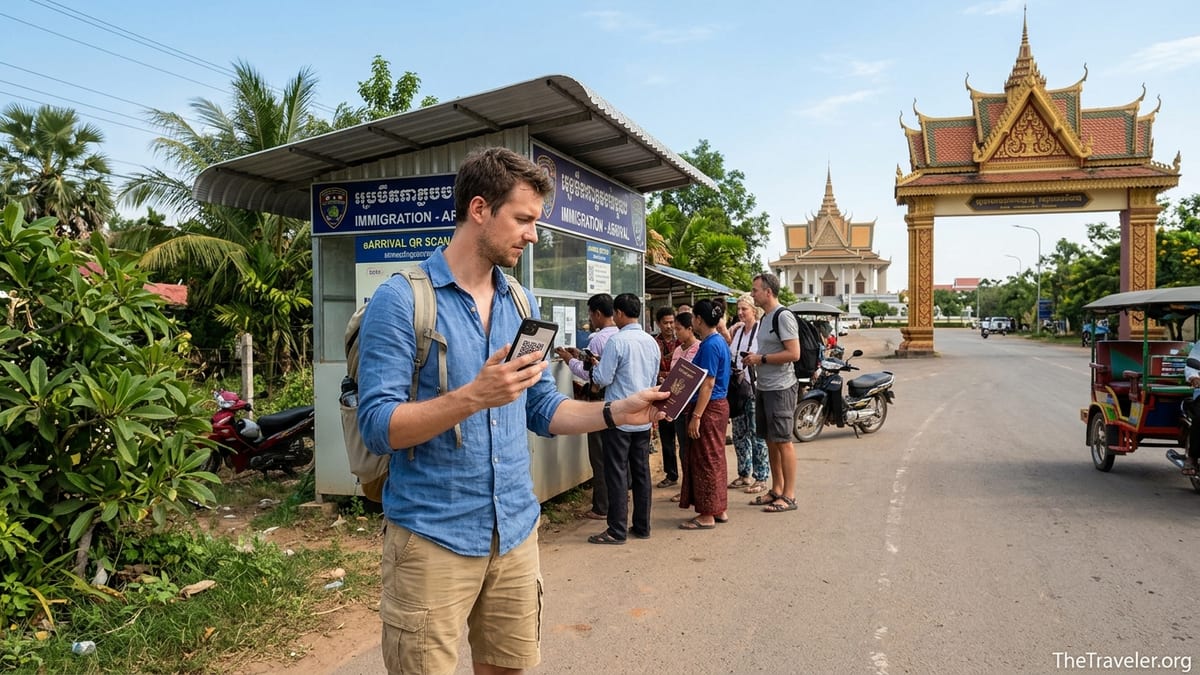
Cambodia’s eArrival system is free and separate from any visa
The eArrival system is Cambodia’s digital replacement for the old paper immigration card and customs declaration. It is mandatory for most foreign travellers, but it is not a visa and it does not give you permission to enter the country. Think of it as a combined arrival and customs form that the government now prefers to receive electronically. Completing it does not remove the need to have a valid visa or to qualify for visa-free entry.
The official platform is operated through the government’s e-Arrival website and the Cambodia e-Arrival mobile application. As of 2026, official guidance recommends that travellers submit their information within seven days before arrival in Cambodia instead of filling any paper card on the plane or at the border. The form asks for basic passport details, your flight or vehicle information, your first-night accommodation in Cambodia and health and customs declarations. Once submitted, you receive a QR code which you present on your phone or printed on paper at immigration.
Most travellers will scan this QR code at a kiosk immediately after landing at Phnom Penh’s Techo International Airport or Siem Reap Angkor International Airport, before seeing an immigration officer. If you forget to complete it in advance, kiosks at the airport generally allow you to fill in the details on arrival, but this can slow you down during peak times when several flights land together. Importantly, there is no government fee for the official eArrival service; any website or app that tries to charge you for simply filing arrival information is adding a private service charge on top of a free government system.
According to recent travel advisories, the same eArrival requirement also applies at major land borders and seaports in a phased manner, although in practice some smaller posts may still offer paper forms. Because implementation can vary, especially at remote borders, travellers arriving overland from Thailand, Vietnam or Laos should complete the eArrival form online beforehand whenever possible, then carry a screenshot of the QR code in case mobile data at the frontier is unreliable.
Who needs a visa and who is visa free
Visa rules differ according to nationality. Citizens of ASEAN countries enjoy visa-free entry to Cambodia for short visits. Based on current official information, nationals of Laos, Malaysia, Philippines, Singapore, Vietnam, Thailand, Indonesia, Brunei Darussalam and Myanmar can enter Cambodia without a tourist visa for stays that range from roughly 14 to 30 days depending on the specific bilateral agreement. A Thai passport holder flying from Bangkok to Phnom Penh, for example, can currently receive a longer visa-free stay by air than when crossing a land border, where the permitted stay is shorter.
Travellers from the United States, United Kingdom, European Union, Australia, Canada, India and most of the rest of the world do not benefit from visa-free entry and must hold a valid visa, either issued in advance or on arrival. For these nationalities, the most common solutions are the tourist eVisa T obtained online, a Visa on Arrival at airports and many land borders, or an ordinary E-class visa which is popular with long-stay visitors and people planning to work or volunteer.
China has been the focus of short-term visa waiver pilots in recent years, but those schemes have been time-limited and subject to change. Travellers with Chinese passports planning trips in 2027 should not rely on earlier promotions and should instead check immediately before travel whether a visa waiver is in force or a standard visa is required again. The safest assumption for non-ASEAN nationals is that some form of visa will still be necessary for tourism in 2027.
Whichever category you fall into, the key point is that the free eArrival declaration never substitutes for visa status. A British passport holder flying London to Siem Reap must still either obtain a tourist eVisa in advance or plan to buy a Visa on Arrival at the airport, even though they have already uploaded their details to the arrival system and obtained a QR code.
Tourist eVisa T, ordinary visa E and Visa on Arrival compared
Cambodia’s tourist eVisa T is the flagship online visa product for short leisure visits. According to government announcements implemented from 1 January 2025, the fee for a tourist eVisa T was reduced to 30 US dollars, making it cost the same as a typical tourist Visa on Arrival at airports and many land borders. The eVisa T is a single entry visa that is usually valid for entry for three months from the date of issue and permits a stay of up to 30 days inside Cambodia.
The ordinary E-class visa is distinct. It is often informally called a “business visa”, although technically it is a category designed for foreigners who may later extend their stay for work, study or long-term residence. The basic ordinary E visa can also be issued online in eVisa form and is typically priced slightly higher than the tourist eVisa, around 35 US dollars in recent fee schedules. The crucial difference is that an E-class visa can often be extended inside Cambodia for periods of three, six or twelve months through immigration or licensed agents, whereas the tourist T visa is intended for short visits and is more restricted in its extensions.
For many nationalities, a Visa on Arrival is available at major airports and land crossings. At Phnom Penh and Siem Reap airports, American, British, Australian, Canadian, Indian, Chinese and most EU passport holders can usually purchase a single-entry tourist visa for 30 US dollars at the arrivals hall. An ordinary E-class Visa on Arrival may also be available at around 35 US dollars. Processing typically involves providing one recent passport photograph, filling a short form and waiting 10 to 30 minutes, although queues can be considerably longer when several regional flights arrive at once.
Extensions of stay are handled separately. Tourists holding a T visa, whether eVisa or Visa on Arrival, may be able to extend once for another 30 days through immigration in Phnom Penh or Siem Reap at an additional fee, while holders of an E visa can pursue longer-term extensions with different conditions depending on employment or sponsor status. Because extension policies and prices are frequently updated, anyone planning to remain in Cambodia beyond 30 days should verify the latest rules with official immigration channels or a reputable visa agency inside Cambodia before committing to flights and accommodation.
Where eVisas are accepted and the Poipet and Cham Yeam problem
An approved Cambodia tourist eVisa T is only valid for entry at specific ports of entry listed on the official system. As of late 2026, that list clearly includes Techo International Airport in Phnom Penh, Siem Reap Angkor International Airport, Sihanoukville International Airport for air arrivals, the Bavet border crossing from Vietnam in Svay Rieng province and the Tropaeng Kreal border post from Laos in Stung Treng province. Travellers entering by bus from Ho Chi Minh City to Phnom Penh, for example, often cross at Bavet and can use an eVisa there without difficulty.
Historically, eVisa entry was also allowed at Poipet on the Thai border in Banteay Meanchey province and at Cham Yeam, near Koh Kong on the coast opposite Thailand’s Trat province. Many older blogs and even some printed guidebooks still state that eVisas are accepted at these crossings. More recent government information, however, confirms that both Poipet and Cham Yeam are temporarily closed to eVisa entry until further notice. Travellers arriving from Thailand at these posts can generally still obtain a Visa on Arrival in their passport, but immigration officers there may refuse an eVisa that lists Poipet or Cham Yeam as the entry point.
This restriction catches out many visitors who plan to travel overland from Bangkok to Siem Reap or from Thailand’s Koh Chang islands to Sihanoukville. A British couple, for example, might apply online for a tourist eVisa and select Poipet as their port of entry because that is where their bus ticket terminates. On arrival, they discover that the eVisa is not accepted and they must either purchase a Visa on Arrival separately or in rare cases be asked to return to Thailand. Until official notices confirm that eVisa acceptance at Poipet and Cham Yeam has resumed, travellers should avoid choosing these border posts when applying online.
Border operating status between Cambodia and Thailand has gone through several phases of tightening and reopening, partly for security reasons and partly in response to regional tensions. By late 2026, crossings such as Poipet and Cham Yeam were generally open for conventional immigration processing and Visa on Arrival services, but oversubscribed bus routes and frequent changes in checkpoint procedures mean travellers should treat any information about land borders as provisional. If your itinerary for 2027 involves crossing by road or boat between Thailand and Cambodia, allow extra time on travel days and keep flexible accommodation plans in case of delays or diversions.
Airports, land borders and seaports: what to expect on arrival
Arrival procedures vary slightly between airports, land checkpoints and seaports, even though the basic rules of passport validity, visa and eArrival apply everywhere. At international airports, the process tends to be more structured and faster, while land borders can involve multiple windows and more informal queuing. Cruise ship passengers docking at Cambodian ports typically have visa formalities handled in cooperation between immigration officers and the cruise line, often via group visas or pre-arranged processing.
Whether you are flying or crossing by road, Cambodia requires that your passport be valid for at least six months beyond the date you plan to leave the country and that it contain at least one blank page for the visa sticker and stamps. Immigration officers can, in theory, deny boarding at your departure airport or refuse entry on arrival if your passport falls short of this requirement, even by a few days. For example, an American traveller with a passport expiring five months after their return flight to Los Angeles risks being turned away at check in for a flight to Phnom Penh.
For Visa on Arrival applications and some E visa extensions, a recent passport-sized photograph is still requested. If you forget to bring one, officials in Phnom Penh and Siem Reap airports often allow a photo to be taken on the spot for a small surcharge in US dollars. At land borders, the practice varies: some crossings insist on a physical photo, while others accept a fee in lieu if you do not have one. To avoid uncertainty, carry at least two spare passport photos in your daypack if you expect to apply for visas or extensions during an overland trip.
Payment methods are another practical issue. Officially, visa fees are quoted in US dollars and immigration officers expect clean, undamaged notes. A Canadian family arriving in Phnom Penh with creased or slightly torn bills may find that their money is refused or exchanged at a poor rate. While some airports have ATMs and currency exchange booths before immigration, relying on them is risky if machines are out of order. For peace of mind, bring sufficient US dollar cash in small denominations to cover visas for all members of your group, plus a buffer for incidental charges such as airport taxis or land-border transport.
Step by step: flying into Siem Reap, arriving in Phnom Penh and entering overland
For a typical tourist flight into Siem Reap Angkor International Airport, the process in 2027 looks like this. Within seven days before departure, the traveller completes the free eArrival declaration online, entering passport details, flight number and hotel booking, then saves the QR code on their phone. If they hold an approved tourist eVisa T, they also print the visa approval letter. After landing, they follow signs to immigration, present the eArrival QR code at a kiosk or officer, then queue at either the eVisa desk or Visa on Arrival counter. With an eVisa, the officer scans the approval, checks the passport and stamps entry for up to 30 days. With Visa on Arrival, the traveller submits their passport, completed visa form and photograph, pays 30 US dollars in cash and waits for the visa sticker before proceeding to the passport control booths.
At Phnom Penh’s Techo International Airport, the flow is similar but usually busier. An American family of four, for example, might choose to apply for tourist eVisas in advance to avoid the Visa on Arrival queue after a long-haul journey. They complete four separate applications on the official eVisa platform, each costing 30 US dollars, and receive approvals by email within a few business days. On arrival they show both their eArrival QR code and printed eVisa approvals to immigration officers and usually clear the formalities within 20 to 30 minutes. If instead they opted for Visa on Arrival, they would pay 120 US dollars in total at the counter and could need longer in line, particularly at evening peak times.
Entering overland from Vietnam or Laos introduces more variables. A frequent route runs from Ho Chi Minh City to Phnom Penh via the Bavet / Moc Bai border. Travellers with tourist eVisas that list Bavet as their entry point generally pass on the Cambodian side without problems. They step off the bus, collect their luggage, present their eArrival QR code and eVisa approval or apply for a Visa on Arrival with a photograph and 30 US dollars, then rejoin the bus once processing is complete. Overland from Laos, the Tropaeng Kreal border post is more remote, so it is sensible to carry printed copies of your eArrival and eVisa confirmations and extra photographs, as photocopying and printing facilities on the frontier are minimal.
By contrast, travellers crossing from Thailand by bus to Siem Reap through Poipet in 2027 may still find that eVisa entry remains suspended at this particular post. In that case, even if they hold an approved eVisa naming Poipet, immigration staff can insist that they purchase a Visa on Arrival separately, paying the standard fee again. For a British backpacker paying 30 US dollars online and then another 30 US dollars at the border, this becomes an expensive lesson in why entry-port restrictions matter. If your itinerary absolutely requires crossing from Thailand, consider either using a route and port where eVisa acceptance is clearly confirmed or budgeting to obtain a fresh Visa on Arrival even if you already purchased an eVisa.
Online application versus Visa on Arrival: costs, time and pitfalls
Applying for a tourist eVisa online has clear advantages for many nationalities. You can pay by credit or debit card, complete the form at home where you have all your documents, and arrive in Cambodia with visa approval already in hand. For solo travellers or couples, the difference in cost between a 30 US dollar eVisa and a 30 US dollar Visa on Arrival is minimal, but skipping the arrivals hall queue can save both time and stress. It also reduces your dependence on finding an ATM or money changer before immigration, which is particularly handy if you land late at night.
Visa on Arrival, by contrast, suits travellers who prefer flexibility or who are not certain about their travel dates until the last minute. A Canadian or Australian visitor who decides on a spontaneous side trip from Bangkok to Siem Reap, for example, may find it easier to simply pay for a Visa on Arrival at the airport than to navigate the online portal and processing time from a phone. Visa on Arrival can also be the fallback when an eVisa is not accepted at the chosen land border or when online payment fails due to bank security checks.
Families and groups should pay attention to cumulative costs and error risks. A family of five applying for tourist eVisas pays 150 US dollars in fees instead of 150 US dollars at the border, but online applications require careful double-checking of each person’s passport number, full name and date of birth. If a child’s passport number is entered incorrectly, the eVisa may be treated as invalid on arrival, forcing the purchase of another Visa on Arrival and potentially complicating the family’s entry record. The same applies if you accidentally select the wrong entry port, such as choosing Poipet on the application form when you actually plan to arrive at Bavet; the eVisa may not be honoured at the real checkpoint.
Scams are another risk. Numerous unofficial websites pay for advertising that makes them appear above the official eVisa portal in search results. These intermediaries usually charge a higher fee than the government’s 30 US dollars, sometimes doubling the cost per person, and in the worst cases may take payment without ever submitting a valid application. To protect yourself, always check that the site you are using is clearly described as an official Cambodian government service before entering passport details or card numbers. If in doubt, contact a Cambodian embassy or consulate in your home country to confirm the correct online platform.
Customs declarations, onward travel proof and staying within the rules
The eArrival system incorporates customs declarations that used to be handled on separate paper forms. Travellers must declare items such as large amounts of cash, certain medicines, drones, high-end electronics and commercial goods. Failing to declare restricted items can lead to confiscation or fines if discovered on inspection. For example, a British digital nomad entering with several new laptops and camera bodies for friends may be asked to pay duty if customs officers conclude the goods are for resale rather than personal use.
Proof of onward travel is not always requested, but Cambodia’s immigration authorities reserve the right to ask for a return or onward ticket, especially from non-ASEAN nationals arriving on short tourist visas. An American arriving on a one-way ticket from Seoul to Phnom Penh with loose plans to exit later by land to Vietnam may be asked to demonstrate their intention to leave within 30 days, for example by showing a flexible bus booking or a refundable air ticket. Airlines at the point of departure can also deny boarding if they judge that your paperwork is insufficient for entry.
Once admitted, staying within the permitted period of stay is critical. Overstays are usually penalised with a daily fine, and longer overstays can complicate future visa applications or lead to detention until the fine is paid. If you foresee needing more than 30 days, the safer approach is to enter with an ordinary E visa and extend it legally at immigration or through a reputable visa agency, rather than relying on informal advice that short overstays are “tolerated”. Always keep copies of your visa, entry stamp and extension documents in a separate place from your passport in case of loss or theft.
When planning multi-country itineraries in mainland Southeast Asia, remember that rules at Cambodian borders can evolve quickly. A land crossing that permitted Visa on Arrival last year might introduce temporary restrictions due to bilateral tensions or infrastructure works, affecting bus routes between Cambodia and neighbouring countries. Before committing to non-refundable tickets that rely on a specific checkpoint, verify its latest operating status with transport companies or local news sources and build in enough flexibility to reroute via another border or a short regional flight if circumstances change.
Conclusion and last checked date
Cambodia’s entry system in the mid-2020s combines a modern eArrival declaration with a mix of online and on-arrival visa options. The most important distinction is that the eArrival form is free and functions as your immigration and customs card, while permission to enter still depends on your nationality and having the correct visa or visa-free status. For many non-ASEAN travellers, a 30 US dollar tourist eVisa T or a 30 US dollar Visa on Arrival remains the standard solution, with the ordinary E-class visa reserved for those planning longer or more work-focused stays.
Travellers in 2027 should pay particular attention to where eVisas are accepted, especially if they plan overland entries from Thailand through Poipet or Cham Yeam, and should assume that information published before 2025 may be incomplete. Checking passport validity, carrying suitable photographs and clean US dollar notes, and verifying that any online service used is genuinely official will remove most of the friction from crossing Cambodian borders. When in doubt, contacting a Cambodian embassy or consulate before departure is still the most reliable way to confirm requirements for your specific nationality and route.
Last checked: 13 November 2026. Visa rules, border operating status and eVisa port lists can change with little notice, so travellers planning trips in 2027 should always confirm the latest information shortly before departure.