


Choosing where to stay is the single most important decision if you want to explore Teno Rural Park in depth. This rugged corner of northwest Tenerife rewards early starts, quiet evenings and unhurried days on foot. Basing yourself in or near the park lets you reach trailheads before the day-tripping crowds, wake up amid terraced fields and ravines, and cut down on daily driving compared with staying in the big resort zones.
Get the latest updates straight to your inbox!
Why base yourself near Teno Rural Park
For many visitors, Teno Rural Park is a one-day excursion from Puerto de la Cruz, Costa Adeje or Los Cristianos. That approach works if you are happy with a single drive through Masca or a quick stop at Punta de Teno. Independent walkers and slow travellers often want something different: dawn light on the ridges, empty paths for the first hour of hiking, and evenings in working villages rather than resort promenades.
Staying near Teno reduces travel time and fatigue. The road network is slow and winding, especially the TF-436 between Buenavista del Norte and Santiago del Teide, so driving in and out from the south or east every day can feel repetitive. A base close to El Palmar, Buenavista or Santiago del Teide brings key trailheads within a short drive instead of a long commute on mountain roads.
The park is exceptional for its living rural culture. Terraced potato fields, small goat farms, traditional cheese-making and local craft traditions are part of daily life in hamlets such as El Palmar, Teno Alto and Masca. Overnighting in these communities gives a very different experience from visiting during peak daytime hours, when viewpoints and bus stops are busiest.
There is also a practical argument. Access to Punta de Teno is now tightly regulated and often only possible by bus from Buenavista del Norte, and access to Masca is subject to traffic and safety measures. Staying nearby makes it easier to adapt to timetable changes, weather closures and last-minute decisions about which trail to hike.
El Palmar: rural heart of central Teno
El Palmar sits in a green valley ringed by ridges and is one of the best all-round bases inside the Teno area. It is a working rural settlement rather than a resort, with small shops, a weekly farmers’ market and a low-key evening atmosphere. The landscape of terraces and surrounding ridgelines means you can start several walks directly from the village without needing to drive.
By car, El Palmar is roughly a short hop over the ridge from Buenavista del Norte, a scenic drive up towards Teno Alto or Los Carrizales, and around half an hour or so across the TF-436 to the Masca area, depending on traffic and weather. Punta de Teno is normally approached by first driving to Buenavista and then using regulated transport where required, so expect a modest drive rather than a quick dash.
Public transport is relatively good by rural standards. A local bus connects Buenavista with El Palmar and Las Portelas, and another route links Buenavista with Masca and Santiago del Teide, passing within reach of various trailheads. Services are not frequent enough for spontaneous late-night travel, but for patient hikers comfortable with timetables, it is possible to link El Palmar with Puerto de la Cruz and other parts of Tenerife by changing buses in Buenavista or Icod de los Vinos.
Accommodation in and around El Palmar consists mainly of casas rurales, small country houses divided into self-contained apartments, and a handful of simple guesthouses. Expect mostly mid-range per-night prices for two people, with some budget-level rooms and occasional higher-end rural houses with upgraded design or views. Many places offer kitchen facilities rather than full hotel services, and not all include breakfast or on-site dining, so it is essential to check what is provided when booking.
Teno Alto and scattered hamlets: beautiful but very limited stays
Teno Alto is an isolated high hamlet of stone houses and pastures above El Palmar. It is known for its cheese-making traditions and expansive views over the massif, and it feels far from the main tourist circuits. This is more of a living rural community than a tourist village, with very modest services and no real nightlife.
The road from El Palmar to Teno Alto is steep and narrow but passable in a normal rental car with care. Driving times from here to Buenavista, El Palmar or Punta de Teno are longer than from the valley floor, and the trip to Masca via TF-436 can feel slow because of the curves. For keen walkers, the advantage is that classic ridge and valley hikes start almost at the doorstep, including routes towards Baracán passes and the high paths above El Palmar.
There is no meaningful public transport directly into Teno Alto, so this base only makes sense if you have a car and are comfortable on minor rural roads. Taxis from Buenavista or El Palmar may be available but need to be ordered in advance and will add to daily costs.
Accommodation is extremely limited, generally one or two rural houses or small complexes at any given time. These are typically simple to mid-range self-catering properties, sometimes with shared outdoor space and strong rustic character rather than hotel-style comfort. Availability is tight, especially in winter hiking season and during Spanish and European holiday periods, so you should be prepared to book well ahead or treat Teno Alto more as a day-hiking area while staying in El Palmar or Buenavista.
Masca: spectacular ravine village with heavy day traffic
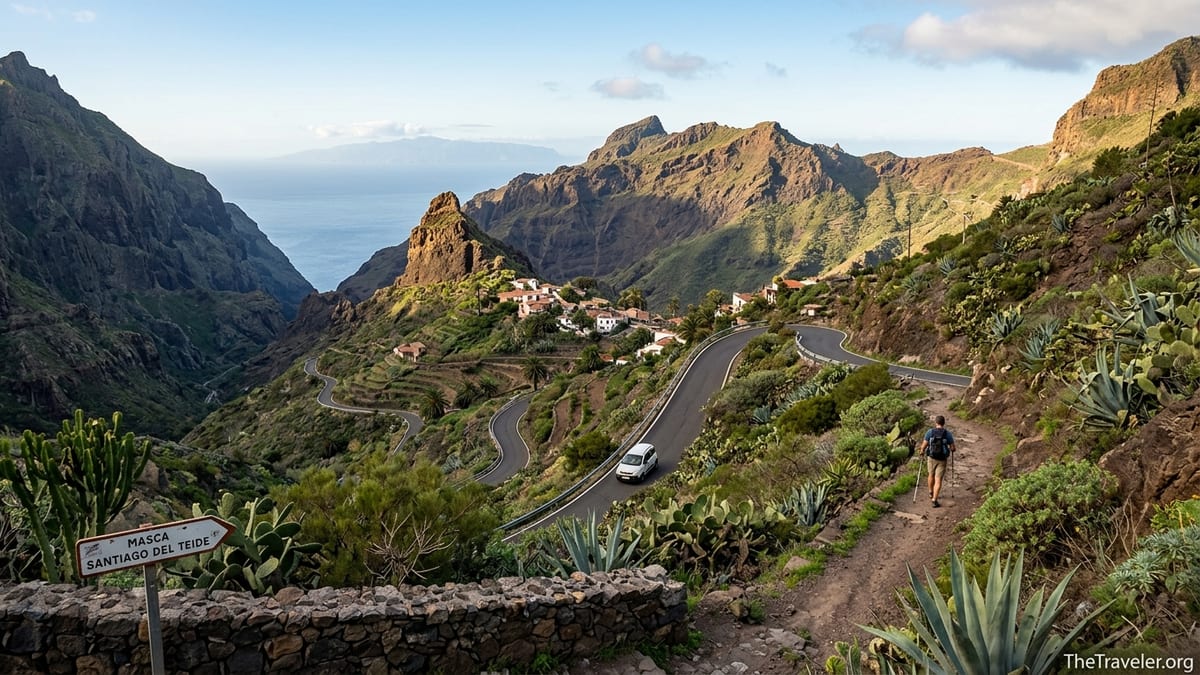
Masca is the iconic ravine village that appears in most photographs of Teno. Perched on a narrow ridge with deep barrancos plunging to either side, it is dramatic and atmospheric, especially early or late in the day. The built-up area is tiny, and services are focused on catering for daytime visitors, with a handful of cafés, souvenir stalls and limited everyday shops.
Access by road is along the twisting TF-436, from Buenavista on one side or Santiago del Teide on the other. Distances on the map look short but progress is slow, and the authorities have introduced transport measures to reduce congestion and improve safety. This includes encouraging bus access from Santiago del Teide and Buenavista and managing parking capacity in the village. Travellers should expect narrow lanes, tight parking and occasional traffic holds.
Public transport access relies primarily on the bus link between Buenavista, Masca and Santiago del Teide, which in turn connects with routes towards Costa Adeje and other parts of the island. For visitors willing to plan around the timetable, it is possible to reach Masca from Puerto de la Cruz or Playa de las Américas with one or two changes, but the overall travel time is significant for a day trip, which again strengthens the case for a nearby base.
Overnight options in and around Masca are few. A couple of casas rurales and small guesthouses offer simple to mid-range rooms in restored houses, sometimes at relatively high per-night rates due to the setting and limited supply. There are no large hotels, and self-catering rules here: some properties offer meals or breakfast but this is not guaranteed. Because of the pressure of day visitors and restricted parking, staying in Masca is most suitable for travellers who value scenery above convenience and who are comfortable arriving with minimal luggage and perhaps leaving the car outside the core of the village.
Buenavista del Norte and the coastal edge of Teno
Buenavista del Norte is the main small town on the northwest tip of Tenerife and covers much of the coastal part of Teno Rural Park. The historic centre, agricultural surroundings and Atlantic coastline give it a quietly lived-in feel. It is large enough to offer supermarkets, banks, health services and a small bus station, but still small enough to feel far from the resort corridors of the south.
By car, Buenavista is a convenient base. The drive up the valley to El Palmar is short, and from there you can continue towards Teno Alto, Monte del Agua and various high passes. Masca is reached via the TF-436 mountain road, taking a modest but twisting drive, while Punta de Teno is accessed along the peninsula. Due to safety and environmental reasons, the road to Punta de Teno is now strictly regulated and, during ongoing works and restrictions, is often only open to the dedicated bus from Buenavista, authorised vehicles or taxis. Travellers should always confirm the latest access rules before planning a sunrise or sunset visit.
Buenavista is the public transport hub for this corner of the island. Regular buses connect the town with Puerto de la Cruz via Garachico, Los Silos and Icod de los Vinos, with Santa Cruz via the north airport, and with El Palmar and Masca. A specific route serves Punta de Teno when access is allowed by bus. This makes Buenavista one of the most practical bases for travellers relying mainly on public transport.
Accommodation in Buenavista ranges from simple budget guesthouses in the historic centre to mid-range small hotels, coastal apartments and a few rural houses in the municipality. Prices cover the spectrum from budget to comfortable mid-range, with occasional higher-end stays on the outskirts or near the coast. Because it functions as an administrative and service centre, more properties stay open year-round, but smaller rural units may still close in low season or between bookings, so flexible travellers should check current opening calendars rather than assuming constant availability.
Nearby villages outside the core park: Santiago del Teide, Los Silos, Garachico and Icod de los Vinos
Several villages just outside the strict protected area boundary offer an attractive compromise between Teno access and wider Tenerife touring. Santiago del Teide, on the south-western side, is a small inland town on a high plateau, linked by the TF-436 to Masca and Buenavista and by other roads to the coastal resorts of Los Gigantes and Costa Adeje. It has services geared both to local residents and to hikers heading for Masca or the almond-blossom trails in late winter.
Santiago del Teide is particularly convenient for visitors arriving from the southwest resort zone with a rental car. Driving from here to Masca is relatively quick compared with starting on the coast, and Buenavista is reachable along the same scenic road. Public buses connect Santiago del Teide with Adeje, Icod de los Vinos and Buenavista, with a specific service running through Masca. Accommodation consists mainly of small hotels, apartments and rural houses in the surrounding countryside, generally in the budget to solid mid-range bracket.
On the northern coast, Los Silos and Garachico sit within the broader Isla Baja area. Los Silos is a quiet agricultural and residential village with a compact historic centre and a low-key seafront. Garachico is a picturesque historic town with lava rock pools, cobbled streets and a stronger tourism profile, making it one of the best bases if you want to combine Teno with excursions along the north coast.
Buses link Los Silos and Garachico directly with Buenavista and Puerto de la Cruz, and road access via the TF-42 is straightforward, avoiding the steepest mountain passes. Driving from Garachico or Los Silos to El Palmar or Buenavista takes a moderate amount of time, but the roads are wider and less intimidating than TF-436. Accommodation here ranges from budget guesthouses and small apartments to higher-end boutique hotels housed in historic mansions in Garachico. Prices can be higher in these character properties, particularly in high season, but they offer more conventional hotel services, including reception, breakfast and sometimes on-site restaurants, compared with many inland casas rurales.
Further east, Icod de los Vinos is a larger town with strong local life, the well-known ancient dragon tree and an inland position on the main northern corridor. It is less of a Teno base and more of a general north Tenerife hub, but regular buses and straightforward road links to Garachico and Buenavista mean that hikers could stay here and day-trip into Teno while benefiting from broader shopping, dining and accommodation choices in a mostly mid-range price band.
Seasonality, booking and practical considerations
Rural accommodation around Teno is limited in absolute terms, and demand fluctuates sharply with season. The mild winter months between roughly November and March are prime hiking season, when European travellers escape colder climates and local holiday periods increase island-wide occupancy. During these months, casas rurales and small guesthouses in El Palmar, Masca, Teno Alto and the Isla Baja area can book up well in advance, and nightly rates tend to be higher.
In spring and autumn, there is often more flexibility, with shoulder-season prices and better chances of finding last-minute rooms, though specific weekends and national holidays can still be busy. In the hottest weeks of summer, some walkers avoid the steeper routes at midday, but families and coastal holidaymakers keep overall demand for accommodation high, particularly around Garachico and Buenavista.
Because many rural properties are family-run, some close temporarily for renovations, personal reasons or agricultural work. Online calendars may not always reflect sudden closures, and amenities such as breakfast service or on-site restaurants cannot be assumed. Travellers should check directly or read up-to-date booking information to confirm what is included. Where breakfast or dinner is not offered, plan ahead for groceries and restaurant options, especially if arriving late.
Drivers should prepare for narrow roads and limited parking, particularly in Masca and some hamlets. It is wise to rent a reasonably small car, avoid arriving at the most popular viewpoints in the middle of the day, and confirm in advance whether your chosen property is on a paved road accessible by standard rental car or reached via particularly tight lanes. In some cases, leaving the car at the edge of a village and walking a few minutes with luggage is part of the experience.
Staying elsewhere on Tenerife and day-tripping to Teno
Many visitors will still prefer to base themselves in larger centres such as Puerto de la Cruz, Costa Adeje or Los Cristianos and visit Teno on one or two long days. This approach offers clear advantages: a broad choice of hotels and apartments in every budget band, plentiful dining and nightlife, frequent public transport along the main corridors, and easy access to other attractions such as Teide National Park or Anaga.
The trade-off is time. From Costa Adeje or Los Cristianos, reaching Buenavista or Masca by car can take the better part of a morning once motorway driving, highland crossings and mountain roads are factored in. From Puerto de la Cruz, the journey along the north coast and into the park is shorter but still substantial, particularly if you are using buses and need to change in Icod de los Vinos or Buenavista. Repeating this travel on consecutive days is tiring and leaves less time for flexible route choices or spontaneous stops.
For travellers planning only one hike in Teno, a day trip from these bases is reasonable, especially on a clear-weather day with an early start. For those who imagine several different hikes, leisurely evenings in small squares and early access to viewpoints before the tour buses, staying nearer the park will usually provide better value in terms of time and experience, even if per-night accommodation prices are similar.
Choosing the right base: scenario-based recommendations
If you rely mainly on buses and want to avoid renting a car, Buenavista del Norte is the strongest base. Its bus station links directly to Puerto de la Cruz and Santa Cruz, and local routes reach El Palmar, Masca and, when open, the access road to Punta de Teno. You will have shops, basic services and a small-town atmosphere, with the option of coastal walks and easy day trips along the Isla Baja coast.
If your priority is quick access to central Teno hiking routes and you do not mind quiet evenings, El Palmar is ideal. From here, you can walk straight onto valley and ridge paths or drive quickly to high passes and hamlets such as Teno Alto. Accommodation is mostly rural houses and small guesthouses, suiting visitors who enjoy self-catering and immersion in agricultural landscapes.
Travellers who want coastal scenery alongside Teno hikes might look first at Buenavista del Norte, Los Silos or Garachico. Buenavista offers the most direct access into the park and the bus to Punta de Teno when running. Los Silos is a sleepy alternative nearby, while Garachico, with its historic architecture and natural rock pools, is best for those who want a stronger sense of place and are happy to add some driving time to reach the main trailheads.
For a car-based hiking holiday combined with other parts of Tenerife, Santiago del Teide works well, especially if you are arriving from the south-west resorts. You can drive to Masca and on towards Buenavista for Teno walks, then drop down to the coast at Los Gigantes or Costa Adeje on non-hiking days. Masca itself is reserved for travellers who prioritise scenery and are prepared to accept limited services, stressful parking and crowds during the day in exchange for unique early-morning or evening views.
Ultimately, the right base depends on your balance between convenience, atmosphere and transport. Choosing a village in or near Teno Rural Park rewards those who value quiet, landscape and local life over nightlife and big-resort infrastructure. With realistic expectations about road conditions, public transport and rural accommodation quirks, staying close to Teno can turn a simple day trip into the highlight of a Tenerife journey.