


More news on this day
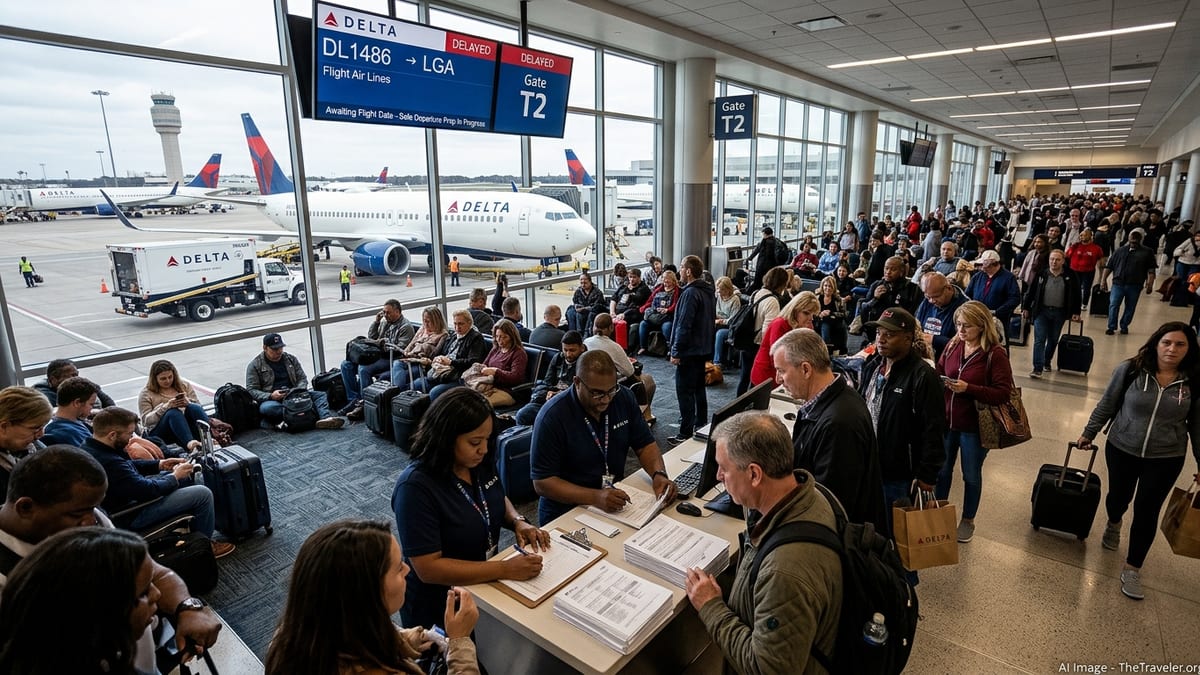
Delta Air Lines is working to restore normal operations ahead of the peak Thanksgiving rush after a failure in its automated aircraft weight-and-balance system on Sunday, November 22, triggered a brief ground stop in Atlanta and delays across the United States, affecting more than 1,000 flights and leaving many passengers scrambling for overnight hotels and rebooked itineraries.
Get the latest news straight to your inbox!
What happened to Delta’s weight-and-balance system
Delta’s problems began on the morning of Sunday, November 22, when the airline’s automated system used to calculate aircraft weight and balance for departing flights malfunctioned. The tool, used across Delta’s network and centrally in Atlanta, normally produces detailed load instructions so ground crews can distribute baggage, cargo and fuel safely before takeoff. When automation failed, dispatchers and ramp staff had to switch to manual workarounds, significantly slowing departures at Delta hubs and outstations.
Complying with strict weight and balance limits is a core safety requirement in commercial aviation, and federal guidance warns that exceeding those limits or mis-distributing weight can compromise an aircraft’s performance. With the automated system unavailable, Delta flights could not simply depart on schedule; flight crews had to wait until new, manually generated load sheets were produced and verified. According to flight-tracking and news reports, the disruption translated quickly into extensive departure queues and tarmac delays across the network.
At Delta’s main hub, Hartsfield-Jackson Atlanta International Airport, the operational slowdown soon triggered a ground stop for some Atlanta-bound flights. The Federal Aviation Administration confirmed that it briefly held certain flights at their departure points at Delta’s request as the airline worked through the load-calculation backlog in Atlanta. The ground stop later evolved into a ground-delay program, spacing arrivals and departures to match the reduced processing capacity on the ramp.
Scope of delays and where they hit hardest
By Sunday afternoon, flight-tracking services were reporting that more than 1,000 Delta flights had been delayed, representing a substantial portion of the carrier’s global schedule that day. Some outlets put the figure higher, noting that nearly half of Delta’s flights experienced delays of at least 15 minutes. Only a small fraction of flights were canceled outright on Sunday, but the cascading effect of long ground holds, displaced aircraft and crew-duty limits led to additional cancellations and missed connections into Sunday night.
Atlanta, as Delta’s largest hub and the world’s busiest airport by passenger volume, was at the center of the disruption. Many of the flights delayed or canceled on Sunday either originated from, connected through or were bound for Hartsfield-Jackson. However, because the weight-and-balance system is used across the airline, the effects were not confined to Georgia. Travelers reported delays in cities including Boston, Dallas-Fort Worth, Washington and Seattle as crews waited for manually prepared load data before pushback, and some aircraft remained parked at gates for hours while awaiting dispatch clearance.
Knock-on disruptions persisted into Monday, November 23. By midday Monday, flight-status boards for Atlanta showed hundreds of delays and several dozen cancellations, the great majority involving Delta flights. Local media at Hartsfield-Jackson cited figures in line with national tracking sites, which showed more than 200 Delta flights delayed and more than 40 canceled by around noon. Many of those cancellations involved flights scheduled to arrive in Atlanta, a common recovery tactic to prevent further congestion at a constrained hub.
What Delta and regulators have said so far
Delta said on Sunday that its teams were working to restore automation for its weight-and-balance calculations and that, in the meantime, they were using manual processes to keep flights moving where possible. The airline later confirmed that the automated system had been restored, but warned that passengers should still expect residual delays and potential cancellations as aircraft and crews were repositioned and schedules were reset. In public statements, Delta acknowledged the significant disruption and apologized to affected customers.
The airline has not yet detailed the specific root cause of the failure. Reporting from several outlets, citing internal communications and pilot briefings, identifies the affected tool as the company’s Automated Load Instruction System, which generates load plans for baggage crews from Delta’s operations center in Atlanta. As of Tuesday, November 24, neither Delta nor federal regulators had published a formal technical explanation of what triggered the malfunction, whether it stemmed from internal software, hardware issues or a third-party system, nor any indication that safety was compromised beyond the preventive delays.
The FAA’s role was limited to managing traffic around Atlanta once Delta alerted the agency to its internal system problems. The brief ground stop applied to certain Atlanta-bound flights, and the agency subsequently implemented a ground-delay program to meter traffic into the airport while Delta operated under manual load procedures. There is no indication that the FAA’s own air traffic systems were at fault in this incident, which is distinct from the separate, FAA-mandated nationwide ground stop on November 13 that impacted all U.S. carriers for several hours.
Impact on Thanksgiving-week travelers
The outage struck at a particularly sensitive moment for travelers. The Sunday before Thanksgiving is traditionally one of the busiest air travel days of the year in the United States, and advance forecasts for 2026 had already projected passenger numbers close to or exceeding pre-pandemic highs. In Atlanta, where Delta dominates the schedule, the timing meant that many passengers starting or ending their holiday trips encountered lines, missed connections and overnight stays that they had not planned for.
Travelers described a mix of multi-hour tarmac waits, repeated rolling delays and late-night cancellations as the outage unfolded. In some cases, passengers who had already boarded were asked to remain on the aircraft while pilots waited for updated weight-and-balance data from Atlanta. Others missed onward flights after initial legs arrived late, and then found limited remaining seats as they tried to rebook during an already crowded holiday period. For some, the only workable solutions involved rerouting to secondary airports and arranging ground transport to their final destinations.
Delta said it was offering refunds to customers who chose not to travel because of the disruption, in line with its usual policy when a flight is significantly delayed or canceled. The carrier also indicated that it was providing hotel accommodations and meal vouchers to eligible passengers who were stranded overnight, particularly in hub cities. However, individual experiences varied depending on when during the day a disruption occurred, local hotel availability and whether passengers were on domestic or international itineraries, and travelers in some online forums reported difficulty securing vouchers during peak crowds.
How this outage fits into a month of aviation tech problems
November 2026 has already been marked by several high-profile technology failures in U.S. aviation, and Delta’s weight-and-balance outage is the latest in that sequence. On Friday, November 13, a separate communications failure affecting multiple FAA facilities led the agency to order a rare nationwide ground stop that halted nearly all U.S. departures for several hours. In that case, airlines including Delta, American and United were forced to suspend flights regardless of their own internal systems, creating backlogs that took much of the weekend to unwind.
In the days surrounding the Delta incident, other carriers also dealt with technology-related disruptions. United Airlines, for example, experienced its own outage earlier in November linked to automated weight-and-balance calculations, prompting cancellations and delays while manual load planning was put in place. Taken together, the incidents have prompted renewed scrutiny of the resilience of both airline-specific IT systems and the broader air traffic infrastructure just as holiday travel volumes surge.
Regulators and aviation-safety advocates have emphasized that these disruptions, while highly inconvenient for travelers, reflect a safety-first posture that prioritizes conservative operational decisions when critical automation fails. In each case, flights were delayed or held on the ground until operators could be confident that weight-and-balance data and traffic-control communications met required standards. At the same time, the string of outages has intensified debate in policy and industry circles about modernization, redundancy and contingency planning for essential aviation technology, from internal airline dispatch tools to the networks that underpin the national airspace system.
What travelers should do next and what to watch for
With Delta’s weight-and-balance automation now reported to be back online, operations at Hartsfield-Jackson and other Delta airports began stabilizing on Monday and into Tuesday. Nonetheless, travelers booked on Delta in the lead-up to Thanksgiving are still being advised to monitor their flight status closely, particularly if they are connecting through Atlanta or other major hubs. Schedule adjustments, equipment swaps and crew-positioning efforts can ripple through an airline’s network for 24 to 48 hours after a major disruption, even after the original technical fault has been corrected.
Passengers planning to travel over the next several days should check in early via Delta’s app or website, enable notifications for gate and schedule changes, and allow extra time at the airport in case of long lines at check-in, bag drop or security. Those with tight connections at Atlanta or other busy hubs may want to review alternative flight options in advance, such as routings through secondary hubs or later departures, in case their original connection time shrinks due to an upstream delay. Travelers holding flexible tickets or with the ability to depart earlier or later in the week may find more options if residual disruptions linger.
Looking beyond this week, both Delta and federal authorities are expected to review the causes and handling of the weight-and-balance system failure as part of standard post-incident analysis. Any findings that lead to changes in procedures, added redundancy or new safeguards could take months to implement and are unlikely to affect travelers’ day-to-day experience in the near term. For now, the most practical step for passengers is to stay informed, build extra time into holiday itineraries and be prepared for the possibility that, even as systems return to normal, some schedules may still be more fragile than usual as the busy Thanksgiving travel period unfolds.