


More news on this day
Delta Air Lines suffered a major disruption to its U.S. network on Sunday, November 22, 2026, after a malfunction in the carrier’s automated weight-and-balance system triggered more than 1,300 delayed flights just as the Thanksgiving travel rush was getting underway.
Get the latest news straight to your inbox!
What Delta Confirms About the Automation Failure
Delta has confirmed that the disruption was caused by a problem with the automated system used to calculate weight and balance for departing flights. The carrier said the malfunction affected “one of the airline’s weight and balance systems,” which feeds crucial data to pilots and dispatchers before takeoff. Complying with weight and balance limits is a core aviation safety requirement, and flights cannot depart until those figures are cleared, which is why a software issue in a back-office tool quickly translated into delays across the network.
According to multiple statements carried by national broadcasters on November 22, Delta described the event as a “technical issue” affecting the automation used for weight-and-balance calculations. The airline did not label it a cyberattack and has not publicly identified a failed component, vendor, or specific software change. In subsequent reporting on November 23, Delta said that the automated system had been restored and was again calculating departing weights and balances, although crews in some locations reported that manual checks were still in use for part of Monday.
In the same statements, Delta stressed that “safety” was the priority while the automation was offline and that teams were using “manual workarounds” to dispatch flights. That framing is consistent with Federal Aviation Administration guidance, which underscores that exceeding an aircraft’s certified weight or operating outside balance limits can compromise performance and structural margins. The airline apologized for the disruption but did not announce a special, systemwide compensation or waiver program specific to this outage beyond its standard delay policies.
By the Numbers: How Many Flights Were Affected?
The scale of Sunday’s disruption is substantial but varies slightly depending on the source and cutoff time. A detailed breakdown from a major U.S. news network, citing FlightAware data on November 22, reported that more than 1,300 Delta flights were delayed nationwide that day as a result of the technical issue. Other outlets citing the same tracking service described the impact as “hundreds” of delays and noted that nearly half of Delta’s schedule was running late at the peak.
Local and national media also reported that Atlanta, Delta’s largest hub, was the epicenter. Coverage on November 22 and 23 referenced several hundred delays and scores of cancellations at Hartsfield-Jackson Atlanta International Airport alone, with morning counts around 300 to 400 delayed Delta flights from Atlanta quickly rising into the high hundreds as the day progressed. Outside Georgia, flight-tracking data and airport boards showed knock-on delays at major Delta stations such as Detroit, Minneapolis–St. Paul, New York, Los Angeles and Seattle as affected aircraft and crews moved through the network behind schedule.
Not all delays on November 22 can be tied solely to the automation failure. The Associated Press reported that Delta told reporters about 70 percent of the delays and cancellations recorded by FlightAware were directly connected to the weight-and-balance issue, with the remainder attributed to weather and air-traffic constraints. That distinction matters for travelers interpreting national statistics: while more than 1,300 delayed Delta flights were recorded Sunday, a portion of those would likely have run late even without the IT problem. By Monday, November 23, operations in Atlanta and across the network were described by several outlets as “stable” or “returning to normal,” though some residual delays persisted as aircraft and crews were repositioned.
How a Weight-and-Balance System Can Disrupt a Holiday Weekend
To understand why a single automation problem could ripple across Delta’s network, it helps to know what the system does. Before every departure, airlines must confirm the total weight of the aircraft and how that weight is distributed. Inputs include the number of passengers, checked and carry-on baggage, cargo, catering and fuel. The resulting weight-and-balance report tells crews which runway and flap settings to use and whether the aircraft is within certified limits. At large hub airports, this process has been extensively automated to avoid time-consuming, error-prone manual calculations.
When Delta’s system malfunctioned on November 22, dispatchers and weight-and-balance specialists had to revert to manual procedures or alternative tools. Aviation experts interviewed in local Atlanta coverage noted that these back-up methods are part of standard training and are designed precisely for use when automation is unavailable. The procedures themselves are not unusual: staff pull data from reservation and baggage systems, apply standard weights and performance tables, and cross-check the outcome before issuing the numbers to the cockpit. What changed on Sunday was volume. A process that is manageable for a handful of flights becomes a choke point when hundreds of departures from a hub are suddenly pushed through the manual route at once.
That surge set off a classic aviation cascade. Aircraft waiting at the gate for paperwork missed planned departure times and, in some cases, air-traffic “slots.” Late departures from Atlanta and other hubs meant aircraft arrived late at their next destinations, which in turn delayed subsequent flights using the same planes or crews. Passengers who had allowed ordinary connection times found themselves misconnecting as their first legs left the origin airport an hour or more behind schedule. With Thanksgiving week demand pushing many flights close to capacity, rebooking options on other departures or airlines were limited, extending the disruption for some travelers into Monday.
The Role of Atlanta and the FAA’s Brief Ground Delay
The worst effects of Delta’s outage were felt at Hartsfield-Jackson Atlanta International Airport, where the airline operates its biggest hub and controls a dominant share of flights. Atlanta is the central spoke in Delta’s U.S. network, funnelling domestic and international passengers through coordinated banks of departures and arrivals. When a system that all outbound jets rely on slows down in Atlanta, the impact reaches well beyond Georgia, affecting travelers connecting through the city from across the country.
On Sunday morning, the Federal Aviation Administration issued a ground delay program affecting some flights into Atlanta. According to national and local reports, that traffic-management measure was put in place at Delta’s request to prevent gridlock at the hub while aircraft already at the gates were being held for manual weight-and-balance checks. The ground delay, which lasted for roughly an hour before being lifted late in the morning, meant that some flights bound for Atlanta were held at their origin airports for longer than scheduled.
Crucially, there is no indication that the FAA’s own air-traffic-control technology failed in this case. Officials and airline statements agree that the underlying problem was internal to Delta’s weight-and-balance automation and that the FAA’s actions were a response, not a cause. For travelers, however, the practical effect was simply another delay: passengers on inbound flights sat on aircraft waiting for takeoff slots, while those already at Atlanta waited for paperwork and gate availability. With a national ground stop tied to the FAA just nine days earlier still fresh in the public mind, the distinction between an airline-specific outage and a systemwide air-traffic failure may have been unclear to many passengers, even though regulators placed responsibility on Delta’s systems this time.
What Travel Disruption Looked Like for Passengers
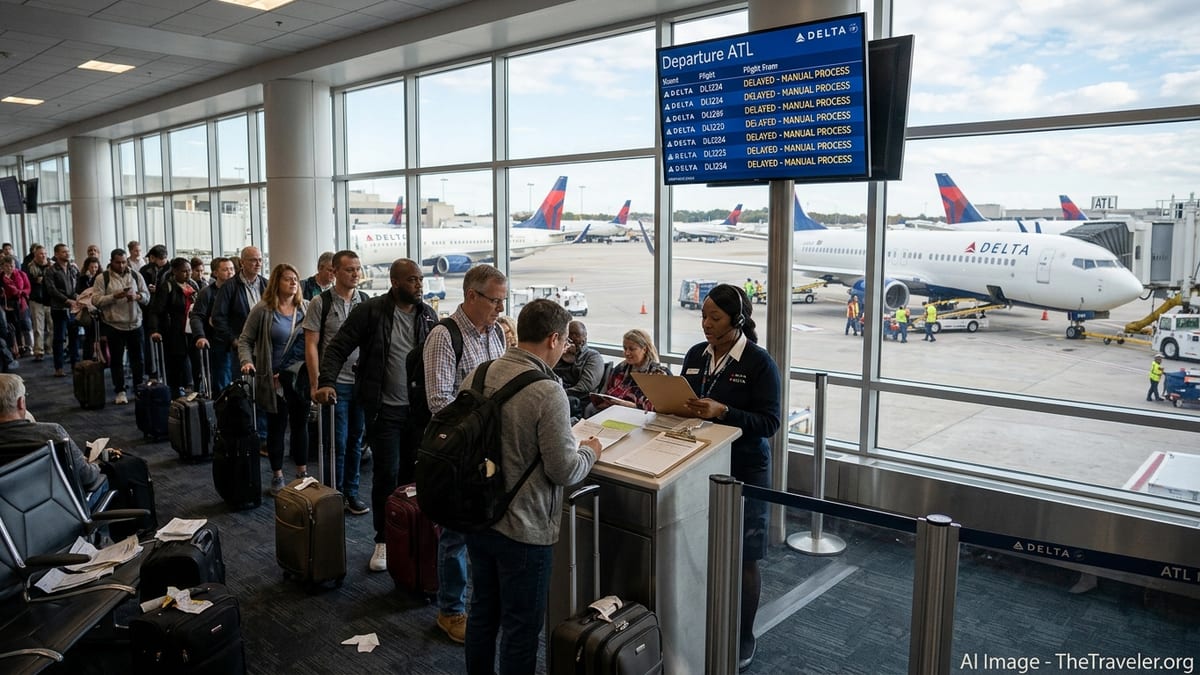
Reports from airports on November 22 described long lines and crowded gate areas at Atlanta and other Delta stations as the outage unfolded during morning and midday banks of flights. Passengers told local journalists they had sat on aircraft at the gate for one to several hours waiting for departure clearance while staff completed manual checks. Others were held in terminal areas as departure times were pushed back in repeated increments. Several travelers reported missed connections and last-minute cancellations after multiple hours on board, illustrating how quickly a technical problem can turn into an overnight stay or a lost trip during a peak travel period.
Because the problem struck at the start of Thanksgiving week, many passengers had limited flexibility. With alternative flights already heavily booked, especially on Sunday and Monday, travelers who missed Delta connections or encountered cancellations did not always find same-day rebooking options on other airlines. Industry coverage noted that some passengers opted to abandon their trips entirely or reschedule for later in the week, while others accepted lengthy overnight layovers to reach their destinations.
For travelers whose upcoming flights were not yet affected, the episode acted as a reminder of how interconnected airline IT and field operations have become. Several travel publications advised passengers heading to the airport in the days after the outage to check their flight status repeatedly, build extra time into connections, and prepare for potential residual delays as Delta reset aircraft and crew rotations. By Monday afternoon, major carriers and airport operators reported that U.S. flight schedules, including Delta’s, were broadly stable again, but some longer connections remained tight as aircraft continued returning to normal positions.
What Happens Next for Delta and Thanksgiving Travelers
As of late Monday, November 23, Delta and Atlanta airport officials were reporting that operations had largely returned to normal, with the weight-and-balance automation system back online and only scattered delays remaining. The airline has not yet released a detailed, technical post-incident report, so key questions about the precise cause, the duration of the core outage window and any planned system changes remain unanswered. Given the timing and scale, however, Delta is likely to face continued scrutiny from regulators, investors and frequent travelers about how its IT infrastructure coped with a predictable peak period.
For those traveling over the remainder of Thanksgiving week, the immediate risk from Sunday’s incident appears to have passed, but its effects linger in more subtle ways. Some aircraft and crew schedules were reworked to recover from the disruption, which can leave parts of the network with slightly reduced slack for several days. If further shocks such as severe weather or air-traffic restrictions occur on top of Sunday’s delays, they could propagate more easily than in a completely normal week. Travelers with tight connections or complex itineraries on Delta may still wish to allow additional buffer time, particularly when transiting through Atlanta.
From a practical standpoint, the most important steps for affected passengers remain routine but essential. Travelers whose flights on November 22 or 23 were significantly delayed or canceled should review their bookings in Delta’s app or on the airline’s website, keep documentation of disruption times, and check what the carrier is offering under its general delay and cancellation policies. Those flying later in the week should monitor real-time status information before leaving for the airport, pay close attention to gate changes and boarding times, and be prepared with backup options such as later departures or overnight accommodation if conditions deteriorate again. Until Delta publishes a fuller account of the incident and any resulting changes, the outage stands as one more reminder that technology issues can matter as much as weather when planning holiday air travel.