


More news on this day
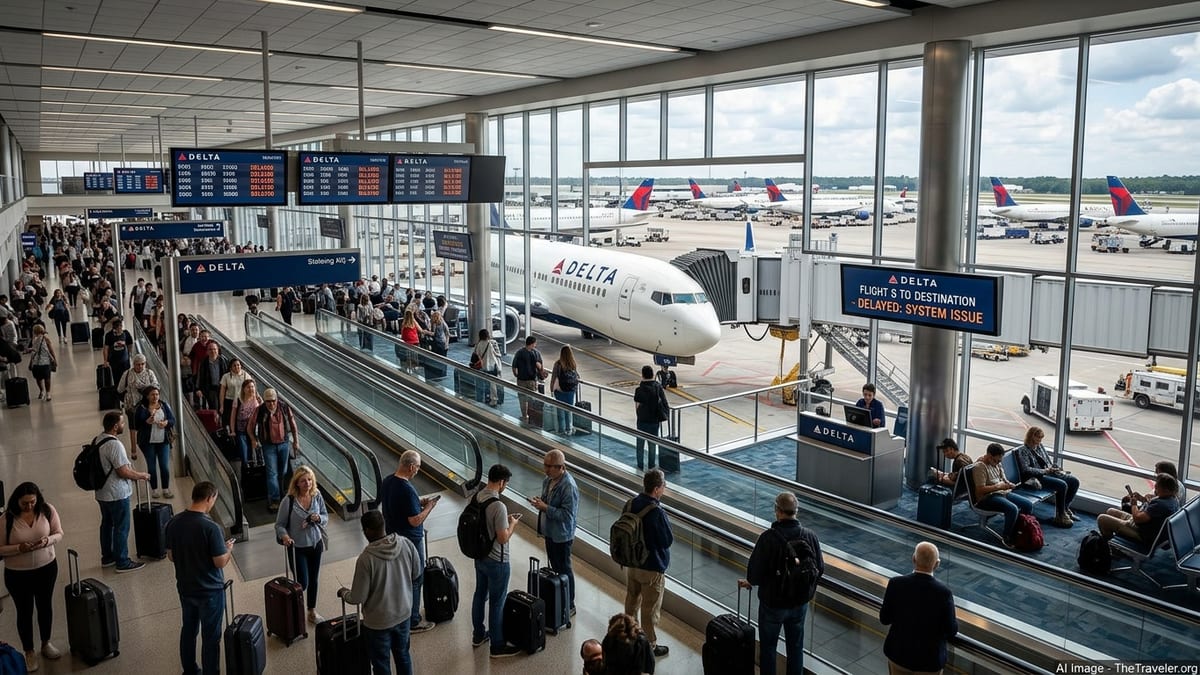
Delta Air Lines passengers across the United States faced delays on Sunday, November 22, 2026, after a malfunction in the carrier’s automated weight-and-balance computing system prompted a short ground stop into its Atlanta hub, disrupting operations at one of the country’s key Thanksgiving travel gateways.
Get the latest news straight to your inbox!
What happened to Delta’s system on Sunday
Delta confirmed on Sunday that an internal automation problem affecting the system that calculates aircraft weight and balance led to significant operational disruption, with departures temporarily halted and knock-on delays across its network. The issue centered on a tool used to ensure that each aircraft’s load, including passengers, baggage and fuel, is properly distributed before takeoff, a core safety requirement in commercial aviation.
According to public statements reported by U.S. media and shared by the airline, the malfunction did not compromise aircraft already in flight, but it did prevent the automated generation of load and balance data needed for some departures. As a result, Delta slowed and in some cases stopped flights while it worked to restore or work around the affected systems, creating a growing backlog at the gates and at check-in. The airline has not, as of November 24, provided detailed technical specifics beyond identifying the affected system as an automated weight-and-balance calculator.
The disruption coincided with one of the busiest travel periods of the year in the United States, when airlines typically operate at or near full capacity. Even a short ground stop or slowdown during such peaks can quickly translate into hundreds of delayed flights as aircraft, crews and passengers fall out of position and scheduled turnaround times become impossible to meet.
Scope of delays at Atlanta and other U.S. airports
The immediate impact of the glitch was felt most acutely at Hartsfield-Jackson Atlanta International Airport, Delta’s primary hub and one of the world’s busiest passenger airports. The Federal Aviation Administration (FAA) issued an approximately hourlong ground stop on Sunday morning, temporarily blocking some flights bound for Atlanta while the airline addressed the problem and traffic into the hub was metered. After the ground stop was lifted, the FAA implemented a program of staggered departure times to manage congestion as operations resumed.
Data from flight-tracking services cited by U.S. news outlets indicated that more than 1,000 Delta flights were delayed on Sunday, representing a substantial portion of the airline’s schedule that day. The majority of these flights operated eventually, but many departed well behind schedule, particularly those touching Atlanta. While there were cancellations, early indications suggested delays significantly outnumbered outright flight scrubs, with Delta focusing on moving aircraft and passengers later in the day where possible.
The disruption rippled through Delta’s broader domestic network, affecting major airports such as New York, Detroit, Minneapolis–Saint Paul, Los Angeles and Salt Lake City, where the carrier maintains large operations. Delays also extended to some international departures and arrivals that connect via Atlanta or other U.S. hubs. Because the outage was relatively short in duration compared with longer multi-day disruptions seen in the past, most airports reported improving conditions by late Sunday and into Monday, although residual delays and some mispositioned aircraft persisted.
How this incident fits into a month of aviation system glitches
The Delta incident came at the end of a volatile stretch for U.S. aviation technology infrastructure. Earlier in November 2026, the FAA experienced a network malfunction that triggered a rare nationwide ground stop, the longest such halt to U.S. air traffic since 2001 and a type of measure that has only been used a handful of times in recent decades. That federal-level outage disrupted airlines across the board and took days for schedules to fully normalize.
Within the same week, United Airlines experienced its own outage that affected internal systems and forced it to delay departures, drawing further attention to the sector’s dependence on complex, tightly interconnected IT and communications platforms. Against that backdrop, Delta’s weight-and-balance automation glitch added another example of how a failure in a single critical system can quickly produce large-scale delays, especially when airlines are running intense holiday schedules with limited spare capacity.
However, the scope and duration of Delta’s latest problem appear more limited than some previous crises. The airline’s operation was described as “stable” by Monday, November 23, with schedules generally running, albeit with some lingering delays. This contrasts with the July 2024 global IT outage linked to a faulty software update from cybersecurity provider CrowdStrike, after which Delta took several days to recover and ultimately canceled thousands of flights. In that earlier case, the carrier’s own public statements and subsequent financial filings acknowledged a multi-day impact and significant financial cost. By comparison, the most recent malfunction has so far been contained to roughly a single day of heavier disruption with shorter knock-on effects.
What Delta and authorities are saying so far
In its public comments on Sunday and Monday, Delta emphasized that safety remained the guiding factor in its decision to slow and halt flights while addressing the automation issue. The airline said its teams were “focused on keeping the operation moving safely and caring for our customers,” and it confirmed that operations had stabilized by Monday. At the time of writing, Delta had not published a detailed engineering explanation or root-cause analysis, which is not unusual in the early days following an internal systems event.
The FAA, which manages the U.S. air traffic system, confirmed the ground stop affecting some flights into Atlanta and later the use of traffic management initiatives to smooth the restart. The agency has not indicated any link between Delta’s internal glitch and the earlier nationwide FAA network issue, and there is currently no public evidence that Sunday’s event involved a cyberattack or broader third-party outage. Based on available information, the episode appears to have been confined to Delta’s own systems related to weight-and-balance calculations, with regulators intervening primarily to manage traffic flows safely around the hub.
Regulatory investigations are common after major disruptions, particularly when previous outages have already attracted scrutiny. U.S. transportation authorities and consumer regulators have in recent years examined airlines’ handling of widespread cancellations, rebooking policies and passenger care obligations following system failures or extreme weather. While no specific new investigation into this latest Delta incident has been announced as of November 24, 2026, the event will likely be reviewed in the context of ongoing oversight of airline operational resilience and IT risk management.
Practical implications and what affected travelers should check
For passengers who were due to travel on Delta on Sunday, November 22, or early Monday, the most immediate effects were delayed departures, missed connections and, in some cases, overnight stays or rebooked itineraries. Delta typically responds to significant disruptions by offering fee waivers for same-carrier rebooking and, when delays are extensive and within the airline’s control, by providing meal vouchers and hotel accommodations according to its customer service commitments and local availability. While Delta has not yet detailed a specific, separate travel waiver tied solely to Sunday’s automation glitch, travelers are being advised through the airline’s usual channels to review their flight status and available options for changes.
Passengers whose trips were interrupted should monitor their booking in the Delta app or on the website and keep any receipts for necessary overnight stays, meals or incidental expenses, as future reimbursement policies or goodwill gestures sometimes evolve in the days after a disruption. Those who missed cruises, tours or connecting flights on other airlines due to Delta delays should also check the conditions of their travel insurance or credit card protections, which may offer additional coverage where the airline’s obligations end. Because formal statements and customer policies can change as an incident is reviewed, travelers who believe they are owed compensation or vouchers should periodically revisit Delta’s advisories over the coming days.
Looking ahead to the remainder of the Thanksgiving travel period, both the FAA and weather services are highlighting the potential for weather-related challenges on top of recent technology issues. With Delta’s operations currently described as stable, the main risk for passengers in the next few days is less about a repeat of Sunday’s specific glitch and more about the cumulative effect of tight schedules, high passenger volumes and any storms that may affect key hubs. Travelers booked on Delta this week should continue to check their flight status frequently, build extra time into connections where possible, and verify any schedule changes directly with the airline or through their booking platform before heading to the airport.