


More news on this day
Masked U.S. immigration officers arrested a father and daughter on the jet bridge of an Alaska Airlines flight at Seattle-Tacoma International Airport on November 21, 2026, disrupting boarding to Los Angeles, delaying the departure for hours and triggering a wave of concern from travelers, airport officials, Washington’s governor and members of Congress about how immigration enforcement is being conducted in passenger areas.
Get the latest news straight to your inbox!
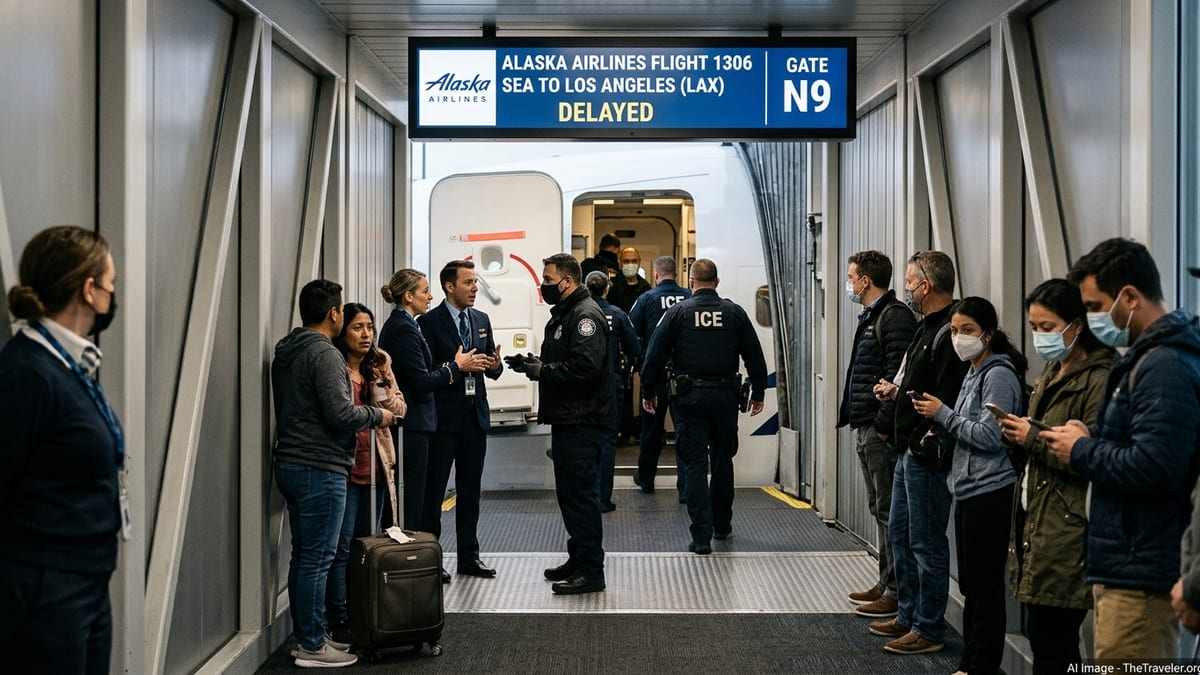
What happened on Alaska Airlines Flight 1306
The confrontation unfolded at about 8 a.m. on Saturday, November 21, as passengers were boarding Alaska Airlines Flight 1306 from Seattle-Tacoma International Airport (SEA) to Los Angeles. According to statements from U.S. Immigration and Customs Enforcement (ICE), the Port of Seattle and Alaska Airlines, several masked ICE officers entered the jet bridge at Gate N9 and moved to detain one of the travelers in the boarding line. Video recorded by passengers shows officers in unmarked jackets and plain clothes wrestling at least one person to the floor while nearby travelers shout and attempt to understand what is happening.
ICE said the operation was a “targeted enforcement” action aimed at arresting Ricardo Larrondo Mendoza, whom the agency describes as a Mexican national who overstayed a U.S. visa. As officers took him into custody on the jetway, another passenger on the same reservation, identified by ICE as his daughter Sofia Hernandez Mejia, became involved in the scuffle. In its statement, the agency alleges that she hurled hot coffee at officers and obstructed the arrest, and that she too was taken into custody and will face a federal charge of assaulting a federal officer.
Lawyers representing the family have disputed ICE’s version of the encounter in subsequent interviews, saying the pair had been following legal processes and were traveling to a family baptism in California. They have not publicly detailed all aspects of the arrest but say both individuals had employment authorization and were surprised to be confronted on the jet bridge. Those legal claims and ICE’s allegations are expected to be tested in immigration and, potentially, criminal court proceedings in the coming weeks.
Delays, disruption and what travelers on board experienced
The enforcement action halted boarding and left those already on the aircraft or in the jet bridge waiting as the situation unfolded in close quarters. Video posted online shows several passengers stepping back toward the terminal end of the jet bridge, some shouting at officers not to separate the family, others calling for airline staff to intervene. Travelers reported crying and visible distress among passengers and crew, with some asking whether it was safe to continue on the flight after witnessing the confrontation.
Flight-tracking data and airline statements indicate that Alaska Airlines Flight 1306, which had been scheduled to depart around 8:10 a.m., was significantly delayed. Local media, citing union officials, reported that several members of the flight crew declined to operate the flight after witnessing the incident, prompting the airline to call in replacement crew members and contributing to a delay of close to three hours. Alaska Airlines has not confirmed every operational detail publicly but has acknowledged a substantial disruption tied directly to the law-enforcement activity at the gate.
For travelers, the arrest created an unusual form of delay compared with more familiar causes such as weather or technical issues. Passengers were initially confined either on the aircraft or at the gate while law enforcement cleared the jet bridge and completed paperwork, and only later received updated departure times. There is no indication that passengers faced additional screening or questioning as a direct result of the arrest once the jetway was reopened, but the incident underscores how off-schedule a flight can become when security and enforcement operations intersect with routine boarding.
Port of Seattle and airline responses
The Port of Seattle, which operates SEA, issued a sharply worded statement on November 21 saying it was “outraged” by the incident and emphasizing that immigration enforcement actions at the airport are carried out without the Port’s prior participation or approval. The Port noted that it has previously discussed protocols for federal enforcement activity at the airport with Department of Homeland Security (DHS) officials, and said it is now in active conversations with DHS to determine whether those protocols were breached by carrying out an arrest in a crowded domestic jetway while passengers boarded a flight.
Port officials stressed that their primary concern is the safety and well-being of travelers, airport workers and airline crews. They described the incident as distressing not only for the family involved but also for others in the confined boarding area, and said they are seeking more information from federal authorities about why the arrest took place on the jet bridge rather than in a less crowded location. In a subsequent public meeting, Port commissioners indicated they would explore what additional steps they can take, within federal constraints, to limit or more tightly control domestic immigration enforcement actions on Port-controlled property.
Alaska Airlines, which is based in Seattle and operates the affected flight, said it was not given advance notice of ICE’s plans and did not participate in coordinating the arrest. In a written statement, the airline said it is required to comply with applicable laws and interact cooperatively with law-enforcement officials but emphasized that it does not direct immigration enforcement activity. Alaska said it is reviewing the circumstances with the Port and federal agencies to understand whether established practices were followed, and reiterated that the safety and privacy of guests and employees remain the airline’s top priority.
Political reaction and legal questions around masked airport arrests
The highly visible nature of the arrest, along with the use of black face coverings by the officers, quickly turned the incident into a political flashpoint in Washington state and beyond. Governor Bob Ferguson, who held a press conference at the airport shortly after the videos spread online, said the operation showed ICE to be “out of control” and argued that masked agents dragging passengers off domestic jetways undermines public trust and stokes fear in immigrant communities. He indicated his office is examining what authority the state may have to respond, including potential legal challenges if it appears federal officers violated state or local laws.
Members of Washington’s congressional delegation also weighed in. Representative Pramila Jayapal called the jetway arrest “totally unacceptable” and characterized violent immigration arrests in everyday public spaces as incompatible with democratic norms. Representative Adam Smith, the ranking member of the House Armed Services Committee, said ICE’s broader conduct across the country is putting people in harm’s way and described the agency as operating akin to a paramilitary force, adding that it “needs to be reined in before causing more chaos and fear.” Representative Suzan DelBene likewise urged stronger federal oversight and accountability, saying taxpayers should not be funding operations that create what she described as terror and instability.
Civil-liberties groups have used the incident to highlight wider concerns about immigration enforcement practices at airports. The ACLU of Washington said it strongly condemns carrying out arrests in crowded jetways using masked, largely unidentifiable officers. The organization argues that such tactics make it harder for individuals to know who is detaining them or to later identify agents if rights are violated, and that enforcement at everyday locations like airports, schools or transit stops can chill people from traveling or accessing essential services. ICE has defended its practices, citing what it describes as a sharp increase in assaults, vehicular attacks and threats directed at its officers and arguing that security concerns justify additional protective measures, including face coverings.
What travelers should know about immigration enforcement at U.S. airports
For travelers passing through U.S. airports, the Sea-Tac incident underscores that immigration enforcement does not occur only at international arrival halls and primary passport control. ICE and other DHS agencies have authority to carry out targeted enforcement operations in many parts of an airport, including public areas, secure departure zones and jet bridges, provided they comply with federal law and any applicable internal protocols. In practice, most such actions remain out of public view, but Saturday’s confrontation shows how disruptive and visible they can be when they occur during active boarding.
U.S. citizens and lawful permanent residents are generally not subject to immigration detention based solely on their status, although they can still be questioned or arrested at airports for other reasons. Noncitizens, including those traveling on valid visas or under other forms of authorization, can be detained if federal databases flag an issue such as a prior removal order, a visa overstay, or an open warrant. Attorneys and advocacy groups recommend that noncitizen travelers carry relevant documents, such as valid passports, evidence of legal status and, where applicable, work permits or travel authorization notices, and suggest that people who have had prior immigration proceedings consult with an attorney before taking domestic or international flights.
For those on board Alaska Flight 1306 and for the many travelers preparing to use Sea-Tac over the busy Thanksgiving period from November 25 to 30, the main practical consequence of Saturday’s arrest was delay and distress rather than changes to check-in or security procedures. The Port of Seattle has not announced any immediate new rules for passengers as a result of the incident, and there is no indication of added screening specific to this case. However, the arrest has reinforced calls from local officials for clearer limits on where and how immigration enforcement should occur in civilian travel spaces, discussions that could eventually shape federal policy and, in turn, the experience of travelers at large U.S. airports.
In the near term, passengers flying through Seattle and other major hubs are unlikely to see visible changes tied directly to this one operation. Travelers can, however, expect continued debate between local authorities and federal agencies over airport enforcement tactics, and possibly new guidance or agreements about notification protocols when ICE plans to carry out an arrest in secure areas. Until any such changes are formalized, the Sea-Tac jetway incident serves as a reminder that law-enforcement activity can unexpectedly intersect with routine trips, and that delays linked to security or enforcement can occur even on purely domestic departures.