


More news on this day
New analysis of federal flight data from the 2025 Thanksgiving travel period shows that some of the United States’ busiest hubs, including Chicago O’Hare and Dallas Fort Worth, experienced significantly higher disruption rates than others, offering travelers clearer guidance on how airport choice and departure time can affect their chances of holiday delays.
Get the latest news straight to your inbox!
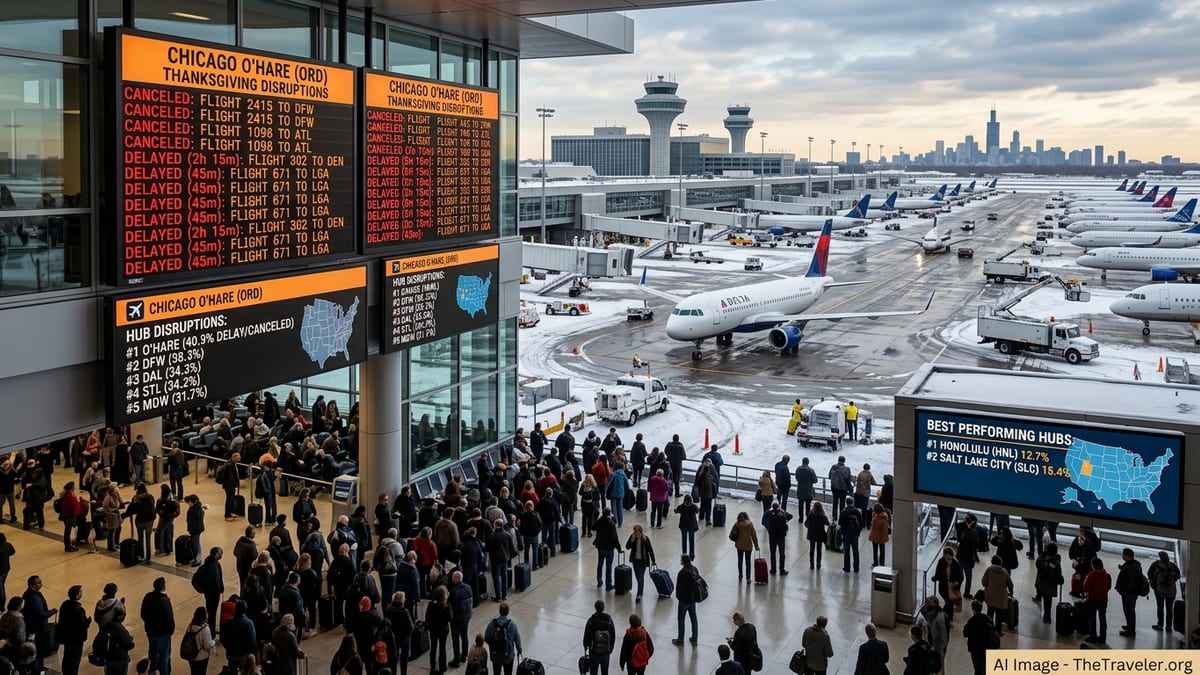
How the Thanksgiving disruption rankings were calculated
The rankings cited in the original study are based on domestic U.S. flight records reported to the Bureau of Transportation Statistics for a defined 2025 holiday window. Researchers examined scheduled flights between November 22 and December 1, 2025, covering the core Thanksgiving travel period and the heavy return days that followed. A flight was counted as disrupted if it was canceled, diverted, or departed at least 15 minutes later than scheduled, mirroring the on-time performance standard used by the U.S. Department of Transportation.
Across all reporting airlines and airports during that window, the data show that roughly one in four flights nationwide arrived 15 minutes or more behind schedule in November and December 2025, when Thanksgiving and Christmas traffic were at their peak. Independent analyses of the same underlying federal datasets confirm that late arrivals in those two months affected close to 25 percent of flights, underlining that the level of disruption highlighted in the Nova Kratom study is consistent with broader federal records rather than a one-off sample.
The study focused on the 50 busiest U.S. airports by scheduled departures over the period. That emphasis on high-traffic hubs means the rankings are most relevant to travelers who connect through major airline bases such as Chicago, Dallas, Atlanta, Denver or New York, rather than very small regional airports where the volume of Thanksgiving flights is far lower and year-to-year variation can be much larger.
Which major hubs saw the most Thanksgiving disruption
Among the 50 busiest airports studied, Chicago O’Hare International Airport recorded the highest disruption rate during the 2025 Thanksgiving period. According to the study, 40.9 percent of scheduled departures from O’Hare were disrupted, meaning they were either canceled, diverted, or left at least 15 minutes late. More than one in ten O’Hare departures in that window were canceled outright, placing the airport at the top of the ranking for cancellations as well as overall disruption.
Dallas Fort Worth International Airport, one of the country’s largest connecting hubs, was close behind. The analysis found a 38.3 percent disruption rate for DFW departures over the same dates, indicating that more than a third of scheduled flights encountered a significant problem. Other airports with comparatively high shares of affected departures included Dallas Love Field at 34.3 percent, St. Louis Lambert International Airport at 34.2 percent and Chicago Midway International Airport at 31.7 percent, suggesting that passengers using both primary and secondary airports in these metropolitan areas faced elevated odds of holiday irregular operations.
The figures for Thanksgiving week at these hubs align with broader federal on-time performance data that show large, weather-sensitive connecting airports shouldering a disproportionate share of national delay minutes. Because these hubs handle dense banks of connecting flights, any arrival that runs late or an episode of poor weather can quickly cascade into missed connection windows and subsequent departures leaving behind schedule, particularly on days when aircraft and crews are already heavily committed.
Airports with comparatively strong Thanksgiving performance
The same analysis also identified large U.S. airports where Thanksgiving-period disruption was notably lower. Salt Lake City International Airport stood out among hubs with over 3,000 departures in the study window, with a disruption rate of 15.4 percent. Only a small fraction of its scheduled departures, about 0.3 percent, were canceled, indicating that most travelers passing through Salt Lake City encountered relatively minor schedule changes compared with many of the country’s largest connecting points.
Honolulu’s Daniel K. Inouye International Airport ranked first overall in the study across all 50 of the busiest airports, with disruptions affecting 12.7 percent of flights during the 2025 Thanksgiving period. That performance is consistent with separate multi-year analyses of Thanksgiving operations, which also place Honolulu near the top of the list for on-time arrivals and departures. The combination of relatively stable late-November weather and a schedule that is less tightly banked than continental hubs appears to contribute to the lower rate of severe delays and cancellations.
Other airports highlighted for comparatively reliable Thanksgiving operations included Washington Dulles International Airport, Pittsburgh International Airport and San Francisco International Airport. Independent reviews of federal on-time performance data show that Salt Lake City and several of these airports have ranked among the better-performing large U.S. hubs across the last three Thanksgiving travel periods, suggesting that their strong 2025 numbers are not solely the result of one unusually smooth holiday week.
Why the rankings matter for regional and connecting travelers
For travelers departing from regional airports, including those in states such as South Dakota, these rankings have practical consequences because many itineraries require a connection through one of the large hubs featured in the study. A passenger leaving a small regional field may have limited choice over the initial departure point, but they often can choose between different mid-continent hubs when booking a multi-leg journey to the East or West Coast.
In practice, this means that even if conditions at a regional airport are favorable, the overall reliability of the trip can depend heavily on the connecting airport’s historical performance at busy times. For example, a traveler able to connect through Salt Lake City instead of a more frequently disrupted Midwest or Plains hub during Thanksgiving week could lower the statistical chance that their itinerary is affected by an extended delay or cancellation. Conversely, itineraries that require tight connections at airports where more than a third of holiday-period departures have historically been disrupted may involve a higher risk of missed onward flights.
It is important to note that these are historical averages for one defined window in 2025, not guarantees for any individual itinerary. Weather systems, airline staffing, air traffic control restrictions and other operational factors can vary significantly from one year to the next. Nevertheless, the relative differences among airports in the same dataset offer travelers an additional piece of information when weighing connection points for high-stakes trips, such as those involving fixed holiday events or nonrefundable ground arrangements.
How departure time shapes the risk of delays
Beyond airport choice, the Nova Kratom study and several independent analyses of federal data reach a similar conclusion about the time of day: flights scheduled earlier in the morning are less likely to be disrupted than those later at night. In the holiday-period dataset underlying the study, departures between 6 a.m. and 7 a.m. were disrupted 12.3 percent of the time, a substantially lower rate than the late-evening window between 10 p.m. and 11 p.m., where 41.4 percent of departures were recorded as disrupted.
More recent nationwide studies using broader 2025 and 2026 BTS data point in the same direction, although with somewhat different percentages because they cover all months and a much larger number of flights. Several analyses of those datasets report that more than 88 percent of flights leaving between about 5 a.m. and 9 a.m. depart on time, while the share falls into the mid-60 percent range for flights scheduled between early evening and late night. The precise figures vary by source and timeframe, but the underlying pattern of reliability decreasing through the day remains consistent.
Researchers attribute a significant share of this pattern to the way delays compound as aircraft move through their daily rotations. Federal statistics on delay causes show that late-arriving aircraft account for roughly two-fifths of all U.S. departure delay minutes, more than any other single category. Because the first flight of the day for a given aircraft usually starts at or close to its base and is less constrained by inbound delays, its on-time performance is often better. As the day progresses, any late arrival tends to push back subsequent departures on the same aircraft, particularly during busy holiday periods when spare aircraft and crews are scarce.
What travelers can do ahead of the next Thanksgiving rush
For the 2026 Thanksgiving period and beyond, travelers cannot eliminate the risk of disruption entirely, but the data behind the new rankings suggest several steps that can tilt the odds in their favor. When possible, choosing itineraries that depart in the early morning remains one of the most reliable ways to reduce exposure to late-arriving aircraft and accumulated delays. In practice, that might mean opting for a 7 a.m. departure instead of a mid-afternoon or late-evening option, even if the early flight is less convenient.
Where there is flexibility in routing, comparing connection options through different hubs can also make a difference, particularly on days historically associated with heavy traffic, such as the Wednesday before Thanksgiving and the Sunday that follows. If two itineraries are otherwise similar in time and cost, but one connects through a hub that has recorded materially fewer Thanksgiving-period disruptions in recent years, the historical data suggest that the latter routing may carry a lower statistical risk of severe delays.
Finally, travelers should treat the rankings as one input rather than a guarantee. For those with fixed plans over the 2026 holiday period, it remains important to monitor forecasts and real-time flight status, allow additional time for connections where schedules permit, and understand airline policies for reaccommodation and overnight disruptions. While past performance in 2025 highlights which hubs and departure times were most exposed to disruption, airline schedules, airport infrastructure projects, and weather conditions continue to change, so checking the latest information close to departure remains essential.