


More news on this day
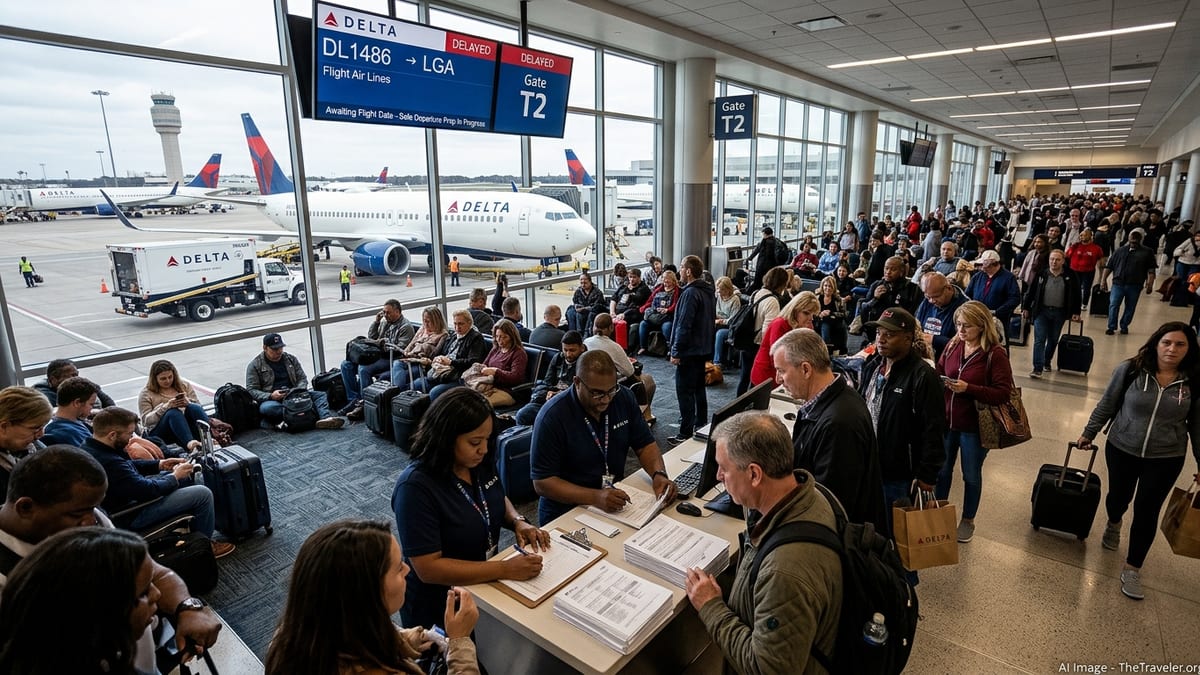
Delta Air Lines says the automated system it uses to calculate aircraft weight and balance is back online after a network-wide outage on November 22 triggered an FAA ground stop for Atlanta-bound Delta flights and caused thousands of delays across the United States at the start of the Thanksgiving travel rush.
Get the latest news straight to your inbox!
What happened to Delta’s weight and balance system
Delta’s disruption began early on Sunday 22 November 2026, when the carrier’s automated tool for calculating aircraft weight and balance stopped functioning properly across its network. The system, often referred to internally as ALIS, normally generates detailed load instructions that ground staff use to distribute baggage and cargo and that dispatchers and flight crews need before they can legally depart. Without reliable automated calculations, flights are not permitted to push back until new weight, balance and performance data are issued.
As the outage emerged, Delta shifted to manual “workarounds,” with ramp agents and load controllers counting bags and preparing hand-written or manually compiled load reports for flight crews. Captains on affected flights advised passengers that a system-wide issue with Delta’s weight software meant they had to wait while dispatch completed manual checks. In practice, that added 30 to 120 minutes of ground time to many departures as staff verified totals and ensured they matched aircraft performance limits.
Because Delta operates one of the largest domestic networks in the United States and runs its scheduling through tightly timed aircraft rotations, the combination of a network-wide system failure and manual processing quickly created a backlog. Planes that departed late from one airport arrived late at the next, and crews often ran up against duty time limits, compounding the disruption throughout Sunday.
FAA ground stop in Atlanta and scale of the disruption
The largest operational impact was felt at Hartsfield–Jackson Atlanta International Airport, Delta’s primary hub and the world’s busiest airport by passenger numbers. At the airline’s request, the Federal Aviation Administration (FAA) first issued a ground stop on the morning of 22 November for Delta and its regional affiliates on flights bound for Atlanta from the contiguous United States. The measure was intended to prevent gridlock on the ground at Atlanta while Delta worked through delayed departures elsewhere in its system.
After roughly an hour, the FAA converted the ground stop into a broader ground delay program that continued to meter Delta arrivals into Atlanta through the middle of the day, citing both the automation problem and periods of low visibility. Advisory summaries indicated average arrival delays of around an hour and a potential upper range near two hours for some flights into the hub. These controls applied only to Delta-operated and Delta Connection services; other airlines flying into Atlanta were not subject to the same program, although they were indirectly affected by airfield congestion and shared gate and taxiway constraints.
Data from flight-tracking services show how widely the disruption spread. On 22 November, Delta recorded more than 2,000 delayed flights, representing roughly two-thirds of its schedule, and several hundred cancellations worldwide as the carrier reset operations. Airports with a strong Delta presence, including Detroit, Minneapolis–St. Paul, New York LaGuardia and Salt Lake City, reported clusters of late departures and arrivals linked back to the Atlanta ground delay and the weight-and-balance outage rather than to local weather.
System restored but residual delays continue
By later on Sunday, Delta said the automation for its departing-flight weight and balance calculations had been restored and that new load closeouts were again being transmitted electronically. The FAA separately confirmed that the delays were not related to any air traffic control or navigation systems, and that the issues were confined to Delta’s own operations and support tools. The airline emphasized that safety procedures were followed throughout and that flights departed only when required weight and balance checks were complete.
Although the technical fault has been fixed, the operational impact has lingered into the early Thanksgiving week. Delta reported that its operation had stabilized on Monday 23 November, but travelers continued to encounter scattered delays as aircraft and crews were repositioned and as the airline cleared passenger backlogs from missed connections. Some passengers and flight crews reported on Monday that dispatchers were still issuing manual clearances on a case-by-case basis as systems were verified and validated, leading to additional short holds before pushback on certain routes.
As of Tuesday 24 November, schedules show Delta running a largely normal operation, with delays and cancellations more in line with seasonal averages and driven primarily by weather and routine congestion rather than by residual technology issues. There has been no indication from the airline or regulators that the outage involved cybersecurity or a broader failure of third-party infrastructure, though Delta has not publicly detailed the precise root cause beyond acknowledging an automation problem affecting its weight and balance tool.
Why weight and balance systems matter for flight safety
Weight and balance calculations are a critical step in every commercial flight’s pre-departure checklist. Airlines must confirm that the total weight of passengers, baggage, cargo and fuel does not exceed the limits certified for that aircraft type, and that this load is distributed so the aircraft’s center of gravity remains within a specified envelope. If an aircraft is loaded outside those boundaries, it can affect takeoff performance, handling characteristics and structural safety.
In normal operations at large carriers such as Delta, sophisticated centralized computer systems draw on booking data, baggage tag scans, cargo manifests and fuel orders to produce a final weight-and-balance report. That report includes key performance figures such as takeoff weight, runway requirements and engine power settings, which pilots must review and accept before they can request clearance to depart. These systems are designed with multiple safeguards and audits, but they remain a single point of dependency; if they fail, airlines must either switch to proven manual methods or keep aircraft on the ground.
The FAA and other regulators stress that compliance with certified weight and balance limits is mandatory rather than discretionary. As a result, when a tool like Delta’s ALIS experiences an outage, airlines cannot simply revert to estimates or continue operating as normal. Instead, they are required to implement contingency procedures that may significantly slow operations, as seen on 22 November when manual counting of bags and recalculation of performance numbers extended turnaround times for many flights.
How this fits into a month of disrupted U.S. air travel
Delta’s technology issue comes less than two weeks after a separate, unrelated outage affected the wider U.S. aviation system. On 13 November, a problem linked to communications infrastructure triggered the longest nationwide ground stop in roughly a quarter century, halting departures across the country for several hours and disrupting tens of thousands of flights. In that case, the FAA said the trigger was tied to an issue outside its own core air traffic control equipment, though full details are still being reviewed.
Other airlines have recently faced similar vulnerabilities in their own operational systems. United Airlines experienced a weight-and-balance computer problem in 2025 that led to more than 1,000 delays and dozens of cancellations, underscoring how dependent modern carriers are on centralized load-planning tools. United also reported a smaller technology outage on 16 November 2026 that briefly affected fewer than 150 flights before normal operations resumed. Officials have said that neither of those incidents was linked to cybersecurity threats.
Alongside these technology issues, a series of weather systems have added to delays in the run-up to Thanksgiving. Forecasts for the current week highlight rain and gusty winds affecting some major East Coast airports, including New York LaGuardia and Newark Liberty, while low clouds and fog have periodically slowed arrivals and departures on both coasts. The combination of weather-related programs and knock-on effects from earlier disruptions has raised the likelihood that U.S. travelers will encounter longer-than-usual queues and occasional last-minute schedule changes as the holiday period progresses.
What Thanksgiving travelers on Delta should expect now
For travelers booked with Delta in the days following the outage, the primary impact is the risk of lingering schedule irregularities rather than ongoing technical problems with the weight and balance system itself. With automation restored, most flights are expected to depart on time, but some aircraft and crews remain out of optimal position after Sunday’s disruptions. This may translate into isolated delays, gate changes or equipment swaps, particularly at heavily utilized hubs such as Atlanta, Detroit, Minneapolis–St. Paul and New York LaGuardia.
Passengers flying through Atlanta should plan for potentially crowded terminals and full flights through the Thanksgiving peak, as the airport expects millions of passengers between 19 November and 1 December. Given the recent system issue, travelers connecting through Delta hubs may wish to allow additional time between flights where possible, keep a close watch on the airline’s app or departure boards for gate and schedule updates, and ensure contact details are correct in bookings so that rebooking notices are received promptly if plans change.
Delta has not issued a broad, system-wide travel waiver specifically tied to the weight-and-balance outage, but the airline has indicated that it is treating cancellations as a last resort and working to re-accommodate disrupted customers on the next available flights. Travelers whose itineraries were significantly affected on 22 November or in the immediate aftermath should review the latest policies on schedule changes and discuss options directly with Delta or their booking agent. As Thanksgiving week continues, the most significant variables for Delta and its passengers are expected to be weather and typical holiday congestion rather than further problems with the carrier’s weight and balance automation.