


More news on this day
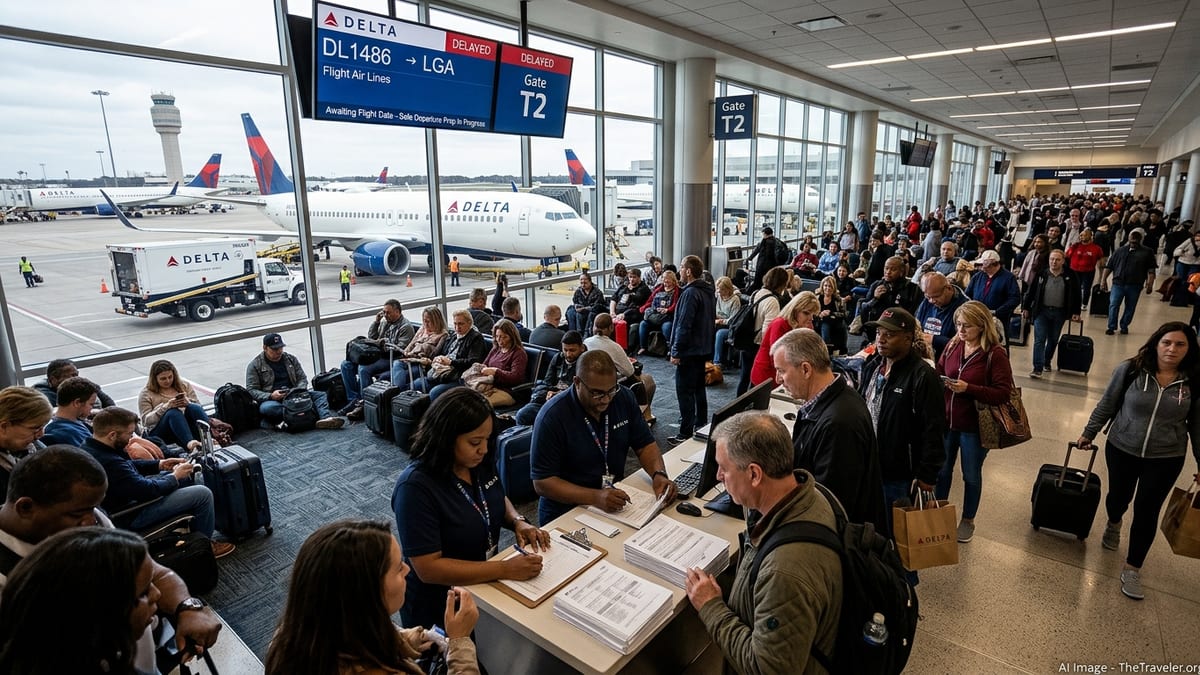
Delta Air Lines suffered a major technical outage of its automated weight-and-balance system on Sunday, November 22, 2026, triggering more than 1,000 delays across its network and snarling traffic at its Atlanta hub just as the U.S. Thanksgiving travel rush began.
Get the latest news straight to your inbox!
What went wrong with Delta’s weight-and-balance system
Delta has confirmed that an automated system used to calculate aircraft weight and balance malfunctioned on November 22, affecting flights throughout the United States during one of the airline’s busiest weeks of the year. The carrier said it resorted to manual workarounds to generate the performance numbers needed before dispatching aircraft, a process that is both slower and more labor‑intensive than using the normal automation.
Weight and balance calculations determine how much an aircraft weighs, how that weight is distributed across the airframe and whether it falls within certified limits for safe takeoff and landing. According to Federal Aviation Administration guidance, exceeding published weight limits or operating with improper balance can compromise structural integrity or aircraft controllability, which is why dispatchers and pilots cannot depart without accurate data. Faced with the system outage, Delta prioritized safety and continued departures only after crews and dispatch manually prepared the necessary paperwork.
The outage appeared to affect Delta’s network broadly rather than being confined to a single airport. Local and national reports, along with passenger accounts, describe delays at Hartsfield-Jackson Atlanta International Airport as well as at other Delta stations including New York, Boston, Seattle, Los Angeles and several mid‑size markets. Although the underlying technical cause has not been detailed by the airline, Delta has said the disruption was not the result of a cyberattack.
Impact on Atlanta and Delta’s nationwide operation
Atlanta, Delta’s largest hub, experienced the most visible disruption. The Federal Aviation Administration issued a ground delay program on Sunday morning for Delta flights bound for Hartsfield-Jackson at the airline’s request, temporarily restricting arrivals into the already busy hub while the weight-and-balance issue was addressed. That program replaced an earlier, more stringent ground stop and was lifted later in the morning once Delta began moving traffic again, but knock‑on effects lingered for much of the day.
Data from flight-tracking services show that more than 1,300 Delta flights were delayed on November 22, with some analyses placing the figure above 1,600 systemwide. A significant portion of those delays were connected to the automation issue, with the remainder attributed to weather and routine operational factors. At Atlanta, local media reported several hundred delayed Delta departures and arrivals, with some passengers remaining on aircraft for multiple hours while crews waited for manually prepared weight-and-balance numbers and gate availability.
The disruption extended well beyond Georgia. Reports from airports including Detroit, Minneapolis, Boston, New York and several West Coast cities described Delta flights holding at gates, returning to gates after boarding or waiting on taxiways while dispatchers completed manual performance paperwork. In some cases, extended ground delays caused crews to reach their duty time limits, resulting in cancellations after passengers had already boarded. While most flights eventually operated, the scale of delays prompted Delta to advise customers to check their flight status frequently and to allow extra time at the airport.
How the outage fits into a string of pre-holiday aviation glitches
The Delta incident came less than two weeks after a nationwide ground stop on November 13 related to an FAA air traffic control network router problem, an event that disrupted more than 18,000 flights across multiple airlines. It also followed a separate outage at United Airlines earlier in November involving that carrier’s own weight-and-balance calculation tools. Together, the sequence of events has heightened concern among travelers and regulators about the resilience of the aviation technology that underpins day-to-day operations.
In the case of Delta’s November 22 outage, the FAA has said that its own air traffic systems were operating normally and that the delays were tied specifically to the airline’s internal automation. The agency’s role was limited to managing airport traffic flows, including the temporary ground delay program for Delta arrivals into Atlanta designed to prevent gridlock as the airline worked through its backlog of flights. There has been no indication from federal officials so far that the Delta incident will prompt formal enforcement action, but it is expected that both the airline and regulators will review the failure to understand what went wrong and how to prevent a recurrence.
For passengers, the clustering of glitches so close to the Thanksgiving travel period has reinforced the possibility that even when weather is benign, technology problems can cause significant disruption. Travel and booking platforms had already reported elevated fares and strong demand for late November journeys, and airlines had scheduled dense holiday timetables. Against that backdrop, a system outage at a major carrier’s largest hub quickly translated into long lines, missed connections and crowded rebooking desks, even though the technical problem itself was resolved within the same day.
Delta’s recovery efforts and current status ahead of peak travel days
By Sunday afternoon, November 22, Delta said its automated weight-and-balance system had been restored. The airline reiterated that safety procedures were followed throughout the disruption and noted that it used manual methods to dispatch flights while the automation was offline. Local coverage from Atlanta and other hubs on Monday, November 23, described operations as stabilizing, with substantially fewer delays than the day before, although some passengers were still experiencing residual schedule changes linked to aircraft and crew being out of position.
Delta has not released a detailed public tally of cancellations, nor has it provided a full technical explanation of the outage beyond acknowledging a failure in the automated tool used for departing flight weight calculations. The carrier has standard policies for compensation and amenities in the event of controllable delays and cancellations, but specific assistance has been handled on a case‑by‑case basis. Some affected travelers reported being rebooked later the same day or the following day, while others received meal vouchers or hotel accommodation when overnight stays became necessary because of missed connections.
At Hartsfield-Jackson, airport officials have projected more than 4 million passengers over the broader Thanksgiving period. After the November 22 disruption, the airport and the airline both urged travelers to arrive early, use online check‑in where possible and monitor digital flight-status tools. With Delta’s systems now reported to be functioning and schedules largely back on track by November 23, there is no formal indication of continuing widespread technical issues, although isolated delays can still occur as operations fully normalize.
What travelers should do next if flying Delta this Thanksgiving week
Travelers booked on Delta during the Thanksgiving period should treat the November 22 outage as a reminder to confirm details before heading to the airport. For flights in the days immediately following the disruption, it is advisable to check status multiple times, including the evening before departure and again on the day of travel, since aircraft routings and crew assignments may have been adjusted as part of Delta’s recovery plan. Passengers with tight connections, particularly through Atlanta, may wish to consider earlier departures where feasible to provide a buffer against any lingering knock‑on delays.
Those whose journeys were affected on November 22 and who have not yet sought assistance can review their original travel documents and Delta’s current policies to determine what they may be eligible to request, such as rebooking options or vouchers. Documentation of delays, such as timestamps from boarding passes or flight-tracking records, can be helpful when discussing options with the airline. Because U.S. regulations for compensation in the case of airline-caused delays differ from the more prescriptive regimes in some other regions, outcomes will vary depending on the specific circumstances of each trip and the discretion of the carrier.
Looking ahead to the remainder of the holiday season, there is no confirmed indication that Delta’s weight-and-balance system faces an ongoing technical threat, but the event illustrates how reliant modern airline operations are on a complex chain of software systems. Travelers planning end‑of‑year trips may therefore want to maintain flexible arrangements where possible, such as allowing additional time between flights, booking earlier departures on peak days and keeping accommodation plans cancellable. While Sunday’s disruption has now largely been resolved, verifying real‑time information directly with the airline remains the most practical step for minimizing the risk of unexpected disruption on busy travel days.