


More news on this day
Delta Air Lines now spells out more clearly what it owes passengers when flights are severely delayed or rescheduled, including meal vouchers after three-hour controllable delays and refunds in a growing set of significant delay and schedule-change situations. Understanding which rules apply, and when, can determine whether you leave with a snack voucher, a hotel night or your money back.
Get the latest news straight to your inbox!
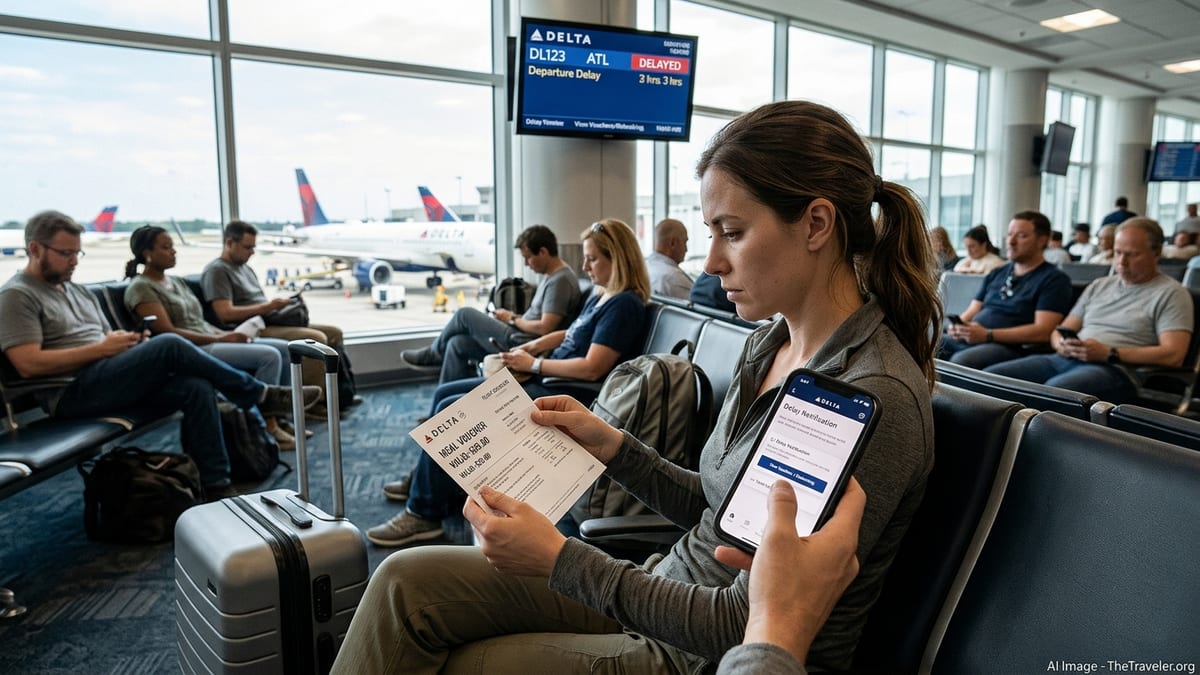
Meal vouchers after three-hour controllable delays
Delta’s current customer service plan, which underpins its commitments on the U.S. Department of Transportation’s Airline Customer Service Dashboard, states that the airline will provide a meal or meal vouchers when a delay or cancellation within Delta’s control results in a wait of three hours or more beyond the scheduled departure time. This commitment, highlighted by the DOT dashboard and Delta’s own Customer Commitment, applies to delays that the airline itself causes, such as crew or maintenance issues, not to disruptions driven by weather or air traffic control constraints.
The three-hour threshold is measured from the original scheduled departure time to the new expected departure time when the disruption is attributable to Delta. When that gap reaches three hours, the airline’s policy is to provide either paper or electronic meal vouchers at the airport, or in some cases to reimburse “reasonable meal expenses” afterward if vouchers were not offered during the disruption. Travelers typically see individual voucher amounts in the range that can cover a basic airport meal, though Delta does not publish a fixed dollar value in its public-facing plan.
Importantly, this three-hour meal entitlement is not a statutory right in U.S. law but a voluntary promise Delta has placed in its customer service plan and on the DOT dashboard. Because it is written into a publicly disclosed policy, regulators treat it as an enforceable commitment rather than a discretionary goodwill gesture. Passengers affected by controllable delays of three hours or more who are not proactively offered a meal voucher can point to both Delta’s Customer Commitment and the DOT dashboard to support a request for vouchers or reimbursement of reasonable food costs.
Hotel vouchers and overnight delays within Delta’s control
For longer disruptions that stretch into the night, Delta’s obligations go beyond food. Under its contract of carriage and customer service plan, the airline commits to providing hotel accommodations and transportation to and from the hotel when a controllable delay or cancellation leaves customers stranded overnight away from home. The company’s own guidance and third-party summaries of Rule 19 in the contract of carriage indicate that when travel is interrupted for more than four hours between roughly 22:00 and 06:00 local time, and the cause is within Delta’s control, eligible passengers should receive a voucher for one night’s lodging at a contracted hotel, plus ground transport between the airport and that hotel.
As with meals, this obligation is limited to interruptions within Delta’s control and to passengers who are not at their home airport. The policy generally excludes weather- and air traffic-related disruptions, and it is framed around “reasonable” and “contracted” hotel costs, which means Delta chooses the property or sets a reimbursement cap rather than covering any hotel a traveler might book on their own. If Delta is unable to secure a room at one of its contracted hotels, the contract of carriage allows for a voucher for future travel roughly equal to the hotel rate it would have paid, subject to a published ceiling.
Travelers should be aware that asking for a cash refund instead of accepting rebooking can affect eligibility for hotel and transport assistance. In complaint responses published by consumer bodies, Delta has argued that once a passenger chooses to cancel and receive a refund when a flight is canceled, its obligation to provide onward services such as hotel and transport ends. This distinction matters in practice: opting for a refund may secure your money back but leave you to cover overnight costs on your own.
Refund rights when delays and schedule changes disrupt your trip
Separate from food and lodging, the central question for many passengers is when a delay entitles them to a cash refund. On that point, there are now two overlapping frameworks: Delta’s own refund policies and new U.S. Department of Transportation rules that define when a flight is “significantly delayed” for refund purposes. The DOT rule, set out in its definition of “significantly delayed or changed flight,” states that a domestic itinerary is significantly delayed for refunds when a carrier-made change pushes departure or arrival by three hours or more beyond the originally scheduled time. For international itineraries touching the United States, the standard is a six-hour or longer change in departure or arrival time.
In parallel, Delta’s delayed or canceled flight information explains how it applies refunds in practice. For tickets issued before 28 October 2024 for travel on or after that date, Delta’s published policy specified that if the originally scheduled departure or arrival time was affected by a significant delay of more than 120 minutes, customers were eligible to cancel their ticket and request a refund. More recent language now aligns more closely with the DOT’s three-hour domestic standard, indicating that when a Delta-caused disruption of three hours or more significantly delays a flight and a customer chooses not to travel, the airline will process a refund for the unused portion of the ticket.
These refund rights apply to both refundable and nonrefundable tickets when the delay threshold and causation test are met. The key conditions are that the delay or schedule change must be initiated by Delta, that the impact crosses the defined time threshold, and that the passenger declines the rebooking options offered. If a traveler accepts new flights and ultimately completes the trip, the remedy usually shifts from a refund to care commitments such as meals and, in some cases, hotel accommodations. Travelers should document the original and revised schedules and keep records of any communication in which Delta offers or acknowledges refund eligibility, as these can be important if a refund is later disputed.
Missed flights, irregular operations and how “no show” rules work
Delays also create knock-on problems for connecting journeys, and Delta’s handling of missed flights is shaped by its irregular operations and no-show policies. When a passenger misses a flight because a previous segment on Delta was delayed or canceled due to irregular operations or a significant schedule change, Delta’s published no-show policy states that the airline will cancel the affected segments but then either refund the unflown portion of the ticket or reissue it for new travel, as long as the coupon has not already been processed for refund.
This means that if a Delta-caused delay of three hours or more on an initial leg effectively makes a later domestic segment unusable, the traveler can generally choose between being rebooked on alternative flights at no additional cost or receiving a refund for the portion of the trip they no longer wish to take. If the airline marks the passenger as a no-show without recognizing the upstream delay as irregular operations, however, the system may initially treat the ticket as forfeited, and the traveler will need to contact Delta to have the irregular operations policy applied and the refund or reissue processed.
For same-day tickets booked on the date of travel, Delta’s Customer Commitment notes that customers may cancel and refund the paid ticket in full until midnight of that day or until travel starts, whichever comes first. Once travel has begun, refund eligibility is governed by the significant delay and irregular operations rules. In all cases, the decisive factors remain who caused the delay, how long it is relative to the original schedule, and whether the passenger chooses to travel on an alternate Delta itinerary or instead to abandon part or all of the trip.
How Delta’s delay commitments compare and what travelers should do next
Viewed alongside other large U.S. airlines, Delta’s delay and care commitments sit within a common framework. On the DOT’s Airline Customer Service Dashboard, all of the major U.S. carriers now state that they provide a meal or meal cash or voucher when a controllable cancellation or delay leaves passengers waiting three hours or more, and all but one commit to supplying hotel accommodations and transport for controllable overnight disruptions. Delta is among the carriers that have codified those promises into their customer service plans and contracts, which gives passengers concrete reference points when seeking redress during operational meltdowns.
At the same time, neither U.S. law nor Delta’s policies guarantee automatic cash compensation purely for the inconvenience of a delay, even one that is lengthy. Unlike some jurisdictions that require fixed payments tied to delay length, the U.S. approach for now centers on refunds for trips a traveler chooses not to take, plus meals, hotel stays and rebooking assistance in specified circumstances. Claims websites and social media discussions sometimes suggest that any delay of three hours or more yields an automatic payment, but under current rules that three-hour threshold is primarily a trigger for meals and refund eligibility, not for separate cash compensation.
For travelers, the practical steps are straightforward but time sensitive. At the airport, once a controllable delay exceeds three hours, it is reasonable to ask Delta staff or use the airline’s app to request meal vouchers if they have not already been issued. If a delay stretches into an overnight stay away from home for reasons within Delta’s control, passengers should request hotel and ground transport assistance before leaving the airport, while also keeping receipts in case reimbursement through an online form is necessary. When a significant delay or schedule change of three hours or more makes a domestic flight, or six hours or more makes an international flight, no longer worthwhile, customers who wish to cancel rather than rebook should explicitly request a refund for the unused portion of their ticket instead of future travel credits. Finally, because policies and federal rules can evolve, passengers with upcoming trips affected by disruptions should check Delta’s delayed or canceled flight page and the DOT’s Airline Customer Service Dashboard on or close to the day of travel to confirm the latest entitlements before deciding whether to wait, rebook or walk away from the flight.