


More news on this day
Delta Air Lines passengers faced widespread delays across the United States on Sunday, November 22, after a failure in the carrier’s automated weight-and-balance system forced crews to revert to manual calculations during one of the busiest travel weeks of the year.
Get the latest news straight to your inbox!
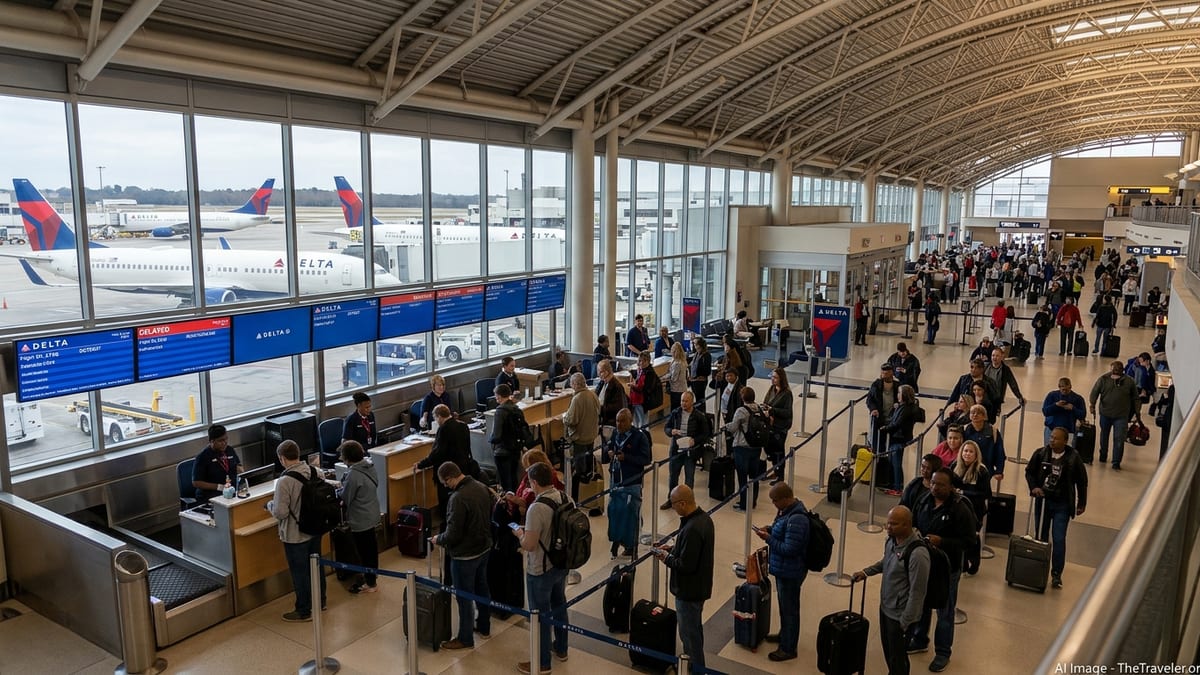
What happened to Delta’s system on November 22
Delta confirmed on Sunday that an issue with its automated weight-and-balance and related baggage load tracking systems disrupted operations across its network. The tools, used to calculate how passengers, cargo and fuel are distributed on each aircraft before departure, went offline on the morning of November 22. According to multiple statements cited by national and local outlets, the airline asked the Federal Aviation Administration to implement a ground stop at Hartsfield-Jackson Atlanta International Airport for Delta flights while it worked to restore the system and put interim procedures in place.
The FAA said publicly that the disruption was specific to Delta’s internal automation and that there were no concurrent problems with federal air traffic control systems. Around Atlanta, the initial ground stop was followed by a ground delay program that meters departures to manage congestion. Flight tracking data from FlightAware showed Delta quickly accounting for a large share of the day’s operational problems, with nearly half of the carrier’s schedule running late at one point on Sunday and hundreds of cancellations systemwide.
By early afternoon, Delta said the automation tools had been brought back online and that it was working flights with a combination of restored systems and manual workarounds. The airline described the issue as resolved later on Sunday, but warned that residual delays would continue through the day as aircraft and crew schedules were realigned.
Scale of delays and where travelers were most affected
While exact tallies vary slightly by source and time of day, data from FlightAware and several aviation trackers indicate that Delta delayed more than 2,100 flights on November 22 and canceled roughly 274. That equated to about 40 to 50 percent of its schedule operating late at the peak of the disruption, with cancellations in the mid single digits as a share of daily departures. Some reports place the total number of affected Delta and Delta Connection flights, including those delayed and canceled, at several thousand once knock-on impacts at downline airports are included.
Atlanta, Delta’s largest hub, experienced the most visible disruption. Around 700 flights at Hartsfield-Jackson were reported delayed on Sunday, according to figures widely cited from FlightAware. Not all of these were Delta-operated services, but the carrier’s network position in Atlanta meant that its outage quickly translated into longer-than-normal queues at security, gate area crowding and delayed departures across concourses. Travelers at other major Delta stations, including Detroit, Minneapolis-St Paul, Salt Lake City, New York’s LaGuardia and Los Angeles, also reported extended waits on the tarmac and at gates while load sheets were prepared and cleared.
By Monday morning, November 23, industry trackers showed a significantly improved picture. Delta’s delay rate had fallen back into the single digits, with only a small fraction of flights canceled relative to the day before. The carrier described its operations as “stable” and largely back on track, though isolated delays and schedule adjustments persisted in some markets as aircraft were repositioned and crews returned to normal rotations.
Why weight-and-balance systems matter for flight safety
Weight-and-balance calculations are a routine but critical part of airline operations. Before each departure, dispatchers and flight crews must know not only the total mass of the aircraft, including passengers, baggage, cargo and fuel, but also how that weight is distributed relative to the aircraft’s center of gravity. Federal Aviation Administration guidance notes that exceeding an aircraft’s certified weight limits, or allowing the center of gravity to fall outside approved ranges, can impair performance and, in extreme cases, compromise structural safety.
Large airlines rely on specialized software to automate these calculations, pulling data from reservations, check-in systems, baggage handling and cargo operations to generate a final load sheet. When that software becomes unavailable, airlines can fall back to manual procedures that use standardized weights and hand-checked baggage counts. These methods are safe when properly applied but are slower, especially across a global network running thousands of daily departures. On November 22, Delta indicated that its employees were using such manual workarounds, which significantly extended the time required to push flights back from the gate.
Aviation regulators did not report any safety incidents arising from Delta’s outage, and there have been no official indications that flights departed without the necessary calculations completed. The delays instead reflected the airline’s decision to slow or halt departures until crews and dispatchers could complete weight-and-balance checks by alternative means. For travelers, that translated into long gate holds and onboard waits while paperwork and final numbers were confirmed.
How Delta and the FAA responded for affected travelers
During and after the outage, Delta said it would rebook travelers whose flights were significantly delayed or canceled on the next available services and would provide meal and hotel vouchers where required under its customer service commitments. Reports from major hub airports on Sunday indicated that rebooking lines grew lengthy at times, particularly for passengers trying to reach smaller regional destinations with limited remaining seat availability ahead of Thanksgiving.
The carrier also extended a limited travel waiver that allowed certain customers booked to fly on November 22 to change their itineraries without a change fee or fare difference if they rebooked to travel by November 23. The waiver focused on routes most affected by the disruption, notably those touching Atlanta and other key Delta hubs. Travelers changing to flights later in the week or over the Thanksgiving weekend were generally subject to normal fare rules, meaning higher prices in many cases if their original tickets were issued well in advance.
From an air traffic management standpoint, the FAA’s role was confined to accommodating Delta’s request for a ground stop and subsequent ground delay program in Atlanta. The agency reiterated that its own nationwide systems, which had experienced a separate and unrelated outage on November 13, were functioning normally on November 22. That distinction matters for travelers because airline-specific technology problems are handled by the carrier, including any compensation or vouchers, whereas broader air traffic control failures tend to affect every airline and often trigger more extensive systemwide waivers.
What this means for Thanksgiving week travelers
The weight-and-balance outage struck at the opening of what is expected to be the busiest Thanksgiving air travel period in more than a decade. Forecasts from aviation analysts and federal data suggest that U.S. airlines are carrying tens of millions of passengers between roughly Friday, November 20, and Monday, November 30, with the single heaviest travel day projected to be Sunday, November 29, when many travelers return home after the holiday weekend. In this context, a one-day disruption at a carrier as large as Delta can ripple outward as displaced passengers compete for remaining seats on already-full flights.
For travelers booked with Delta in the days following the outage, the most immediate effect is the potential for residual delays on specific routes where aircraft and crews are still out of their usual positions. Schedules on Monday and Tuesday show far fewer disruptions than on Sunday, but flight tracking services continue to report scattered delays tied to ongoing congestion at major hubs and localized weather in parts of the country. Anyone connecting through Atlanta, in particular, may want to allow additional time between flights and monitor gate and departure time changes closely.
Because the outage was confined to Delta’s systems, travelers on other U.S. carriers are not directly affected, although crowded terminals and shared infrastructure at major airports can still produce knock-on inconveniences such as longer check-in and security lines. With Thanksgiving itself falling on Thursday, November 26, passengers across all airlines are being advised by airports and carriers to arrive early, keep contact information current in their reservations for timely notifications, and verify flight status repeatedly on the day of travel, particularly in light of recent technology incidents at Delta, United and within the FAA’s own systems earlier in the month.
Looking ahead, Delta has not yet published a detailed technical explanation of the root cause of Sunday’s outage beyond describing it as an issue with its automated systems, nor has it announced specific long-term changes to prevent a recurrence. Until more information emerges, travelers can treat the November 22 disruption as a reminder that even routine background systems can significantly affect operations when they fail. For those flying over the remainder of the Thanksgiving period, the most practical steps remain the same: build extra time into connections, consider earlier flights in the day where possible, confirm any rebookings or waivers directly with the airline rather than relying solely on third-party tools, and keep proof of expenses in case the carrier later offers reimbursement for delays linked to its own technology.