


More news on this day
More than 1,300 flights within, into or out of the United States were delayed and nearly 200 were canceled on Monday, November 23, as airlines worked to recover from a Delta Air Lines automation outage on Sunday that rippled into the first major day of the Thanksgiving travel rush.
Get the latest news straight to your inbox!
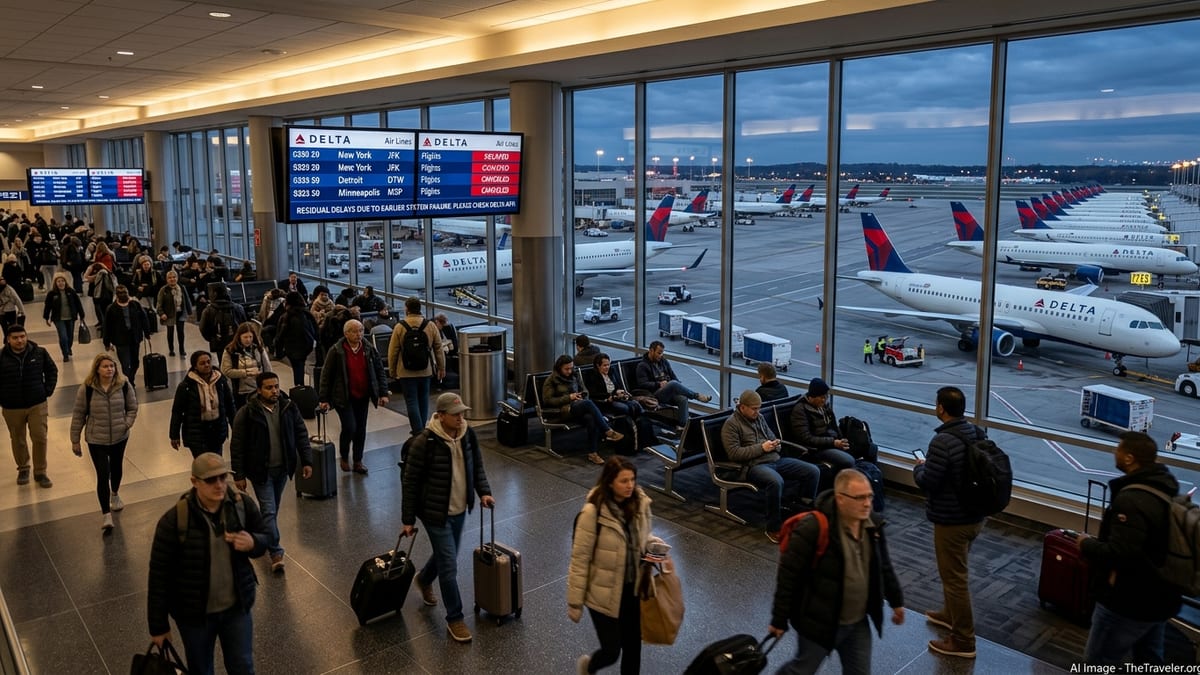
Residual disruption from Delta’s automation failure
Monday’s disruption followed a significant technical failure at Delta Air Lines on Sunday, November 22, involving the carrier’s automated weight and balance system. The tool is used to calculate how passengers, cargo and fuel are distributed on an aircraft before departure. When the system malfunctioned, Delta crews across the network were forced to switch to manual processes, slowing departures and triggering delays that extended well beyond the period of the initial fault.
Delta confirmed that the issue was specific to its internal automation and said the problem was resolved by Sunday afternoon, with operations described as stable by Monday morning. Nonetheless, data from flight-tracking services show that thousands of Delta flights were affected on Sunday, including more than 2,000 delays worldwide and hundreds of cancellations, as queues of aircraft and crews fell out of position.
The worst of the disruption centered on Hartsfield-Jackson Atlanta International Airport, Delta’s largest hub. The Federal Aviation Administration issued a ground stop early Sunday holding Delta flights bound for Atlanta at their origin airports while the carrier worked through the automation problem, then transitioned to a ground delay program to meter departures into the already congested airspace. That backlog of aircraft and crews contributed to Monday’s broader pattern of delays across multiple U.S. airports, even after the underlying technical cause had been fixed.
How widespread were Monday’s delays and cancellations?
By mid-morning on Monday, flight tracking data showed at least 1,305 delays involving U.S. flights and 186 cancellations. Globally, more than 10,700 flights had been delayed and just under 1,000 canceled by roughly the same time of day. These figures include all carriers operating within the United States, not only Delta, but aviation data providers and industry reports link a substantial share of the U.S. disruption to knock-on effects from Delta’s Sunday outage.
Residual delays were most visible at airports where Delta has a significant presence, including Atlanta, Detroit, Minneapolis–St. Paul, Salt Lake City, Los Angeles and New York’s LaGuardia and JFK airports. Travelers at these hubs encountered aircraft arriving late from previous segments, tighter turnaround times at the gate and rolling schedule adjustments as airlines attempted to restore normal operations ahead of the peak holiday travel days later in the week.
The impact was compounded by the fact that the disruption came at the very start of the Thanksgiving travel period, when schedules are heavily loaded and planes typically depart close to full. When flights in such periods are canceled or heavily delayed, rebooking passengers becomes more difficult because there are fewer empty seats available on later services. That dynamic contributed to the 186 cancellations recorded across U.S. carriers by late morning and meant some travelers faced multi-hour waits or, in a smaller number of cases, overnight stays before they could be accommodated on alternative flights.
Interaction with Thanksgiving travel and recent system outages
The Delta automation failure did not occur in isolation. It followed a series of technology-related disruptions affecting U.S. air travel in November, including a nationwide Federal Aviation Administration communications problem earlier in the month and a separate outage at United Airlines that briefly halted departures and delayed hundreds of flights. Those earlier events had largely subsided before the weekend, but they provided a reminder of how quickly glitches in aviation technology can cascade across the network.
At the same time, federal data and industry forecasts indicate that Thanksgiving 2026 is expected to be among the busiest air travel periods in more than a decade, with several hundred thousand flights scheduled in the nine-day window from November 23 to December 1. Airports including Atlanta, Dallas–Fort Worth, Denver, Chicago O’Hare and Los Angeles have all prepared for passenger numbers at or near record levels, and airlines have increased capacity on many routes. This tight operating environment leaves relatively little slack in schedules when something goes wrong.
As of Monday, airlines and the FAA were not reporting ongoing infrastructure problems beyond the resolved Delta outage. Instead, the delays were primarily attributed to recovery operations, along with localized weather constraints in some regions and standard air traffic flow management measures used to control congestion. Aviation officials have emphasized that safety protocols, such as holding departures during system checks or metering arrivals into crowded airspace, can lengthen delays in the short term but are designed to prevent more serious knock-on issues.
What airlines are saying about passenger options
Delta has acknowledged that the automation failure originated within its own systems and has stated that it is working with affected travelers on rebooking and, in some cases, providing hotel accommodation, meals and ground transportation where passengers experienced major delays. The carrier has not published a full breakdown of how many passengers qualified for those forms of assistance, and policies vary depending on whether a disruption is considered within the airline’s control or caused by external factors such as weather or air traffic restrictions.
Other U.S. airlines were less directly affected by the automation glitch but still faced congestion at shared airports and in shared airspace. Most carriers continued to advise passengers to monitor flight status closely, rely on airline apps or text alerts for the fastest notice of schedule changes and arrive at the airport earlier than usual during the holiday period. For travelers connecting between airlines on separate tickets, customer service agents reiterated that each carrier is responsible only for the segments it operates, which can complicate rebooking in the event of missed connections caused by disruption on another airline.
Within the bounds of federal regulations, carriers set their own policies for compensation in the case of delays. In the United States, airlines are generally not required to provide vouchers or compensation for delays or cancellations, although they must offer a refund if a flight is canceled and the passenger chooses not to travel. Some airlines, including Delta, may voluntarily offer meal or hotel vouchers when disruptions are linked to technical issues within their control, but travelers are usually asked to keep receipts and submit claims if they purchase their own accommodation or food during a lengthy delay.
Practical steps for travelers caught in Monday’s disruption
For passengers whose flights were delayed or canceled on Monday, the most immediate priority was securing an alternative itinerary. Travel specialists typically recommend using an airline’s mobile app or website as a first step, since many carriers will automatically present rebooking options digitally before they become available through airport agents. In large-scale disruptions, online tools can update faster than queue-based customer service channels, particularly when phone wait times stretch into hours.
Booking directly with the airline rather than through a third-party platform can simplify this process, because the operating carrier retains full control over the ticket and can move the traveler more flexibly between flights or partner airlines where agreements exist. When tickets are issued by an online travel agency or another intermediary, the operating airline may be limited in the changes it can make without the involvement of the original seller, which can slow rebooking during busy periods.
Once a new itinerary is issued, passengers are also advised to check whether there is any residual value in the original ticket. In some situations, especially when a traveler accepts a rebooking onto a cheaper itinerary or a different cabin, portions of the original fare or ancillary fees may be refundable or applicable as future credit. Those rights vary by airline and fare type and are not always fully explained by frontline staff during disruption management, so it can be useful to review the detailed conditions attached to the ticket after travel is complete.
What travelers should watch for over the rest of Thanksgiving week
Airlines and aviation authorities reported that Delta’s core systems were functioning normally by Monday and that no separate nationwide air traffic control issues were in effect. However, the combination of a recent technology outage, high passenger volumes and seasonal weather risks means that travelers over the remainder of Thanksgiving week should plan for the possibility of continued localized delays, even if widespread cancellations do not recur.
For those yet to travel, checking in as early as permitted, opting for morning flights when available and allowing additional time for connections can reduce the risk of being stranded if a new disruption arises. Passengers transiting through major hubs that experienced the worst of Sunday and Monday’s disruption, particularly Atlanta, may want to verify that minimum connection times in their bookings are realistic given current conditions and consider contacting the airline to request an earlier inbound segment if a planned connection is particularly tight.
Given that airline operations can change quickly, the most reliable up-to-date information will continue to come from official airline communication channels, airport status boards and federal aviation notices. Before heading to the airport, travelers should confirm departure times, terminals and gate assignments and be prepared for changes even after check-in. With several of the busiest days of the holiday period still ahead, building flexibility into travel plans remains the most effective way to manage the lingering effects of Sunday’s Delta outage and any further bottlenecks that might emerge.