


More news on this day
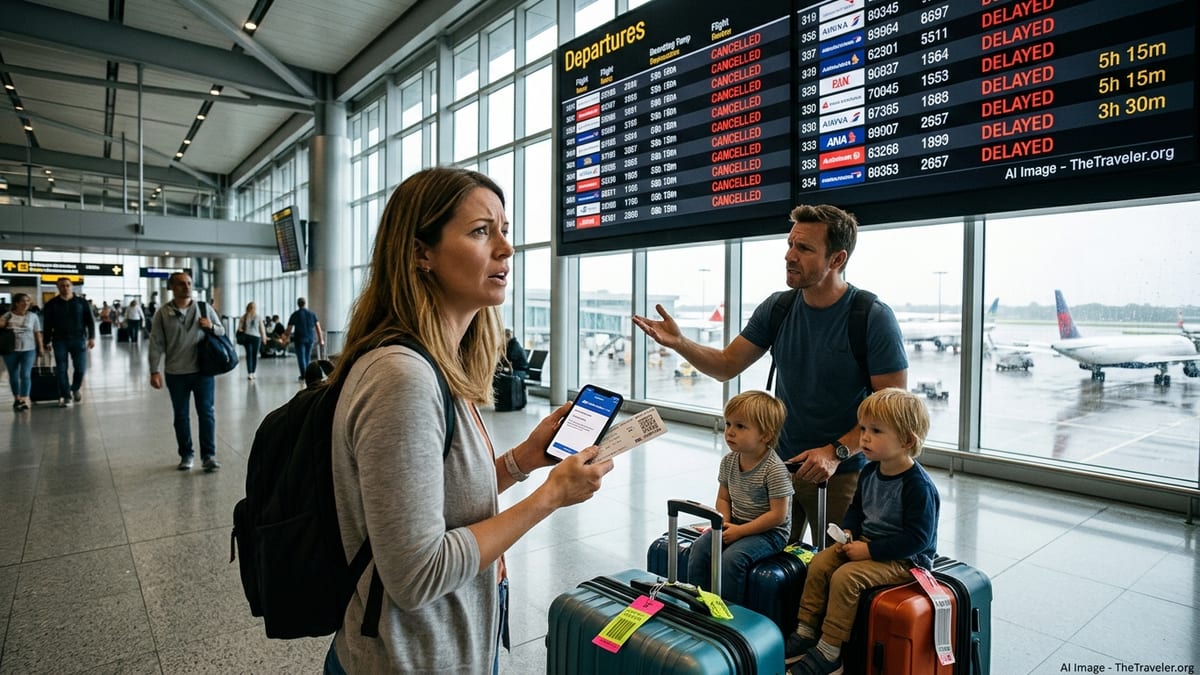
As millions of Americans prepare to fly for Thanksgiving, new U.S. Department of Transportation rules in force since mid‑2024 are reshaping what passengers are owed when flights are cancelled, heavily delayed or bags go missing, making it more important than ever for travelers to understand their rights before they reach the airport.
Get the latest news straight to your inbox!
Automatic cash refunds after major disruptions
For years, U.S. travelers often had to argue with airlines or hunt through contracts of carriage to work out whether they were entitled to a refund after a disrupted flight. In April 2024, the Department of Transportation (DOT) adopted a final rule, effective June 25, 2024, that for the first time defines what counts as a “significant change” and requires airlines and ticket agents to provide automatic refunds in clear cases where passengers are entitled to get their money back and do not accept alternative transportation or a voucher.
Under this rule and related statutory requirements, a refund is owed when a flight is cancelled or significantly changed and the passenger chooses not to travel on the new option. For timing changes, DOT now treats a delay of three hours or more on a domestic itinerary, or six hours or more on an international itinerary, as a significant change. If the airline cancels your flight altogether, moves your departure or arrival by at least those thresholds, or makes other major changes such as switching your departure or destination airport, and you decline the alternatives, you have a right to a cash refund of the unused transportation rather than just a credit.
The DOT guidance implementing the 2024 FAA Reauthorization Act further requires airlines to notify passengers of these rights and to issue refunds automatically when the right to a refund is undisputed, for example when a flight is cancelled and no alternative is accepted. The department has set deadlines for airlines and ticket agents to complete those refunds, generally within seven business days for credit card purchases and within 20 days for tickets bought with cash or other payment methods. The refund must include the full fare plus government taxes and any airline-imposed mandatory fees related to the unused transportation.
What counts as a significant delay, and what does not
The new federal standards are narrow and specific. They focus on a passenger’s right to get their money back if they do not want to take a materially changed trip, rather than on compensation for the inconvenience of delays when they still travel. For timing, the three-hour domestic and six-hour international thresholds apply to changes in either departure or arrival time compared with the original schedule. DOT has emphasized that these thresholds are designed to prevent a situation where repeated short “rolling delays” leave passengers waiting for many hours without ever technically crossing a refund threshold.
However, if you accept the airline’s rebooking on a significantly delayed or changed flight and ultimately travel, DOT rules do not require the airline to pay additional cash compensation for the delay itself, beyond refunding any extra services you did not receive. Likewise, the federal rules do not set compensation standards for shorter delays under three hours on domestic itineraries or under six hours on international ones. Airlines may still accommodate customers in these cases as a matter of policy, but it is not a federal entitlement to a refund.
Other situations are also now clearly defined. A change to or from a connection that substantially lengthens the journey, a downgrade to a lower cabin than originally booked, or a change in the number of connections may constitute a significant change that triggers a refund right if the customer declines the revised itinerary. The details can vary by circumstance, so DOT encourages passengers to document all communications and to file a complaint with both the airline and the department if they believe their refund rights are not being honored.
Lost and delayed baggage: fees, incidentals and limits
Baggage problems remain one of the most frustrating parts of air travel, particularly around busy holidays. Long-standing DOT rules, updated in recent years, require airlines to compensate passengers when checked bags are lost, damaged or significantly delayed on both domestic and most international trips. On itineraries covered by the Montreal Convention, which includes most international services operated by major carriers, airlines are liable up to a fixed monetary limit for provable losses. For domestic travel on U.S. carriers, DOT has set separate liability limits per passenger, adjusted periodically for inflation.
In addition, DOT rules now require airlines to refund checked baggage fees when a bag is not delivered within specific timeframes after the flight’s arrival. According to the department’s automatic refund guidance, passengers who pay to check a bag are entitled to a refund of that fee if they file a mishandled baggage report and the bag does not reach them within 12 hours on a domestic flight, or within longer windows on international flights depending on distance. The precise hours and thresholds can vary by airline and itinerary, so passengers should review their carrier’s published policy and keep boarding passes and bag tags to support any claim.
Beyond the refund of bag fees, airlines are also obligated to reimburse “reasonable, actual and verifiable” incidental expenses that passengers incur as a direct result of baggage delay, up to the applicable liability limits. DOT enforcement policy has long taken the position that carriers may not impose arbitrary daily caps that prevent travelers from recovering legitimate costs, such as purchasing basic clothing or toiletries while waiting for a missing suitcase. Travelers are encouraged to save receipts for all necessary purchases and to submit them promptly to the airline, understanding that luxury items or nonessential goods are unlikely to be covered.
Documenting your case when seeking a refund or reimbursement
A major practical finding from recent consumer research is that rights on paper do not always translate into refunds in practice. A national study published in November 2026 by legal services provider LegalShield reported that more than one in four travelers whose flights were cancelled or changed said their refund requests were turned down or ignored, and only a minority recalled being told upfront by the airline that they were eligible for a refund. That gap between federal requirements and passenger experience makes careful documentation essential, especially during busy travel periods.
DOT advises passengers to retain booking confirmations, screenshots of original and updated schedules, written notices of cancellations or delays, and any receipts for extra expenses such as meals, hotels or replacement items purchased while bags are missing. At the airport, mishandled bag reports should be filed with the airline as soon as a bag is confirmed missing, ideally before leaving the arrivals area. For flight disruptions, it is often useful to ask customer service agents to note in your booking record whether the delay or cancellation was within the airline’s control, as this can influence what the carrier voluntarily offers under its customer service commitments.
If an airline refuses a refund that appears to be required under federal rules, passengers can submit a complaint directly to DOT through its aviation consumer portal. The department forwards those complaints to airlines and can investigate patterns of noncompliance. While this process does not guarantee an individual outcome, it creates a regulatory record that has already led to enforcement actions and policy changes in previous years, and it may prompt the airline to revisit the case.
Airline commitments beyond the legal minimums
Separate from refund rights, many large U.S. airlines have made public commitments about how they will treat customers when flights are disrupted for reasons within the carrier’s control, such as crew scheduling issues or certain mechanical problems. These commitments are summarized on DOT’s Airline Cancellation and Delay Dashboard, which allows passengers to compare airlines on issues such as whether they provide meal vouchers during long delays or hotel rooms when overnight stays become necessary because of an airline-caused disruption.
The dashboard does not create new legal rights, but it does hold carriers to their own published standards. For example, some airlines state that they will arrange hotel accommodation or reimburse reasonable hotel costs when a traveler is stranded overnight by a controllable cancellation, subject to availability and caps. Others commit to rebook affected passengers on their own next available flight at no additional cost, and in some cases to place customers on another carrier if a suitable option is not available on their own network. These policies typically do not apply when weather or air traffic control issues are the primary cause of the delay, so passengers should be careful to ask what the airline considers the reason for the disruption.
Because policies differ by carrier and can change, travelers are advised to check the most recent version of their airline’s customer service plan before departure, especially if flying on a lower-cost carrier that may offer fewer accommodations during disruptions. Saving a copy of the relevant page or taking screenshots on a mobile device can be helpful when discussing options with agents during a busy travel day, since front-line staff may be juggling many passengers and constraints at once.
What travelers should verify before holiday trips
With the 2024 refund rule now in effect and its implementation deadlines largely passed by late 2026, the framework for U.S. airline passenger rights is more detailed than in previous holiday seasons, but travelers still need to verify the specifics that apply to their particular trip. Before heading to the airport, passengers should confirm their itinerary details, check whether any schedule changes have already occurred, and review their airline’s policies on refunds, rebooking and baggage, including how to file claims and what time limits apply.
For those relying on tight connections or traveling to important events such as family gatherings, it may be prudent to consider what options would be acceptable if the original flight is substantially delayed or cancelled, including whether an earlier or later flight, or a departure from a nearby airport, would still work. If a major disruption hits, understanding that a three-hour domestic or six-hour international change generally qualifies as a significant delay for refund purposes can help travelers evaluate whether to ask for their money back and pursue another route, or to accept the carrier’s rebooking.
Finally, because airlines and regulators may update policies in response to operational issues or new legislation, passengers planning trips for later in the year should recheck DOT resources and airline communications closer to their departure date. The broad outlines are unlikely to change quickly, but details such as liability limits, processing timelines and carrier-specific commitments can be adjusted over time. Knowing the current rules and keeping careful records remains the most effective way for travelers to protect themselves when flights do not go as planned.