


More news on this day
As millions of Americans fly for the 2026 holiday season, tougher U.S. refund rules mean many travelers are now entitled to automatic cash back when flights are canceled or heavily delayed, or when checked bags arrive late or not at all. Knowing when those protections apply, and how to avoid common pitfalls, can make the difference between a stressful disruption and a reimbursed one.
Get the latest news straight to your inbox!
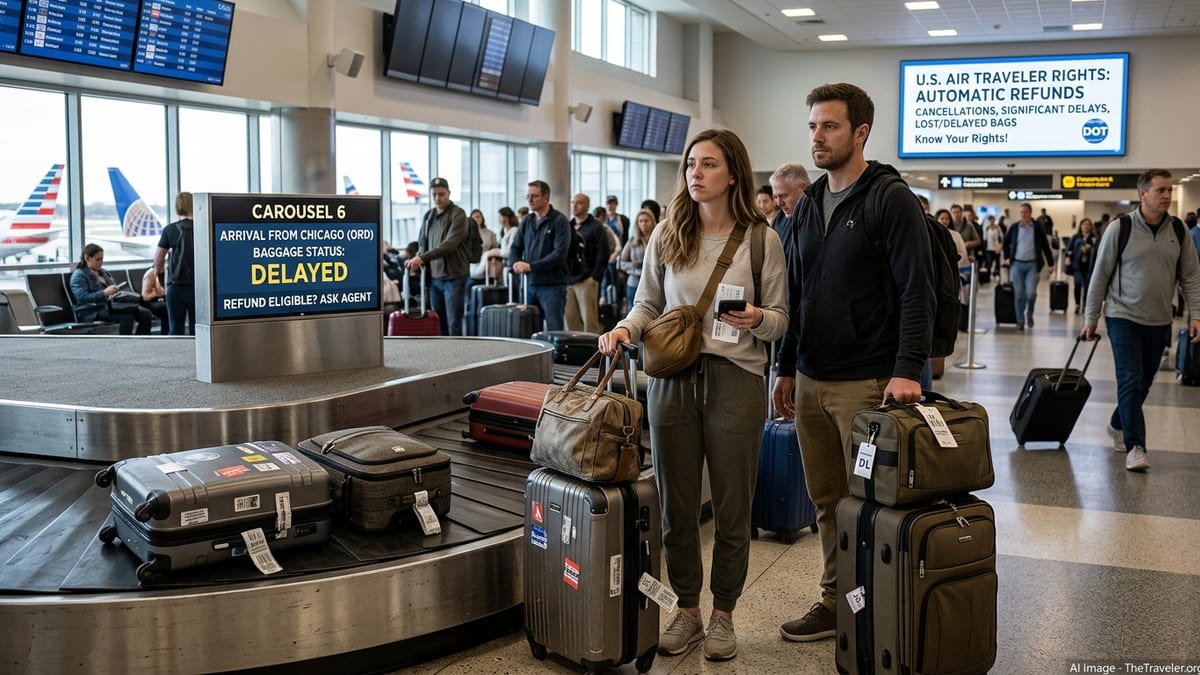
New U.S. refund rules now in force for major delays and cancellations
The most significant change for U.S. air travelers this holiday season is that many refunds no longer have to be chased. Under a final rule issued by the U.S. Department of Transportation (DOT), airlines must provide automatic refunds when they cancel a flight or make a “significant” change and the passenger does not accept alternative transportation or a voucher. The rule took effect on June 25, 2024, with key refund obligations reinforced by the Federal Aviation Administration Reauthorization Act of 2024 from May 16, 2024, and related regulations that kept an October 28, 2024 compliance date for several remaining provisions.
For cancellations and significant delays occurring on or after May 16, 2024, airlines are required to clearly notify passengers of their right to a refund and to process that refund automatically if the traveler chooses not to take the changed or alternative flight. DOT guidance for small businesses, which also explains passenger rights, defines a significant delay for these automatic notifications and refunds as broadly including delays of at least three hours on domestic itineraries and at least six hours on international itineraries when compared with the original schedule.
While airlines can still offer rebooking, credits or vouchers, they cannot make those offers a prerequisite for receiving money back if a passenger is legally entitled to a refund. Importantly, DOT rules specify that refunds must be made in the original form of payment within set timelines, typically within seven business days for credit card purchases and 20 calendar days for cash or other payments. That means a traveler whose Thanksgiving flight is canceled for an airline-controlled reason and who decides not to travel is entitled to a prompt cash refund rather than just a credit for future travel.
When a delayed or lost bag triggers a refund of baggage fees
Separate from flight delays themselves, U.S. rules now spell out when airlines must return checked baggage fees. Under the DOT’s “Refunds and Other Consumer Protections” rule, carriers are required to refund bag fees when checked luggage is lost or “significantly delayed,” in addition to reimbursing reasonable expenses under existing baggage liability rules. The refund requirement for checked baggage fees and other ancillary services took effect for disruptions on or after October 28, 2024.
DOT defines significant baggage delay by reference to how long it takes for a bag to be delivered after the aircraft arrives at the gate at the passenger’s final destination. For a domestic itinerary, an airline must refund the checked bag fee if a passenger files a mishandled baggage report and the bag is not returned within 12 hours of gate arrival. For international itineraries that begin or end in the United States, the threshold is 15 hours from gate arrival when the longest segment between the United States and a foreign point is 12 hours or less, and 30 hours for longer intercontinental sectors.
In practice, this means that a traveler arriving on a Friday evening domestic flight whose bag does not appear until Saturday afternoon is likely eligible for both reimbursement of out-of-pocket essentials under general baggage liability rules and a refund of the bag fee itself once the airline verifies the delay. If the bag is never found and is declared lost, DOT guidance also specifies that a refund of the checked baggage fee is due along with compensation for the contents up to regulated limits on domestic itineraries and treaty limits internationally.
Understanding the limits of compensation and what remains at airline discretion
Although the refund landscape has become more favorable to passengers, there are important limits. U.S. law distinguishes between refund rights and compensation for inconvenience. The DOT rules on automatic refunds cover the return of what a traveler has already paid for, such as the ticket price or an ancillary fee, when the airline does not deliver the service. They do not create a general right to extra money purely for the inconvenience of a delay, nor do they automatically require airlines to pay for hotels or meals when disruptions occur, except where those obligations are imposed by individual carrier policies or contracts of carriage.
The DOT’s Airline Cancellation and Delay Dashboard summarizes which airlines have committed to providing meals, hotels and ground transport during controllable disruptions. These commitments, which many large U.S. carriers adopted after the severe disruption periods of 2022 and 2023, vary by airline and are not identical to legal refund obligations. For example, an airline may promise to provide meal vouchers and overnight accommodation when a delay is within its control, such as a crew scheduling issue, while not making the same commitment for weather-related disruptions. However, regardless of cause, if a delay reaches the DOT’s threshold for a significant change and the traveler cancels the trip, the refund rules can still apply.
Travelers on flights that touch the European Union face a different framework. Regulation EC 261/2004 provides standardized compensation and care in many cases of long delay, cancellation or denied boarding. Unlike the U.S. rules, EC 261 can entitle passengers departing an EU airport, or arriving in the EU on an EU carrier, to fixed cash compensation based on distance when they reach their final destination three hours or more late and the cause is not an “extraordinary circumstance.” This is separate from any refund of the unused ticket, so some travelers may benefit from both U.S. refund protections and EU compensation rules on the same disrupted journey depending on routing and operating carrier.
Steps travelers should take before and after a disruption
To benefit from the stronger U.S. refund rules, passengers still need to take several practical steps. Before traveling, it remains important to book directly with the airline or ensure that any third-party booking site clearly identifies the merchant of record. Under DOT regulations, the entity that charged the card is responsible for issuing the refund on the airfare when a qualifying cancellation or significant delay occurs, even if a travel agency rather than the airline processed the payment. For ancillary services such as checked bags, however, DOT guidance makes clear that passengers must seek refunds from the airline operating the flight, even when the fee was paid through a ticket agent.
Once a problem arises, documentation matters. If a flight is canceled or significantly delayed, travelers should retain their boarding passes, any written notices from the airline, and screenshots of updated schedules that show the length of the delay. If baggage is missing, DOT consumer materials advise filing a mishandled baggage report with the airline as soon as it is clear the bag did not arrive, and keeping copies of the report number. The clock for a baggage fee refund and reimbursement of essentials is generally measured from the time passengers are first able to leave the aircraft at the final destination until the bag is returned or delivered to an agreed location.
During the disruption, travelers should also ask airline staff to confirm what assistance is available voluntarily beyond legal minimums, such as hotel or meal vouchers, particularly when the cause is under the airline’s control. DOT’s consumer information stresses that airlines often resolve many complaints when passengers first work with airport or call center staff, but that unresolved issues can later be escalated through written complaints to the carrier and, if necessary, to DOT’s Aviation Consumer Protection office, which tracks patterns of noncompliance and can take enforcement action.
What to check now for the 2026 holiday season and beyond
With the new rules fully in effect, U.S. officials have signaled they expect compliance through the 2026 holiday period rather than further delays in implementation. Public statements from the Transportation Department in 2025 and 2026 have rejected industry requests to postpone key provisions linked to both the 2024 refund rule and the FAA reauthorization mandates, keeping in place the May and October 2024 dates and subsequent technical updates that clarified definitions such as “significantly delayed or changed flight.” For travelers flying in November and December 2026, that means the enhanced refund protections should apply to qualifying disruptions as a matter of legal obligation, not airline choice.
Before departing, travelers can improve their position by reviewing their airline’s contract of carriage and customer service commitments, which are usually posted on the carrier’s website. These documents explain, in plain language, when the airline will provide hotel accommodation, meal vouchers or ground transport during disruptions, which often goes beyond what law requires but can vary sharply between carriers. They also describe the exact process for requesting refunds for tickets, bag fees and ancillary services such as seat selection that were not provided.
Looking ahead to future peak periods, passengers should expect further regulatory attention to air travel reliability rather than fewer rules. Recent episodes of technology outages and air traffic system problems have prompted renewed scrutiny in Washington of both airline operations and government-run systems. At the same time, work continues internationally on updating EU passenger rights and clarifying how national and regional regimes interact. For individual travelers, however, the core advice remains immediate and practical: know when a refund is mandatory, keep thorough records during any disruption, and act promptly to claim what you are owed so that a delayed flight or missing bag does not also mean a lost refund.