


More news on this day
European regulators have extended conflict-zone bulletins covering large parts of Middle Eastern airspace until 31 January 2027, just as ongoing Saudi airport disruptions, Pakistan’s continued ban on Indian aircraft and short-term restrictions for an Asia-Pacific summit converge to complicate flight planning for both scheduled and charter operators across the region.
Get the latest news straight to your inbox!
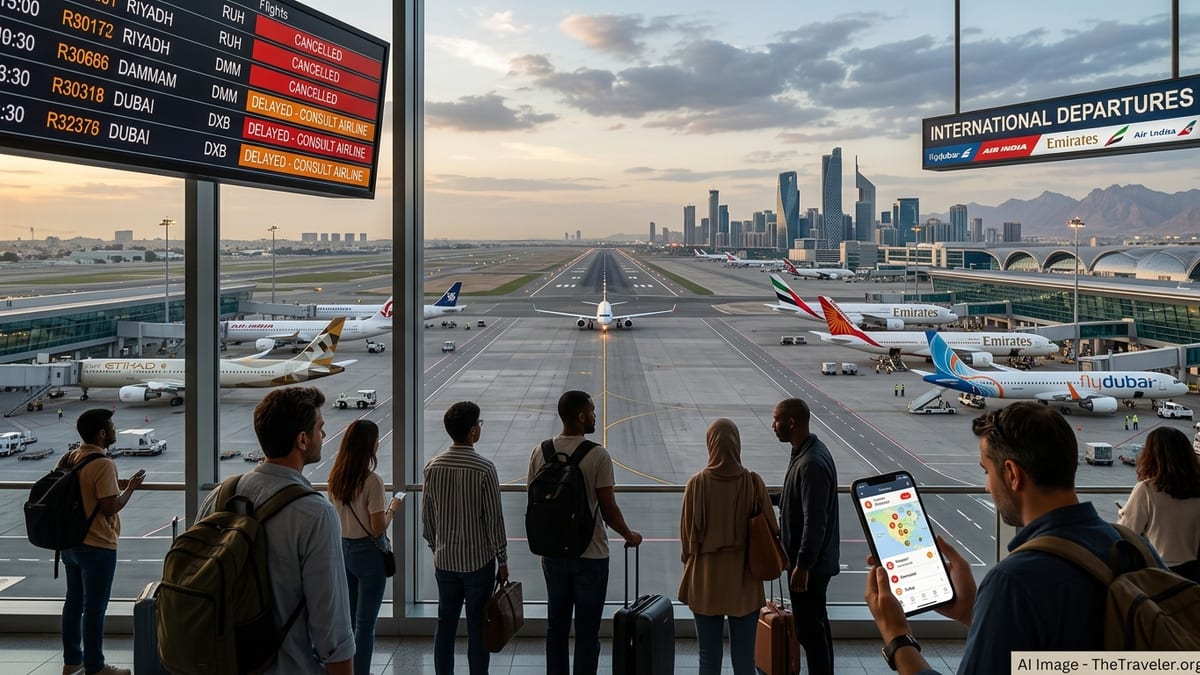
Conflict-zone warnings now stretch deep into the 2026–27 winter season
The European Union Aviation Safety Agency has confirmed that six of its Conflict Zone Information Bulletins for the Middle East were revised on 16 November 2026, with their validity now running until 31 January 2027. The active notices cover the airspace of Saudi Arabia, Iran, Iraq, Lebanon and Jordan, as well as the Persian Gulf and Gulf of Oman, and advise European Union operators to apply strict risk assessments before routing over or near these areas.
The Saudi Arabia bulletin, first published in September 2026, remains in force after heightened security incidents around key airports and energy infrastructure. Separate bulletins on Iran and Iraq focus on elevated risks from state and non-state armed groups, while the Lebanon and Jordan advisories reflect the potential for spillover from regional tensions and missile activity. A separate document on the Gulf and Gulf of Oman warns of possible threats to civil aviation from military operations or drone and missile launches at sea.
EASA’s bulletins are informational rather than binding, but EU member states and many non-European carriers treat them as a critical input for their own safety and security assessments. The decision to extend all six bulletins to the end of January effectively signals that regulators do not expect risk levels in these parts of the region to fall back to pre-crisis norms during the peak year-end travel period, which includes Christmas, New Year and school holidays for many origin markets.
Saudi airport disruption continues to reshape Gulf and India flight schedules
Saudi Arabia’s internal security situation has led several international airlines to prolong or adjust suspensions of services to key Saudi gateways, particularly Riyadh and Dammam. Etihad Airways has confirmed that all passenger and cargo flights between Abu Dhabi and Riyadh, and between Abu Dhabi and Dammam, remain cancelled through 30 November 2026 because of the regional disruption and local security measures. The airline has resumed flying to Jeddah but is maintaining the suspension on the two eastern and central routes for the rest of the month.
Indian carriers have taken similar steps on their Saudi networks. Air India and its low-cost affiliate Air India Express have extended suspensions of flights to Riyadh and Dammam until 30 November, citing the prevailing situation and associated operational risks. The two airlines had already paused services earlier in the autumn and are now offering affected passengers the option to rebook travel dates, subject to availability, or to request full refunds for journeys scheduled within the suspension period.
Additional disruption has come from IndiGo, India’s largest domestic airline and a major player in short-haul Gulf markets. The carrier has suspended services to Jeddah, Madinah, Riyadh and Dammam until at least 30 November, again referencing the broader security environment in Saudi Arabia and the need to follow official advisories. With three Indian airline groups reducing or pausing Saudi flying at the same time as Gulf-based carriers trim selected Saudi frequencies, overall nonstop capacity between India, the United Arab Emirates and the kingdom remains sharply reduced compared with early 2026.
Flights between the UAE and Saudi Arabia remain patchy as routings shift
For travellers in the Gulf, the most visible impact is the irregular pattern of flights between the United Arab Emirates and Saudi Arabia. Etihad’s cancellations on Abu Dhabi–Riyadh and Abu Dhabi–Dammam routes have been extended in stages, first to mid-November and now to 30 November. Local media in the UAE report that while Etihad continues to operate to Jeddah, its timetables show no scheduled passenger services to Riyadh and Dammam before December.
Other UAE-based carriers have maintained at least partial connectivity to the kingdom, but with frequent short-notice adjustments. Emirates is still operating selected flights from Dubai to major Saudi cities, including Jeddah and Madinah, yet on 21 November booking systems showed limited or no live status information for some services to Riyadh and Dammam on particular days. Flydubai, which serves a broader range of secondary Saudi destinations, has restored certain routes while cancelling or leaving blank status entries for others, depending on how local conditions evolve. Air Arabia and Saudi carriers continue to operate some schedules, though often with rerouted flight paths and additional planning constraints.
The stop-start pattern is linked not only to security concerns in Saudi Arabia but also to the overlay of regional conflict-zone advisories and temporary airspace restrictions. Carriers operating between the UAE and Saudi Arabia have had to plan around changing routings, with some flights using more southerly tracks or extended detours to avoid areas of heightened risk. These reroutings can lengthen flight times, complicate crew scheduling and increase fuel burn, making marginal routes harder to sustain, particularly where demand has also softened because of traveller nervousness.
Pakistan’s ban on Indian aircraft and Asia-Pacific summit limits compress options
While Middle Eastern airspace is subject to renewed caution, operators in South and East Asia are also contending with constraints closer to home. Pakistan has extended its ban on Indian-registered aircraft using Pakistani airspace until 24 December 2026. The restriction, which applies to both scheduled and non-scheduled flights, forces Indian carriers heading west to route around Pakistan, typically adding distance and increasing operating costs on services to the Middle East and Europe.
For passenger airlines such as Air India and IndiGo, the Pakistan overflight ban interacts with Saudi airport disruptions in ways that can narrow the viable options for non-stop or one-stop itineraries. Flights that might otherwise have routed across Pakistan to the Gulf must now use longer paths over the Arabian Sea or via other neighboring airspace, sharply reducing the flexibility to absorb further restrictions. The additional distance can push some city pairs toward the edge of narrowbody aircraft range, especially when operators are also seeking to avoid specific conflict zones highlighted in EASA and national advisories.
At the same time, temporary flight restrictions introduced around a recent Asia-Pacific summit have affected certain charter and business aviation routings in the wider region. Security and airspace management measures around major diplomatic events typically include time-limited no-fly zones, altitude caps or slot controls over host cities and nearby approach routes. While these measures are generally well publicized in advance, charter operators serving multinational corporate and government delegations have had to stitch summit-related restrictions together with the longer-running Middle Eastern conflict bulletins and South Asian overflight limits when planning complex multi-leg trips.
Implications and next steps for scheduled and charter travelers
For scheduled airline passengers, the immediate implication is a need for closer monitoring of flight status and more flexibility in routing choices through the end of 2026. EASA’s decision to keep conflict-zone bulletins in place until at least 31 January 2027 means that winter-season timetables will continue to be built around elevated risk levels in several Middle Eastern airspace blocks. EU and many non-EU carriers are likely to maintain their more conservative routings as default, and some may be reluctant to add marginal new services that would require overflight of the most sensitive areas.
Travelers planning journeys involving Saudi airports, particularly Riyadh and Dammam, should pay careful attention to airline advisories and booking conditions covering the period to 30 November. Etihad, Air India, Air India Express and IndiGo have all published end dates for current suspensions on specific routes, but these are explicitly subject to change if security or regulatory assessments shift. Some Gulf-based airlines and Saudi carriers are still operating selected services, so alternative routings may be available, albeit sometimes at short notice and with extended total journey times.
Charter operators face an even more complex environment, as bespoke routings and tight schedules leave less room to absorb detours. Operators arranging flights that might ordinarily cross Iranian, Iraqi, Saudi or adjacent Gulf airspace will need to check both EASA bulletins and the latest notices from local civil aviation authorities, adjusting flight levels or routings where required. When flights also involve Indian operators or India–Europe sectors, Pakistan’s overflight ban until 24 December further constrains corridor choices, potentially requiring additional fuel stops and schedule buffers.
Across both scheduled and charter markets, the most practical step for travelers and trip planners is to treat all routing assumptions for late November, December and January as provisional. Airline and regulator updates over the coming weeks will determine whether Saudi flight suspensions are relaxed, whether Pakistan’s airspace ban is extended or lifted after 24 December, and whether EASA decides, in its next review ahead of February, to further extend, modify or withdraw its conflict-zone bulletins. Until then, anyone flying through the affected regions should remain prepared for last-minute time changes, aircraft substitutions or rerouting and should ensure that contact details in airline reservations are up to date so they can receive alerts as conditions evolve.