


More news on this day
After a weekend plagued by a major Delta Air Lines technology outage and a recent nationwide FAA ground stop, U.S. flight schedules were largely recovering on Monday, November 23, but travelers heading into the busy Thanksgiving week are still contending with lingering delays, frayed nerves and fresh reminders of how quickly aviation disruptions can spread across the country.
Get the latest news straight to your inbox!
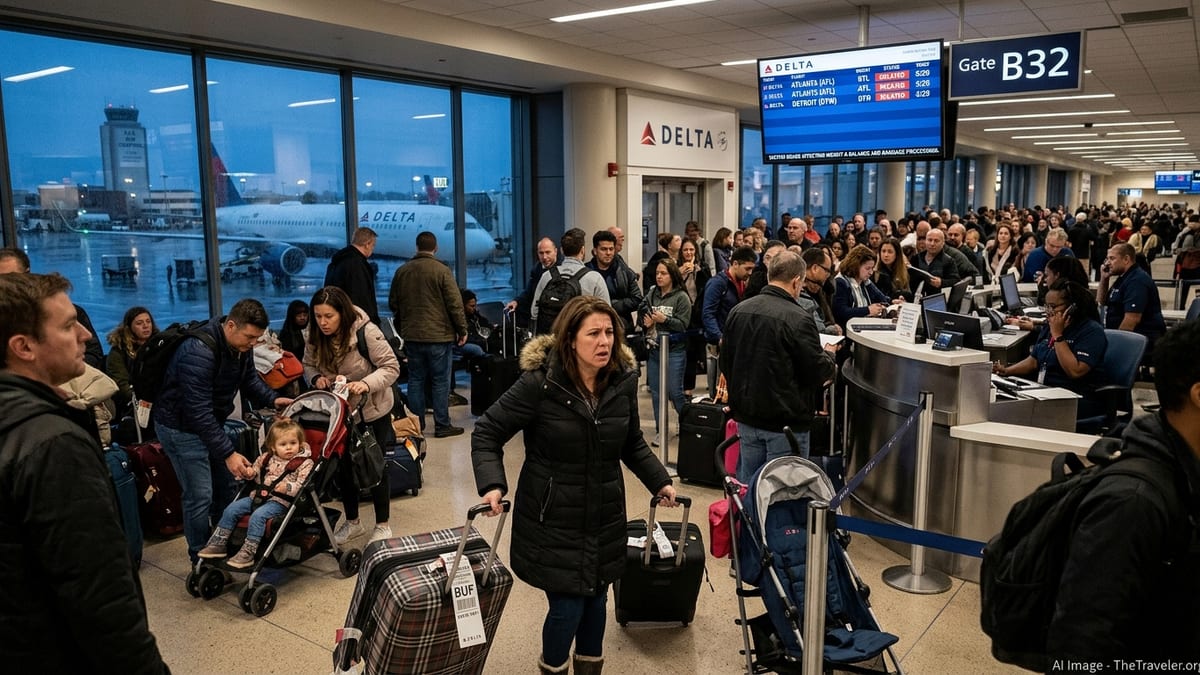
What happened with Delta and the FAA this week
The latest disruption began on Sunday, November 22, when Delta Air Lines experienced an outage affecting the automated systems it uses to calculate aircraft weight and balance and to process baggage. According to flight-tracking data summarized by multiple outlets, the issue delayed roughly 1,600 to 2,000 Delta flights and led to more than 200 cancellations across the United States on a single day, just as the Thanksgiving travel rush was ramping up.
Delta said the malfunction was confined to the airline’s own technology and that flight operations remained safe while crews reverted to manual workarounds. Manual weight-and-balance calculations and baggage handling, however, take significantly longer, which is why departures were held at gates and knock-on delays built up across Delta’s network throughout Sunday.
The airline reported by Monday, November 23, that its systems had been restored and described operations as “stable,” yet some residual delays and schedule adjustments persisted at hubs such as Atlanta and Minneapolis as aircraft and crews were repositioned. Passengers connecting through those hubs, including those flying from medium-size airports like Buffalo, remained at risk of missed connections and last‑minute gate changes even if their first flight departed on time.
The Delta outage followed a separate and unrelated disruption just over a week earlier, when a telecommunications router failure prompted the Federal Aviation Administration to order a temporary nationwide ground stop. That incident, which began on Friday, November 13, affected departures across the country for several hours while air traffic control systems were stabilized. Airports including major Delta hub Detroit and regional facilities such as Buffalo Niagara International recorded hundreds of cancellations and delays over that November 13 to 16 period before schedules gradually returned to normal.
Buffalo and other regional airports: local boards, national problems
At Buffalo Niagara International Airport, operated by the Niagara Frontier Transportation Authority, terminal operations documentation shows staff working through the mid‑November FAA outage and subsequent recovery as flights were rescheduled and passengers rebooked. By the start of Thanksgiving week, airport officials said day‑to‑day operations and staffing levels were back to normal, with security and check-in functioning as usual.
Normal staffing does not always translate into a smooth trip, however, when problems originate elsewhere in the network. Aviation data and federal consumer reports highlight how a delay at a large hub can quickly cascade to regional airports. If an inbound aircraft from Atlanta or Detroit is late because of congestion or a tech issue at those airports, the knock-on effect can be a delayed departure for passengers waiting in Buffalo, even under clear skies and with no local operational problems.
Recent federal Air Travel Consumer Reports underscore how common this type of disruption has become. In late 2025 and through much of 2026, roughly one in four U.S. flights arrived at least 15 minutes behind schedule, with delays concentrated at the largest hub airports where banks of connecting flights are closely timed. Buffalo typically sees better on‑time performance than some coastal hubs, but its reliance on connecting traffic means passengers are still vulnerable when airlines have to reset their national schedules after an outage like Delta’s.
Holiday demand, fragile schedules and traveler concerns
The timing of these glitches is amplifying anxiety. Thanksgiving remains one of the busiest travel periods of the year in the United States. Forecasts compiled by AAA and airport authorities suggest that around six million people are expected to fly over the Thanksgiving holiday window in 2026, with the Wednesday before Thanksgiving and the Sunday after among the busiest days for both airports and airlines.
Higher passenger volumes reduce the margin for error in airline schedules. When flights are already close to full and aircraft are deployed at high utilization, a major outage or weather event leaves carriers with fewer spare planes and open seats to absorb stranded travelers. Over the past ten days, U.S. flyers have seen multiple systems failures: the FAA ground stop, a technology issue that temporarily halted United Airlines departures, and now Delta’s weight-and-balance and baggage outage at the start of Thanksgiving week. Aviation safety regulators and airline executives say these incidents are not connected, but they highlight how dependent modern air travel is on complex software and communications systems.
For individual passengers, the impact is uneven. Many Delta and connecting-airline customers were able to complete their journeys on Sunday and Monday with only minor delays. Others, particularly those with tight connections through Atlanta or Detroit, faced missed onward flights, last‑minute rebookings and, in some cases, overnight stays when later flights were already full. The experience has been especially stressful for travelers with added responsibilities, such as parents flying alone with infants or people on short holiday breaks with limited flexibility to extend their trips.
Airport workers and airline frontline staff have also borne the brunt of the disruption. While the outages were caused by back‑end technology, gate agents, flight attendants and customer service teams are the ones facing long lines of frustrated travelers seeking rebooking or compensation. Labor representatives and passenger advocates alike note that these staff do not control the underlying systems yet are often the public face of a disruption, which can contribute to tense scenes at boarding gates and customer service desks.
What protections and recourse U.S. flyers actually have
For U.S. travelers caught up in delays like those seen after the Delta outage, the rules and remedies can be confusing. Under federal regulations, airlines must provide prompt and accurate information when a flight is canceled or significantly delayed. Within 30 minutes of becoming aware of a cancellation, a delay of 30 minutes or more, or a diversion, carriers are required to update their flight status displays and other information sources within their control at U.S. airports. This is meant to ensure that passengers looking at airport boards or airline apps receive consistent, near‑real‑time updates.
Refund and compensation rules are more limited. The U.S. Department of Transportation’s Airline Cancellation and Delay Dashboard shows, airline by airline, what each carrier pledges to provide when a disruption is within its control. All major U.S. airlines, including Delta, must offer a refund when a flight is canceled and the passenger chooses not to travel, regardless of the reason. Additional compensation, such as meal vouchers or hotel rooms, depends on the airline and on whether the delay is deemed controllable, for example a crew or maintenance problem, versus outside causes such as weather or air traffic control restrictions.
Technical outages within an airline’s own systems generally fall on the “controllable” side of the ledger, although the precise classification can vary by circumstance. In previous IT incidents, some carriers have offered travel credits or frequent flyer miles to affected passengers as a goodwill gesture, above and beyond what regulations require. Passengers who believe they were denied a refund or basic assistance that should have been provided can file a complaint directly with the airline and, if necessary, escalate it to the Department of Transportation, which tracks consumer reports and can take enforcement action in cases of widespread non‑compliance.
Travel insurance and credit card protections may provide an additional layer of security, but coverage terms differ widely. Some standalone policies reimburse for hotel, meals and alternative transport when a delay exceeds a specified threshold and is due to a covered cause. Certain premium credit cards include trip delay and cancellation benefits when all or part of the fare is charged to the card. Travelers are advised to review those terms carefully before travel rather than assuming that every disruption will qualify for reimbursement.
How Thanksgiving flyers can reduce their risk this week
With Delta’s systems back online and the FAA ground stop lifted, aviation authorities and airlines expect U.S. flight operations to remain broadly stable through Thanksgiving, barring new technical problems or significant weather. Still, historical performance data and the events of the past week suggest that passengers should prepare for above‑average risk of delays on the busiest days.
Airports, airline operations centers and travel experts consistently emphasize a few practical steps for travelers in this environment. First, monitoring flight status through the airline’s own app or website remains one of the fastest ways to receive schedule changes, gate swaps or rebooked itineraries. That information usually updates before airport departure boards and allows travelers to respond more quickly if a connection becomes impossible.
Second, where feasible, flying nonstop instead of connecting and carrying on luggage rather than checking it can significantly reduce exposure to disruptions like baggage-system outages. A delayed or misrouted checked bag may take days to reunite with its owner during peak periods, particularly when weather or earlier outages have already strained baggage-handling operations. For families or travelers who must check bags, placing medications, a change of clothes and key documents in a carry-on can mitigate the impact of temporary baggage delays.
Finally, timing and preparation matter. During peak holiday periods, major U.S. airports and the Transportation Security Administration recommend arriving at least two hours before a domestic departure and even earlier for international flights. Leaving extra time for traffic, parking and security screening reduces the risk that an unexpected queue or minor schedule change will cause a missed flight. For those with critical commitments, such as a fixed event start time or an international connection, flying a day earlier than strictly necessary can provide a cushion when airline networks are under strain.
Over the coming days, travelers using airports like Buffalo Niagara, Atlanta, Detroit and other key nodes in the U.S. system should see mostly normal operations, with the caveat that aircraft and crew positioning after the Delta outage may continue to cause scattered delays. Anyone flying this week is advised to keep an eye on weather forecasts along their route, watch for airline alerts and verify their flight status repeatedly in the 24 hours before departure, especially if they are connecting through a hub that was hit hardest by the recent glitches.